Contents
show
HubSpot CRM vs Salesforce: Which Is Better for Businesses in 2026
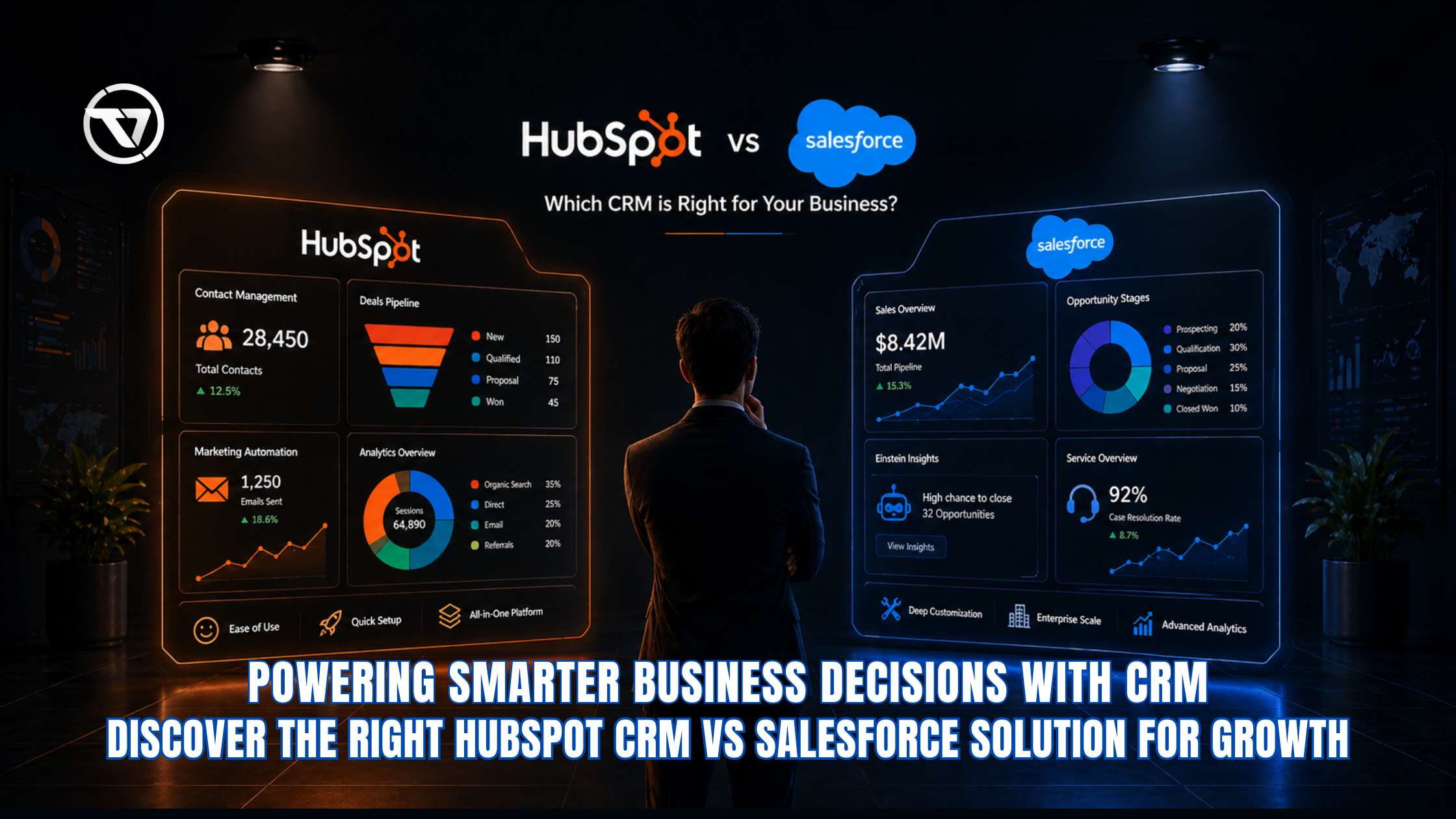
Choosing the right CRM in 2026 isn’t just about tracking contacts—it’s about building a unified revenue engine powered by automation, AI, and data. The debate around hubspot crm vs Salesforce has intensified as both platforms evolve rapidly with AI copilots, predictive analytics, and deeper integrations.
Businesses today are under pressure to personalize customer experiences while scaling efficiently, and CRM platforms sit at the center of that transformation. According to the report, global CRM revenue is expected to surpass $109 billion by 2026, making it one of the fastest-growing enterprise software categories and a critical investment decision for modern organizations.
HubSpot CRM vs Salesforce: Core Differences
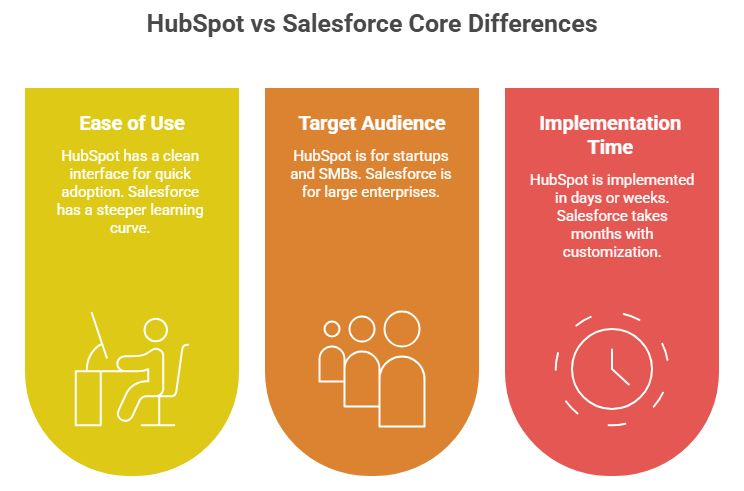
At a high level, HubSpot and Salesforce represent two different CRM philosophies: simplicity versus complexity. HubSpot focuses on ease of use and fast deployment, while Salesforce emphasizes deep customization and enterprise scalability. Understanding these core differences is essential before diving into specific features.
1. Ease of Use and User Experience
HubSpot offers a clean, intuitive interface that allows teams to get started quickly with minimal training, making it ideal for fast adoption. Salesforce, while powerful, comes with a steeper learning curve due to its extensive customization capabilities and layered interface. As a result, HubSpot prioritizes usability, whereas Salesforce prioritizes flexibility and depth.
2. Target Audience and Business Size Fit
HubSpot is best suited for startups, SMBs, and growing mid-market companies that need an all-in-one platform without complexity. Salesforce is designed for large enterprises with intricate sales processes and global operations requiring advanced customization. This distinction makes HubSpot accessible and Salesforce more enterprise-focused.
3. Implementation Time and Cost
HubSpot can typically be implemented within days or weeks due to its plug-and-play nature and prebuilt tools. Salesforce implementations often take months, especially when customization and integrations are involved. According to Nucleus Research, heavy CRM customization can increase total cost of ownership by up to 40%.
HubSpot CRM Features vs Salesforce CRM Features
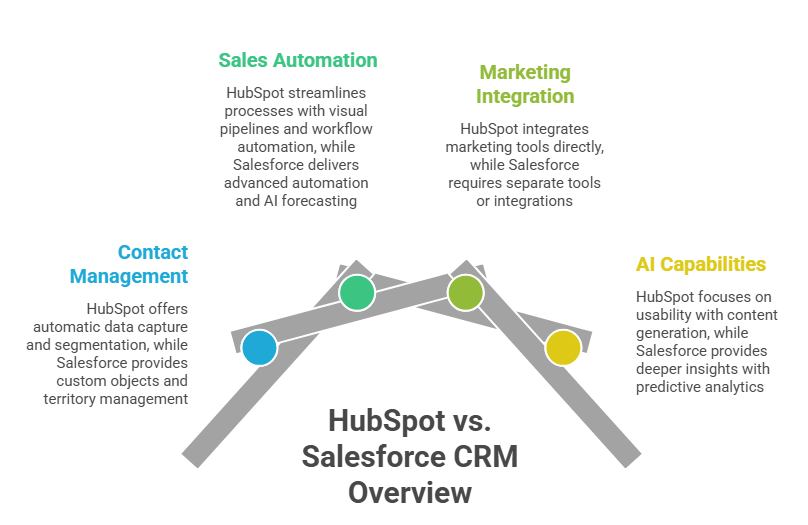
Feature comparison is where the HubSpot CRM vs Salesforce CRM debate becomes more nuanced, as both platforms offer robust capabilities tailored to different business needs. HubSpot emphasizes an all-in-one ecosystem, while Salesforce provides modular, highly customizable solutions. Evaluating these features side by side reveals how each platform supports sales, marketing, and analytics differently.
1. Contact and Lead Management
HubSpot simplifies contact and lead management with automatic data capture, timeline tracking, and easy segmentation tools. Salesforce offers more advanced capabilities like custom objects, territory management, and detailed lead routing. This makes HubSpot efficient for straightforward workflows and Salesforce better for complex data structures.
2. Sales Automation and Pipelines
HubSpot provides visual pipelines, workflow automation, and built-in email tracking that streamline sales processes. Salesforce Sales Cloud delivers advanced automation, AI-driven forecasting, and multi-step approval systems. Salesforce reports that automation tools can boost sales productivity by 14.5%.
3. Marketing Integration
HubSpot integrates marketing tools directly into its CRM, including email campaigns, landing pages, and content management. Salesforce requires separate tools, such as Marketing Cloud or third-party integrations, to achieve similar functionality. This makes HubSpot more cohesive for inbound marketing strategies.
4. AI and Analytics Capabilities
HubSpot’s AI focuses on usability with features like content generation and predictive lead scoring. Salesforce Einstein AI provides deeper insights through predictive analytics and opportunity intelligence. IDC reports that AI-powered CRM systems can improve conversion rates by up to 30%.
HubSpot CRM vs Salesforce Pricing and Scalability
Pricing and scalability are critical decision factors, especially when evaluating long-term CRM investments. HubSpot and Salesforce differ significantly in how they structure pricing and support growth. Businesses must consider both upfront costs and future scalability when choosing between the two.
- HubSpot offers a free CRM with scalable pricing tiers that grow alongside business needs.
- Salesforce has higher starting costs with no permanent free plan, making it more expensive upfront.
- HubSpot includes many features out of the box, reducing reliance on paid add-ons.
- Salesforce often requires additional tools, integrations, and consultants, increasing total costs.
- Salesforce project management provides superior scalability for large enterprises handling complex operations and global teams.
HubSpot CRM vs Salesforce Sales Cloud Lead Management Comparison
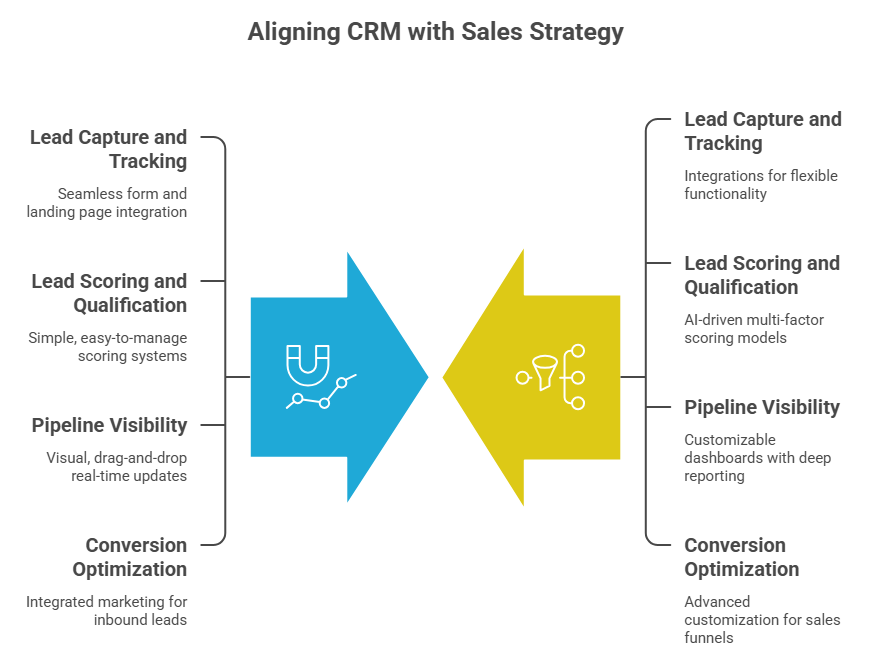
Lead management is a critical function where both platforms showcase their strengths in different ways. HubSpot focuses on simplicity and inbound lead nurturing, while Salesforce emphasizes customization and advanced scoring models. Comparing these approaches helps businesses align CRM capabilities with their sales strategies.
1. Lead Capture and Tracking
HubSpot offers built-in tools like forms and landing pages for seamless lead capture and tracking. Salesforce typically requires integrations or additional tools for similar functionality. This makes HubSpot more plug-and-play, while Salesforce is more customizable.
2. Lead Scoring and Qualification
Salesforce provides advanced lead scoring models with AI-driven insights and multi-factor evaluation. HubSpot offers simpler scoring systems that are easier to implement and manage. This difference reflects Salesforce’s enterprise focus and HubSpot’s usability advantage.
3. Pipeline Visibility
HubSpot delivers visual, drag-and-drop pipelines that provide real-time updates and clarity. Salesforce offers customizable dashboards with deeper reporting capabilities. Both are effective, but Salesforce provides more analytical depth.
4. Conversion Optimization
HubSpot’s marketing integration enables strong conversion tracking and optimization for inbound leads. Salesforce relies on additional tools for similar capabilities but offers more advanced customization. This makes HubSpot more efficient for marketing-driven sales funnels.
HubSpot vs Salesforce CRM Differences in Integrations
Integrations play a vital role in extending CRM functionality across business systems. HubSpot and Salesforce both offer extensive integration capabilities but differ in complexity and depth. Understanding these differences is key to building a scalable tech stack.
- Salesforce AppExchange offers a vast ecosystem of enterprise-grade integrations and extensions.
- HubSpot’s marketplace is easier to use and focused on quick setup and usability.
- Salesforce provides highly flexible APIs for complex, custom integrations.
- HubSpot offers developer-friendly APIs but with simpler implementation requirements.
- Both platforms integrate with major tools like Slack, Google Workspace, and Microsoft 365, with Salesforce offering deeper enterprise-level customization.
Choosing the Right CRM: HubSpot vs Salesforce vs Alternatives
When evaluating CRM platforms, businesses often compare HubSpot and Salesforce alongside alternatives like Pipedrive to understand where each solution fits. HubSpot CRM integration through virtual assistants provides a balanced, all-in-one platform that combines marketing, sales, and service tools, making it ideal for growing businesses that need simplicity without sacrificing functionality. Salesforce, on the other hand, delivers unmatched customization and scalability, making it the preferred choice for enterprises with complex workflows and large-scale operations.
In comparison, Pipedrive focuses primarily on sales pipeline management with a simpler interface, offering less functionality than both HubSpot and Salesforce. This positions HubSpot as a middle-ground solution—more powerful than Pipedrive but less complex than Salesforce. For most small to mid-sized businesses, HubSpot offers the best balance of usability, cost, and features, while Salesforce remains the top choice for organizations that require deep customization and enterprise-grade capabilities.
How Virtual Assistants Help Identify the Right CRM Choice
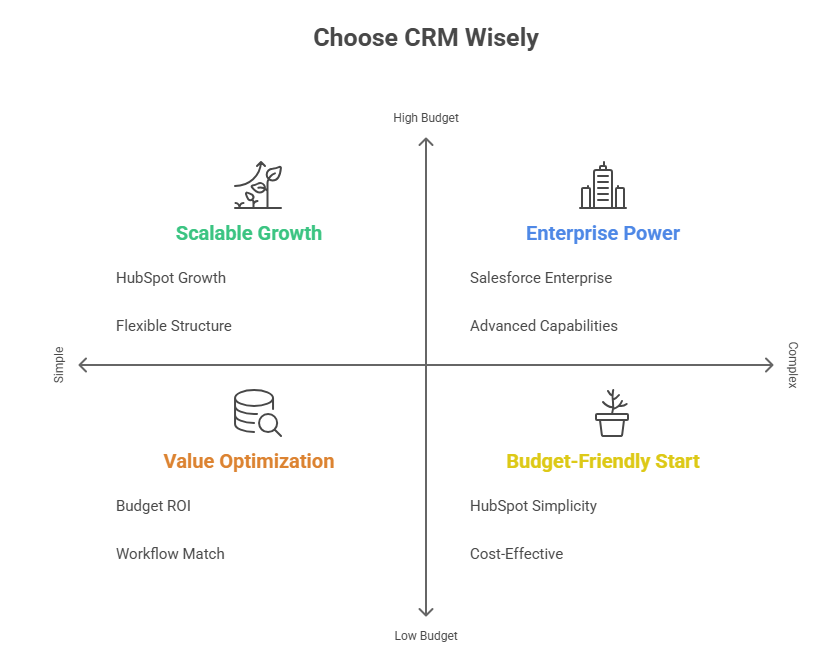
Choosing between HubSpot and Salesforce requires a clear understanding of business goals, operational complexity, and future scalability needs. Virtual assistants play a strategic role in evaluating these factors and translating them into practical CRM recommendations. By combining research, analysis, and hands-on support, they help businesses confidently decide the right platform.
- Virtual assistants assess your business size, sales processes, and operational requirements to determine whether HubSpot’s simplicity or Salesforce’s advanced capabilities are a better fit.
- They conduct detailed comparisons of hubspot crm vs salesforce crm features to match platform strengths with your specific workflow needs.
- Virtual assistants analyze budget constraints, pricing models, and paid content marketing ROI to identify which CRM offers the best value and long-term return on investment.
- They evaluate scalability requirements, helping businesses decide whether they need Salesforce’s enterprise flexibility or HubSpot’s growth-friendly structure.
- Virtual assistants review integration needs and existing tech stacks to ensure the selected CRM aligns seamlessly with your current tools.
- They test usability and onboarding complexity, ensuring the chosen CRM can be adopted efficiently by your team without unnecessary friction.
TaskVirtual: Your Partner in CRM Management and Support

Managing CRM systems like HubSpot and Salesforce can quickly become complex, especially when businesses need to balance data accuracy, automation workflows, and sales performance tracking. From configuring pipelines to ensuring seamless integrations, maintaining an efficient CRM requires time, expertise, and consistent monitoring. TaskVirtual provides expert virtual marketing assistant services that simplify CRM management, helping businesses streamline operations and make informed decisions between platforms like HubSpot and Salesforce.
1. Expert CRM Consultation and Setup
TaskVirtual’s skilled virtual assistants help businesses evaluate CRM needs, compare HubSpot and Salesforce features, and assist with setup and configuration. They ensure your CRM aligns with your sales processes, reducing inefficiencies and improving team productivity.
2. Affordable and Flexible Pricing
Hiring in-house CRM specialists can be expensive, but TaskVirtual offers cost-effective solutions. With pricing plans starting from just $3.12/hour to $14.99/hour, businesses can access expert CRM support without stretching their budgets.
3. Comprehensive CRM Support Solutions
From managing contacts and pipelines in HubSpot to assisting with Salesforce workflows and integrations, TaskVirtual covers all aspects of CRM operations. Their scalable services adapt to whether you need occasional support or full-time CRM project management.
4. Ongoing Monitoring and Optimization
TaskVirtual provides continuous CRM support by tracking performance metrics, optimizing workflows, and ensuring data accuracy. Their proactive approach helps businesses maintain efficiency and improve conversion rates over time.
5. Proven Track Record of Excellence
With 364 positive reviews and a 4.7-star rating on trusted VA platforms, TaskVirtual is recognized as a reliable partner worldwide. Businesses rely on their expertise to manage CRM systems effectively and support long-term growth.
FAQ Section
1. Which is better: HubSpot CRM or Salesforce?
It depends on your business size. HubSpot is better for small to mid-sized businesses, while Salesforce is ideal for large enterprises.
2. Is HubSpot CRM really free?
Yes, HubSpot offers a free CRM with core features, but advanced tools require paid plans.
3. Why is Salesforce more expensive?
Salesforce offers deeper customization, enterprise scalability, and advanced analytics, which increase cost.
4. Can HubSpot replace Salesforce?
For many SMBs, yes. But large enterprises with complex workflows may still prefer Salesforce.
5. Which CRM is easier to use?
HubSpot is significantly easier to learn and use compared to Salesforce.
6. Does Salesforce have better AI than HubSpot?
Salesforce Einstein AI is more advanced for enterprise analytics, but HubSpot’s AI is improving rapidly and is easier to use.
Conclusion + CTA
The hubspot crm vs Salesforce decision ultimately comes down to complexity versus usability. Choose HubSpot if you want simplicity, faster onboarding, and an all-in-one growth platform, while Salesforce is the better option if you need deep customization, enterprise scalability, and advanced analytics.
Both platforms are evolving rapidly in 2026, especially with AI integration, making them powerful tools for modern businesses. The right choice isn’t about which CRM is “better”—it’s about which one aligns with your operational maturity and growth strategy, so start by mapping your sales process, team size, and future scalability needs to make a confident decision.
Sources
- Statista – CRM market revenue: https://www.statista.com/statistics/268957/worldwide-customer-relationship-management-software-revenue/
- Statista – CRM market share: https://www.statista.com/statistics/411309/market-share-worldwide-crm-software/
- Salesforce Research Reports: https://www.salesforce.com/resources/research-reports/
- HubSpot Company Data: https://www.hubspot.com/company-news
- Nucleus Research CRM Value Matrix: https://nucleusresearch.com/research/single/crm-value-matrix/
- Forrester CRM TEI Study: https://www.forrester.com/report/the-total-economic-impact-of-crm/
For more such content, follow our website.
 Siddhartha Basu is a Technical Writer at Task Virtual. He loves online games, e-book reading, and Yoga.