

Contents
show
How a Virtual Financial Planning Assistant Reduces Adviser Workload
Financial advisers across the United States face mounting pressure from rising client expectations for personalized guidance and growing regulatory demands. Data entry, report generation, and compliance documentation often consume large portions of the workday, leaving limited time for high-value client conversations—challenges a Virtual Financial Planning Assistant is designed to address.
A virtual financial planning assistant- an AI-powered tool built for wealth management and financial planning workflows- directly addresses this imbalance by handling routine analysis, document processing, meeting preparation, scenario modeling, and follow-up communications. In 2026, with adviser retirements accelerating and demand for advice expanding, firms adopting these assistants gain capacity without proportional headcount increases, resulting in lower burnout risk, higher client capacity, and more sustainable practices.
The Growing Workload Crisis for Financial Advisers
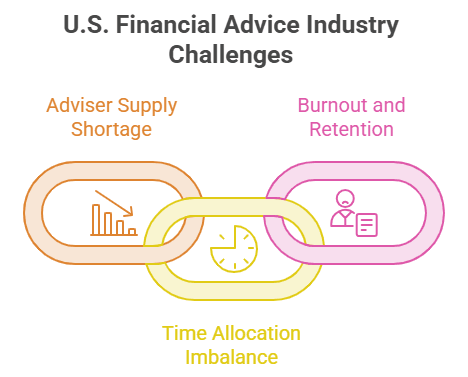
The U.S. financial advice industry faces a clear capacity challenge as client needs expand while the available adviser workforce grows only modestly. Operational burdens continue to limit the time professionals can devote to relationship-building and complex planning. Understanding the scale of these pressures is essential for evaluating solutions that restore balance.
1. Rising Client Demand Meets Shrinking Adviser Supply
The U.S. financial advice industry confronts a structural shortage. According to McKinsey analysis, approximately 110,000 advisers, about 38 % of the current workforce, are expected to retire over the next decade. At current productivity levels, the industry could face a shortage of 90,000 to 110,000 advisers by 2034.
Meanwhile, the Bureau of Labor Statistics counted about 326,000 personal financial adviser jobs in 2024, with projected growth of 10 % through 2034, much faster than average. Demand continues to outpace organic supply of new talent.
2. Time Allocation Reality Versus Ideal
Fidelity research shows that advisers currently spend only about 33 % of their day in client meetings. Roughly 20 % goes to preparing reports and plans, and 18 % to compliance and administrative tasks. Advisers themselves say their ideal allocation would put 51 % of time into client-facing work, with far less on reports and admin. Nearly three-quarters (72 %) identify reducing the administrative burden as the change that would most improve their workday.
These numbers translate into real strain. Unsupported senior advisers can spend several hours per week solely on administrative tasks, contributing to lower wellbeing scores and a higher likelihood of considering a job change.
3. Burnout and Retention Pressures
Kitsche’s research and related industry studies link high administrative loads to reduced wellbeing. Advisers who spend more hours on admin and compliance report lower life-satisfaction scores and an elevated risk of turnover. Long workdays and weekend work remain common in financial services, even as overall burnout rates have improved somewhat in recent years.
These pressures compound over time. When advisers consistently devote large blocks of their week to low-value tasks, the cumulative effect can erode job satisfaction, increase the chance of leaving a firm or the profession, and limit the energy available for the thoughtful client work that originally drew many into the field. A virtual financial planning assistant directly targets these pressure points by automating the lowest-value, highest-volume activities.
Core Capabilities of a Virtual Financial Planning Assistant

Virtual financial planning assistants combine natural language processing, document intelligence, and workflow automation tailored to wealth management. They function as digital support that prepares materials and surfaces insights so advisers can apply professional judgment more efficiently.
1. Automated Data Gathering and Document Processing
- Use optical character recognition and natural language processing to extract key data from tax returns, brokerage statements, insurance policies, and estate documents.
- Reduce processes that once required an hour of manual review to a few minutes while generating structured insights for planning discussions.
- Populate client profiles automatically, flag missing information, and surface anomalies for human review.
- Eliminate repetitive data entry and reduce transcription errors that later require correction.
2. Meeting Preparation, Note-Taking, and Follow-Up
- Integrate with video platforms or phone systems to transcribe conversations, identify action items, and draft summary notes.
- Deliver reported savings of five to ten or more hours per week on meeting-related work.
- Free the equivalent of roughly 500 hours annually across a typical schedule of multiple client meetings.
- Generate personalized follow-up emails, update the CRM with next steps, and create task lists after meetings, reducing after-hours work.
3. Scenario Modeling and Plan Generation
- Run Monte Carlo simulations, tax-aware projections, Social Security optimization scenarios, and multi-goal cash-flow models far faster than traditional spreadsheet approaches.
- Complete modeling that previously required two to three hours in 20-30 minutes with higher consistency.
- Allow advisers to retain full control to adjust assumptions and interpret results for clients.
- Produce initial plan drafts and scenario comparisons ready for professional refinement and client presentation.
4. Compliance Documentation and Reporting Support
- Draft first versions of regulatory documentation, suitability notes, and annual review packages from structured data and meeting transcripts.
- Apply firm templates automatically and flag items requiring human attestation.
- Shorten the compliance cycle while keeping the adviser as the final accountable party.
- Maintain clear audit trails that support regulatory review and internal quality standards.
Quantified Workload Reduction and Capacity Gains
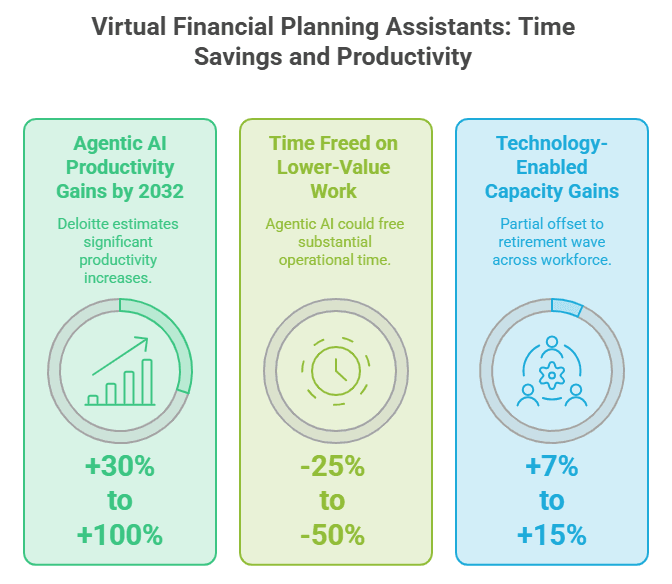
Time savings from virtual financial planning assistants translate directly into measurable capacity. Industry reports and adviser experiences show consistent reductions in hours spent on routine tasks. These gains support both greater client service and improved professional sustainability.
1. Hours Saved Per Week and Per Year
Multiple adviser reports and industry surveys converge on meaningful time savings. Tools focused on meeting workflows alone often free 5-10+ hours weekly. Broader AI adoption across planning and administrative tasks can reclaim dozens to hundreds of hours annually per adviser. One specialized platform reported helping advisers reclaim the collective equivalent of 62 years of working time in a single year through automated report generation.
2. Productivity Uplift Projections
Deloitte estimates that agentic AI could deliver adviser productivity gains of roughly 30 % to 100 % by 2032, potentially freeing 25-50 % of time currently spent on lower-value operational work. At the industry level, this capacity expansion could support the equivalent of trillions of additional assets under management without proportional increases in headcount. Early adopters already report reallocating saved hours toward business development, deeper planning conversations, and relationship building.
3. Impact on Client Capacity
With 10 hours saved weekly, an adviser can realistically take on additional clients or expand service depth for existing ones. Technology-enabled capacity gains of 7-15 % across the workforce have been cited as partial offsets to the looming retirement wave. Firms that systematically deploy virtual assistants position themselves to grow revenue per adviser while protecting work-life balance.
Practical Implementation for Advisory Firms

Successful adoption of a virtual financial planning assistant requires careful selection, thoughtful change management, and measurement, as 70% of change programs fail. Firms approaching implementation as comprehensive workflow redesign—not a simple technology add-on—capture greater benefits.
1. Selecting and Integrating the Right Assistant
- Prioritize clear use cases such as meeting notes, document extraction, plan drafting, or compliance support.
- Choose tools with strong security certifications, CRM and planning-software integrations common among RIAs and broker-dealers, and transparent audit trails.
- Establish firm policies defining what data may be processed and how outputs are reviewed, treating data privacy and regulatory compliance as non-negotiable.
2. Change Management and Training
- Provide training that emphasizes collaboration rather than replacement, positioning the assistant as a junior team member who prepares drafts and surfaces insights.
- Redesign workflows around the technology instead of simply layering tools onto existing processes.
- Focus on human-AI partnership so that the highest returns come from advisers applying professional judgment to AI-prepared materials.
3. Measuring Results and Iterating
- Track hours spent on previously manual tasks before and after deployment, along with client capacity, response times, plan delivery speed, and adviser wellbeing indicators.
- Begin with a pilot group of tech-comfortable advisers, refine prompts and templates based on feedback, then expand.
- Continuously improve the AI’s understanding of firm language and processes so that time savings compound over months.
Addressing Common Concerns and Limitations
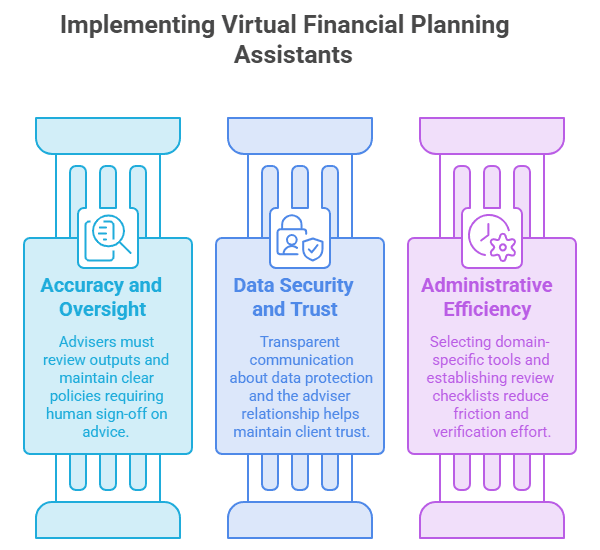
Adoption of virtual financial planning assistants raises legitimate questions about accuracy, security, and net efficiency. Addressing these concerns openly helps firms implement the technology responsibly. Clear policies and human oversight remain central to realizing benefits while managing risks.
1. Accuracy, Oversight, and Professional Responsibility
Virtual assistants accelerate work but do not replace fiduciary judgment. Advisers must review outputs, especially recommendations involving taxes, investments, or estate planning. Firms should maintain clear policies requiring human sign-off on advice and maintain records of AI-assisted processes for audits.
2. Data Security and Client Trust
Clients increasingly encounter AI in financial services. Transparent communication about how tools protect data and support, not replace, the adviser relationship helps maintain trust. Younger clients often show higher comfort with AI-assisted processes, while older clients may prefer explicit reassurance of human oversight.
3. Avoiding New Administrative Overhead
Some studies note that time saved by AI can be partially offset by time spent verifying outputs. Selecting domain-specific tools trained on financial planning data, establishing review checklists, and refining prompts reduce this friction. Over time, as models improve and firm-specific knowledge bases mature, verification effort declines relative to the gross time savings.
Future Outlook: Scaling Advice Delivery Sustainably
As generative and agentic AI mature, virtual financial planning assistants will handle increasingly complex multi-step workflows- gathering data across accounts, generating initial plans, preparing client-ready presentations, and drafting ongoing communication sequences. Advisers who thrive will treat these systems as force multipliers that expand capacity while preserving empathy, ethical judgment, and complex problem-solving.
Firms that invest now in the right tools, training, and process redesign will be better positioned to serve more households, retain talent, and navigate demographic shifts. Continuing with manual-heavy workflows risks higher burnout, slower growth, and difficulty competing for both clients and the next generation of advisers.
TaskVirtual: Dedicated Virtual Support for Financial Advisers

Managing the volume of administrative, research, and follow-up work that accompanies client planning can quickly overwhelm even experienced advisers. Coordinating document collection, organizing client data, preparing meeting materials, and handling routine communications often pulls focus away from strategy and relationship building. TaskVirtual supplies an expert virtual financial planning assistant service that helps financial advisers streamline these supporting tasks so more time remains available for high-value client work.
1. Specialized Assistance for Adviser Workflows
TaskVirtual’s virtual assistants help organize client information, prepare preliminary research summaries, manage scheduling and follow-up communications, and support documentation routines. They assist with recurring administrative processes so advisers can concentrate on plan design, client conversations, and professional judgment.
2. Affordable and Flexible Pricing
Hiring full-time support staff can be costly for many practices. TaskVirtual offers budget-friendly options with pricing plans starting from just $3.12/hour to $14.99/hour, making dedicated virtual assistance accessible to solo practitioners, small teams, and larger advisory firms alike.
3. Comprehensive Workload Relief Solutions
From organizing client files and coordinating information requests to supporting meeting preparation and tracking action items, TaskVirtual covers a wide range of operational needs. Services scale easily whether an adviser requires occasional help or consistent weekly support for ongoing practice management.
4. Continuous Support and Quality Oversight
TaskVirtual provides regular updates and proactive coordination so tasks stay on schedule. Their structured approach helps ensure that supporting work is completed accurately and on time, reducing the administrative load that otherwise competes with client-facing responsibilities.
5. Established Record of Reliability
With 364 positive reviews and a 4.7-star rating on trusted VA platforms, TaskVirtual is recognized as a dependable partner for professionals seeking reliable virtual assistance. Advisers turn to their team to simplify operational demands and free capacity for the work that matters most.
FAQ Section
1. What is a virtual financial planning assistant?
It is an AI-powered software system built for financial planning and wealth management workflows. It automates data extraction, meeting documentation, scenario modeling, report drafting, and routine communications while leaving final advice and client relationships with the licensed adviser.
2. How many hours can a virtual assistant realistically save each week?
Advisers commonly report 5–10+ hours per week from meeting notes, document processing, and plan preparation alone. Broader adoption across administrative and compliance tasks can produce larger cumulative savings.
3. Will a virtual financial planning assistant replace human advisers?
No. These tools handle repetitive and analytical support tasks. Clients continue to need human judgment, behavioral coaching, complex decision-making, and relationship management—areas where licensed professionals remain essential.
4. How do these tools handle sensitive client data and compliance?
Reputable platforms use enterprise-grade encryption, access controls, and audit logs. Firms must still maintain policies requiring human review of advice and ensure the chosen tools meet applicable privacy and regulatory standards.
5. What is the typical implementation timeline for an advisory firm?
Pilots can begin within weeks once integrations and security reviews are complete. Meaningful firm-wide time savings often appear within three to six months as templates, prompts, and workflows are refined.
6. Are virtual assistants suitable for solo advisers as well as larger firms?
Yes. Solo practitioners often gain the most relative capacity because they lack large support staff. Cloud-based tools with straightforward interfaces allow individual advisers to reclaim hours without hiring additional personnel.
Conclusion + CTA
A virtual financial planning assistant is a practical response to rising client demand and constrained adviser capacity. By removing hours of administrative, documentation, and preparatory work, these tools let advisers spend more time understanding clients, crafting tailored strategies, and building lasting relationships.
Firms and individual practitioners that adopt thoughtfully, measure results, and keep human oversight central will operate with greater efficiency, lower burnout risk, and stronger growth potential. Evaluate your current time allocation this week, identify the most repetitive tasks, and explore domain-specific virtual financial planning assistants that integrate with your existing systems. Start with a focused pilot, track the hours returned, and scale what works. The capacity you free today becomes the foundation for serving more clients and practicing more sustainably tomorrow.
Sources
- McKinsey & Company, “The looming advisor shortage in US wealth management”
- U.S. Bureau of Labor Statistics, Personal Financial Advisors occupational data
- Financial Planning, coverage of AI time savings for advisers
- Fidelity Adviser Solutions / IFA DNA study on adviser time allocation
- Deloitte Center for Financial Services, agentic AI productivity projections
- FPSB / related global financial planner AI adoption insights
- Kitces Research Advisor Wellbeing studies
- Cerulli Associates adviser headcount and retirement projections
For more such content, visit our website.
 Siddhartha Basu is a Technical Writer at Task Virtual. He loves online games, e-book reading, and Yoga.