Contents
show
Executive Assistant vs Virtual Assistant: Key Differences
In today’s hybrid and remote-first American workplace, leaders face a critical choice when scaling support: hire an executive assistant or a virtual assistant. The debate around executive assistant vs virtual assistant often centers on strategy versus execution, depth of partnership versus task efficiency, and cost versus impact. As remote work remains a fixture – with BLS data showing roughly 22-35% of workers engaging in some telework depending on the measure – understanding these roles helps executives, founders, and managers protect their time without over- or under-investing in support. Clarity on the distinctions prevents mismatched hires that drain budgets or leave high-value strategic work unsupported, especially as organizations balance flexibility with the need for reliable administrative capacity.
This guide breaks down definitions, day-to-day responsibilities, skills, costs, hiring scenarios, and trends so you can match the right role to your needs. Whether you lead a startup, scale-up, or established company, the right choice multiplies an executive’s impact by aligning support structure with actual bottlenecks rather than defaulting to familiar titles. Careful evaluation of scope, autonomy requirements, and budget ensures that the investment delivers lasting productivity gains rather than temporary relief.
Defining the Roles Clearly
Understanding the foundational differences between these two support roles is essential before comparing responsibilities or costs. Many organizations use the titles interchangeably, yet the expectations, autonomy levels, and business impact diverge significantly. Clear definitions prevent hiring mistakes and set accurate performance standards from the start.
1. What an Executive Assistant Does
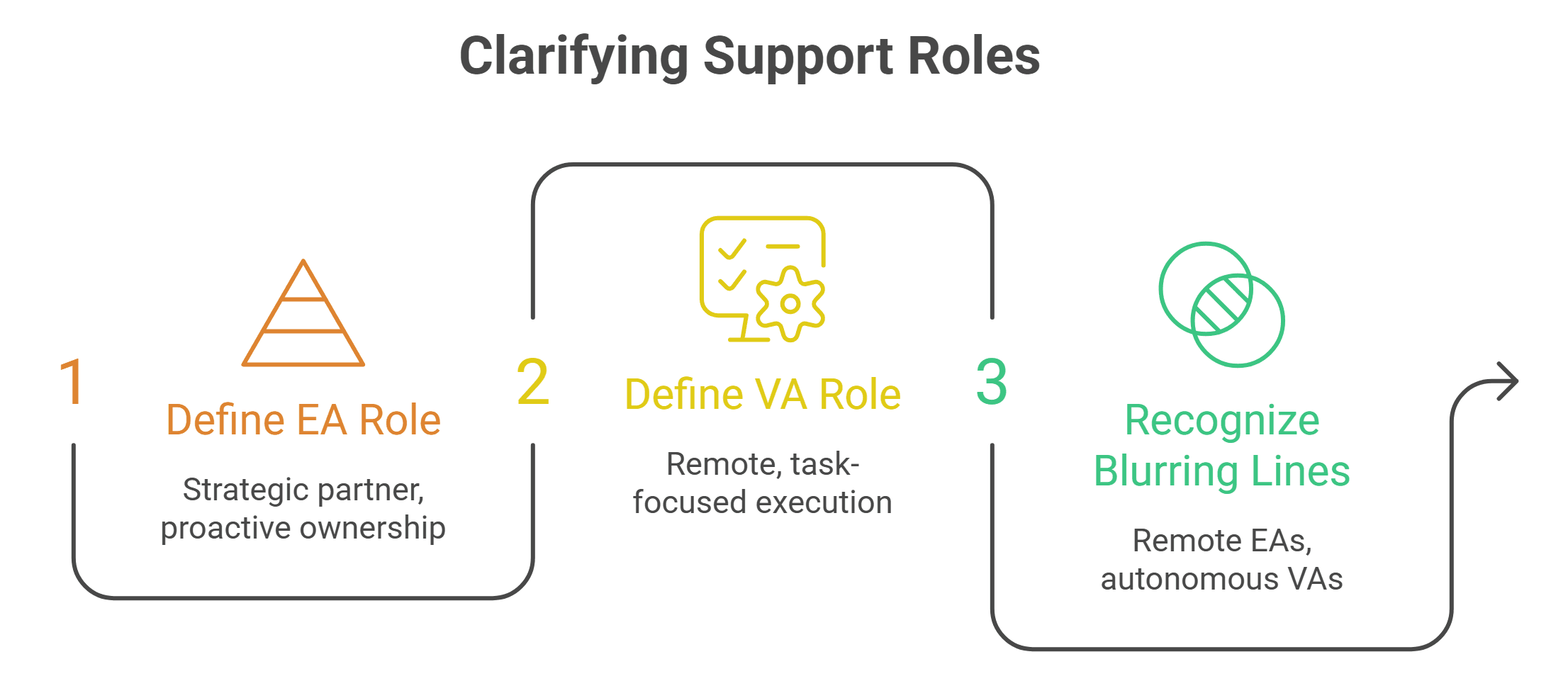
An executive assistant (EA) functions as a high-level strategic partner, typically dedicated to one or a small number of senior leaders. Traditional EAs have long worked on-site, though remote and hybrid arrangements have expanded significantly. Their core mandate goes beyond calendar management: they anticipate needs, protect the executive’s focus, manage complex stakeholder relationships, prepare for board or investor meetings, handle sensitive communications, and often own projects that require judgment and institutional knowledge.
According to the U.S. Bureau of Labor Statistics, executive secretaries and executive administrative assistants numbered about 502,800 in 2024, with a median annual wage of $74,260. These professionals routinely handle research, report preparation, information requests, correspondence, visitor management, conference calls, and scheduling at a sophisticated level. Many also support multiple managers or contribute to broader operational workflows.
2. What a Virtual Assistant Does
A virtual assistant (VA) is a remote professional—often an independent contractor or agency-placed specialist—who delivers defined administrative, technical, or specialized tasks. VAs commonly manage email triage, scheduling, data entry, research, social media posting, customer support, bookkeeping support, or process-driven work across one or multiple clients. The relationship is typically more transactional and instruction-based than the embedded partnership of an EA.
VAs thrive on clear processes and repeatable work. They excel when instructions are precise, and outcomes are measurable, making them highly efficient for volume or specialized execution without the overhead of full-time employment. Many VAs develop strong systems over time and can handle increasingly complex assignments within their defined scope, offering scalable capacity that adapts to fluctuating business needs while remaining cost-effective for organizations that prioritize execution over strategic partnership.
3. How the Lines Sometimes Blur
Remote executive assistants are increasingly common, and some experienced VAs now operate with greater autonomy. In practice, a remote EA and a VA may use similar tools, but their core focus differs: EAs prioritize context, judgment, and proactive ownership, while VAs focus on reliable execution of scoped tasks. In 2025, telework was routinely allowed for 39.5% of executive secretaries and executive administrative assistants, according to the U.S. Bureau of Labor Statistics.
Confusing the two roles can create mismatched expectations. Hiring a VA for EA-level anticipation may lead to repeated clarification, while using an EA mainly for routine tasks can underuse strategic capacity. Clear role boundaries or hybrid arrangements help organizations use both models effectively.
Core Differences in Roles and Responsibilities
The practical distinctions between executive assistants and virtual assistants appear most clearly in daily scope, decision-making patterns, and relationship dynamics. These differences determine how much independent judgment each role exercises and how deeply each integrates into leadership workflows. Examining them side by side reveals why one role cannot simply substitute for the other without trade-offs.
1. Scope of Work and Decision Authority
- EAs operate with a broad, open-ended scope that includes prioritizing the executive’s calendar against strategic goals and declining low-value meetings.
- They prepare briefing materials, draft high-stakes communications, and coordinate cross-functional projects that require institutional knowledge.
- EAs make real-time judgment calls within defined parameters, often involving confidential board materials or investor relations cadence.
- Complex travel planning and multi-stakeholder coordination fall within their typical responsibilities.
- Overall, their work demands deep business understanding and the ability to act as an extension of the executive’s priorities.
2. Proactivity Versus Responsiveness
- Strong EAs anticipate needs by building buffer time before important meetings and surfacing relevant research unprompted.
- They track follow-ups across stakeholders and flag emerging conflicts or opportunities before issues escalate.
- This proactive approach reduces the executive’s cognitive load and protects focus time.
- VAs generally respond to assigned work, delivering speed, accuracy, and consistency once direction is given.
- High-quality VAs may develop process ownership over time, yet the baseline expectation remains reliable execution rather than independent prioritization of the executive’s overall agenda.
3. Relationship Depth and Integration
- EAs develop intimate knowledge of their principal’s preferences, communication style, priorities, and organizational politics.
- They often attend meetings virtually or in person, interact with the broader leadership team, and become a trusted extension of the executive office.
- This depth of integration supports confidential handling of sensitive matters and long-term continuity.
- VAs maintain professional but more limited relationships, frequently supporting multiple clients at once.
- Integration for VAs remains task– or process-focused rather than holistic, offering flexibility and specialization at the expense of continuous organizational context.
Skills, Qualifications, and Experience Levels
Success in either role depends on a distinct mix of hard skills, soft skills, and accumulated experience. Executive assistants require broader judgment and relational capacity, while virtual assistants emphasize digital fluency and process reliability. Understanding these requirements helps organizations write accurate job descriptions and evaluate candidates effectively.
1. Essential Skills for Executive Assistants
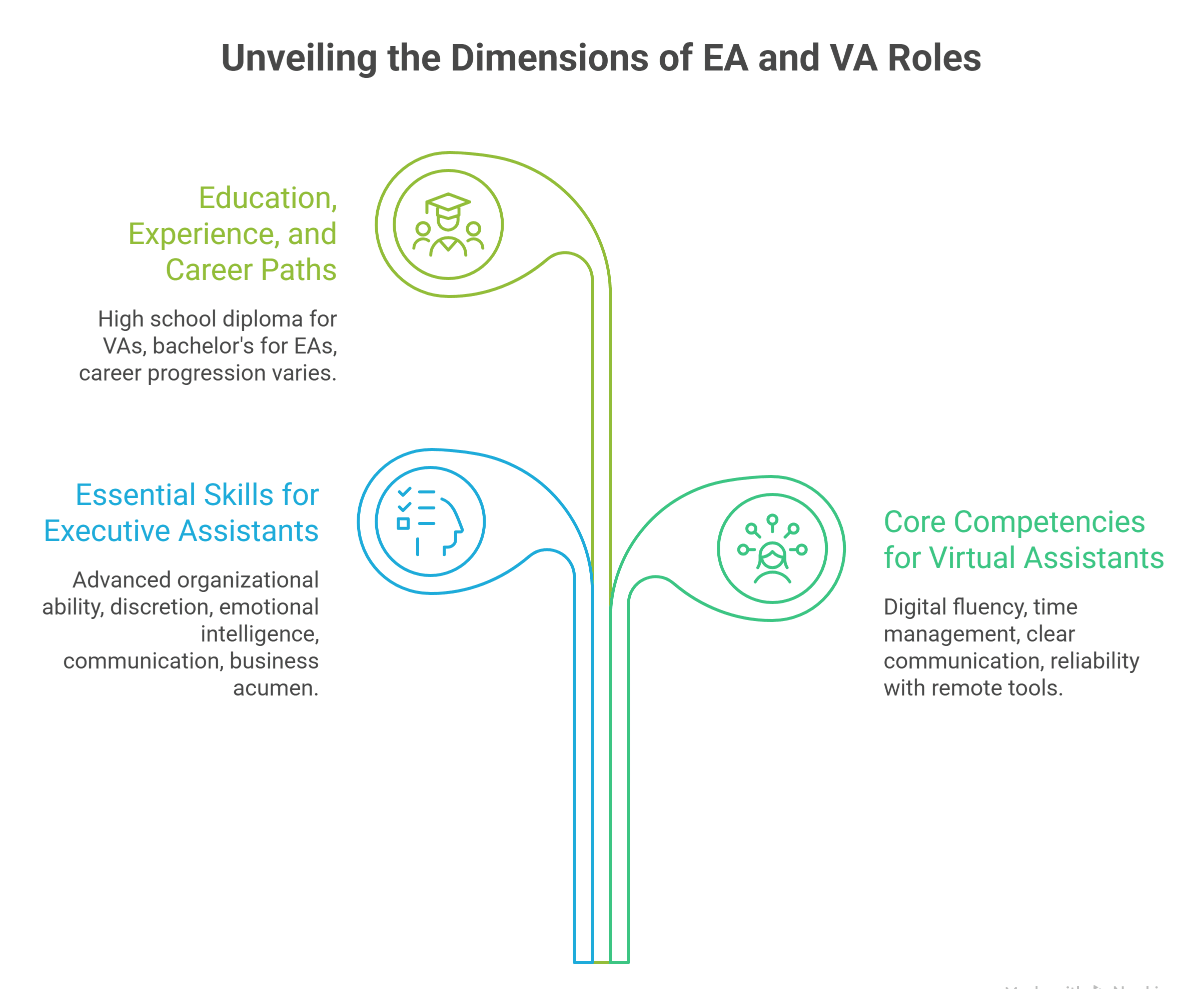
Successful EAs combine advanced organizational ability with discretion, emotional intelligence, written and verbal communication excellence, and business acumen. They navigate complex calendars under shifting priorities, manage sensitive information with complete confidentiality, and coordinate multi-stakeholder projects that often span departments or external partners. Comfort with tools ranging from advanced calendar and email systems to CRM and project management platforms and basic data analysis is expected, along with the ability to represent the executive professionally in high-visibility situations.
Judgment under pressure remains non-negotiable. Many EAs hold bachelor’s degrees and bring several years of progressive administrative or office experience that has prepared them to operate with limited supervision. The capacity to read organizational dynamics, anticipate second-order effects of decisions, and maintain composure during crises distinguishes high-performing EAs from purely task-oriented support professionals.
2. Core Competencies for Virtual Assistants
VAs need strong digital fluency, time management, clear written communication, and reliability with remote collaboration tools such as shared drives, project software, and messaging platforms. Specializations in social media management, bookkeeping software, research techniques, customer support platforms, or light design tools can significantly increase their value to clients. Adaptability across different client environments and technology stacks is also a frequent strength, allowing VAs to onboard quickly and deliver consistent results.
Many VAs are self-taught or trained through specialized platforms and agencies rather than formal degree programs. This aligns with Upwork research showing that 74% of executives consider degrees irrelevant when hiring freelancers, prioritizing proven expertise instead. The best VAs combine technical competence, process adherence, independent execution, and proactive communication, keeping clients informed without constant follow-up.
3. Education, Experience, and Career Paths
BLS data for the broader secretaries and administrative assistants group (3.45 million jobs in 2024) shows a median wage of $47,460 and notes a high school diploma or equivalent as typical entry-level education, with variation by specialty. Executive-level roles generally demand more experience and command higher pay, reflecting the greater judgment and confidentiality requirements. Career progression for EAs can lead toward chief of staff, operations management, or specialized executive support positions within larger organizations.
VAs often expand into specialized freelancing, agency ownership, or higher-value remote support niches focused on particular industries or skill sets. Some transition into full-time remote EA roles once they have demonstrated the capacity for deeper context and proactive ownership. Continuous skill development—particularly around AI tools, advanced software, and process design—strengthens long-term career prospects for professionals in both categories.
Cost Structures and Employment Models

Compensation and employment arrangements differ substantially between the two roles and directly influence total cost of ownership. Organizations must weigh salary or hourly rates against benefits, taxes, flexibility, and management overhead. These structural differences often determine which model is sustainable for a given stage of growth or budget.
1. Compensation Benchmarks
- The 10th percentile for these roles falls around the $48,000–$50,000 range.
- The 90th percentile exceeds $107,000–$109,000 in updated figures.
- Fully loaded costs for an employed EA (salary, benefits, taxes, equipment, and space) rise substantially higher than base salary alone.
- VA rates vary widely by location, specialization, and model, with offshore or nearshore options often delivering significant savings relative to U.S. full-time hires, while specialized U.S.-based VAs command premium hourly or monthly retainers.
2. Employment Versus Contractor Arrangements
- EAs are commonly full-time employees integrated into the organization, receiving set hours, benefits, and formal HR processes.
- This employment model fosters loyalty, deep institutional knowledge, and consistent availability but reduces flexibility and increases fixed costs.
- VAs usually work as independent contractors or through agencies on an hourly, retainer, or project basis.
- The contractor approach allows clients to scale hours up or down and hire specialized talent for discrete needs without long-term employment commitments.
When to Choose an Executive Assistant or a Virtual Assistant
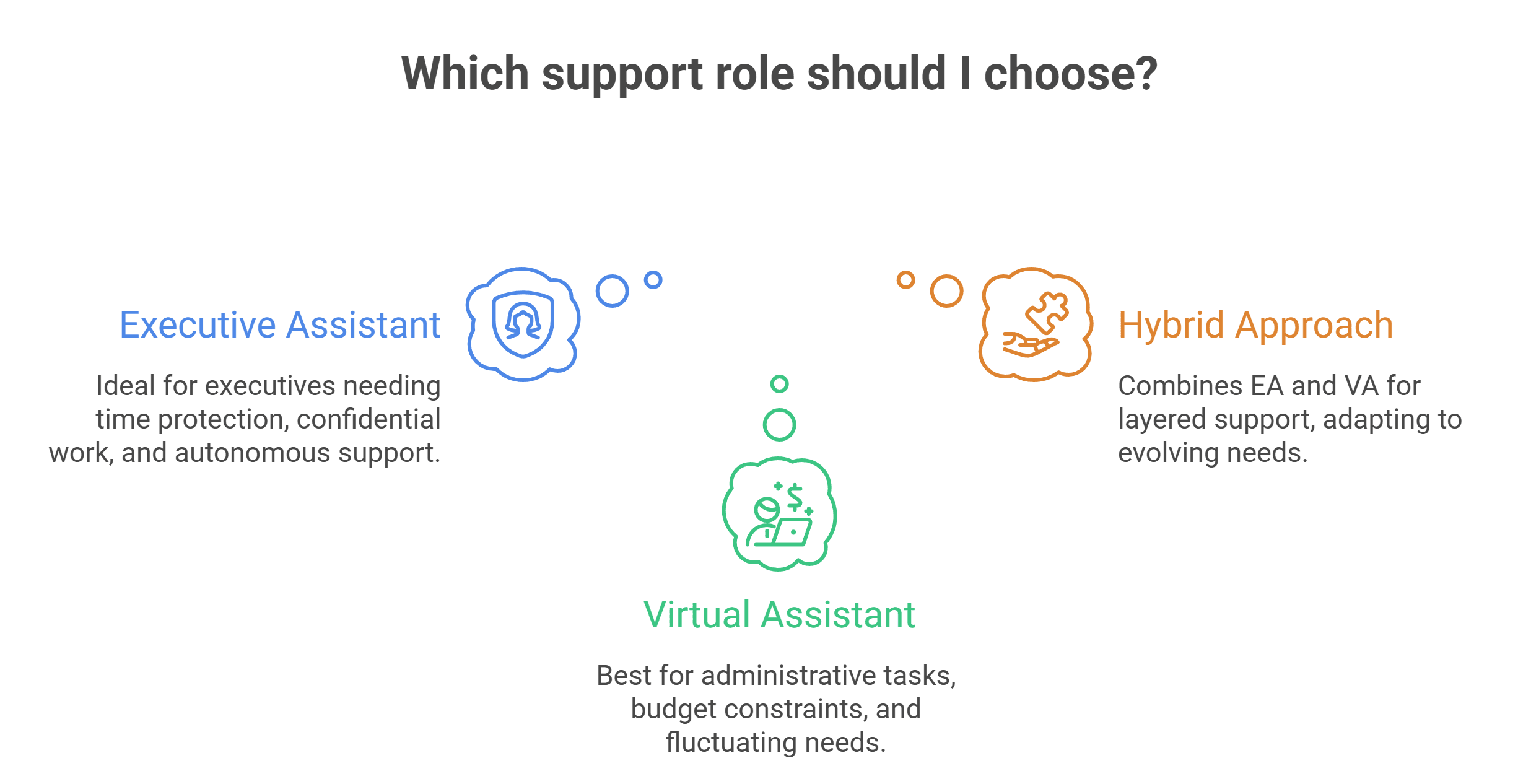
Selecting the appropriate support role requires an honest assessment of current bottlenecks, confidentiality demands, and available budget. The wrong choice creates either wasted capacity or persistent gaps in strategic coverage. Matching the role to actual needs produces clearer returns on investment and smoother daily operations.
1. Scenarios Ideal for an Executive Assistant
Hire an EA when the executive’s time is the primary bottleneck, priorities shift rapidly, confidential or high-stakes work predominates, or the leader needs a true thought partner who can act with autonomy. Founders raising capital, CEOs of growing companies, or leaders juggling board, investor, and internal demands often benefit most. The investment pays off through protected focus time and reduced decision fatigue.
2. Scenarios Where a Virtual Assistant Excels
A VA is the better fit for clear, repeatable administrative loads – email and calendar hygiene, research projects, content or social media support, data work, or customer-facing processes – especially when budget constraints exist or needs fluctuate. Small businesses, solopreneurs, or teams that already have strong processes in place gain efficiency without the cost of a full strategic partner. Many organizations successfully use VAs for volume work while reserving EA-level support for the C-suite.
3. Hybrid and Evolving Approaches
Some companies pair a dedicated remote EA for strategic coverage with specialized VAs for execution layers, creating a layered support system that addresses both high-judgment and high-volume needs. Others begin with a capable VA to handle foundational administrative work and later upgrade to an EA as organizational complexity and stakeholder demands increase. The key is matching scope, autonomy requirements, and budget rather than defaulting to one title. Clear documentation of processes, regular communication cadences, and periodic role reviews help hybrid models function smoothly and prevent overlap or gaps. Over time, many growing organizations refine these arrangements to balance cost efficiency with the strategic partnership senior leaders require.
Future Outlook for Administrative Support Roles

Administrative support roles continue to evolve under pressure from technology, remote work norms, and shifting organizational priorities. Both executive assistants and virtual assistants will remain relevant, yet the skills and expectations attached to each title are changing. Leaders who understand these trends can hire more resilient talent and design support structures that adapt rather than become obsolete.
1. Technology and AI Influence
- Automation and AI tools are reshaping routine tasks such as basic scheduling, data entry, and simple correspondence.
- BLS projections for secretaries and administrative assistants overall show little or no change (0% growth) from 2024–2034.
- A slight decline is projected specifically for executive secretaries and executive administrative assistants (about –2%).
- Openings will still arise largely from replacements as workers transfer or leave the labor force.
- Higher-judgment, relationship-driven, and context-heavy work remains harder to automate fully and will continue to require skilled human professionals.
2. Remote Work Permanence and Talent Access
- Sustained telework rates – hovering in the low-to-mid 20s percent range in recent BLS measures and higher in some surveys – expand the available talent pool.
- Both remote EAs and VAs benefit from broader geographic access to skilled professionals.
- Employers gain flexibility to seek specialized or cost-effective support beyond local labor markets.
- Stronger remote management practices, clear documentation, and consistent communication norms become essential for success.
- Organizations that invest in these capabilities can attract higher-caliber remote talent and maintain productivity across distributed teams.
3. Evolving Role Expectations
- Demand is shifting toward professionals who combine administrative excellence with tool fluency and basic project ownership.
- The ability to work effectively alongside AI systems and apply them within AI project management workflows is becoming a core expectation rather than a differentiator.
- EAs who demonstrate strategic contribution and measurable impact on executive productivity will remain highly competitive.
- VAs who specialize in particular domains or deliver continuous process improvements strengthen their market position.
- Continuous learning around emerging tools and refined soft skills will separate top performers from those limited to traditional task execution.
TaskVirtual: Flexible Virtual Support for Modern Leaders

When the choice between an executive assistant and a virtual assistant feels complex, many leaders turn to specialized platforms that deliver reliable remote administrative capacity without the cost or commitment of a full-time hire. TaskVirtual connects executives, founders, and teams with skilled virtual assistant professionals who handle the practical execution side of support – calendar coordination, email management, research, scheduling, and process-driven tasks – so leaders can stay focused on high-value work. The service is designed to complement both strategic EA partnerships and pure task-based needs, giving organizations a flexible option that scales with changing priorities.
1. Skilled Matching and Role Alignment
TaskVirtual carefully pairs clients with virtual assistants experienced in administrative workflows, prioritization support, and remote collaboration tools. Whether the need is structured task execution or more advanced calendar and communication management, the platform helps ensure the assigned professional understands the scope and can deliver consistent results that align with the distinctions outlined between executive and virtual support roles.
2. Accessible Pricing That Scales with Demand
Full-time executive assistants often carry high fixed costs in salary, benefits, and overhead. TaskVirtual offers a more adaptable alternative, with pricing plans starting from just $3.12/hour to $14.99/hour. This range makes high-quality virtual assistance accessible to solopreneurs, growing teams, and established organizations that want efficient support without long-term employment commitments.
3. Broad Administrative and Operational Coverage
From inbox organization and meeting coordination to research requests, travel logistics, and recurring process management, TaskVirtual covers the range of tasks that commonly fall under virtual assistant responsibilities. Services can expand or contract based on current workload, making it easier to address volume needs while reserving deeper strategic partnership for a dedicated executive assistant when required.
4. Consistent Oversight and Reliable Delivery
Beyond completing assigned work, TaskVirtual emphasizes clear communication, status updates, and quality checks. This ongoing support helps maintain accountability and ensures that administrative tasks are handled accurately and on schedule, reducing the management burden on busy executives and teams.
5. Established Client Confidence
With 364 positive reviews and a 4.7-star rating on trusted VA platforms, TaskVirtual is recognized as a dependable partner for remote administrative support. Clients rely on the platform to deliver consistent execution that frees time for higher-level priorities and complements broader decisions about executive versus virtual assistance.
Frequently Asked Questions
1. What is the main difference between an executive assistant and a virtual assistant?
An executive assistant provides high-level, proactive, judgment-based support as a strategic partner to senior leaders. A virtual assistant focuses on executing defined administrative or specialized tasks remotely, usually under clearer direction.
2. Which role costs more?
Executive assistants typically cost more because of higher salaries (BLS median around $74,260), benefits, and full-time employment structures. Virtual assistants often cost less through contractor or offshore models, though specialized U.S.-based VAs can approach mid-range rates.
3. Can a virtual assistant perform executive assistant duties?
Some experienced VAs handle advanced tasks, and remote EAs exist. However, true EA-level work requires deep context, exclusive focus, high trust, and independent judgment that most multi-client VA arrangements do not fully replicate.
4. Do I need an in-office executive assistant or can the role be remote?
Many EAs now work remotely or hybrid successfully when communication systems, trust, and processes are strong. Complex stakeholder or physical-presence needs may still favor on-site or hybrid arrangements.
5. How do employment projections look for these roles?
BLS projects little overall change for secretaries and administrative assistants through 2034 and a modest decline for the executive specialty, driven partly by technology and managers handling more tasks themselves. Replacement openings remain substantial.
6. Should a startup hire a VA or an EA first?
Most early-stage startups benefit from a capable VA for foundational administrative relief. An EA becomes more valuable once the founder’s time is constrained by complex, high-stakes decisions and stakeholder management.
Conclusion and Next Steps
Choosing between an executive assistant and a virtual assistant is less about titles and more about matching scope, autonomy, integration, and budget to your actual bottlenecks. EAs deliver strategic partnership and cognitive relief for senior leaders; VAs deliver efficient, scalable execution of defined work. Misalignment creates frustration and wasted spend, while the right fit multiplies an executive’s impact.
Audit your current time sinks, confidentiality needs, decision volume, and budget. Document processes where possible. Then decide whether you need a dedicated partner who anticipates and prioritizes or skilled remote capacity that executes reliably. Many organizations evolve from one model to a layered approach as they grow.
Sources
- U.S. Bureau of Labor Statistics, Occupational Outlook Handbook: Secretaries and Administrative Assistants (employment, wages, and projections data).
- U.S. Bureau of Labor Statistics, Occupational Employment and Wage Statistics for Executive Secretaries and Executive Administrative Assistants.
- U.S. Bureau of Labor Statistics telework and work-at-home data from the Current Population Survey and related reports.
- Additional BLS occupational employment and wage releases referenced for median pay and employment counts.
For more such content, visit our website.
 Siddhartha Basu is a Technical Writer at Task Virtual. He loves online games, e-book reading, and Yoga.