


A certified virtual assistant is a remote professional who has completed formal training or certification programs designed to validate their competencies, technical abilities, and professional knowledge in virtual assistance. According to industry data, certified virtual assistants with specialized qualifications have about a 22% higher chance of being hired quickly compared to non-certified counterparts, highlighting how credentials improve market confidence and employment outcomes. Certification functions as a credibility mechanism, helping clients and businesses distinguish between general freelancers and individuals who have undergone structured skill development, and while certification is not a legal requirement, it often serves as a proxy indicator of professionalism, consistency, and operational reliability in remote work environments where direct supervision is limited.
What Is a Certified Virtual Assistant?
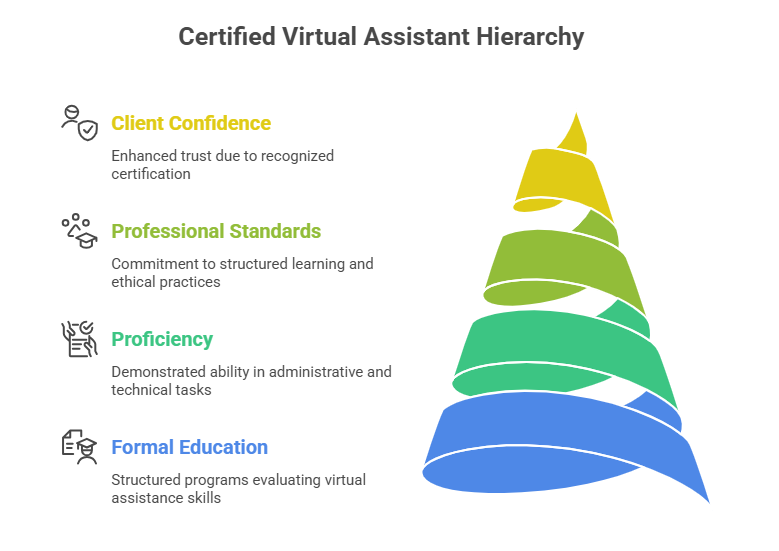
A certified virtual assistant is a remote support professional who has completed formal education or training programs that evaluate and validate their ability to perform virtual assistance tasks. Certification generally indicates demonstrated proficiency in administrative, technical, or business-related workflows. It also signals a commitment to structured learning and professional standards.
Unlike informal experience-based virtual assistants, certified professionals have typically undergone assessments or examinations aligned with defined competencies, which serve as structured indicators of capability and professional readiness. Workforce studies show that more than 40% of remote-capable employees in the United States continue to work in hybrid or fully remote arrangements, illustrating the persistence of distributed work and the rising importance of validated, role-specific skills. These credentials help standardize expectations regarding skills, communication practices, and work methodologies, and in many cases, certification enhances client confidence during the hiring process by reducing perceived risk and signaling commitment to recognized standards.
What Does “Certified” Mean in Virtual Assistance?
Within the virtual assistance industry, “certified” usually refers to the successful completion of recognized training programs or professional courses rather than government licensing. Certification commonly involves curriculum-based learning, practical assessments, and evaluation of operational knowledge related to remote work. It primarily functions as a professional validation framework rather than a regulatory designation.
Common Areas of Certification for Virtual Assistants

Virtual assistant certifications span multiple domains, reflecting the wide variety of tasks businesses outsource to remote professionals. These credentials often emphasize either foundational administrative capabilities or specialized technical functions. The scope of certification frequently correlates with the complexity of client requirements.
1. Administrative and Executive Support Certification
These certifications focus on operational efficiency, organizational management, and executive-level assistance. They typically validate competencies such as calendar coordination, inbox management, document preparation, and internal communications. A certified administrative virtual assistant or certified executive virtual assistant is generally trained to handle high-responsibility tasks with minimal supervision.
2. Technical Skills Certification
Technical certifications emphasize proficiency with digital tools, automation platforms, CRM systems, and workflow software. They assess the assistant’s ability to manage back-end systems, integrate applications, and optimize productivity environments. A certified remote virtual assistant with technical credentials is often positioned for roles requiring software fluency and systems management.
3. Digital Marketing Certification
Marketing-focused certifications validate capabilities in content scheduling, social media operations, email campaigns, SEO fundamentals, and performance tracking. These credentials are particularly relevant for businesses prioritizing online visibility and audience engagement. A certified online virtual assistant specializing in marketing typically supports brand growth initiatives.
4. Customer Support Certification
Customer service certifications evaluate client communication strategies, ticket management processes, conflict resolution techniques, and service workflows. They confirm that the assistant understands structured support systems and client interaction protocols. Such credentials are valuable for organizations with high customer engagement volumes.
5. Industry-Specific Certification
Certain certifications address niche industries, including real estate, legal assistance, healthcare administration, e-commerce operations, and bookkeeping. These programs ensure familiarity with sector-specific terminology, compliance considerations, and workflows. Specialization frequently increases professional differentiation and earning potential.
Why Businesses Prefer Certified Virtual Assistants
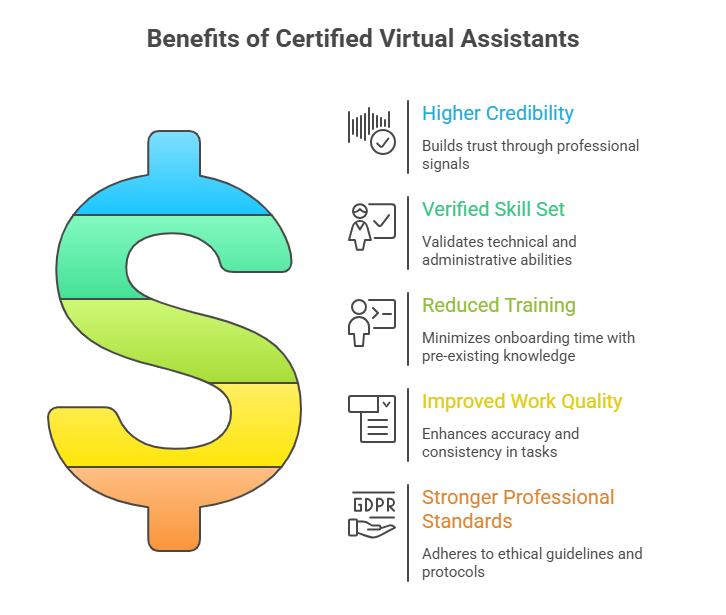
Businesses increasingly rely on remote professionals for operational scalability, cost optimization, and task delegation. Certification introduces an additional layer of predictability and trust in remote engagements. Although not universally required, credentials often influence hiring decisions in competitive markets.
1. Higher Credibility and Trust
Certification functions as a professional signal, reducing uncertainty regarding baseline competencies. It provides reassurance that the assistant has undergone a structured evaluation rather than relying solely on self-reported experience. For many clients, this credibility advantage simplifies vendor selection.
2. Verified Skill Set
Credentials help validate technical knowledge, administrative capabilities, and workflow familiarity. A professional certified virtual assistant or certified business virtual assistant is often perceived as possessing standardized competencies aligned with industry expectations. This verification reduces perceived hiring risk.
3. Reduced Training Requirements
Certified assistants typically require less onboarding for routine tasks due to pre-existing knowledge of common tools and procedures. Their training often includes exposure to widely used productivity platforms and communication standards. This efficiency can accelerate operational integration.
4. Improved Work Quality
Formal training frameworks frequently emphasize accuracy, documentation practices, and task management methodologies. Certification can contribute to consistency, structured execution, and error reduction. Over time, this may positively influence deliverable quality.
5. Stronger Professional Standards
Certified professionals often adhere to defined workflows, service protocols, and ethical guidelines embedded within training programs. This structured approach benefits organizations requiring reliability and procedural discipline. It also enhances predictability in long-term engagements.
Certified Virtual Assistant vs Non-Certified Virtual Assistant
| Aspect | Certified Virtual Assistant | Non-Certified Virtual Assistant |
|---|---|---|
| Credibility | Higher | Varies |
| Skill Validation | Formal | Experience-based |
| Client Confidence | Stronger | Depends on portfolio |
| Training Background | Structured | Variable |
| Reliability Perception | Higher | Mixed |
Certification alone, however, does not guarantee performance outcomes.
Limitations of Certification in Virtual Assistance

Despite its advantages, certification has inherent limitations that businesses must recognize. Not all certifications maintain equivalent rigor, credibility, or practical relevance. Real-world experience, adaptability, communication effectiveness, and problem-solving abilities frequently exert greater influence on performance than credentials alone. Additionally, some highly capable virtual assistants operate successfully without formal certification, relying instead on demonstrated expertise and portfolio strength.
How to Verify a Certified Virtual Assistant
Verification remains a necessary step in the hiring process, regardless of certification claims. Credentials should be assessed alongside demonstrable competencies and prior work evidence. Structured evaluation mitigates the risk of misrepresentation or skill mismatch.
1. Review Certification Details
Examine the nature, scope, and issuing body of the certification. Determine whether the credential required practical assessments or theoretical coursework. Validate that the certification aligns with required tasks.
2. Confirm Issuing Organization Credibility
Research the certifying institution’s reputation and industry recognition. Credible organizations typically maintain transparent standards and evaluation criteria. Unknown providers may require deeper scrutiny.
3. Request Work Samples
Portfolio review offers direct insight into practical capabilities. Samples help assess quality, consistency, and technical proficiency. They also reveal communication style and attention to detail.
4. Conduct Interviews
Interviews evaluate problem-solving skills, communication clarity, and workflow understanding. They allow exploration of experience beyond certification. Behavioral questioning often reveals operational maturity.
5. Start with Trial Assignments
Short-term assignments provide empirical performance evidence. Trials assess responsiveness, accuracy, and compatibility. This approach reduces long-term hiring risk.
Benefits of Becoming a Certified Virtual Assistant

Certification offers meaningful professional advantages for individuals pursuing virtual assistance careers. It enhances marketability, strengthens perceived credibility, and supports positioning as a verified certified virtual assistant. In competitive environments, credentials may facilitate client acquisition and pricing leverage.
Beyond reputation benefits, certification encourages structured skill development and exposure to best practices. It may increase eligibility for specialized roles, including positions within a certified virtual assistant company or agencies seeking standardized expertise. Over time, this can influence income stability and career scalability.
Who Should Hire a Certified Virtual Assistant?

Certification becomes particularly relevant when operational accuracy, confidentiality, or technical expertise are critical. While many tasks can be handled by experienced non-certified assistants, certain scenarios justify prioritizing credentials. Decision-making should consider task complexity and risk tolerance.
1. Businesses Requiring Specialized Skills
Organizations needing advanced technical, marketing, or administrative capabilities often benefit from certified professionals. Certification may indicate familiarity with structured workflows and tools. This reduces training overhead and execution variability.
2. Companies Handling Sensitive Data
Businesses managing confidential records, financial information, or proprietary data may prefer certified assistants. Credentials can signal procedural discipline and professional standards. However, contractual safeguards remain essential.
3. Startups Needing Reliable Support
Startups operating with limited internal resources frequently require dependable remote assistance. Certified professionals may offer predictable task execution and workflow understanding. This can stabilize early-stage operations.
4. Agencies Outsourcing Client Work
Agencies delegating deliverables to remote staff often prioritize consistency and quality control. Certification can serve as a screening criterion for baseline competencies. It also simplifies vendor evaluation processes.
5. Professionals Seeking Experienced Assistance
Executives, consultants, and entrepreneurs managing complex schedules may prefer certified assistants. Credentials may indicate proficiency in executive support functions. Compatibility assessment remains necessary.
TaskVirtual: Scalable Certified Virtual Assistant Support

Modern businesses frequently encounter workload imbalances that cannot be efficiently addressed through traditional hiring models. Administrative backlogs, operational coordination, and recurring digital tasks can accumulate rapidly, creating productivity constraints. TaskVirtual delivers structured, certified virtual assistant services designed to support organizations requiring consistent, remote, and professionally managed assistance.
1. Structured Expertise and Operational Support
TaskVirtual provides access to a professional certified virtual assistant capable of managing administrative processes, scheduling workflows, and communication tasks. Their assistants operate within standardized procedures, ensuring predictable execution and reduced process friction. This model is particularly beneficial for companies seeking a certified business virtual assistant or a certified executive virtual assistant.
2. Affordable and Flexible Pricing
Rather than committing to fixed employment overhead, businesses can engage TaskVirtual through flexible service tiers. Pricing plans remain identical to the referenced structure, ranging from $3.12/hour to $14.99/hour, allowing cost control without sacrificing capability. This positioning supports organizations evaluating certified virtual assistant cost considerations while maintaining budget discipline.
3. Multi-Domain Virtual Assistance Capabilities
TaskVirtual assistants support a wide spectrum of functions, including administrative coordination, customer interactions, research activities, and digital task management. This flexibility enables clients to deploy a certified administrative virtual assistant, certified personal virtual assistant, or certified online virtual assistant, depending on operational needs. The scalability accommodates both short-term and ongoing engagements.
4. Continuous Support and Quality Monitoring
Service delivery emphasizes consistency, responsiveness, and performance reliability. TaskVirtual integrates workflow tracking mechanisms and communication protocols to maintain service continuity. This reduces operational disruptions commonly associated with ad-hoc freelance arrangements.
5. Demonstrated Reliability and Client Confidence
TaskVirtual maintains the same documented reputation metrics, supported by 364 positive reviews and a 4.7-star rating across recognized virtual assistant marketplaces. These indicators contribute to client confidence and vendor credibility. Businesses seeking a verified certified virtual assistant or the best certified virtual assistant frequently prioritize such performance signals.
Final Answer: What Is a Certified Virtual Assistant?
A certified virtual assistant is a remote professional who has completed structured training programs designed to validate skills, technical knowledge, and workflow competencies. Certification enhances credibility, strengthens client trust, and may reduce onboarding friction in professional engagements. Nevertheless, certification should be evaluated alongside demonstrable experience, communication effectiveness, and practical performance indicators. Businesses aiming to hire certified virtual assistant professionals should balance credentials with empirical assessment to ensure optimal alignment with operational needs.
FAQ: Certified Virtual Assistant
1. Does certification make a virtual assistant better?
Certification improves credibility, but experience remains essential.
2. Are certified virtual assistants more expensive?
Often yes, due to validated expertise.
3. Can non-certified VAs be highly skilled?
Yes. Many rely on strong practical experience.
4. How important is certification when hiring a VA?
It depends on task complexity and business needs.
5. Should I rely only on certification?
No. Always review samples and conduct trials.
 Siddhartha Basu is a Technical Writer at Task Virtual. He loves online games, e-book reading, and Yoga.





As someone who follows the outsourcing space closely, I appreciate how you emphasized the multi-domain capabilities of certified VAs. It’s not just about admin work anymore; it’s about finding a strategic partner who brings verified technical skills to the table. Great post!