
Contents
show
How a Virtual Recruiting Assistant Enhances Hiring and Candidate Experience
A virtual recruiting assistant is a remote specialist who supports recruiters, HR departments, and growing businesses by managing sourcing, screening coordination, interview scheduling, candidate communication, and recruitment administration. They function as an operational extension of hiring teams, handling process-driven work that often slows recruitment cycles, and many organizations report up to 30–40 % faster time-to-hire when administrative recruitment tasks are streamlined through outsourcing and automation. By offloading repetitive yet critical tasks, organizations gain speed, consistency, and measurable efficiency without the fixed costs associated with expanding in-house staff. This model has become particularly valuable in high-volume hiring environments where responsiveness and pipeline visibility directly impact business outcomes. For businesses aiming to stay competitive, reducing time-to-hire by even a fraction can protect productivity and improve candidate engagement.
What Is a Virtual Recruiting Assistant?

A virtual recruiting assistant is a remote professional dedicated to supporting talent acquisition workflows, recruitment operations, and hiring coordination. Unlike a generalist VA, a recruiting virtual assistant understands recruitment lifecycles, applicant tracking systems, and candidate management protocols. Their contribution centers on improving process efficiency while integrating seamlessly with existing hiring infrastructure.
A virtual assistant for recruitment operates within structured hiring pipelines and collaborates closely with recruiters, hiring managers, and HR stakeholders to ensure smooth coordination and data accuracy. In fact, about 70 % of companies now conduct at least part of their recruitment and onboarding processes virtually, reflecting how remote hiring support roles have become integral to talent acquisition workflows. A virtual recruitment assistant is trained to manage recruitment data, scheduling dependencies, and candidate touchpoints with precision, reducing manual oversight. In practical terms, organizations that hire a virtual recruiting assistant support gain scalable operational capacity without increasing internal administrative burden.
What Does a Virtual Recruiting Assistant Do?
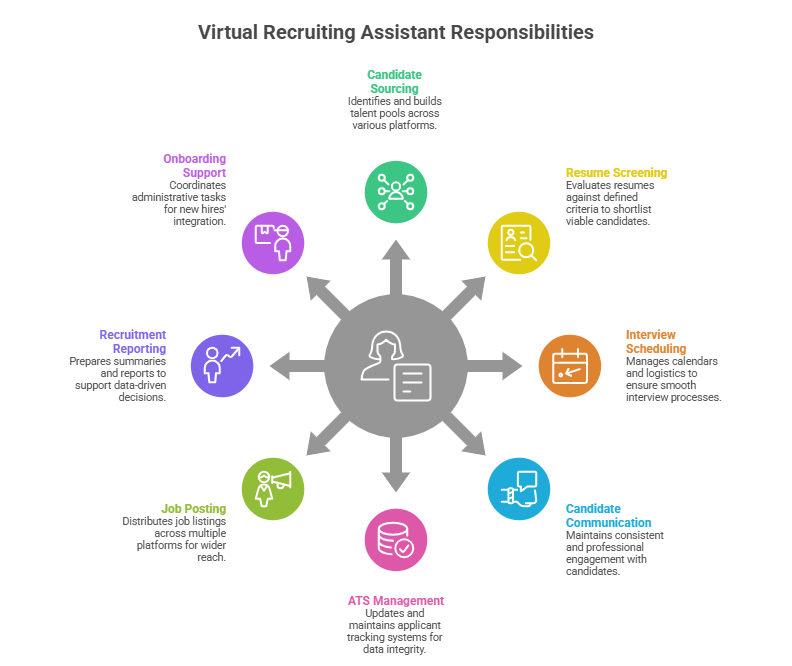
Recruitment is a sequence of interdependent activities, many of which are time-intensive but not decision-critical. A remote recruiting assistant focuses on these operational layers to maintain pipeline continuity and prevent process bottlenecks. Their responsibilities span sourcing, coordination, communication, and data maintenance — functions that directly influence hiring velocity.
1. Candidate Sourcing and Research
A virtual assistant for talent sourcing proactively identifies prospective candidates across platforms, databases, and professional networks. They build structured talent pools by collecting, organizing, and validating candidate information relevant to defined hiring criteria. A LinkedIn virtual assistant is particularly more effective in passive candidate discovery, where precision search and profiling are essential.
2. Resume Screening Support
A virtual assistant for candidate screening evaluates resumes against recruiter-defined filters such as skills, experience, certifications, and role alignment. They shortlist viable profiles while systematically excluding irrelevant applications, preserving recruiter focus for high-value interactions. This structured screening layer improves consistency, reduces cognitive load, and accelerates early-stage evaluations.
3. Interview Scheduling and Coordination
A virtual assistant for interview scheduling manages calendar logistics, availability conflicts, confirmations, and rescheduling cycles across stakeholders. Recruitment timelines often degrade due to scheduling friction, making coordination a high-impact function. Dedicated scheduling oversight reduces delays, prevents candidate drop-offs, and stabilizes hiring workflows.
4. Candidate Communication and Follow-Ups
Candidate engagement requires timely, professional, and structured communication across multiple touchpoints. A virtual assistant for recruiters ensures consistent follow-ups, interview instructions, and status updates without gaps. Reliable communication management improves candidate perception, strengthens employer branding, and reduces ghosting incidents.
5. Applicant Tracking System (ATS) Management
ATS integrity directly influences recruitment visibility, reporting accuracy, and decision confidence. A virtual recruiting assistant services provider routinely updates candidate records, tracks application stages, logs interactions, and corrects data inconsistencies. Clean, current data enables recruiters and HR leaders to evaluate pipelines with precision.
6. Job Posting and Listing Management
Job distribution requires monitoring multiple platforms, maintaining description accuracy, and tracking source performance. A virtual assistant for recruitment manages postings, updates listings, and ensures consistency across channels. This structured dissemination approach expands candidate reach while preserving brand alignment.
7. Recruitment Reporting and Documentation
Recruitment decisions rely on structured metrics, not intuition alone. A dedicated recruiting virtual assistant prepares pipeline summaries, hiring reports, and tracking documentation to support operational oversight. Standardized reporting improves forecasting, workload planning, and stakeholder communication.
8. Onboarding Coordination Support
Early onboarding involves documentation collection, scheduling dependencies, and compliance workflows. A virtual recruiting assistant for HR teams helps coordinate forms, communication, and preliminary administrative steps. This reduces transition friction and supports smoother integration for new hires.
Skills Required for a Virtual Recruiting Assistant

An effective virtual recruiting assistant USA professional requires a blend of communication proficiency, recruitment literacy, and systems competence. They must understand hiring workflows, candidate lifecycle stages, and recruiter expectations across sourcing and screening processes. Precision, responsiveness, and structured coordination are foundational attributes rather than optional advantages.
A US-based virtual recruiting assistant often brings familiarity with regional hiring norms, professional etiquette, and platform behaviors relevant to American recruitment ecosystems. Technical fluency with ATS platforms, scheduling tools, and candidate databases is essential for maintaining operational accuracy. Analytical attention to detail, data management discipline, and basic resume evaluation capabilities collectively define performance reliability.
Benefits of Hiring a Virtual Recruiting Assistant
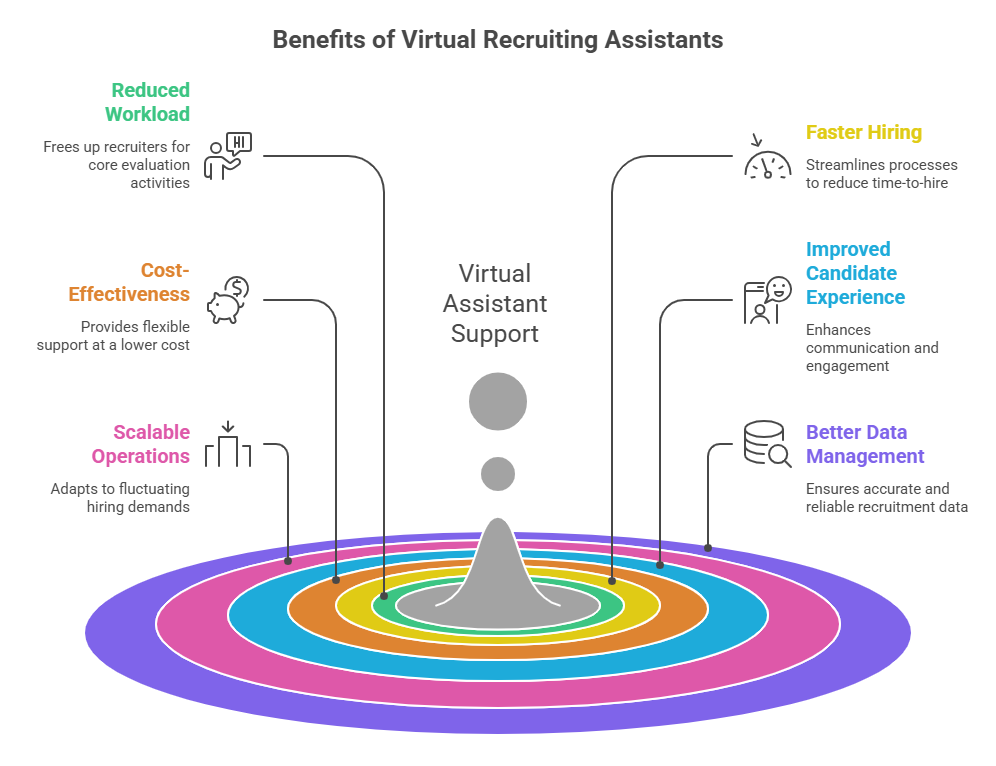
Recruitment inefficiencies rarely stem from strategic failures; they usually originate from operational overload. An affordable VA for recruiting addresses these process constraints by stabilizing coordination layers and reducing administrative drag. The resulting improvements manifest in recruiter productivity, hiring speed, and candidate experience.
1. Reduced Recruiter Workload
Recruiters spend substantial time on coordination, follow-ups, and system updates rather than core evaluation activities. A virtual assistant for recruiters absorbs repetitive operational responsibilities, allowing recruiters to prioritize interviews and stakeholder collaboration. This shift improves cognitive efficiency and decision quality.
2. Faster Hiring Cycles
Hiring velocity depends on eliminating process bottlenecks across sourcing, screening, and scheduling. A virtual assistant for interview scheduling and sourcing coordination ensures pipeline continuity without delays. Reduced friction directly correlates with shorter time-to-hire metrics.
3. Cost-Effective Recruitment Support
Expanding internal teams introduces salary, infrastructure, and overhead obligations. A hire virtual recruiting assistant strategy provides flexible operational capacity at a fraction of traditional staffing costs. This model supports budget optimization while preserving recruitment effectiveness.
4. Improved Candidate Experience
Candidate perception is shaped by responsiveness, clarity, and consistency of communication. A virtual recruitment assistant maintains structured interactions that prevent confusion and disengagement. Positive candidate experience strengthens employer reputation and acceptance rates.
5. Scalable Hiring Operations
Recruitment demand fluctuates based on growth cycles, seasonality, and market dynamics. A remote recruiting assistant model enables rapid scaling without structural disruption. Organizations adjust support levels based on real-time hiring requirements.
6. Better Data and Pipeline Management
Recruitment visibility depends on accurate, current, and structured data. A dedicated recruiting virtual assistant preserves ATS integrity and reporting reliability. Clean data improves forecasting, resource allocation, and performance analysis.
Virtual Recruiting Assistant vs In-House Recruiting Staff
| Aspect | Virtual Recruiting Assistant | In-House Staff |
|---|---|---|
| Cost | Lower | Higher |
| Flexibility | High | Limited |
| Scalability | Easy | Difficult |
| Overhead | Minimal | High |
| Hiring Speed | Fast | Slower |
Many companies adopt hybrid hiring models.
Who Should Hire a Virtual Recruiting Assistant?

Recruitment agencies, staffing firms, and search consultancies benefit significantly from a virtual recruiting assistant for staffing agencies model, particularly in high-volume sourcing environments. HR departments facing workload spikes often rely on a virtual recruiting assistant for HR teams to stabilize coordination layers. Startups experiencing rapid scaling cycles gain agility by integrating remote recruitment support.
Small organizations with limited internal HR capacity frequently adopt a virtual recruiting assistant for a small business strategy to maintain hiring momentum. Businesses requiring targeted sourcing often leverage a virtual recruiting assistant for LinkedIn sourcing to access passive talent pools. Across sectors, any organization managing structured hiring pipelines can extract measurable value from virtual recruitment support.
TaskVirtual: Virtual Recruiting Assistant Services Designed for Modern Hiring

Recruitment operations demand precision, responsiveness, and structured execution, particularly when hiring volumes increase or pipelines become complex. TaskVirtual supports recruiters, staffing firms, and HR departments by delivering specialized virtual recruiting assistant services that reduce coordination burdens and stabilize workflows. By combining sourcing assistance, scheduling management, and recruitment administration support, TaskVirtual enables organizations to maintain hiring velocity without expanding internal headcount.
1. Recruitment Workflow Support and Optimization
TaskVirtual assistants help organizations streamline sourcing, screening, coordination, and pipeline tracking activities. They operate within existing recruitment systems, ensuring minimal disruption to established hiring processes. This structured operational support reduces recruiter overload while improving process continuity.
2. Affordable and Flexible Pricing
TaskVirtual provides cost-efficient recruitment assistance without the financial commitments associated with full-time staffing. With pricing plans starting from just $3.12/hour to $14.99/hour, businesses gain predictable and scalable support options. This flexibility allows organizations to align recruiting assistant costs with actual hiring demand.
3. End-to-End Recruitment Coordination
TaskVirtual assistants contribute across multiple operational layers, including candidate sourcing research, interview scheduling, and ATS updates. Their involvement helps maintain pipeline accuracy while preventing administrative bottlenecks. This integrated support structure strengthens overall recruitment efficiency.
4. Continuous Administrative and Communication Support
TaskVirtual professionals assist with candidate follow-ups, scheduling updates, and recruitment documentation tasks. Consistent coordination minimizes delays and reduces candidate disengagement risks. This reliability directly improves hiring experiences for both recruiters and applicants.
5. Proven Service Reliability
With 364 positive reviews and a 4.7-star rating across recognized virtual assistant platforms, TaskVirtual demonstrates consistent service quality. Clients leverage TaskVirtual to stabilize recruitment operations, enhance responsiveness, and manage high-volume hiring environments. The track record reflects operational dependability rather than isolated performance outcomes.
Final Answer: What Is a Virtual Recruiting Assistant?
A virtual recruiting assistant is a specialized remote professional who supports recruitment operations through sourcing, screening, coordination, interview scheduling, ATS management, job posting oversight, reporting, and onboarding support. They function as an operational force multiplier, reducing recruiter workload while improving process consistency and hiring efficiency. Organizations leveraging virtual recruiting assistant services gain scalable capacity, faster hiring cycles, and stronger candidate engagement without the financial and administrative constraints of expanding internal teams. As recruitment complexity increases across industries, the virtual recruiting assistant’s cost advantage and structural flexibility make this model an increasingly strategic workforce decision.
FAQ: Virtual Recruiting Assistant
1. Can a virtual recruiting assistant source candidates?
Yes. Candidate research and sourcing are common tasks.
2. Is hiring a virtual recruiting assistant cost-effective?
Yes. It significantly reduces recruitment overhead.
3. Do virtual recruiting assistants screen resumes?
Yes, based on recruiter-defined criteria.
4. Can startups benefit from recruiting assistants?
Yes. Startups often benefit the most due to rapid hiring needs.
5. Do virtual recruiting assistants replace recruiters?
No. They support recruiters rather than replace them.
 Siddhartha Basu is a Technical Writer at Task Virtual. He loves online games, e-book reading, and Yoga.