Contents
show
How to Master Task Management and Workflow Automation with CRM
In today’s fast-paced American business environment, effective CRM task management and workflow automation are essential to staying competitive. Sales teams handle high volumes of interactions daily, making organized systems critical. CRM with workflow management helps companies respond faster and scale efficiently.
With AI integration accelerating in 2026, predictive task prioritization is reshaping operations, with 83% of teams using AI reporting revenue growth. This guide provides practical insights to help you excel at CRM task management & workflow automation.
Why CRM Task Management Matters in 2026
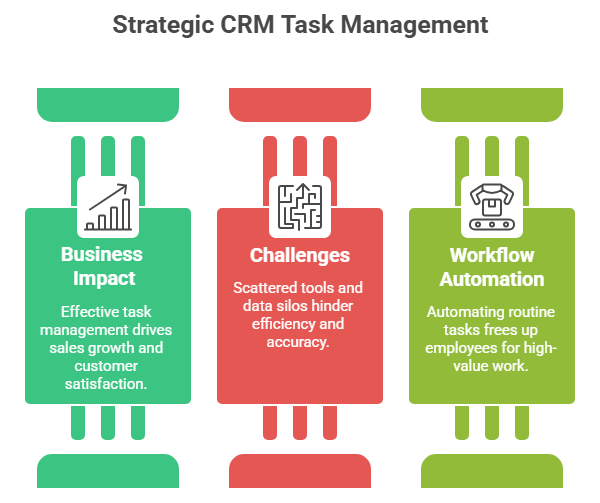
Effective CRM task management, combined with workflow automation, is a game-changer for American businesses seeking sustainable growth. Companies that implement these systems gain better visibility into customer interactions while reducing operational friction. As remote and hybrid work models continue, streamlined task processes have become more important than ever for maintaining team alignment.
1. The Business Impact of Strong Task Management
Effective crm task management directly influences key performance indicators across sales, marketing, and customer service departments. Organizations with strong task systems experience a 29% increase in sales and see sales cycles shorten by 8-14% through systematic follow-up and tracking. These improvements create compounding effects that enhance overall business performance and customer satisfaction levels.
2. Common Challenges Without Proper Systems
Many American businesses still rely on scattered emails, spreadsheets, and disconnected tools. This fragmentation causes an estimated 57% of employee time spent on communication alone, much of it redundant. Data silos result in incomplete customer views, with 76% of organizations reporting that less than half their CRM data is accurate and complete.
3. How Workflow Automation Changes the Game
Crm workflow management automates routine sequences, such as lead assignment, follow-up emails, and status updates. Automation reduces repetitive tasks, freeing teams for high-value work. Businesses implementing crm and workflow management see employee productivity improvements and up to 30% time savings for many workers.
Choosing the Right CRM for Task Management and Automation
Selecting the ideal CRM platform forms the foundation for successful task management and workflow automation. The right choice aligns with your business size, industry, and specific operational needs while supporting future growth, with companies making aligned selections seeing up to 62% higher sales revenue.
- Modern CRMs should offer native task boards, automated triggers, and strong integration capabilities.
- Mobile access and real-time notifications keep teams productive on the go.
- AI-powered suggestions and customizable dashboards improve user experience.
- Salesforce excels for enterprises, while HubSpot suits smaller teams.
- Zoho CRM provides affordable and robust crm task management features.
- Scalability and seamless tool connections support business growth.
Setting Up Effective CRM Task Management
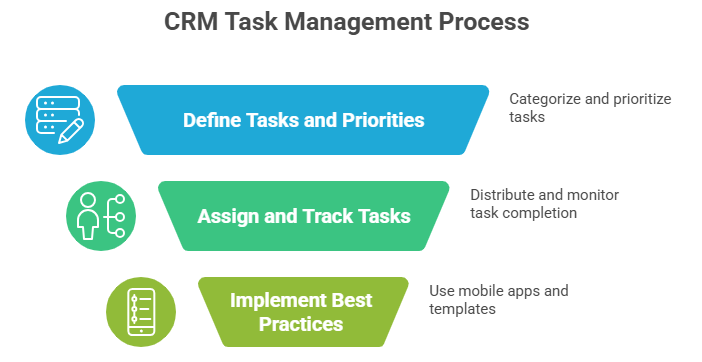
Implementing strong CRM task management requires thoughtful planning and consistent execution across your team. A well-designed setup creates clear accountability while reducing manual oversight needs. This foundation enables smoother daily operations and better customer experiences overall.
1. Defining Tasks and Priorities
Begin by thoroughly categorizing all customer-related activities into clear groups, such as follow-ups, meetings, data entry, and reporting requirements. Using priority matrices within your CRM helps align daily tasks with broader business objectives and individual roles. This structured approach ensures important activities receive proper attention while preventing less critical items from consuming excessive time.
2. Assigning and Tracking Tasks
Role-based task assignment prevents bottlenecks and distributes workload more evenly across team members. Real-time dashboards provide instant visibility into completion rates, potential delays, and overall progress metrics. Regular performance reviews maintain accountability while allowing managers to offer support without resorting to micromanagement practices.
3. Best Practices for Daily Use
Daily check-ins through mobile CRM apps help teams maintain momentum and address issues promptly. Standardizing task templates for recurring activities promotes consistency and reduces setup time across different departments. Encouraging mobile usage proves especially valuable, as 65% of salespeople using mobile CRM meet their quotas more consistently.
Implementing Workflow Automation in Your CRM
CRM workflow management by a virtual assistant handling CRM transforms manual processes into efficient, automated sequences that save significant time and reduce errors. Proper implementation requires careful mapping of existing procedures before configuring automated steps. This strategic approach ensures automation supports rather than disrupts your current operations.
- Map current processes to identify repetitive tasks suitable for automation.
- Configure triggers and actions to build reliable automated sequences.
- Test workflows thoroughly with sample data before full rollout.
- Train team members on working with the new automated processes.
- Monitor performance and gather feedback for necessary adjustments.
- Expand automation gradually as the team gains confidence.
Measuring Success and ROI
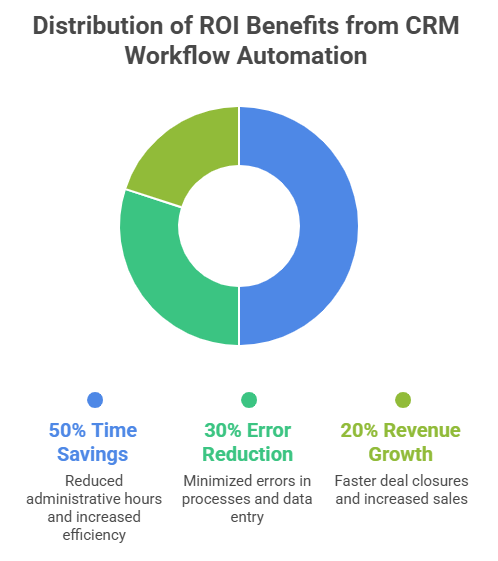
Tracking results from your CRM task management and workflow automation efforts ensures continuous improvement and justifies the investment. Clear metrics help identify what works well and where additional optimization may be needed. Regular evaluation keeps your systems aligned with evolving business goals and market conditions.
1. Key Performance Metrics (KPIs)
Key metrics should include task completion rates, average response times to customer inquiries, and overall conversion improvements. Pipeline velocity and customer satisfaction scores typically rise noticeably when crm with workflow management functions is used effectively. Monitoring these indicators provides actionable insights for ongoing refinement of your automation strategies.
2. Calculating ROI
Workflow automation by paid online marketing delivers 200-300% ROI within the first year through substantial time savings and error reduction. Factor in both direct benefits, like reduced administrative hours, and indirect gains, such as higher revenue from faster deal closures. Comprehensive calculations should account for implementation costs alongside long-term productivity improvements across teams.
3. Tools for Analytics and Reporting
Built-in CRM dashboards offer immediate visibility into performance trends and automation effectiveness. Integration with dedicated business intelligence tools provides deeper analytical capabilities for complex reporting needs. Regular audits of these analytics help teams identify optimization opportunities and maintain system efficiency over time.
Overcoming Common Implementation Challenges

Successful CRM task management adoption requires proactive attention to common obstacles that many American businesses encounter. Addressing these challenges early increases the likelihood of smooth AI implementation by virtual assistants and higher user engagement. Strategic planning helps minimize disruption while maximizing long-term value.
- Use training programs and champions to boost user adoption rates.
- Implement regular data cleansing and validation rules early on.
- Start simple and expand customization gradually over time.
- Budget for ongoing maintenance and system updates.
- Test integrations thoroughly before full deployment.
- Provide clear documentation to help teams resolve issues.
Future Trends in CRM Task Management and Automation
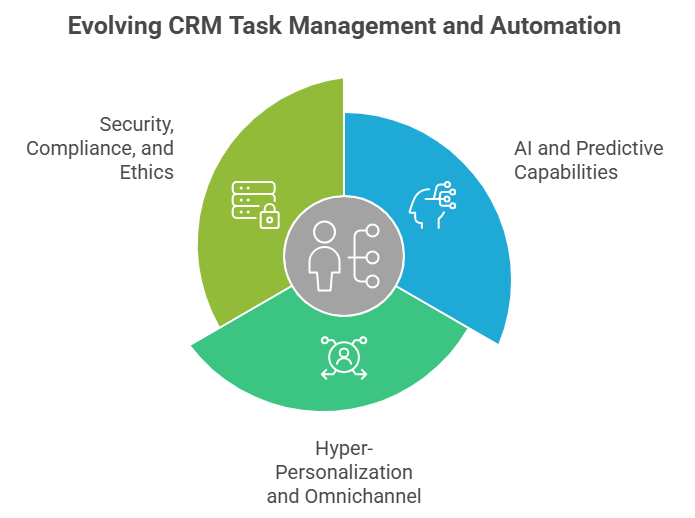
The landscape of CRM task management & workflow automation continues evolving rapidly with new technologies shaping future capabilities. American businesses that stay ahead of these trends gain significant competitive advantages in efficiency and customer experience. Understanding emerging developments helps with strategic planning and technology investments.
1. AI and Predictive Capabilities
AI will increasingly predict task urgency and recommend optimal workflows based on historical patterns and current conditions. Generative AI tools will assist in creating personalized follow-up content and suggestions automatically. These capabilities reduce manual planning time while improving decision quality across sales and service teams.
2. Hyper-Personalization and Omnichannel
Automation will enable seamless experiences across multiple channels, including email, phone, social media, and in-person interactions. Customers increasingly expect quick, highly personalized responses tailored to their specific preferences and history. Advanced systems will coordinate these touchpoints automatically while maintaining consistent messaging and service quality.
3. Security, Compliance, and Ethics
Growing regulations make automated compliance checks and detailed audit trails essential for many industries. Security features will continue advancing to protect sensitive customer data within automated workflows. Ethical considerations around AI usage will require careful attention to maintain transparency and trust with customers.
Case Studies: Real American Business Successes
A Midwest retail chain successfully automated lead nurturing and task reminders within its CRM system. This implementation dramatically reduced response times while improving conversion rates across their stores. Team members reported higher job satisfaction due to fewer manual administrative tasks. The business achieved measurable revenue growth within the first year of adoption.
A larger enterprise on the East Coast implemented sophisticated CRM workflow management across multiple departments. They achieved over 50% reduction in manual processes through intelligent automation. Deal closure times shortened significantly while team morale improved due to a more strategic work focus. These changes contributed to stronger competitive positioning in their market.
How Virtual Assistants Help with CRM Task Management & Workflow Automation

Virtual assistants can bridge the gap between complex CRM tools and practical daily execution for American businesses. They provide expert support that accelerates setup and ensures consistent use of CRM task management and workflow automation without adding full-time overhead.
- Virtual assistants help configure task boards, set up automated triggers, and integrate your CRM and essential business tools.
- They manage daily task assignments, track progress, and maintain accurate customer data to prevent errors.
- Skilled VAs create and optimize workflows for lead nurturing automation, follow-ups, and reporting processes.
- They offer ongoing training to your team and troubleshoot issues to keep automation running smoothly.
- Virtual assistants monitor performance metrics and suggest improvements to boost overall efficiency.
- They handle repetitive updates and data entry, freeing your core team for high-value customer work.
TaskVirtual: Your Partner in CRM Task Management & Workflow Automation

Managing CRM tasks, setting up workflows, and maintaining automation processes can feel overwhelming for busy American businesses. From configuring complex rules to ensuring consistent data accuracy, these responsibilities often pull focus from core growth activities. TaskVirtual provides expert virtual assistants for CRM handling that simplifies CRM task management and workflow automation, helping teams stay organized and efficient.
1. Expert CRM Consultation and Setup
TaskVirtual’s skilled virtual assistants help select the right CRM platform, design custom task structures, and build automated workflows tailored to your sales and customer service needs. They assist with lead routing, task prioritization, and integration setup to ensure smooth daily operations.
2. Affordable and Flexible Pricing
Hiring a full-time CRM specialist can be expensive, but TaskVirtual makes it cost-effective. With pricing plans starting from just $3.12/hour to $14.99/hour, their services are budget-friendly and accessible to small businesses and growing enterprises alike.
3. Comprehensive Workflow Automation Solutions
From mapping processes and creating automated sequences to managing task assignments and reporting dashboards, TaskVirtual covers it all. Their scalable support adapts whether you need one-time setup help or ongoing crm and project management assistance.
4. Ongoing Support and Quality Assurance
TaskVirtual provides continuous monitoring, performance tweaks, and proactive updates to keep your CRM running smoothly. Their dedicated support ensures tasks are completed on time, workflows function reliably, and your team experiences minimal disruptions.
5. Proven Track Record of Excellence
With 364 positive reviews and a 4.7-star rating on trusted VA platforms, TaskVirtual is recognised as a reliable partner worldwide. Clients count on their expertise to streamline CRM task management and drive real business efficiency.
FAQ Section
1. What is CRM task management?
It refers to the processes and tools within a CRM for creating, assigning, tracking, and completing customer-related tasks efficiently.
2. How does workflow automation benefit CRM users?
It streamlines repetitive processes, reduces errors, saves time (often 30%+ for employees), and improves consistency.
3. Which CRM is best for workflow automation?
Salesforce, HubSpot, and Zoho offer strong capabilities, depending on business size and budget.
4. How long does it take to see ROI from CRM automation?
Many businesses see returns within 6-12 months, with full benefits emerging over 1-2 years.
5. Can small businesses afford CRM task management tools?
Yes. Many platforms offer scalable pricing with free tiers or low-cost starters suitable for U.S. SMBs.
6. What are the risks of poor CRM workflow management?
Missed opportunities, data inaccuracies, frustrated teams, and lost revenue—37% of users report revenue loss from poor data.
Conclusion
Mastering CRM task management and workflow automation positions your business for sustainable growth in 2026 and beyond. By implementing structured tasks, intelligent automations, and continuous optimization, American companies can achieve higher productivity, better customer experiences, and impressive revenue gains.
Start small: audit your current processes, select the right CRM, and automate one high-impact workflow this week. The results will compound over time.
CTA: Ready to transform your operations? Explore leading CRM platforms today or consult with a specialist to build a customized crm workflow management strategy tailored to your goals. Your future productivity starts now.
Sources
- Salesforce and related industry reports (via aggregated stats).
- Validity CRM Data Management Report.
- Various Statista, McKinsey, and PMI insights on productivity and automation.
For such content, visit our website.
 Siddhartha Basu is a Technical Writer at Task Virtual. He loves online games, e-book reading, and Yoga.