Contents
show
How Does ChatGPT Differ from Waymo AI
In an era where artificial intelligence powers everything from daily conversations to transportation, one question stands out for curious minds: how ChatGPT differs from Waymo AI. These two prominent AI systems represent distinct branches of the technology. Generative AI for language and physical AI for real-world navigation capture the public imagination. Both symbolize innovation from OpenAI and Alphabet’s Waymo.
ChatGPT, launched by OpenAI in late 2022, revolutionized how people interact with machines through natural language. Waymo AI powers Alphabet’s self-driving robotaxis and focuses on safely operating vehicles in complex urban environments. As AI adoption surges across the U.S., with 52% of American adults now using AI large language models like ChatGPT, understanding their core differences is essential. This helps clarify what each excels at, their limitations, and their roles in shaping daily life, work, and safety.
What Is ChatGPT? Core Technology and Capabilities
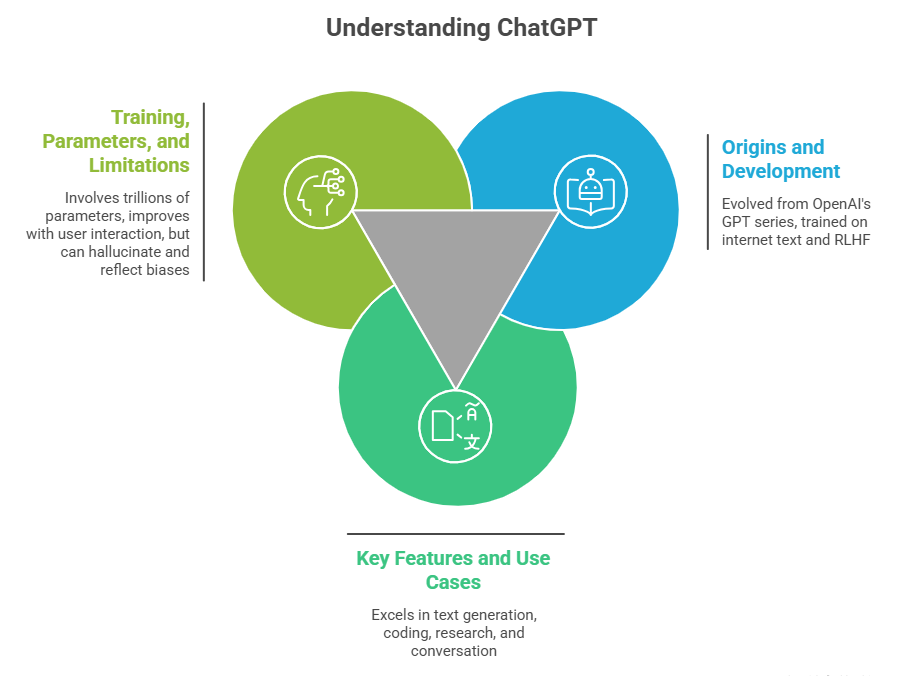
ChatGPT is a leading generative AI model built for natural language understanding and content creation. Unlike autonomous driving systems, this is where ChatGPT differs from Waymo AI, as it focuses on text-based tasks with remarkable fluency and speed. Developed by OpenAI, it serves millions of users seeking instant assistance across personal and professional needs. Its accessibility has made advanced AI tools available to everyday Americans, with 34% of U.S. adults now having used ChatGPT.
1. Origins and Development of ChatGPT
ChatGPT stems from OpenAI’s GPT series of large language models. Trained on vast datasets of publicly available internet text, it predicts and generates human-like responses. Post-training involves reinforcement learning from human feedback (RLHF) to align outputs with helpfulness and safety preferences. By 2026, ChatGPT will boast around 900 million weekly active users, reflecting explosive growth from 100 million shortly after launch.
2. Key Features and Use Cases
ChatGPT excels at text generation, coding assistance, research summarization, creative writing, and conversational tasks. Americans use it for drafting emails, learning skills, analyzing data, and entertainment. Enterprise versions support business workflows, with millions of paying subscribers driving significant revenue. It operates in the digital domain, delivering instant responses without physical interaction or real-time sensor data, making it highly scalable for remote work and education.
3. Training, Parameters, and Limitations
Models like GPT-4o and successors involve trillions of parameters trained on massive text corpora. They improve via user interactions (with opt-out options) but can hallucinate facts, lack true understanding, and reflect training data biases. Updates occur through new model releases rather than continuous real-world embodiment. Ongoing refinements focus on reducing errors while expanding multimodal capabilities for broader American user needs.
What Is Waymo AI? Core Technology and Capabilities
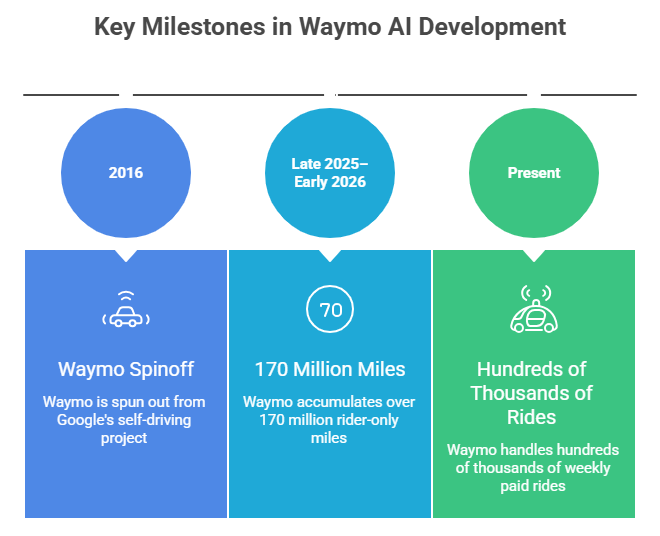
Waymo AI represents advanced embodied intelligence focused on autonomous mobility. It enables fully driverless vehicles to navigate real-world conditions safely and efficiently. Built for physical operation, it prioritizes reliability in unpredictable environments. This technology is transforming urban transportation across select U.S. cities, achieving 85% fewer crashes compared to human-driven vehicles in its operating areas.
1. Origins and Development of Waymo AI
Waymo, spun out from Google’s self-driving project in 2016, develops Level 4 autonomous driving technology. Its AI system—the Waymo Driver—integrates perception, behavior prediction, and planning modules for fully driverless operation in defined areas. By late 2025–early 2026, Waymo had accumulated over 170 million rider-only miles across cities like Phoenix, San Francisco, Los Angeles, and Austin. It now handles hundreds of thousands of weekly paid rides with strong safety metrics.
2. Key Features and Use Cases
Waymo AI powers robotaxis that navigate complex traffic, detect pedestrians, predict behaviors, and make safe decisions in real time. Riders enjoy driverless trips via apps, with applications expanding to delivery and broader mobility. It prioritizes safety-first design in physical environments while providing accessible transportation for older adults, individuals with disabilities, and daily commuters in congested urban areas.
3. Sensors, Planning, and Real-World Operation
Waymo uses LiDAR, radar, cameras, and advanced computing for 360-degree perception. Its planner considers safety as foundational, unlike systems optimizing capability first. It handles edge cases through extensive simulation and real-world data, with remote assistance for rare scenarios. Continuous data collection from millions of miles enables iterative improvements tailored to U.S. urban conditions.
Fundamental Differences: Generative AI vs. Embodied Physical AI

ChatGPT and Waymo AI represent two fundamentally different uses of artificial intelligence. This is where ChatGPT differs from Waymo AI because one works in digital spaces while the other interacts directly with the physical world. Their architectures, training methods, risk profiles, and success metrics reflect these distinct domains. Understanding these differences helps clarify their unique strengths and limitations in 2026.
- ChatGPT works in the digital domain, generating text and code with easy deployment.
- Waymo AI operates in the physical world, where errors risk collisions.
- ChatGPT uses transformer LLMs trained on text data with fast updates.
- Waymo combines deep learning, safety rules, and HD maps for driving.
- ChatGPT succeeds via high user engagement and revenue.
- Waymo achieves 81-92% fewer serious crashes than human drivers.
- Both advance AI along specialized, parallel paths.
Real-World Applications and Societal Impact
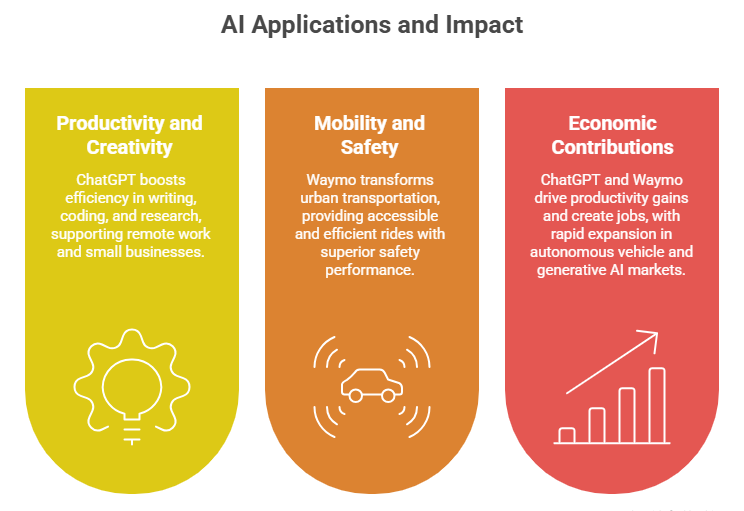
ChatGPT and Waymo AI deliver value in entirely different aspects of American life. Generative tools boost knowledge work while autonomous systems enhance physical mobility and safety. Their combined influence drives economic growth through BPO virtual assistant support and societal changes. Both technologies continue expanding their reach across the United States.
1. Productivity and Creativity: ChatGPT’s Strengths
For U.S. workers and students, ChatGPT improves efficiency in writing, coding, and research. This is where ChatGPT differs from Waymo AI because it supports digital productivity rather than physical transportation. It also helps with remote work, education, and small business tasks through accessible tools. However, its limitations include potential inaccuracies that require human oversight. Many professionals now use it daily to accelerate tasks and enhance creative output.
2. Mobility and Safety: Waymo AI’s Strengths
Waymo transforms urban transportation by providing accessible, sober, and efficient rides. It benefits older people, people with disabilities, and those in congested cities. Safety data indicates superior performance in avoiding high-risk scenarios like intersection crashes. Projections suggest widespread autonomous adoption could save tens of thousands of lives annually in the U.S. by reducing human-error crashes.
3. Economic Contributions
ChatGPT and similar tools drive productivity gains across sectors. Waymo creates jobs in tech, maintenance, and operations while disrupting traditional driving roles. Early data show mixed but positive economic signals in launch cities. Autonomous vehicle markets and generative AI applications continue to experience rapid expansion, with applied AI in vehicles projected to grow substantially.
Technical Challenges and Ethical Considerations
Both ChatGPT and Waymo AI face significant technical and ethical hurdles despite their successes. Issues range from accuracy and safety to privacy and societal effects. Addressing these challenges is critical for a responsible virtual assistant for AI implementation. Public trust and regulatory frameworks will shape their future growth.
- ChatGPT can produce plausible but incorrect hallucinations.
- Waymo errors risk physical harm, managed by safety planning and updates.
- ChatGPT allows training opt-outs but faces misinformation issues.
- Waymo collects sensor data under strict NHTSA privacy rules.
- Both raise biased concerns from training data and geography.
- Regulations are lighter for chat tools, stricter for autonomous vehicles.
- Scalability and high energy use challenge both systems.
The Future: Convergence or Specialization
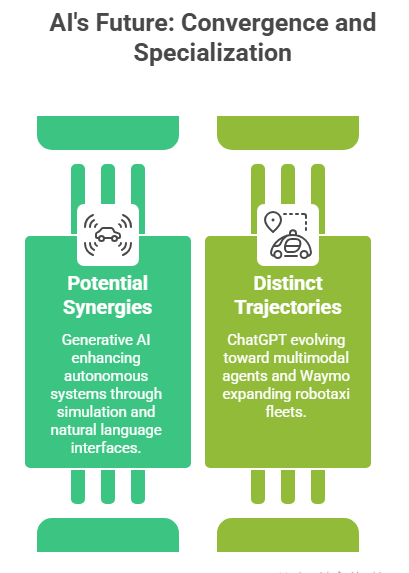
The paths of ChatGPT and Waymo AI point toward continued innovation in AI. Integration opportunities exist alongside their core specialized roles. Future developments like web development and web design trends will likely balance collaboration with distinct evolution. Both will play important parts in advancing American technology and society.
1. Potential Synergies
Generative AI can enhance autonomous systems through better simulation, scenario generation, and natural language interfaces inside vehicles. Waymo and similar platforms may integrate conversational AI for passenger experiences. This cross-pollination could accelerate development and improve user interactions. Such synergies promise more capable and user-friendly autonomous solutions.
2. Distinct Trajectories
ChatGPT will likely evolve toward multimodal agents and deeper reasoning. Waymo AI will expand robotaxi fleets, potentially to more cities, while pushing toward broader operational domains. Both contribute to AI’s overall advancement, but solve different problems. Their specialized progress drives faster innovation in their respective fields.
How Virtual Assistants Help with Artificial Intelligence
AI-powered virtual assistants help everyday users understand advanced AI systems like ChatGPT and Waymo more easily. This is where ChatGPT differs from Waymo AI because users often need different types of support for generative AI and embodied AI. Virtual assistants simplify complex tools, optimize usage, and encourage safe, effective adoption. This human AI collaboration improves productivity while reducing technical frustrations. Their support makes cutting-edge AI more accessible to average Americans.
- Virtual assistants teach effective ChatGPT prompting to improve output and reduce hallucinations.
- They help plan and book safe Waymo rides in supported cities.
- Experts integrate ChatGPT and Waymo into business and personal workflows.
- They track AI updates and ensure ethical, private usage.
- Assistants troubleshoot issues for both language and mobility AI.
- They boost efficiency by combining both tools in daily tasks.
TaskVirtual: Your Partner in AI Assistance Services

Navigating tools like ChatGPT for productivity and Waymo for safe mobility can feel complex. From prompt engineering to integrating AI into daily workflows and planning autonomous rides, users often need expert guidance. TaskVirtual offers specialized AI virtual assistants who help maximize both generative and embodied AI technologies for personal and professional use.
1. Expert AI Tool Consultation and Review
TaskVirtual’s skilled assistants guide users on optimizing ChatGPT for writing, coding, and research while explaining Waymo’s robotaxi features for safe urban travel. They review best practices, create custom prompts, and help integrate AI into workflows.
2. Affordable and Flexible Pricing
Hiring a full-time personal assistant can be expensive, but TaskVirtual makes it cost-effective. With pricing plans starting from just $3.12/hour to $14.99/hour, their services are budget-friendly and accessible to individuals, families, and businesses.
3. Comprehensive AI Support Solutions
From mastering ChatGPT’s capabilities and comparing it with other LLMs to planning efficient Waymo rides and understanding autonomous driving safety, TaskVirtual covers it all. Their scalable services adapt to whether you need occasional help or consistent AI management support.
4. Ongoing Support and Quality Assurance
TaskVirtual provides continuous updates on AI advancements, usage tips, and real-time assistance for both language models and mobility platforms. Their proactive support ensures you get maximum value from tools like ChatGPT and Waymo without confusion or wasted time.
5. Proven Track Record of Excellence
With 364 positive reviews and a 4.7-star rating on trusted VA platforms, TaskVirtual is recognised as a reliable partner worldwide. Clients count on their expertise to simplify AI adoption and streamline everyday tasks.
FAQ Section
1. Can ChatGPT drive a car like Waymo AI?
No. ChatGPT generates text or code but lacks real-time perception, planning, or vehicle control capabilities. Waymo AI is purpose-built for safe physical driving.
2. Which is safer: ChatGPT or Waymo AI?
They address different risks. Waymo demonstrates 80-90%+ reductions in serious crashes versus humans. ChatGPT’s risks involve inaccurate advice rather than physical harm.
3. How many people use ChatGPT vs. ride in Waymo vehicles?
ChatGPT has hundreds of millions of weekly users globally. Waymo serves hundreds of thousands of weekly rides in select U.S. cities, with rapid growth.
4. Do they use the same type of AI?
Both leverage deep learning, but ChatGPT uses transformer LLMs for language, while Waymo combines neural networks with specialized robotics and planning AI for embodiment.
5. Will they merge in the future?
Partial integration is likely—e.g., generative AI for AV simulations or in-cabin assistants—but core functions remain specialized due to different requirements.
6. Which has more economic impact today?
ChatGPT drives broader immediate productivity and revenue across industries. Waymo creates high-value mobility services with strong safety ROI in its markets.
Conclusion
ChatGPT and Waymo AI exemplify AI’s diverse power: one masters language and ideas in the digital realm, the other conquers the complexities of the physical world to move people safely. Understanding how ChatGPT differs from Waymo AI highlights that no single system dominates AI—specialization drives progress. As both evolve, they promise safer roads, enhanced productivity, and new opportunities for Americans.
Sources
- Waymo Official Safety Impact Reports (waymo.com/safety)
- OpenAI and Business of Apps ChatGPT Statistics
- Peer-reviewed studies and NHTSA data referenced via Waymo analyses
- Vox, TechCrunch, and market research reports on AI and AV growth (2025-2026 data)
For more such content, visit our website.
 Siddhartha Basu is a Technical Writer at Task Virtual. He loves online games, e-book reading, and Yoga.