Contents
show
Can I Use An AI Narrator on YouTube Without Losing Monetization
YouTube creators are asking one question more than ever in 2026: Can I use an AI narrator on YouTube? The short answer is yes. However, success requires originality, proper disclosure, and real viewer value. YouTube’s policies target low-effort mass-produced content while supporting thoughtful AI use.
AI narrators deliver fast production, consistent quality, and multilingual options without hiring voice talent. Over 80% of new YouTube creators now use some form of AI in their workflow. Creators who combine AI with strong human input in scripting, editing, and visuals build sustainable channels. Purely automated repetitive setups often face demonetization risks. This guide covers policies, tools, and strategies for American creators
YouTube’s Official Stance on AI Narrators in 2026
YouTube allows AI-generated voices when creators follow Community Guidelines and monetization rules. The platform updated its repetitive content policy in 2025 to address inauthentic mass-produced videos. Disclosure is required for realistic synthetic content. Thoughtful human-guided AI use remains eligible for monetization and YouTube video promotion.
1. Policy Overview and Disclosure Requirements
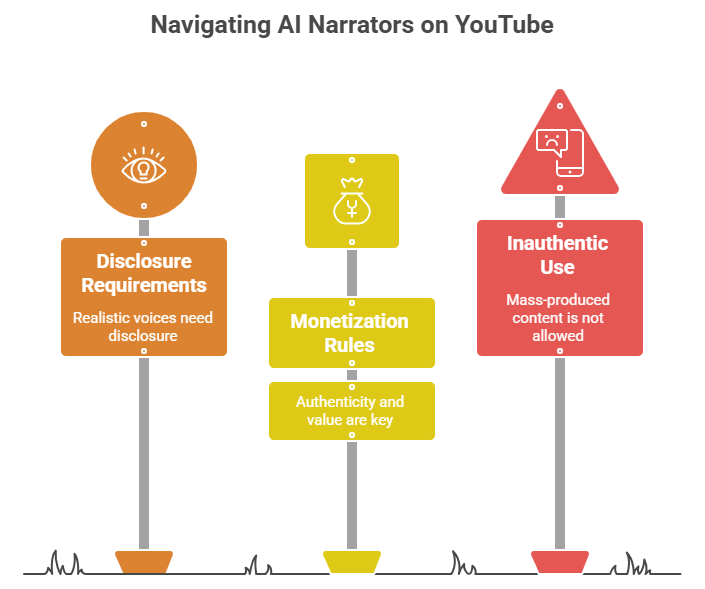
YouTube requires disclosure of altered or synthetic content when realistic, especially voices that could mislead. Use the Studio toggle during upload. Failure to disclose can lead to penalties, while proper disclosure does not block monetization if value is added. Generic AI narration over stock footage without insight is a key enforcement target. Human input in scripting and editing is essential.
2. Monetization Rules for AI-Narrated Content
AI voiceover videos can be monetized in 2026 if they show authenticity and viewer value. Purely automated channels with identical formulas and minimal variation risk demonetization. Successful examples blend AI narration with original research, analysis, custom editing, and niche expertise. YouTube favors content with clear differences between videos and strong human direction.
3. Inauthentic vs. Authentic AI Use
Mass-produced slideshows with robotic TTS over generic B-roll and scraped scripts are not allowed for monetization. In contrast, high-quality AI narration that supports original storytelling, education, or entertainment with strong production value is encouraged and rewarded. The key difference is meaningful human creativity versus template automation.
Benefits of Using AI Narrators on YouTube
AI narrators have transformed content creation for many YouTube channels. They provide professional results quickly and affordably. Creators gain flexibility to test ideas and maintain schedules. According to Adobe’s 2025 Creators’ Toolkit Report, 86% of creators now actively use creative generative AI, showing how widely AI has become part of modern content workflows. Adoption continues to grow as tools improve in realism and features.
1. Speed and Scalability
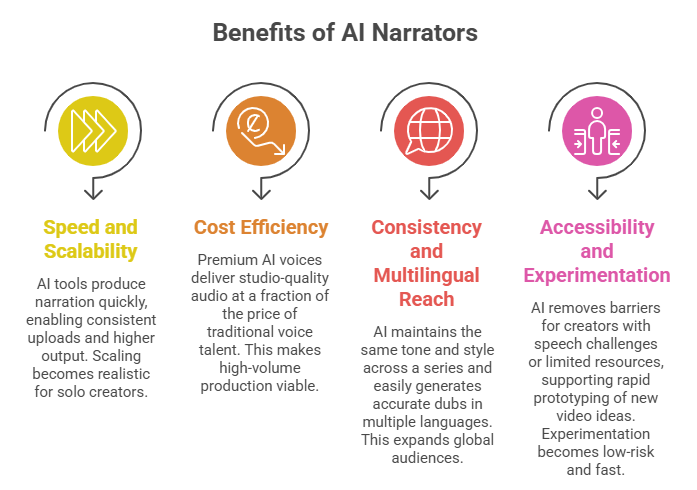
AI tools produce professional narration in minutes instead of hours or days. This enables consistent upload schedules that boost algorithm performance. Many creators achieve 2-3x faster production, allowing higher output without burnout. Scaling becomes realistic for solo creators handling multiple niches or languages.
2. Cost Efficiency
Traditional voice talent costs $100–$500+ per hour. Premium AI voices deliver studio-quality audio at a fraction of the price through affordable subscriptions. This makes high-volume production viable for independent creators and small teams. Budget savings can be redirected to better visuals or marketing.
3. Consistency and Multilingual Reach
AI maintains the same tone and style across an entire series. It easily generates accurate dubs in dozens of languages to expand global audiences. YouTube’s Auto Dubbing complements these capabilities for broader reach. Consistent delivery builds stronger brand recognition over time.
4. Accessibility and Experimentation
AI removes barriers for creators with speech challenges or limited resources. It supports rapid prototyping of new video ideas and niches. Experimentation becomes low-risk and fast. This democratizes high-quality narration for diverse creators.
Top AI Narrator Tools for YouTube Creators in 2026
Several advanced AI voice tools stand out for YouTube production in 2026. They offer realistic emotion, customization, and workflow integration. According to MarketsandMarkets, neural text-to-speech engines and speech synthesis are estimated to hold 49.6% of the AI voice generator market in 2025, highlighting the growing demand for more natural and advanced voice generation. Creators should test options based on their specific niche and style needs.
- ElevenLabs offers ultra-realistic voices with emotion and prosody control.
- Murf AI provides large voice libraries and strong collaboration tools.
- PlayHT excels in custom pronunciation and natural flow.
- Google’s tools and YouTube features support quick dubs and edits.
- Many combine ElevenLabs with editing software for the best results.
- Test multiple tools to match your brand and audience.
How to Create High-Quality AI-Narrated YouTube Videos

Creating standout AI-narrated content requires careful planning and human oversight. Strong scripts and visuals turn AI efficiency into engaging videos. Following best practices helps avoid penalties while maximizing retention and earnings. Proper optimization and transparency build audience trust.
1. Scripting for AI Success
Write natural conversational scripts with varied sentence lengths and rhythm. Include emotional cues, pause markers, and emphasis instructions for better delivery. Avoid overly complex phrasing that sounds robotic. Always review and edit output thoroughly for flow and accuracy before final production.
2. Voice Selection and Customization
Select voices that align with your channel brand and target audience demographics. Adjust stability, clarity, and similarity settings to achieve natural prosody. Ethical voice cloning of your own voice strengthens personal branding. Experiment with multiple options and fine-tune for emotional range.
3. Visuals and Production Value
Pair narration with original footage, custom animations, or properly licensed high-quality stock. Use strong editing, relevant B-roll, graphics, and smooth pacing to maintain interest. Add hooks every 10-15 seconds and vary shot composition. High production standards significantly reduce audience drop-off.
4. SEO Optimization
Optimize titles, YouTube description and hash tag, thumbnails, and chapters with relevant keywords, including “AI narrator YouTube.” Add timestamps and generate accurate closed captions. Research trending topics and long-tail phrases. Well-optimized metadata improves discoverability and ranking potential.
5. Disclosure and Transparency
Toggle the synthetic content label in Studio when required for realistic AI elements. Mention AI assistance openly in descriptions to build trust. Many viewers value efficiency when content delivers clear benefits. Transparency supports long-term channel credibility and compliance.
Common Pitfalls and How to Avoid Demonetization
YouTube actively flags low-effort AI patterns in 2026. Avoiding common mistakes protects monetization and channel health. Focus on originality and consistent quality. Human creativity remains the deciding factor for success.
- Avoid repetitive templates with minimal variation between videos.
- Do not rely on generic TTS over pure stock footage without insight.
- Steer clear of mass uploading low-effort automated content.
- Never clone voices without permission or for misleading purposes.
- Add unique analysis, storytelling, or personal touches.
- Vary formats and topics while monitoring analytics.
Legal and Copyright Considerations
Raw AI-generated audio generally cannot be copyrighted in the US because it lacks sufficient human authorship. However, your complete video—including original scripts, editing choices, selection, and arrangement—can receive protection when human creativity is substantial. Always document your contributions.
Avoid unauthorized cloning of celebrity or personal voices, as this risks privacy violations, claims, and content removal. YouTube supports measures like the NO FAKES Act and provides labeling tools. Stay updated with U.S. Copyright Office guidance on human-AI collaborative works for full compliance.
Real-World Stats on AI and YouTube
Data highlights the scale and opportunities in AI-assisted YouTube creation. Revenue and adoption trends show strong growth. Quality-focused creators benefit most from these tools.
- YouTube generated $36.1 billion in advertising revenue in 2024, up 14.6% year-over-year.
- The platform hosts over 113 million active channels.
- The global AI voice market is expanding rapidly through 2030.
- AI tools enable significant efficiency gains for creators.
- High-quality human-sounding AI improves retention and RPM.
- More creators integrate AI for narration and production.
Measuring Success: Analytics and Optimization
Track key metrics like average view duration, total watch time, audience retention curves, and RPM to gauge performance. AI narration improves consistency but benefits greatly from human emotional touches that boost engagement. Regularly test different voices, styles, and delivery approaches.
Use A/B testing for thumbnail making, titles, and intros to identify what resonates with your audience. Analyze drop-off points and adjust pacing or content depth accordingly. Combine data insights with creative iteration for steady channel growth and higher earnings over time.
How Virtual Assistants Help with AI Narration on YouTube
Virtual assistants streamline AI narration setup and YouTube video editing service for YouTube creators. They bridge the gap between powerful tools and policy compliance. This support helps maintain quality while saving time.
- Virtual assistants select and configure the best AI narrator tools like ElevenLabs for your channel style.
- They write and optimize natural scripts with proper cues for realistic delivery.
- Assistants handle disclosure setup, SEO, and visual pairing to meet YouTube rules.
- They monitor analytics and adjust content to avoid demonetization risks.
- Virtual assistants manage multilingual dubs and consistency across video series.
- They ensure ethical voice use and high production standards for better retention.
TaskVirtual: Your Partner in AI YouTube Narration

Setting up and optimizing AI narration for YouTube channels can be complex and time-consuming. From selecting the right tools to ensuring policy compliance and high production quality, many creators need expert support. TaskVirtual offers specialized AI virtual assistance to help you implement AI narrators effectively while maintaining originality and monetization eligibility.
1. Expert AI Tool Consultation and Setup
TaskVirtual’s assistants help you choose and configure the best AI narrator tools, create natural scripts, and fine-tune voices for professional YouTube results. They ensure proper integration with your workflow and YouTube Studio requirements.
2. Affordable and Flexible Pricing
Hiring a full-time personal assistant can be expensive, but TaskVirtual makes it cost-effective. With pricing plans starting from just $3.12/hour to $14.99/hour, their services are budget-friendly and accessible to individuals, families, and businesses.
3. Comprehensive AI Content Support Solutions
TaskVirtual handles YouTube AI transcription optimization, disclosure setup, visual pairing, and SEO for AI-narrated videos. Their support covers everything from avoiding common pitfalls to building compliant, high-retention content.
4. Ongoing Support and Quality Assurance
TaskVirtual provides continuous monitoring, analytics review, and updates to keep your AI narration strategy aligned with YouTube’s evolving policies and best practices.
5. Proven Track Record of Excellence
With 364 positive reviews and a 4.7-star rating on trusted VA platforms, TaskVirtual is recognised as a reliable partner worldwide. Creators rely on their expertise to simplify AI narration and grow successful YouTube channels.
FAQ Section
1. Will my AI-narrated videos get demonetized?
No, if they add original value, vary across videos, and follow disclosure rules. Mass-produced repetitive content is the main risk.
2. Do I need to disclose AI narration?
Yes, when it creates realistic synthetic content. Use the Studio toggle; labels help transparency without hurting eligibility.
3. What’s the best AI voice for YouTube?
ElevenLabs leads for realism, but test voices suited to your niche. Expressive, natural options perform best.
4. Can I monetize faceless AI channels?
Yes, many do successfully with quality scripting, visuals, and editing. Authenticity and viewer value are key.
5. Is AI narration better or worse for RPM?
High-quality AI often matches or approaches human voices, but flat robotic delivery usually leads to lower retention and earnings.
6. Are there copyright issues with AI voices?
Raw AI output isn’t copyrightable, but your edited video can be. Avoid unauthorized voice cloning.
Conclusion
Using an AI narrator on YouTube in 2026 is not only allowed — it’s a powerful way to scale high-quality content creation when done right. Focus on originality, viewer value, ethical practices, and transparency to build a thriving channel that ranks, engages, and monetizes sustainably.
The future belongs to creators who use AI as a tool to amplify their unique voice and ideas, not replace them. Start experimenting today with premium tools, invest in strong scripts and visuals, and stay up to date with YouTube’s evolving guidelines.
Sources
- YouTube Official: How Creators Use AI (youtube.com/howyoutubeworks/ai/)
- YouTube Monetization Policies (support.google.com/youtube/answer/1311392)
- Industry reports from Business of Apps, Grand View Research, and creator analyses (2025-2026)
- Additional policy and tool references are linked in the text.
For more such content, visit our website.
 Siddhartha Basu is a Technical Writer at Task Virtual. He loves online games, e-book reading, and Yoga.