Contents
show
10 Business Functions You Can Outsource Without Losing Control
American small business owners often find themselves stretched across too many operational details that pull focus from growth and strategy. Between managing daily workflows, responding to customers, maintaining records, and handling outreach, the core work that drives revenue can easily take a back seat. Strategic outsourcing of selected business functions offers a practical path forward, allowing owners to gain specialized capacity while retaining full process ownership, quality standards, and final decision rights.
In 2026, this model has become more accessible through refined tools, remote talent platforms, and proven governance frameworks. Reflecting the scale of this shift, Statista projects the global Business Process Outsourcing (BPO) market to generate $434.99 billion in revenue in 2026. Companies of any size can now hand off routine work in areas such as admin support, customer interactions, financial record-keeping, CRM maintenance, and outreach campaigns without surrendering control. The key lies in choosing the right tasks, documenting clear standards, and installing simple oversight mechanisms that keep accountability internal.
Safe-First Function Criteria for Outsourcing
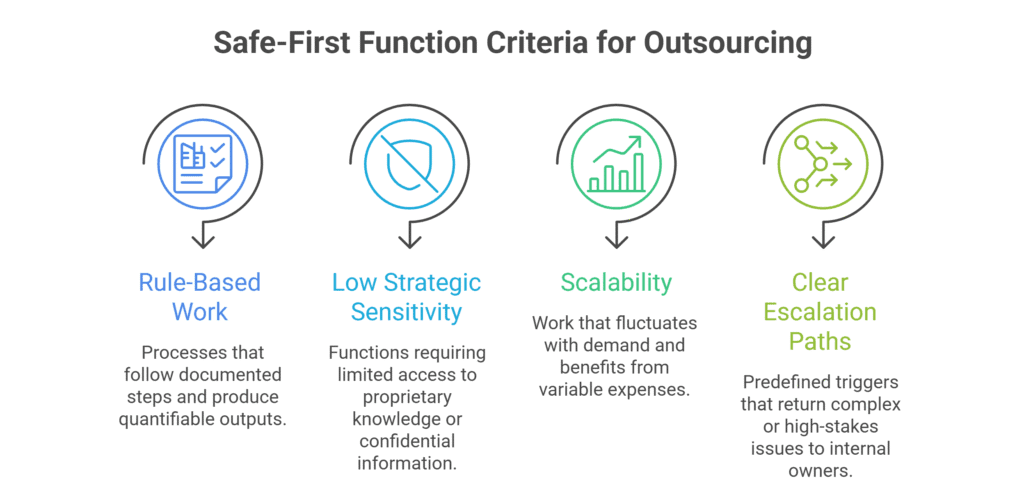
Selecting the right work to move outside the company protects both quality and ownership. Not every task is suitable for external handling, and applying clear filters prevents costly missteps. The following criteria help identify functions that deliver leverage while keeping risk low.
1. Rule-Based and Measurable Work
Processes that follow documented steps and produce quantifiable outputs perform best when outsourced. Tasks such as transaction coding, invoice processing, basic ticket triage, and routine data updates fit this profile because they can be scored against accuracy, volume, and turnaround time. When the work can be captured in a standard operating procedure and reviewed through objective metrics, external teams deliver consistent results and owners maintain clear visibility.
Strategic judgment, product direction, key relationship management, and final pricing decisions remain internal because they lack the same level of predictability. Measuring outcomes weekly in the early stages confirms that quality stays aligned with expectations and allows quick adjustments before issues compound.
2. Low Strategic Sensitivity and Data Risk
Functions that require only limited access to proprietary knowledge or highly confidential information reduce exposure. Operational data, standard customer inquiries, and routine record maintenance can be shared under controlled permissions, while core intellectual property, sensitive financial models, and strategic plans stay inside the company. Proper data classification and access restrictions form the foundation of safe handoffs.
Evaluating the sensitivity of each process before any transfer helps avoid unnecessary risk. Contracts that include clear data-handling clauses and audit rights further protect the business while still enabling external support.
3. Scalability Without Permanent Headcount
Work that fluctuates with demand benefits most from an external model. Seasonal customer volume, campaign-driven content needs, or month-end financial spikes can expand or contract without the fixed cost of additional full-time staff. Converting these areas into variable expenses preserves cash flow and avoids hiring freezes or layoffs during slower periods.
This flexibility supports growth without locking the company into permanent overhead. Owners gain the ability to match capacity to actual workload while keeping long-term headcount focused on core value creation.
4. Clear Escalation Paths
Every outsourced process requires predefined triggers that return complex or high-stakes issues to internal owners. Exceptions above a set dollar amount, unusual customer complaints, or regulatory questions must route quickly to the right decision-maker. Documented escalation matrices remove ambiguity and protect service quality.
Testing these paths periodically confirms that the handoff works under real conditions. Clear ownership of exceptions ensures that external teams never operate beyond their defined scope.
10 Business Functions You Can Outsource
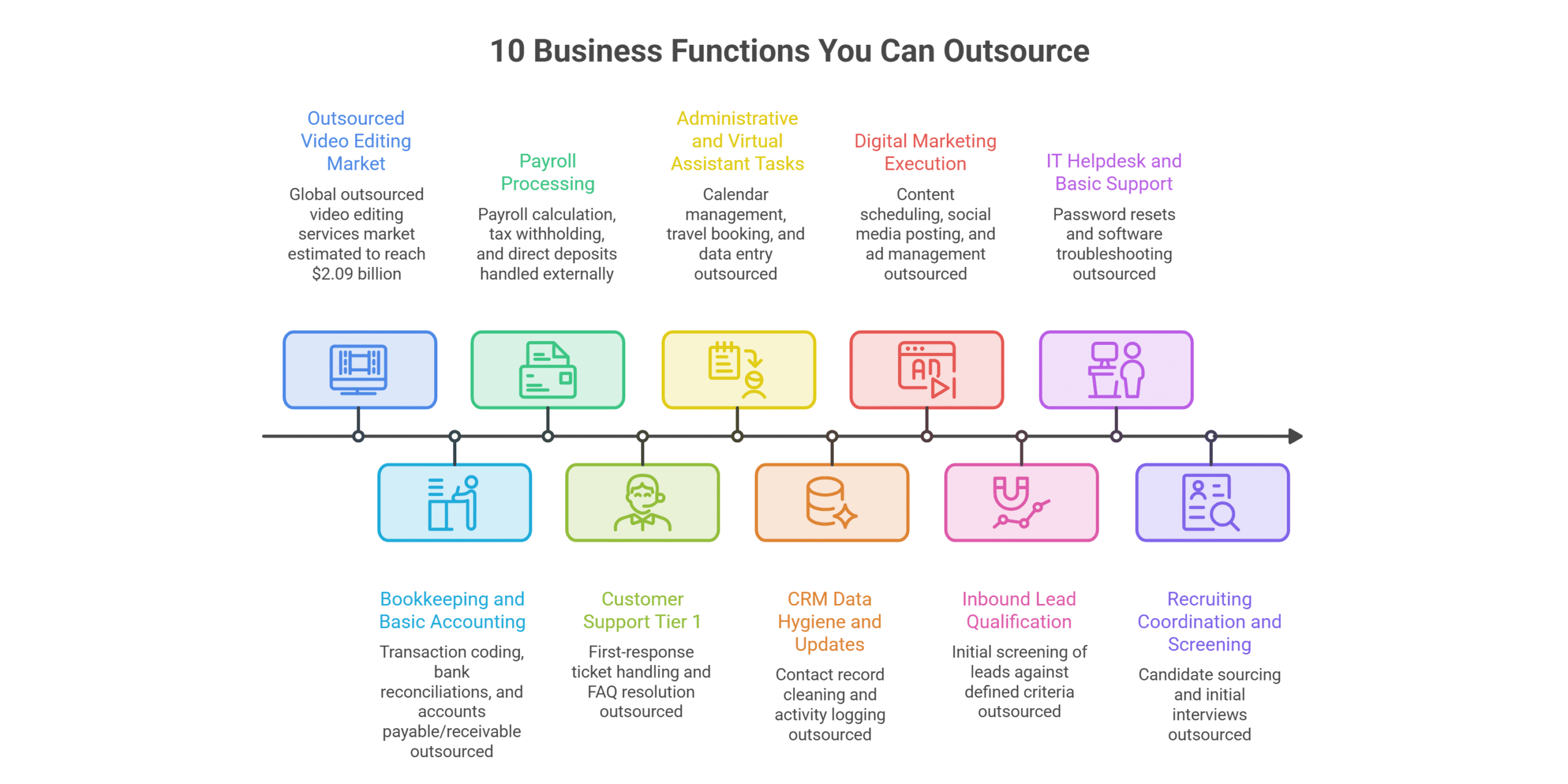
The following ten functions consistently deliver value for U.S. small and mid-sized businesses when governed properly. Each one can be moved outside the company while strategy, approvals, and accountability remain internal. Choosing among them depends on current time sinks and growth priorities.
1. Bookkeeping and Basic Accounting
Transaction coding, bank reconciliations, accounts payable, and accounts receivable follow clear rules and produce measurable outputs. Many small businesses already rely on Bookkeeping Services for these tasks because the work is repetitive and compliance-driven. Keeping final review of financial statements and tax strategy in-house preserves oversight while freeing internal time for analysis and planning.
2. Payroll Processing
Payroll calculation, tax withholding, and direct deposits operate under strict formulas and deadlines. External providers manage volume and regulatory updates while the business retains approval of pay rates and employee changes. This function often serves as a reliable first step because the rules are well defined and outcomes are easy to verify.
3. Customer Support Tier 1
First-response ticket handling, FAQ resolution, order status updates, and basic troubleshooting free internal teams for higher-value interactions. Clear scripts, response-time targets, and escalation criteria for complex or high-value issues keep quality consistent. A Virtual Receptionist can handle initial call screening and routing as part of this layer, ensuring callers reach the right resource quickly.
4. Administrative and Virtual Assistant Tasks
Calendar management, travel booking, data entry, email triage, and document preparation consume significant founder hours. These tasks map cleanly to a Virtual Assistant or Personal Assistant and return time for revenue-generating activity. Priority setting and weekly review stay with the internal manager so direction never drifts.
5. CRM Data Hygiene and Updates
Cleaning contact records, logging activities, updating opportunity stages, and running standard reports keep systems accurate without requiring strategic judgment. Data Handling of this type improves pipeline visibility while sales leaders focus on relationships and closing. Access controls and regular sampling protect information integrity.
6. Digital Marketing Execution
Content scheduling, social media posting, basic SEO updates, email campaign setup, and paid ad management can move outside once strategy and brand guidelines are set. Digital Marketing execution works well when the business retains campaign direction and budget approval. This separation keeps creative and technical work moving while ownership of messaging stays internal.
7. Inbound Lead Qualification
Initial screening of form fills or chat inquiries against defined criteria such as budget, timeline, and fit improves sales efficiency. Qualified leads escalate to internal sales; others are nurtured or closed by the external team. Clear scorecards and rapid escalation protect conversion rates.
8. IT Helpdesk and Basic Support
Password resets, software troubleshooting, device setup guidance, and ticket routing reduce interruptions for internal staff. IT Support Services handle the volume while infrastructure decisions, security architecture, and vendor selection remain internal. This division keeps technical operations stable without expanding permanent headcount.
9. Graphic Design and Content Production
Social graphics, simple landing page assets, blog formatting, and template-based creative work scale effectively with external designers. In 2026, the global outsourced video editing services market is estimated to reach $2.09 billion, reflecting growing demand for external creative production. Video Editing Services can support short-form or campaign content while final creative sign-off remains with the internal owner.
10. Recruiting Coordination and Screening
Sourcing candidates, scheduling interviews, and conducting initial screenings against a scorecard frees HR or founders from volume work. Final interviews and offer decisions remain internal so cultural fit and role requirements stay protected. Structured scorecards keep the process objective and efficient.
SOP, QA, Dashboard, and Escalation Controls That Protect Ownership

Control does not disappear when work moves outside the company; it simply shifts to documentation, measurement, and clear decision rights. Installing these four mechanisms from the start prevents drift and builds confidence. Each element reinforces the others and creates a transparent operating rhythm.
1. Documented Standard Operating Procedures
- Capture every process step, tool, decision tree, and exception in a living document that both parties can reference.
- Version-control the SOPs and require formal acknowledgment of updates so everyone works from the same standard.
- Review and refine the documents quarterly so they remain accurate as tools or requirements evolve.
2. Quality Assurance Sampling and Scorecards
- Sample a set percentage of completed work each week or month and score it against explicit criteria such as accuracy, tone, completeness, and SLA adherence.
- Share scorecards with the provider and discuss trends so improvement becomes collaborative rather than punitive.
- Adjust sampling rates as performance stabilizes, keeping the process efficient while still protective.
3. Real-Time or Near-Real-Time Dashboards
- Provide shared visibility into volume, response times, error rates, backlog, and cost per unit through existing tools or simple reporting views.
- Review the dashboards weekly during the first months, then shift to bi-weekly or monthly once results are consistent.
- Use the data to guide conversations rather than to micromanage individual tasks.
4. Defined Escalation Matrices
- Map every exception type to a named internal owner and a clear response window so complex issues never stall.
- Include high-value customer matters, financial variances above a threshold, and any compliance flags in the matrix.
- Test the paths periodically to confirm that handoffs work under real conditions and update them as roles change.
Start-Small Sequence for Low-Risk Adoption
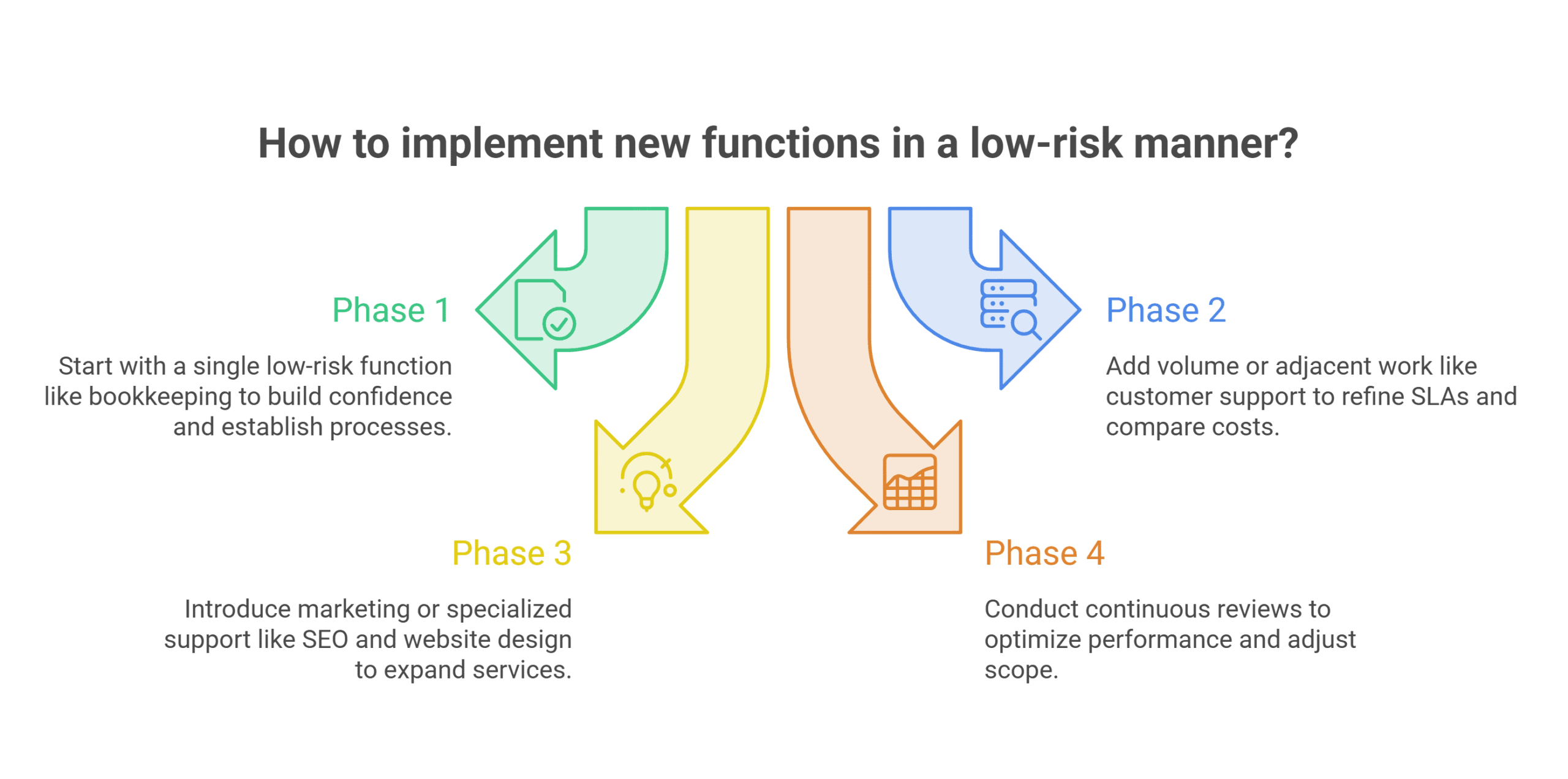
Launching multiple functions at once multiplies complexity and risk. A staged approach builds internal confidence, refines the control system, and creates early wins that justify expansion. The sequence below keeps each phase manageable and measurable.
Phase 1: Single Low-Risk Function (Weeks 1–8)
Begin with bookkeeping or basic admin tasks because they follow clear rules and carry limited customer impact. Document the SOP, establish QA sampling, and set a weekly check-in cadence. Measure time saved and error rates so the results are visible and actionable.
Phase 2: Add Volume or Adjacent Work (Months 3–6)
Once the first function is stable, expand into customer support Tier 1 or CRM hygiene using the same control framework. Compare internal versus external cost and quality side by side. Use the data to refine SLAs and communication rhythms before adding further scope.
Phase 3: Layer Marketing or Specialized Support
With governance proven, introduce Digital Marketing execution elements such as Social Media Marketing, SEO Services, Facebook Marketing, Instagram Marketing, or LinkedIn Marketing & Campaigns while keeping strategy and budget approval internal. Online Marketing Services and Website Design Services or Website Development can also enter at this stage once brand guidelines are firm. Maintain the same dashboard and escalation model so oversight remains consistent.
Phase 4: Continuous Review and Optimization
Hold quarterly business reviews that examine performance data, cost trends, and process improvements. Adjust scope, SLAs, or providers based on evidence rather than assumption. This ongoing rhythm keeps the model efficient as the business grows.
Function-to-Role Map: Who Owns What

Clear ownership prevents confusion and protects decision rights. Mapping each function to an internal accountable party while allowing external execution creates a clean division of labor. The following structure works for most small and mid-sized teams.
- In Bookkeeping / Payroll, the external team executes; the internal finance lead or owner reviews and approves.
- For Customer Support Tier 1, the External agents handle routine tickets; internal customer success or operations owns escalations and policy changes.
- Under Admin / VA tasks, the assistant executes; internal manager or founder sets priorities and reviews weekly.
- CRM hygiene: External data team updates records; sales or operations owns pipeline strategy and stage definitions.
- Marketing execution: External specialists run campaigns; internal marketing owner or founder owns messaging, budget, and performance targets.
- IT helpdesk: External support resolves tickets; internal or fractional technology lead owns architecture and security policy.
- Recruiting coordination: External recruiter sources and screens; hiring manager conducts final interviews and decides.
Additional Considerations for American Small Businesses
Labor market conditions and technology continue to favor flexible models that convert fixed costs into variable ones. In 2026, 34% of U.S. SMBs plan to use external partners for their technology strategy, either through hybrid or fully outsourced models. Smaller firms are adopting the practice as platforms and talent pools mature. Cost savings relative to equivalent full-time hires are common when scope is well defined, though exact figures vary with volume, location, and complexity.
Compliance remains essential. For financial, payroll, and customer-data work, providers must meet relevant U.S. standards and contracts should include data-processing agreements plus audit rights. Regular reviews of access permissions and performance data keep the arrangement secure and effective over time.
TaskVirtual: Your Partner in Controlled Business Function Outsourcing

Handling multiple operational responsibilities in-house can quickly overwhelm small business owners and pull attention away from strategy and growth. From managing routine admin workflows and customer interactions to maintaining accurate records and executing outreach campaigns, the cumulative load often leaves little room for higher-value work. TaskVirtual supports businesses by providing reliable outsourced business solutions for these rule-based functions while preserving clear ownership, documented standards, and final decision rights on the client side.
1. Expert Process Alignment and Oversight
TaskVirtual’s experienced team works within client-defined SOPs and escalation matrices to handle administrative support, basic bookkeeping tasks, CRM updates, and Tier 1 customer interactions. They focus on measurable execution so internal leaders retain full visibility and control over priorities, quality standards, and exceptions.
2. Affordable and Flexible Pricing
Hiring full-time staff for every support role can strain budgets, yet TaskVirtual offers a cost-effective alternative. With pricing plans starting from just $3.12/hour to $14.99/hour, their services remain accessible for small businesses that need scalable help without permanent overhead.
3. Comprehensive Coverage Across Key Functions
From calendar and email management to data hygiene, inbound lead screening, and coordinated marketing execution support, TaskVirtual covers the practical workload that fits the safe-first criteria outlined earlier. Their approach adapts to whether a company needs occasional assistance or consistent capacity across several functions.
4. Ongoing Visibility and Quality Assurance
TaskVirtual emphasizes transparent reporting, regular sampling against agreed scorecards, and proactive updates so clients always know performance levels. This structure supports the dashboard and QA controls that protect ownership while the external team handles day-to-day volume.
5. Proven Track Record of Excellence
With 364 positive reviews and a 4.7-star rating on trusted VA platforms, TaskVirtual is recognised as a reliable partner worldwide. Clients count on their structured approach to free internal capacity while keeping process ownership and decision rights firmly in place.
FAQ
1. What can small businesses outsource first?
Bookkeeping, payroll, or basic admin tasks are the safest starting points because they are rule-based and low customer-facing risk.
2. How do I outsource admin without losing control?
Write clear SOPs, require weekly activity reports or shared dashboards, set approval thresholds, and keep priority-setting internal.
3. Is customer support a good function to outsource?
Yes, for Tier 1 volume work. Keep complex or high-value issues escalated to internal staff and monitor quality through sampling and scorecards.
4. Can I outsource bookkeeping and still stay compliant?
Yes, when the provider follows your chart of accounts, you retain final review rights, and the engagement includes proper data security and audit access.
5. Should I outsource CRM management?
Outsource data entry, hygiene, and routine updates. Keep sales process design, stage definitions, and strategic reporting internal.
6. How much marketing can I outsource?
Execution (content production, scheduling, ad management) works well once brand guidelines and campaign goals are defined. Strategy and budget approval stay with the business owner.
Conclusion and Next Step
Outsourcing selected business functions is no longer a last resort for cash-strapped companies. It is a deliberate operating model that lets American small businesses access specialized capacity, convert fixed costs to variable ones, and reclaim founder time for growth. The difference between success and frustration lies in the controls: clear criteria for what to outsource, documented SOPs, quality sampling, visible dashboards, and unambiguous escalation paths.
Start with one low-risk function this quarter. Document the process, set the metrics, choose a provider that embraces transparency, and measure results. Once the system works, expand deliberately. Control does not require doing everything yourself—it requires owning the standards and the decisions.
If you are ready to map your current time sinks to the ten functions above, begin with a simple audit of hours spent on admin, support, bookkeeping, CRM, and marketing execution. That data will show exactly where outsourcing can free capacity without surrendering ownership.
Sources
- Statista Business Process Outsourcing market outlook
- Capital Counselor / Deloitte-referenced outsourcing statistics 2026
- Clutch and related small business outsourcing surveys
- Industry reports on IT, finance, and marketing outsourcing adoption rates
For more such content, visit our website.
 Siddhartha Basu is a Technical Writer at Task Virtual. He loves online games, e-book reading, and Yoga.