
A legit virtual assistant is a trustworthy, skilled remote professional who delivers consistent, high-quality work, communicates clearly, protects confidentiality, and operates with professional standards. Legitimate VAs are defined by reliability, verified experience, transparent processes, and strong client feedback—not just low pricing or marketing claims.
What Is a Legit Virtual Assistant?

A legit virtual assistant is a genuine remote professional who provides administrative, technical, creative, or operational support while maintaining professional ethics, accountability, and reliability. In the United States, about 22.8% of employees worked remotely at least part of the time remotely as of early 2025 remotely, illustrating the widespread adoption of remote work that fuels demand for remote support roles like virtual assistants. Legitimacy is not determined by geography or pricing; instead, it depends on skills, communication, work quality, and credibility.
A credible remote assistant operates with the discipline and structure expected of any professional service provider. They are not merely task executors but dependable contributors integrated into business workflows. The distinction lies in consistent performance, professional conduct, and verifiable capability rather than promotional claims.
Why Businesses Worry About Hiring a Legit Virtual Assistant
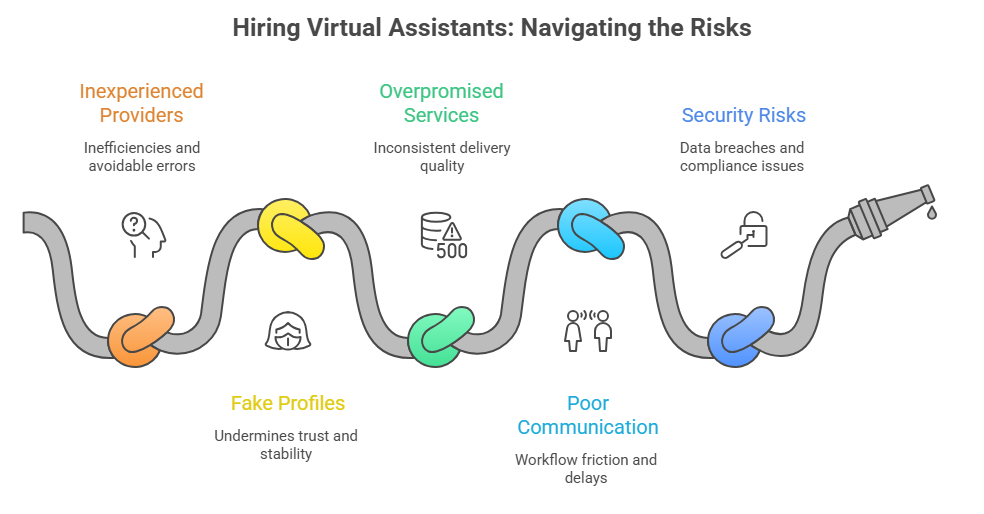
The remote staffing ecosystem has expanded rapidly, creating both opportunity and uncertainty. While many providers deliver excellent results, the market also contains unqualified or misrepresented candidates.
1. Inexperienced Providers
Many individuals offer virtual support without sufficient training or operational exposure. This often results in inefficiencies, avoidable errors, and increased supervision overhead. Businesses seeking legitimate virtual assistant services must assess practical competence rather than relying on self-descriptions.
2. Fake Profiles
Fabricated experience, stock images, and exaggerated credentials remain common risks across freelance marketplaces. Entrust reports that digital forgeries accounted for 57.46% of document fraud cases, underscoring how easily online identities can be manipulated. Verified virtual assistants reduce this risk by maintaining transparent profiles and consistent digital footprints.
3. Overpromised Services
Unrealistic guarantees frequently signal insufficient understanding of workload complexity. Claims of universal expertise typically correlate with inconsistent delivery quality. A reliable virtual assistant defines boundaries, specializations, and realistic outcomes.
4. Poor Communication Practices
Ineffective communication remains one of the primary failure points in remote collaborations. Delayed responses, vague updates, and ambiguous reporting create workflow friction. A trusted virtual assistant maintains clarity, cadence, and professional correspondence standards.
5. Security Risks
Remote work inherently involves access to sensitive systems, documents, and credentials. Inadequate security awareness exposes organizations to data breaches and compliance issues. Trustworthy virtual assistant services emphasize confidentiality protocols and responsible data handling.
Understanding these concerns clarifies why structured evaluation is essential during safe virtual assistant hiring processes.
Key Characteristics of a Legit Virtual Assistant

Professional legitimacy manifests through observable behaviors and operational reliability. These indicators collectively reduce business risk and improve collaboration efficiency. Assessing these traits provides a practical framework for decision-making.
1. Verified Experience and Skills
Competent assistants articulate specific competencies, industry exposure, and tool familiarity. Their expertise descriptions remain precise rather than generalized. A legitimate remote assistant substantiates capability with concrete examples and task-level clarity.
2. Professional Communication
Effective communication reflects organization, precision, and consistency. Timely responses and structured updates indicate workflow discipline. A trustworthy virtual assistant eliminates ambiguity through clear language and defined availability.
3. Transparent Processes and Expectations
Professional providers outline deliverables, timelines, pricing structures, and engagement models. This transparency reduces misunderstandings and misaligned assumptions. An authentic virtual assistant proactively establishes operational boundaries.
4. Positive Reviews or References
Reputation signals reliability within distributed work environments. Testimonials, case studies, and references provide third-party validation. A trusted virtual assistant typically maintains a verifiable performance history.
5. Consistent Work Quality
Dependable output remains a defining credibility marker. Meeting deadlines and maintaining accuracy demonstrates operational maturity. A reliable virtual assistant prioritizes precision, repeatability, and accountability.
6. Confidentiality and Data Security Awareness
Professional assistants recognize the importance of secure access and privacy compliance. Acceptance of NDAs and adherence to data protection norms are baseline expectations. Trustworthy virtual assistant services incorporate security-conscious workflows.
Red Flags That Suggest a VA May Not Be Legitimate
Warning indicators frequently emerge during early interactions or screening phases. Excessive promises, resistance to evaluations, inconsistent communication, and absence of work samples warrant caution. Suspiciously low pricing for complex responsibilities often signals skill-quality mismatches or credibility concerns.
How to Hire a Legit Virtual Assistant

Engaging remote support without structured evaluation increases operational and financial risk. A disciplined hiring process ensures alignment between business needs and provider capabilities. Careful selection improves long-term productivity and collaboration stability.
Step 1: Define Your Task Requirements
Clearly enumerate responsibilities, expected outcomes, and required competencies. Specify tools, platforms, and performance standards relevant to the role. Precision at this stage improves candidate filtering and reduces onboarding friction.
Step 2: Evaluate Experience and Specialization
Prioritize demonstrated expertise aligned with your operational context. Domain familiarity frequently outweighs generic versatility. A verified virtual assistant will present focused strengths rather than broad, unsupported claims.
Step 3: Conduct an Interview or Screening Call
Assess communication clarity, problem-solving orientation, and professionalism. Evaluate responsiveness and comprehension of task scenarios. Interaction quality often predicts collaboration effectiveness.
Step 4: Request Samples or Portfolios
Direct evidence of past work provides objective validation. Examine accuracy, structure, and consistency of outputs. An authentic virtual assistant readily supplies relevant examples.
Step 5: Start With a Paid Trial Period
Short-term engagements reveal reliability, adaptability, and workflow compatibility. Trials reduce commitment risk while validating performance expectations. This step is fundamental to safe virtual assistant hiring strategies.
Step 6: Use Contracts and NDAs
Formal agreements clarify responsibilities, confidentiality, and accountability. Documentation protects both parties and establishes professional boundaries. Legitimate virtual assistant services operate comfortably within contractual frameworks.
Benefits of Hiring a Legit Virtual Assistant
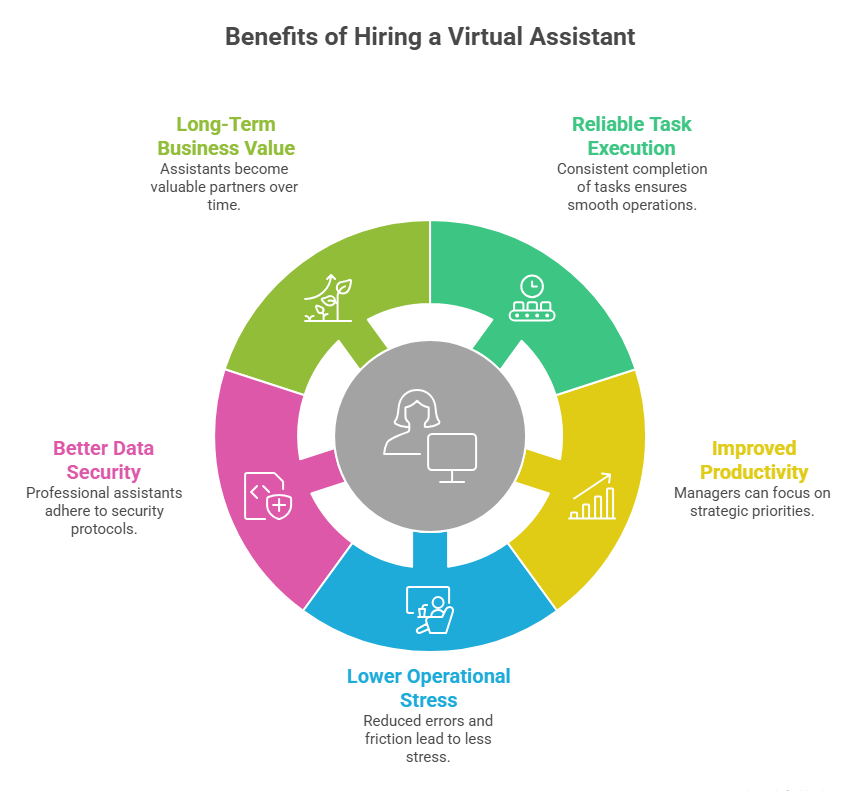
Strategic delegation requires confidence in execution quality and reliability. Professional remote support reduces cognitive load and operational bottlenecks. The value extends beyond cost efficiency toward measurable productivity gains.
1. Reliable Task Execution
Consistent completion of assigned responsibilities stabilizes operational workflows and prevents bottlenecks. Predictable performance reduces the need for constant oversight and corrective intervention, enabling smoother day-to-day execution.
2. Improved Productivity
Effective delegation reallocates managerial attention toward strategic and revenue-generating priorities. Structured assistance accelerates task throughput while preserving accuracy and process continuity.
3. Lower Operational Stress
Dependable support minimizes error cycles, missed deadlines, and coordination friction. Clear communication and reliable execution significantly reduce cognitive and managerial load.
4. Better Data Security Practices
Professional assistants operate with confidentiality awareness and responsible access behaviors. Adherence to defined security protocols lowers organizational exposure to information risks.
5. Long-Term Business Value
High-performing assistants frequently transition into embedded operational partners. Continuity strengthens institutional knowledge retention and process efficiency over time.
Legit Virtual Assistant vs Unverified Freelancer
| Aspect | Legit Virtual Assistant | Unverified Freelancer |
|---|---|---|
| Credibility | High | Variable |
| Communication | Professional | Inconsistent |
| Reliability | Stable | Unpredictable |
| Security Awareness | Strong | Uncertain |
| Work Quality | Consistent | Variable |
Common Myths About Legit Virtual Assistants

Misconceptions often distort hiring decisions and evaluation criteria. Separating assumptions from operational realities improves selection accuracy.
Myth 1: Cheap VAs Are Not Legitimate
Pricing alone does not determine competence or professionalism. Market rates vary by geography, specialization, and business model efficiencies. Many highly capable providers operate within competitive cost structures without compromising quality.
Myth 2: Only Agency-Based VAs Are Reliable
Independent professionals frequently deliver exceptional service quality. Organizational affiliation does not inherently guarantee performance. A US-based legit virtual assistant or global provider should be evaluated using identical credibility standards.
Myth 3: Certifications Guarantee Legitimacy
Credentials do not automatically translate to practical capability. Execution quality, communication discipline, and reliability carry greater weight. A verified virtual assistant demonstrates competence through measurable outcomes rather than documentation alone.
TaskVirtual: Professional Support Backed by Operational Discipline

Modern businesses increasingly depend on remote professionals to maintain efficiency, accuracy, and continuity across daily operations. However, identifying a reliable virtual assistant capable of delivering consistent results requires careful evaluation of credibility, workflow maturity, and communication standards. TaskVirtual positions itself as a structured solution for organizations seeking dependable virtual assistance without the uncertainty commonly associated with freelance hiring.
1. Expert Consultation and Task Evaluation
TaskVirtual’s virtual assistants emphasize understanding client workflows before execution begins. This structured onboarding approach clarifies priorities, tools, and expected outcomes. Businesses benefit from reduced misalignment, clearer delegation, and faster productivity integration.
2. Affordable and Flexible Pricing
Cost efficiency remains a primary consideration when adopting remote support models. TaskVirtual offers scalable pricing structures designed to accommodate varying workload intensities. With plans starting from just $3.12/hour to $14.99/hour, organizations can optimize operational spending without sacrificing service reliability.
3. Comprehensive Virtual Assistance Solutions
TaskVirtual supports a broad spectrum of operational, coordination, and administrative tasks. Services are designed to adapt to both short-term requirements and long-term business processes. This flexibility enables companies to maintain continuity while scaling support as demands evolve.
4. Ongoing Support and Quality Assurance
Consistency and reliability require more than initial task completion. TaskVirtual maintains structured communication, progress visibility, and performance monitoring. This ensures deliverables remain aligned with expectations and deadlines.
5. Proven Track Record of Excellence
Credibility is reinforced through documented client experiences and measurable satisfaction indicators. TaskVirtual holds 364 positive reviews alongside a 4.7-star rating across recognized VA platforms. Such performance metrics signal reliability, professionalism, and sustained client trust.
Final Answer: What Is a Legit Virtual Assistant?
A legit virtual assistant is a trustworthy remote professional who demonstrates verified skills, reliable communication, consistent work quality, transparency, and strong confidentiality practices. Businesses benefit most when they evaluate credibility carefully and implement structured hiring and management processes.
FAQ: Legit Virtual Assistant
1. How can I verify if a virtual assistant is legit?
Review experience, request samples, conduct interviews, and begin with a trial engagement.
2. Are legit virtual assistants expensive?
Cost structures vary widely depending on specialization, region, and scope of responsibilities.
3. Do legit virtual assistants sign NDAs?
Yes. Professional providers typically accept confidentiality and data protection agreements.
4. Can freelancers be legit virtual assistants?
Yes. Legitimacy depends on professionalism, reliability, and demonstrated competence.
5. Should I always start with a trial project?
Yes. Trial phases reduce uncertainty and validate working compatibility.
 Siddhartha Basu is a Technical Writer at Task Virtual. He loves online games, e-book reading, and Yoga.