Contents
show
AI Consulting vs Hiring In-House: What Growing Businesses Need to Know
Artificial intelligence is no longer a futuristic luxury; it is essential. With 88% of organizations using AI in at least one business function in 2025 (up from 78% the prior year), growing businesses face a critical strategic choice: organizations evaluate AI Consulting vs Hiring In-House for speed, cost, and long-term control while making decisions for scalable growth alignment.
This decision impacts everything from time-to-value and costs to innovation and risk management. For SMBs and scaling enterprises, the stakes are high: move too slowly, and competitors pull ahead; commit to the wrong model, and you burn resources without results.
AI consulting offers immediate access to specialized talent, proven frameworks, and cross-industry insights. In-house teams deliver deep business integration and sustained ownership. Many successful organizations choose a hybrid path. This comprehensive guide analyzes both approaches using real-world insights, costs, timelines, and best practices to help growing businesses decide what works for them in 2026.
The Rise of AI Adoption and the Build-vs-Buy Dilemma
Growing businesses are under pressure to adopt AI to stay competitive in a rapidly evolving market while evaluating AI Consulting vs Hiring In-House strategically aligned. This build-versus-buy decision is central to strategic planning as organizations weigh speed against long-term control, shaping resource allocation and risk in digital transformation journey processes.
1. Why AI Implementation Is Urgent for Growing Businesses
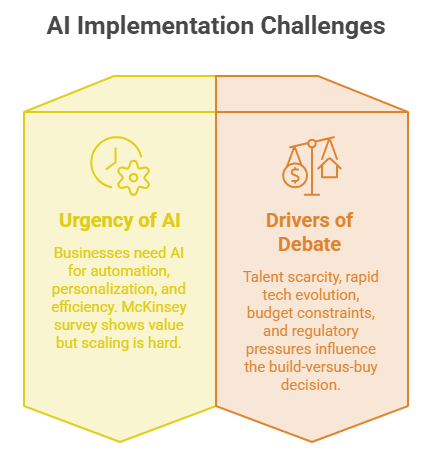
Businesses are racing to integrate AI for automation, personalization, predictive analytics, and efficiency gains. McKinsey’s 2025 State of AI survey highlights that organizations using AI see tangible value, but scaling remains challenging for many. Growing companies often lack the internal bandwidth or specialized skills to deploy AI effectively. Talent shortages exacerbate this as senior AI roles take months to fill and competition for experts is fierce.
2. Key Drivers Behind the Consulting vs. In-House Debate
Talent scarcity and high salaries drive many businesses toward external help since demand for AI professionals outstrips supply. Rapid tech evolution requires ongoing expertise to keep pace with generative AI, agents, and regulations. Budget constraints for SMBs favor flexible ROI-focused solutions over heavy fixed overhead, while regulatory pressures demand specialized knowledge for compliance.
Understanding AI Consulting: External Expertise on Demand
AI Consulting vs Hiring In-House provides growing businesses with flexible access to specialized skills without long-term commitments of full-time hires, while enabling faster AI initiatives and cost-efficient scaling in competitive markets, effectively for a company’s growth.
1. What AI Consulting Typically Involves
- AI consulting firms deliver end-to-end support through workflow automation, including strategy development, readiness assessments, model building, and data pipeline engineering.
- Engagements cover deployment, governance, training, and can be project-based, retainers, or advisory.
- Consultants apply battle-tested methodologies from multiple clients for solutions like chatbots, predictive models, computer vision, or process automation.
- They enable faster implementation by bringing proven frameworks and cross-industry insights directly to the table.
- Quality engagements emphasize knowledge transfer to build internal capabilities over time.
2. Advantages for Growing Businesses
- Speed to value stands out as consultants deliver prototypes in 2-8 weeks and production deployments in 60-90 days.
- Businesses gain immediate access to top talent and best practices without lengthy recruiting delays.
- Cost flexibility allows payment for scoped projects rather than full-time salaries, with typical year-one costs ranging from $200K–$500K.
- Consultants provide objective perspectives that help identify blind spots and ensure compliance with regulations.
- Scalability enables easy adjustment of support levels as business needs evolve.
3. Potential Drawbacks
- Less deep cultural integration occurs initially compared to permanent internal teams.
- Knowledge transfer requires deliberate planning to prevent long-term dependency on external providers.
- Quality can vary across firms, so thorough vetting for proven delivery and industry fit is essential.
Building an In-House AI Team: Long-Term Investment and Control
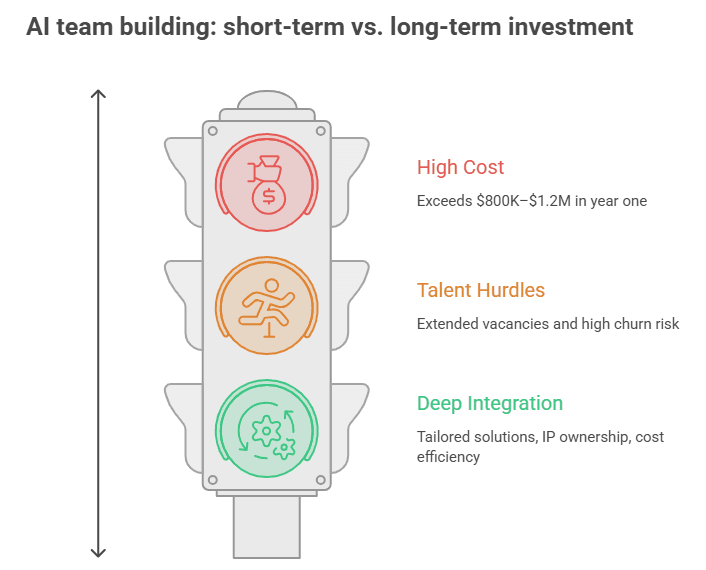
Building an in-house AI team represents a significant commitment for growing businesses seeking sustained competitive advantage through proprietary capabilities. This path demands upfront investment but fosters deep alignment with company-specific needs over time. Many organizations view it as a strategic move toward self-sufficiency in AI-driven innovation.
1. What an In-House AI Team Looks Like
A viable in-house AI team typically includes ML engineers, data engineers, AI product managers, MLOps specialists, and domain experts. These roles focus on custom development, ongoing optimization, and tight alignment with proprietary data and business processes. Over time, the team develops intimate knowledge of internal systems that external partners cannot fully replicate, enabling continuous innovation tailored to unique organizational contexts.
2. Advantages for Growing Businesses
Deep integration and institutional knowledge allow in-house teams to create highly tailored solutions that evolve with the business. Full IP ownership and control support the development of competitive moats through proprietary systems. Long-term cost efficiency emerges after the initial ramp-up period of 9-14 months, when per-unit output becomes more economical for continuous high-volume AI work while also fostering a broader innovation culture internally.
3. Challenges and Real Costs
High year-one total cost of ownership for a minimal team often exceeds $800K–$1.2M fully loaded, including base salaries around $550K, benefits at 1.3–1.5x, recruiting fees of 20-25%, and tooling. Talent acquisition hurdles arise in a competitive market with extended vacancies and high churn risk, which adds replacement costs of 150-200% of salary. Slower initial results stem from 4-6+ month hiring delays per role plus ramp time, while significant management overhead, infrastructure, and ongoing training further increase resource intensity.
Head-to-Head Comparison: AI Consulting vs Hiring In-House
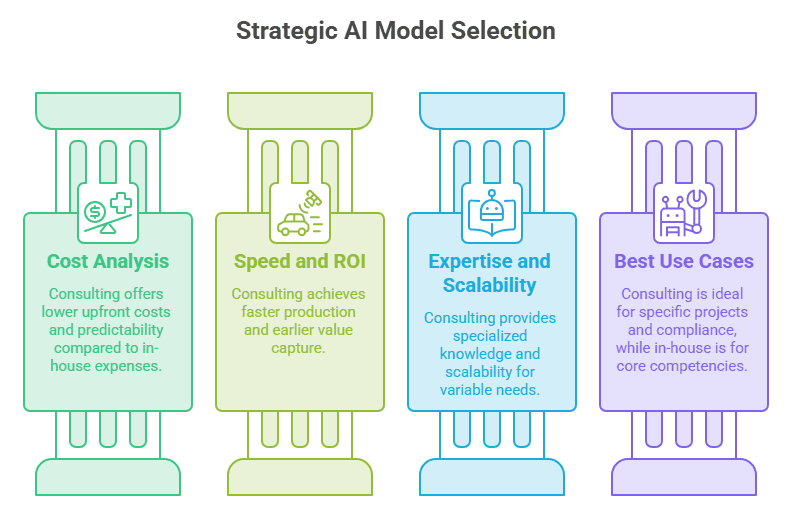
The comparison between AI consulting and in-house teams reveals trade-offs in speed, cost, and control that growing businesses must evaluate based on their maturity and goals. 72% Understanding these differences helps leaders choose the model that best aligns with current needs and future ambitions.
1. Cost Breakdown (Year 1 Focus)
- Consulting provides lower upfront commitment and predictability with scoped projects typically costing $200K–$500K versus higher in-house totals.
- In-house expenses compound through hidden costs like attrition at 150-200% of salary and delayed ROI during ramp-up.
- Overall, year-one TCO favors consulting for most growing businesses seeking cost certainty without full-time overhead.
2. Speed and Time-to-ROI
- Consulting achieves production 2.3x faster, enabling earlier value capture and compounding learning advantages.
- In-house timelines extend to 9-14 months for first deployments due to hiring and onboarding cycles.
- This speed gap creates significant competitive edges for businesses that prioritize rapid implementation.
3. Expertise, Scalability, and Risk
- Consulting excels in specialized, cross-industry knowledge and compliance.
- In-house provides continuity and proprietary depth but limited breadth initially.
- Scalability favors consulting for variable needs; in-house for steady, core AI functions.
4. Best Use Cases
- Choose AI consulting for specific projects, rapid pilots, ROI validation, compliance needs, or when internal talent is lacking.
- Opt for in-house development when AI serves as a core competency, requires continuous high-volume work, involves highly sensitive data, or builds long-term strategic moats.
- Many growing businesses benefit from sequencing both approaches for optimal results.
Hybrid AI Strategies: Optimal Path for Growing Businesses
A phased hybrid approach is 48% popular among growing businesses seeking the best of both worlds. Organizations typically start with consultants for strategy, initial deployments, assessments, and training during the first months before transitioning primary ownership to in-house teams for ongoing iteration. Consultants often continue in advisory roles to provide specialized support as needed.
This model minimizes risks while accelerating value creation and internal capability building. Success depends on strong knowledge transfer plans and clear handoff processes that ensure smooth evolution over time. Business size, maturity, and industry play key roles in determining the ideal balance between consulting and in-house models.
How Virtual Assistants Help in Growing Businesses
Virtual assistants offer a practical middle ground for growing businesses navigating the AI consulting versus in-house dilemma. They provide flexible, on-demand support that bridges immediate expertise needs with long-term capability building without the full commitment of traditional consulting or hiring. This approach helps companies test AI initiatives efficiently while controlling costs and building internal confidence.
- Virtual assistants conduct AI readiness assessments and identify high-ROI use cases for your industry and operations.
- They support hybrid implementations by coordinating consultants and in-house teams for smooth transitions.
- Virtual assistants manage project timelines, vendor coordination, and deployment reporting.
- They assist with knowledge transfer, documentation, and training to reduce external dependency.
- Virtual assistants track AI performance metrics and recommend optimizations for sustained value.
- They provide compliance checks and governance support to align with regulations.
TaskVirtual: Your AI Implementation Partner
Growing businesses often struggle to navigate the complexities of AI adoption while balancing speed, cost, and long-term control. Deciding between AI consulting and building an in-house team can feel overwhelming amid talent shortages and rapid technological changes. TaskVirtual offers expert virtual AI assistance that simplifies this journey by providing flexible support for strategy, implementation, and ongoing optimization tailored to your business needs.
1. Expert AI Consultation and Strategy
TaskVirtual’s skilled AI specialists help evaluate your readiness, recommend the right mix of consulting and in-house approaches, and guide initial deployments with proven frameworks for automation, predictive analytics, and generative AI solutions.
2. Affordable and Flexible Pricing
Hiring a full-time personal assistant can be expensive, but TaskVirtual makes it cost-effective. With pricing plans starting from just $3.12/hour to $14.99/hour, their services are budget-friendly and accessible to individuals, families, and businesses.
3. Comprehensive AI Support Solutions
From AI readiness assessments and pilot projects to knowledge transfer for hybrid models and ongoing model optimization, TaskVirtual delivers scalable solutions that adapt to your specific use cases, compliance requirements, and growth stage.
4. Ongoing Support and Quality Assurance
TaskVirtual goes beyond initial setup by providing continuous monitoring, performance tracking, and expert guidance to ensure your AI initiatives deliver measurable ROI while aligning with evolving business goals and regulatory standards.
5. Proven Track Record of Excellence
With 364 positive reviews and a 4.7-star rating on trusted VA platforms, TaskVirtual is recognised as a reliable partner worldwide. Clients count on their expertise to simplify AI adoption and streamline implementation decisions.
FAQ Section
1. Is AI consulting more expensive than building an in-house team?
No, typically not in year one. Consulting offers lower TCO ($200K–$500K for scoped work) versus $800K–$1.2M+ for a minimal in-house team, with faster results. Long-term, in-house can become cheaper for sustained needs.
2. How long does it take to see ROI with each approach?
Consulting: Weeks to months. In-house: 9-14+ months. Hybrids balance speed and sustainability.
3. What if we have sensitive data?
Both can work with strong NDAs, security protocols, and on-prem/private models. In-house offers maximum control; vetted consultants handle compliance effectively.
4. Can consultants help build our in-house team?
Yes—many engagements include training, knowledge transfer, and phased handoffs.
5. How do I choose the right AI consulting firm?
Look for proven case studies, industry experience, certification (e.g., IABAC), transparent pricing, and a focus on knowledge transfer and measurable outcomes.
6. What are the biggest risks to avoid?
Poor knowledge transfer (consulting dependency), underestimating in-house ramp-up costs/delays, or lacking governance. Start small, measure rigorously, and plan for hybrid evolution.
Conclusion
For growing businesses in 2026, AI consulting vs in-house isn’t an either/or decision—it’s about aligning the right capabilities with your stage, goals, and resources. Consulting provides speed, expertise, and flexibility to capture early wins and validate value. In-house builds enduring strength and ownership. The hybrid model often delivers the best of both: rapid progress today and self-sufficiency tomorrow.
Whether you choose consulting or build an internal team, the goal should be to connect AI investment with measurable business outcomes. Explore AI consulting and automation to understand how businesses can build a practical AI strategy.
Evaluate your current maturity, define clear use cases with ROI potential, and act decisively. The organizations that thrive will treat AI as a strategic capability, not a one-off project.
Ready to move forward? Assess your AI readiness, explore tailored consulting options, or start building your roadmap. Contact a reputable AI partner today to turn potential into performance.
Sources
- McKinsey Global Survey on AI (2025)
- Various industry analyses from Lumenova, IABAC, Holmes Consultants, Arbisoft, and others (as referenced)
- Statista and market research reports on AI adoption and consulting markets
For more such content, visit our website.
 Siddhartha Basu is a Technical Writer at Task Virtual. He loves online games, e-book reading, and Yoga.