

Contents
show
How Business Intelligence Virtual Assistants Help Reduce Decision-Making Risk
In today’s fast-paced economy, executives face mounting pressure to make high-stakes decisions amid uncertainty, data overload, and rapid market shifts. Business intelligence virtual assistants (BI virtual assistants) combine AI, natural language processing, and advanced analytics to deliver actionable insights on demand. These intelligent systems act as proactive advisors that query vast datasets, identify patterns, and suggest optimal paths while flagging risks.
For American businesses navigating inflation concerns, supply chain volatility, and competitive disruption, BI virtual assistants offer a significant edge through agentic AI. They go beyond traditional dashboards by automating decision support and reducing latency in insight generation, with organizations using AI-driven BI tools reporting up to 30% faster decision-making. This guide explores their role, benefits, and proven impact on lowering decision-making risks.
Understanding Business Intelligence Virtual Assistants
Business intelligence virtual assistants represent a major evolution in how organizations interact with data. These AI-powered tools make complex analytics accessible to users at all levels through conversational interfaces, with 72% of businesses now adopting AI in at least one function. By integrating seamlessly with existing systems, they help businesses move from reactive reporting to proactive decision intelligence.
1. Defining BI Virtual Assistants and Their Evolution
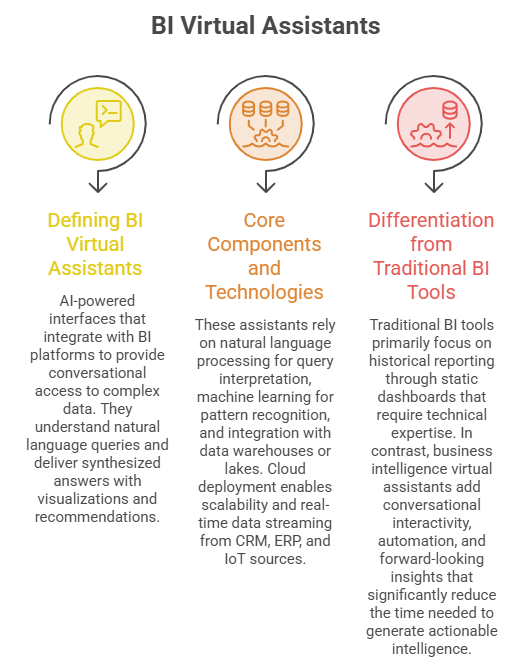
Business intelligence virtual assistants are AI-powered interfaces that integrate with BI platforms to provide conversational access to complex data. Unlike static reports, they understand natural language queries and deliver synthesized answers with visualizations and recommendations. Their evolution from best BI tools has been driven by machine learning and generative AI, democratizing data access for non-technical users across departments.
2. Core Components and Technologies
These assistants rely on natural language processing for query interpretation, machine learning for pattern recognition, and integration with data warehouses or lakes. Cloud deployment enables scalability and real-time data streaming from CRM, ERP, and IoT sources. Security features such as role-based access and encryption ensure compliance in regulated U.S. industries.
3. Differentiation from Traditional BI Tools
Traditional BI tools primarily focus on historical reporting through static dashboards that require technical expertise. In contrast, business intelligence virtual assistants add conversational interactivity, automation, and forward-looking insights that significantly reduce the time needed to generate actionable intelligence. This shift allows organizations to respond to market changes in hours rather than weeks, making them far more effective for dynamic decision environments in 2026.
The Hidden Risks in Traditional Business Decision-Making
Poor decision-making continues to plague many U.S. organizations, often resulting from fragmented data and human limitations, with 85% of business leaders experiencing decision distress in the past year. These risks can lead to substantial financial losses and missed opportunities in competitive markets.
- Inefficient decision processes cost Fortune 500 companies around $250 million yearly in wasted wages.
- Poor data quality leads to trillions in annual U.S. economic losses.
- Cognitive biases contribute to high product launch failure rates of up to 80%.
- Data silos create fragmented views that lead to flawed strategic choices.
- Over-reliance on intuition increases exposure to market shifts and inefficiencies.
- Economic uncertainty further amplifies decision risks for American businesses.
How Business Intelligence Virtual Assistants Mitigate Decision Risks
Business intelligence virtual assistants address critical gaps in traditional decision processes by providing intelligent, data-driven support through quantitative market research services. They combine real-time analysis with predictive capabilities to help leaders make more confident choices. These tools are particularly valuable for U.S. businesses operating in volatile economic conditions.
1. Real-Time Data Access and Analysis
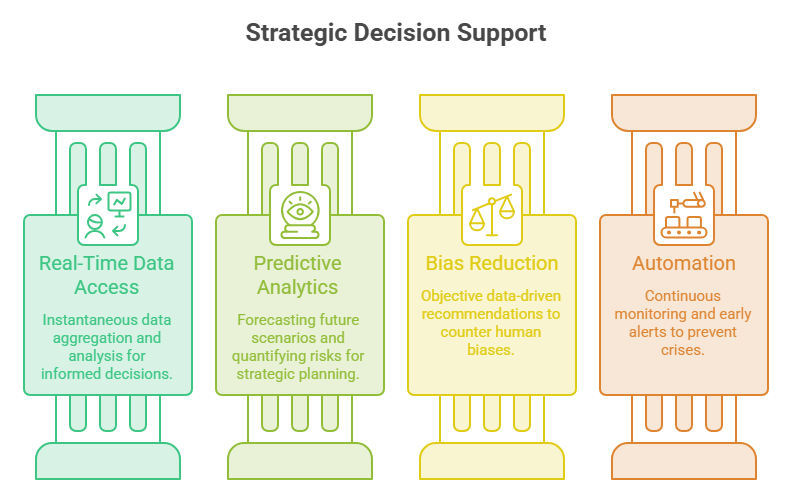
BI virtual assistants aggregate and analyze data from multiple sources instantaneously, eliminating dangerous delays in information access. Users can query across integrated platforms to receive a unified, comprehensive view that reduces reliance on outdated or partial reports. This capability significantly lowers the risk of decisions based on incomplete information in fast-moving markets.
2. Predictive and Prescriptive Analytics
These assistants use historical and real-time data to forecast various scenarios with high accuracy. They model “what-if” outcomes for strategic moves like pricing changes or market expansions while quantifying associated risks. By offering clear recommendations and mitigation strategies, they transform uncertainty into manageable, informed action.
3. Bias Reduction and Scenario Simulation
BI virtual assistants ground all recommendations in objective data, effectively countering common human cognitive biases. Advanced systems enable leaders to simulate multiple future scenarios and stress-test strategies before making commitments. This data-driven approach leads to more balanced and resilient decision-making across the organization.
4. Automation of Routine Monitoring
These tools continuously monitor key metrics and flag anomalies such as sudden demand drops or compliance issues in real time. Early alerts allow teams to address potential problems before they escalate into major crises. Automation frees up valuable time while maintaining constant vigilance over critical business indicators.
Key Benefits of Business Intelligence Virtual Assistants
Business intelligence virtual assistants deliver measurable advantages that go well beyond basic reporting capabilities. They empower organizations to operate with greater precision and agility in competitive environments. American companies adopting these tools often gain significant strategic advantages.
- AI-augmented BI enables faster and more accurate decision-making.
- Companies see over 10% higher annual revenue with empowered data tools.
- Automation delivers 53% faster incident response and 27% fewer stockouts.
- Enhanced risk management supports five times better timely decisions.
- Conversational interfaces break data silos and boost collaboration.
- Early adopters gain strong competitive advantages in dynamic markets.
Business Intelligence Tools for Virtual Assistants and Implementation
Selecting and implementing the right business intelligence virtual assistants requires careful planning and strategic alignment. Modern tools have made advanced analytics more accessible than ever before. Successful adoption depends on strong data foundations and user-focused deployment.
1. Leading Tools and Platforms
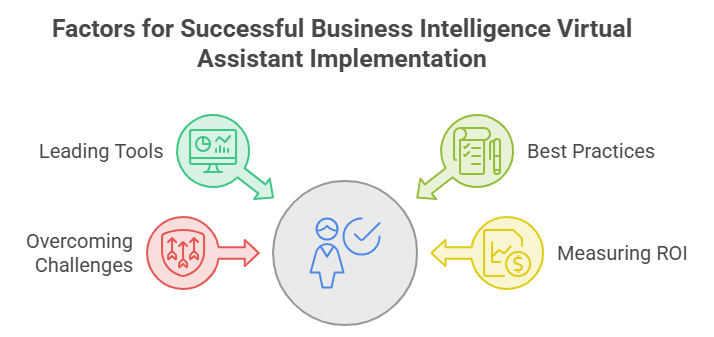
Popular platforms such as Microsoft Power BI, Tableau with AI features, ThoughtSpot, and Qlik offer robust conversational interfaces. Many integrate effectively with enterprise copilots and custom AI solutions for enhanced functionality. These tools support seamless connections with existing data ecosystems while maintaining high security standards.
2. Best Practices for Successful Implementation
Begin with clear objectives, comprehensive data governance, and a focused pilot program in one department. User training and hybrid human-AI workflows prove essential for smooth adoption and high engagement rates. Organizations should prioritize data quality and scalability from the start to maximize long-term value.
3. Overcoming Challenges
Data readiness remains a key hurdle, as many IT leaders still feel unprepared for full-scale implementation. Integration complexity and change management require dedicated attention and structured approaches. Addressing security, compliance, and user adoption early helps ensure sustainable success.
4. Measuring ROI
Track key metrics including decision speed, error reduction, cost savings, and direct revenue impact. Most organizations see payback within months through substantial efficiency improvements. Regular assessment helps refine usage and demonstrate clear business value over time.
Future Trends in Business Intelligence Virtual Assistants
Agentic AI will enable next-generation business intelligence virtual assistants to handle complex, multi-step processes autonomously while maintaining human oversight for critical decisions. Multimodal capabilities incorporating voice, visuals, and real-time IoT data will create deeper and more contextual insights. Embedding analytics directly into daily workflows will make intelligent assistance feel seamless and natural.
Ethical considerations and enhanced governance will shape future development, like web content development services, with greater emphasis on transparency, bias mitigation, and explainability. U.S. regulatory evolution will push organizations toward more responsible AI practices. Cloud-based adoption is expected to continue rising strongly, giving businesses of all sizes powerful decision tools throughout the decade.
How Virtual Assistants Help with Business Intelligence

Virtual assistants play a vital role in enhancing business intelligence by bridging the gap between raw data and practical business decisions through business automated data analysis services. They empower teams with on-demand support, making advanced analytics more approachable for non-technical users across organizations. This human-AI collaboration ensures smoother adoption and consistent value from BI systems.
- Virtual assistants simplify complex data queries into easy conversations.
- They create customized reports for different departmental needs.
- Virtual assistants support employee training and BI tool adoption.
- They improve data quality through cleaning and integration tasks.
- Virtual assistants speed up scenario analysis and risk evaluation.
- They maintain dashboards, alerts, and compliance records efficiently.
TaskVirtual: Your Partner in Business Intelligence Virtual Assistants

Implementing business intelligence virtual assistants can feel complex for many U.S. organizations dealing with data overload and high-stakes decisions. From selecting the right platforms to integrating predictive analytics and ensuring user adoption, the process demands expertise and ongoing management. TaskVirtual provides specialized business intelligence virtual assistant services that simplify deployment, reduce decision risks, and deliver actionable insights tailored to your business needs.
1. Expert Consultation and Review
TaskVirtual’s skilled professionals guide you through platform selection, data integration, and custom AI configuration. They help align BI virtual assistants with your specific goals, from risk forecasting to real-time analytics, ensuring maximum value from day one.
2. Affordable and Flexible Pricing
Hiring a full-time personal assistant can be expensive, but TaskVirtual makes it cost-effective. With pricing plans starting from just $3.12/hour to $14.99/hour, their services are budget-friendly and accessible to individuals, families, and businesses.
3. Comprehensive Business Intelligence Solutions
From real-time data mining techniques and predictive modeling to scenario simulation and automated reporting, TaskVirtual covers every aspect of BI support. Their scalable services adapt whether you need occasional strategy sessions or full-time virtual assistant management for ongoing decision intelligence.
4. Ongoing Support and Quality Assurance
TaskVirtual goes beyond initial setup by delivering continuous monitoring, performance optimization, and proactive updates. Their dedicated support ensures your business intelligence virtual assistants remain accurate, secure, and aligned with evolving market conditions.
5. Proven Track Record of Excellence
With 364 positive reviews and a 4.7-star rating on trusted VA platforms, TaskVirtual is recognised as a reliable partner worldwide. Clients count on their expertise to simplify BI implementation and strengthen data-driven decision-making.
FAQ Section
1. What are business intelligence and virtual assistants?
They are AI-driven tools that provide conversational access to BI data, offering insights, forecasts, and recommendations to support decisions.
2. How do business intelligence virtual assistants reduce decision-making risk?
By delivering real-time, data-backed insights, predictive modeling, and anomaly detection, they minimize reliance on incomplete information or intuition.
3. What are the main benefits of business intelligence virtual assistants?
Key benefits include faster insights, reduced errors, cost savings, improved risk management, and broader data accessibility across teams.
4. Which industries benefit most from BI virtual assistants?
Finance, retail, healthcare, and manufacturing see significant gains in efficiency, forecasting, and compliance.
5. What tools integrate well with business intelligence virtual assistants?
Platforms like Power BI, Tableau, and ThoughtSpot pair effectively with AI interfaces for enhanced functionality.
6. How should companies implement business intelligence and virtual assistants?
Begin with data assessment and pilots, prioritize training and governance, then scale with measurable KPIs.
7. Are BI virtual assistants suitable for small businesses?
Yes, cloud-based options offer scalable, cost-effective solutions that provide competitive insights without heavy investment.
Conclusion
Business intelligence virtual assistants represent a transformative shift in how American companies approach decision-making. By mitigating risks through accurate, timely, and actionable intelligence, they empower leaders to navigate complexity with greater confidence and agility. As AI capabilities advance, early adopters will gain lasting advantages in efficiency, innovation, and resilience.
Ready to reduce your decision risks? Assess your current BI setup, explore integration with a virtual assistant, and consult experts to tailor a solution for your needs. Start small, measure impact, and scale toward a truly data-driven future. Contact a BI specialist today to schedule a demo and unlock smarter decisions tomorrow.
Sources
- Scoop Market (various BI and VA statistics)
- Precedence Research, Fortune Business Insights, Polaris Market Research (market sizes)
- IBM, McKinsey, Gartner (adoption and benefits)
- New York BEX / McKinsey & IoD (decision costs)
- Statista and industry reports (via aggregated data)
For more such content, visit our website.
 Siddhartha Basu is a Technical Writer at Task Virtual. He loves online games, e-book reading, and Yoga.