Contents
show
Social Media VA vs Social Media Agency: Which is Better
In today’s digital-first economy, maintaining a strong social media presence is no longer optional—it’s essential for brand visibility, customer engagement, and revenue growth. With billions of users scrolling daily, businesses are turning to external help: either a social media VA (Virtual Assistant) or a full social media agency. But which is better?
A social media VA is typically a remote professional or small team handling execution-focused tasks like scheduling posts, basic engagement, and content calendar management. In contrast, a social media agency offers comprehensive services, including strategy development, advanced analytics, campaign management, paid advertising, and creative production with specialized teams.
As AI tools and algorithm changes accelerate in 2026, the decision hinges on your business stage, budget, goals, and need for hands-on control versus strategic depth. This guide draws from industry analyses to provide a clear, unbiased comparison – helping you avoid common pitfalls like underinvestment in strategy or overpaying for unused capacity. Whether you’re a solopreneur or scaling SME, understanding social media VA options versus agencies ensures you invest wisely for measurable ROI.
What Is a Social Media VA?
A social media virtual assistant serves as a reliable remote extension of your team, dedicated to maintaining consistent online activity without requiring full-time in-house staff. These professionals bring flexibility and specialized focus to social media tasks, making them particularly valuable for businesses seeking efficient support. By handling routine operations effectively, a skilled social media VA helps free up valuable time for owners to concentrate on broader business priorities.
1. Core Responsibilities of a Social Media VA
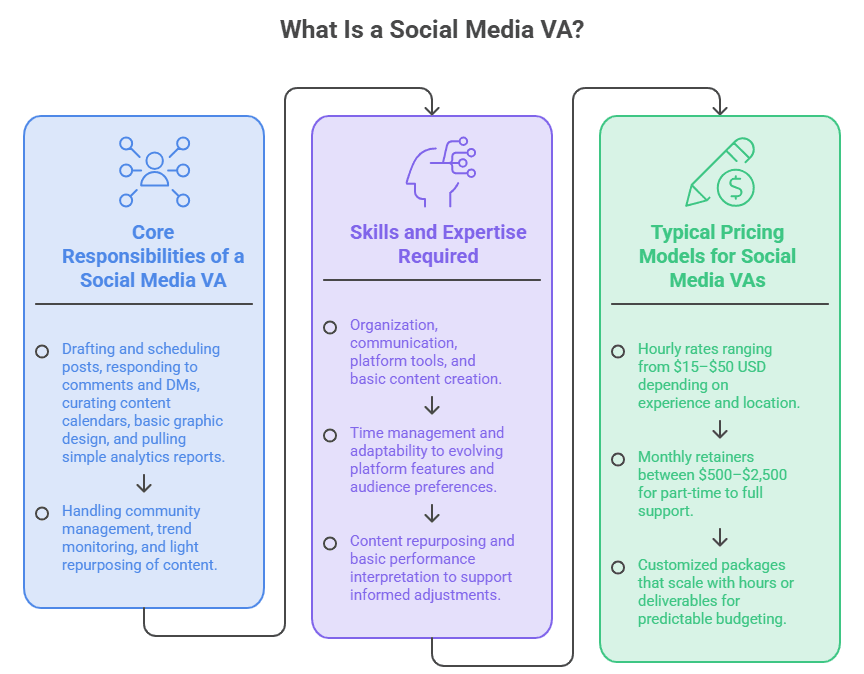
Social media virtual assistants focus on day-to-day execution that keeps your channels active and consistent. Typical tasks include drafting and scheduling posts, responding to comments and DMs, curating content calendars, basic graphic design (e.g., via Canva), and pulling simple analytics reports.
Many VAs also multitask across admin duties, making them versatile for businesses needing broad support. Experienced social media VAs can handle community management, trend monitoring, and light repurposing of content, allowing owners to focus on core operations.
2. Skills and Expertise Required
Effective social media VAs excel in organization, communication, platform tools (Hootsuite, Buffer, Meta Business Suite), and basic content creation. While not always deep strategists, top VAs stay updated on algorithm shifts and audience behaviors. Specialization in niches like e-commerce or B2B boosts their value.
Beyond foundational tools and soft skills, successful VAs demonstrate strong time management and adaptability to evolving platform features and audience preferences. They often develop proficiency in content repurposing and basic performance interpretation to support informed adjustments. This combination ensures reliable execution that aligns with brand guidelines while maintaining engagement quality.
3. Typical Pricing Models for Social Media VAs
Social media VAs often charge hourly ($15–$50 USD, depending on experience and location) or monthly retainers ($500–$2,500 for part-time to full support). This flexibility suits startups and small businesses with limited budgets. Offshore or hybrid models can lower costs further while maintaining quality through vetted providers.
Many providers offer customized packages that scale with hours or deliverables, providing predictability for budgeting purposes. This structure allows businesses to start small and expand support as needs grow without significant upfront commitments. Overall, the accessible pricing makes social media VAs an attractive entry point for professional assistance.
What Is a Social Media Agency?
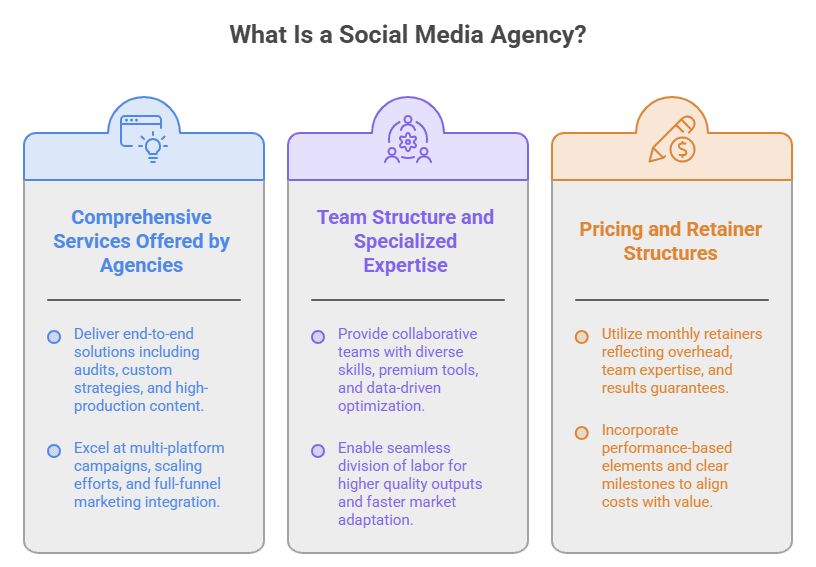
A social media agency functions as a full-service partner equipped to manage and elevate your social media ecosystem through expert teams and methodologies. With 73% of consumers saying they would switch to competitors if brands do not respond on social media, agencies combine strategy, creative execution, and expertise to drive outcomes.
1. Comprehensive Services Offered by Agencies
Social media agencies deliver end-to-end solutions: in-depth audits, custom strategies, high-production content (videos, Reels, graphics), paid ad campaigns, influencer partnerships, crisis management, and detailed performance reporting. They often include dedicated strategists, copywriters, designers, and analysts.
Agencies excel at multi-platform campaigns and scaling efforts during launches or peak seasons. This breadth ensures comprehensive coverage that goes beyond basic posting to encompass full-funnel marketing integration. Their services frequently incorporate advanced elements like audience segmentation and competitive benchmarking for superior positioning.
2. Team Structure and Specialized Expertise
Unlike a solo social media VA, agencies provide collaborative teams with diverse skills. This includes access to premium tools, A/B testing expertise, compliance knowledge (e.g., for regulated industries), and data-driven optimization that drives growth.
The structured team approach enables seamless division of labor where specialists handle their domains efficiently. This results in higher quality outputs and faster adaptation to market changes or platform updates. Clients benefit from institutional knowledge accumulated across multiple accounts and industries.
3. Pricing and Retainer Structures
Agencies typically use monthly retainers starting at $2,500–$15,000+, reflecting overhead, team expertise, and results guarantees. Higher tiers include dedicated account managers and advanced features like custom reporting dashboards.
These models often incorporate performance-based elements or tiered deliverables to align costs with value received. The investment reflects the depth of resources and strategic input provided consistently over time. Businesses typically see structured contracts that outline clear milestones and reporting cadences for accountability.
Key Differences: Social Media VA vs Social Media Agency

Social media VAs and agencies both support presence but differ significantly in approach, resources, and outcomes. With Facebook delivering the highest social media ROI for 54% of marketers, understanding these distinctions helps businesses choose support that matches capabilities, growth ambitions, efficiency, results, and investment priorities.
1. Scope of Work and Strategic Depth
- Social media VAs primarily execute predefined plans—ideal when you have clear guidelines but lack time.
- Agencies develop and refine strategies, conduct competitor analysis, and adapt to trends proactively.
- A VA follows; an agency leads.
- This difference affects how proactively your social channels evolve and respond to opportunities.
2. Cost Efficiency and ROI Considerations
- VAs offer higher cost-efficiency for consistent execution, often delivering strong results for businesses under $3K/month budgets.
- Agencies justify higher costs through specialized campaigns that can yield faster scaling.
- ROI depends on alignment and measurement in both cases.
- Budget constraints often favor starting with VA support before scaling.
3. Scalability and Customization
- VAs scale via additional hours or team additions, but may hit limits with complex needs.
- Agencies scale seamlessly with dedicated resources for enterprise-level demands, such as cross-channel integrations or large ad spends.
- Customization levels vary based on provider flexibility and client requirements.
- Growth trajectory determines the most suitable scalability path.
4. Communication and Control
- Direct, flexible communication is a VA hallmark—quick Slack updates and personalized attention.
- Agencies provide structured processes (strategy calls, approvals), but may involve more layers.
- This potentially slows responses for fast-moving brands in some cases.
- Preference for hands-on involvement influences the ideal communication style.
Pros and Cons of Hiring a Social Media VA
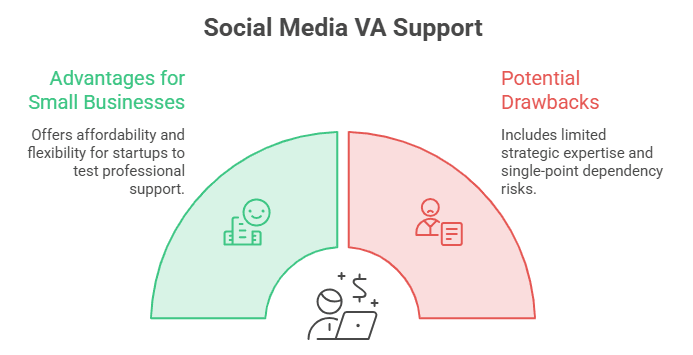
Hiring a social media virtual assistant offers a practical solution for businesses seeking dedicated support without the overhead of larger teams or agencies. This approach provides balanced assistance tailored to specific operational needs while maintaining affordability. Many organizations find VAs to be an excellent starting point or ongoing solution for social media management.
1. Advantages for Small Businesses and Startups
Advantages for small businesses and startups include affordability and flexibility that lower entry barriers for testing professional support without long-term commitments. Personalized attention fosters close working relationships and seamless integration with other administrative tasks handled by the same VA. Quick implementation and multitasking capabilities maximize efficiency for resource-conscious operations.
2. Potential Drawbacks and Limitations
Potential drawbacks include limited strategic expertise that may stall growth if foundational plans remain weak over time. Single-point dependency risks, such as vacations or turnover, can create temporary gaps without adequate backup systems in place. Variable quality across providers requires thorough vetting, and supplementation might become necessary for advanced advertising or sophisticated design requirements.
Pros and Cons of Working with a Social Media Agency

Social media agencies represent a strategic investment for businesses pursuing ambitious online growth. With ad spending expected to grow 10.90% annually through 2030, their capabilities address complex challenges beyond execution, suiting organizations prioritizing professional depth and measurable scaling.
1. Benefits for Scaling and Complex Campaigns
- Expert Strategy and Results: Data-backed plans and specialized teams drive measurable growth.
- Comprehensive Resources: Access to production studios, ad experts, and analytics suites.
- Risk Mitigation: Backup teams and compliance support.
- Time Savings: Full delegation of thinking and doing.
2. Challenges and Higher Investment Needs
- Higher Costs: May strain smaller budgets.
- Less Personal Touch: Potential for generic service if not a priority client.
- Approval Loops: Slower adaptation to hyper-local trends.
- Overkill for Simple Needs: Excess capacity for basic posting.
When to Choose a Social Media VA Over an Agency
Deciding on a social media VA involves evaluating operational context and resource availability carefully. With 83% of small businesses maintaining or increasing outsourced service spending, this choice supports practical execution and cost management, providing an effective foundation before more extensive support options.
1. Ideal Business Stages and Scenarios
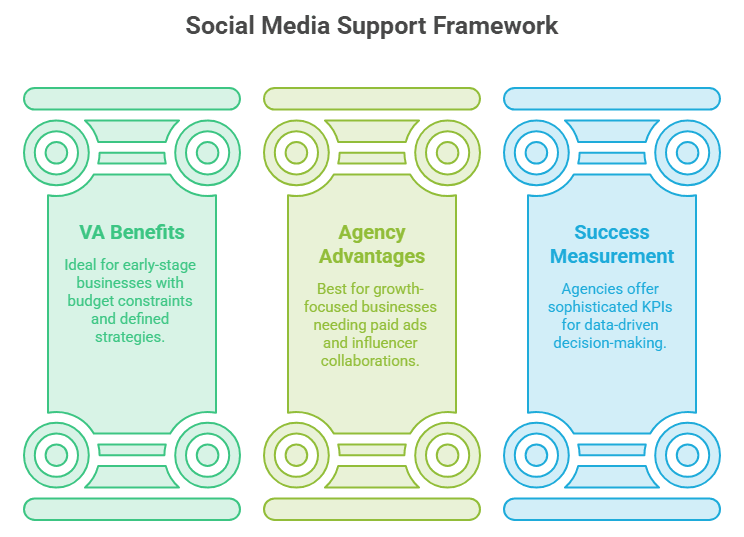
Choose a social media VA if you’re in early growth, have a defined strategy, need consistent posting/engagement, or operate on a tight budget. This option works particularly well for solopreneurs, e-commerce stores, or local businesses maintaining a presence without heavy campaigns. The flexibility supports gradual scaling as business demands evolve naturally over time.
2. Growth-Focused or Enterprise Needs
Opt for an agency when social media serves as a primary growth driver requiring paid ads, influencer collaborations, or complex compliance measures. Established brands with sufficient budgets for high-ROI campaigns benefit significantly from the specialized resources and coordinated efforts available. This approach accelerates results in competitive markets where strategic sophistication provides clear advantages.
3. Measuring Success and Long-Term Strategy
Agencies often provide sophisticated KPIs, including engagement rates, conversion tracking, and customer acquisition costs, aligned with overarching business objectives. This data-driven methodology supports sustainable expansion and informed decision-making across marketing channels. Regular reporting and strategic adjustments ensure long-term alignment with evolving goals and market conditions.
TaskVirtual: Your Partner in Social Media Virtual Assistance

Navigating social media demands consistent effort across posting, engagement, and performance tracking, which can quickly overwhelm busy entrepreneurs and small teams. From crafting timely content to responding to audience interactions and monitoring trends, the daily requirements often pull focus from core business activities. TaskVirtual delivers expert social media virtual assistant services that streamline your online presence, ensuring professional management without the burden of full-time hires.
1. Expert Consultation and Review
TaskVirtual’s skilled virtual assistants help select optimal platforms and tools, organize content calendars, and execute posting schedules aligned with your brand voice. They manage community interactions, basic analytics reviews, and content repurposing to maintain momentum across channels.
2. Affordable and Flexible Pricing
Hiring a full-time personal assistant can be expensive, but TaskVirtual makes it cost-effective. With pricing plans starting from just $3.12/hour to $14.99/hour, their services are budget-friendly and accessible to individuals, families, and businesses.
3. Comprehensive Social Media Support Solutions
From developing content calendars and scheduling posts to handling audience engagement and simple performance reporting, TaskVirtual covers essential execution needs. Their scalable services adapt to whether you need occasional support for campaigns or ongoing daily management for multiple platforms.
4. Ongoing Support and Quality Assurance
TaskVirtual provides continuous monitoring and timely updates on performance and audience feedback. Their proactive approach ensures your social media remains active, responsive, and aligned with business goals without added stress.
5. Proven Track Record of Excellence
With 364 positive reviews and a 4.7-star rating on trusted VA platforms, TaskVirtual is recognised as a reliable partner worldwide. Clients count on their expertise to simplify social media management and streamline everyday online tasks.
FAQ Section
A social media VA focuses on task execution and daily operations, while an agency provides full strategy, creative teams, and advanced campaigns.
Hourly rates range from $15 to $50, or $500–$2,500 monthly, making them accessible for most small businesses.
For basic needs and execution, yes. For strategic growth, paid ads, or complexity, an agency (or hybrid) is superior.
Absolutely—cost-effective consistency without heavy overhead.
Higher-level strategy often yields faster audience growth, better ROI on ads, and comprehensive reporting.
Assess your budget, current strategy maturity, growth goals, and need for control. Start small with a VA if unsure.
Conclusion
There’s no universal “better” choice between a social media VA and a social media agency—it depends on your unique needs, stage, and objectives. Social media VAs shine for affordable, flexible execution and multitasking support, ideal for bootstrapped or steady-state operations. Agencies deliver powerful strategy and scalability for ambitious growth.
The choice between a VA and an agency often comes down to whether the business needs execution support, strategic leadership, or a combination of both. Our guide to social media management VA services breaks down the roles and workflows that can help clarify that decision.
Evaluate your social media goals honestly, test with clear KPIs, and consider starting with a VA before scaling to agency-level support. The right partner will amplify your brand voice, engage your audience, and drive real business results in 2026 and beyond.
Ready to elevate your social media? Contact a reputable social media VA provider or agency today for a consultation tailored to your business. Share your experiences or questions in the comments!
Sources
- Pew Research Center Social Media Fact Sheet
- Statista reports on social media advertising and marketing
- Various industry blogs and analyses from BNL Media, Virtually Priceless, Keach Assistants, Virtual Staffing, and others (referenced for role comparisons)
- Additional data from DataReportal, HubSpot, and market research summaries
For most such content, visit our website.
 Siddhartha Basu is a Technical Writer at Task Virtual. He loves online games, e-book reading, and Yoga.