Contents
show
How Claude AI Virtual Assistant Builds AI Agents for Business Tasks
Claude AI agents are intelligent systems built with Anthropic’s Claude models that autonomously execute multi-step business tasks. They combine reasoning, tool use, Skills templates, and computer control to handle workflows without constant human input. When paired with virtual assistants, these agents turn natural-language instructions into reliable automation for small businesses, agencies, startups, and entrepreneurs in the US and UK.
Small businesses lose 20–30 hours weekly to repetitive tasks like email triage, data entry, and report generation—with studies showing that entrepreneurs spend up to 36% of their workweek on administrative work. Claude AI, combined with virtual assistants, addresses this by creating custom agents that run 24/7, scale instantly, and reduce costs compared to hiring or building in-house tools.
What This Means for Businesses
Claude AI agents let US and UK teams automate 60–80% of routine knowledge work while keeping humans in the loop for decisions. Virtual assistants build, monitor, and refine these agents using Claude’s native features—no coding team required—making it easy for businesses to have this fully managed by experts. Resulting in faster operations, lower overhead, and scalable output that grows with revenue. Teams shift focus from repetitive admin to high-value strategy and client work. Agents run 24/7 across time zones without extra headcount. Small businesses and agencies achieve consistent output at lower cost while maintaining quality and compliance through Skills and Projects. Virtual assistants handle prompt tuning and exception management, delivering reliable automation that scales directly with business growth.
How This Actually Works
Claude AI agents follow a loop: observe input, reason with business context, select tools or Skills, execute, and output results. The model uses its 1M-token context window to maintain full conversation history and company knowledge. Virtual assistants prompt the agent once, then let it run autonomously via Claude Cowork (desktop control) or API calls. It works in business workflows because Claude’s Skills standardize repeatable processes, and the computer uses the tool to handle real desktop actions like opening apps or editing spreadsheets. No fragile scripts—just reliable, auditable execution.
Core Capabilities of Claude AI for This Use Case
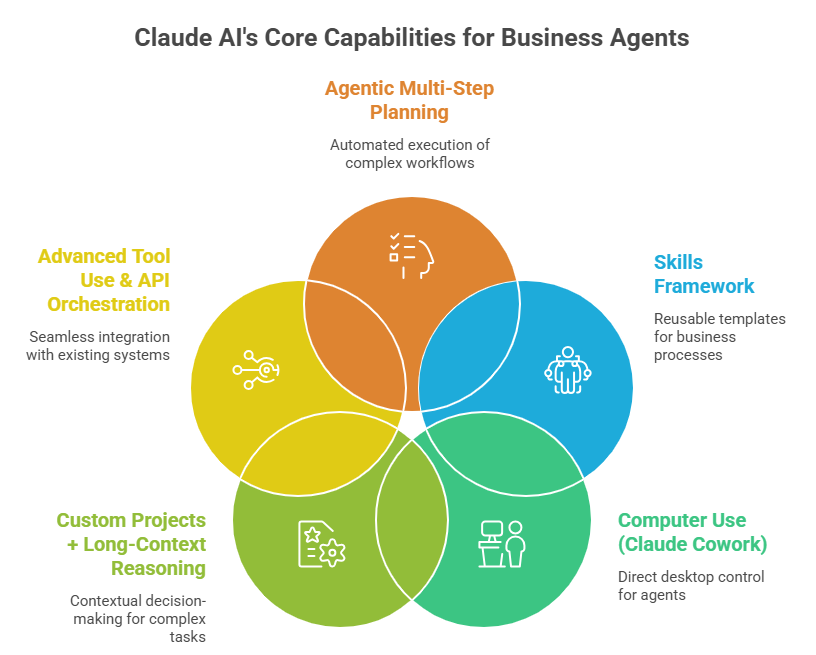
Claude AI offers five core capabilities for business agent development: Skills Framework, Computer Use (Claude Cowork), Custom Projects with long-context reasoning, Advanced Tool Use & API orchestration, and Agentic Multi-Step Planning. Studies indicate that businesses can automate up to 60–70% of routine knowledge work using AI. Virtual assistants use these capabilities to build and run Claude AI agents quickly without coding, enabling small businesses to automate tasks reliably while keeping human oversight minimal.
1. Skills Framework
Skills are reusable, natural-language templates that teach Claude exact business processes. Virtual assistants create a Skill by describing the workflow once; Claude generalizes it into a macro that auto-suggests or triggers on command. In practice, a VA builds an “Invoice Approval Skill” that extracts data from PDFs, matches against purchase orders, and posts to accounting software. It matters because every output follows brand and compliance rules, eliminating variation and training time.
2. Computer Use (Claude Cowork)
Claude Cowork gives agents direct desktop control: screenshots, mouse clicks, keyboard input, and app navigation. Virtual assistants configure the agent to open Gmail, read attachments, update CRMs, or fill Google Sheets without API access. In practice, the agent processes a stack of supplier invoices by opening the PDF viewer, extracting line items, and logging entries. It matters for businesses because it works with existing tools—no new software or integrations needed.
3. Custom Projects + Long-Context Reasoning
Projects store company documents, SOPs, and past decisions so agents act with perfect context. Claude maintains state across sessions for multi-day tasks. Virtual assistants upload brand guidelines and historical data once. In practice, an agent qualifies leads by cross-referencing email tone against past successful deals. It matters because decisions stay consistent and personalized at scale.
4. Advanced Tool Use & API Orchestration
Claude calls external tools dynamically via the MCP standard and API. Virtual assistants expose CRMs, calendars, or databases as tools. In practice, the agent checks inventory in real time before confirming orders. It matters because agents connect legacy systems without custom middleware. This enables seamless integration with existing business tools.
5. Agentic Multi-Step Planning
Claude breaks complex requests into subtasks, self-corrects, and loops until complete. Virtual assistants set guardrails and approval points. It matters because one prompt replaces entire manual workflows. This allows businesses to automate complex processes with a single instruction.
Why Companies Use Claude AI
Claude AI delivers 70-85% cost savings versus dedicated automation platforms. Agents scale instantly across departments with no extra infrastructure. Virtual assistants handle prompt engineering and exception monitoring, freeing founders to focus on growth. Efficiency gains appear in days, not months. Teams reduce manual workload significantly while maintaining accuracy and compliance. Businesses achieve consistent output without hiring additional staff or developers. This combination supports rapid growth for small businesses and agencies in the US and UK.
Tasks Virtual Assistants Perform Using Claude AI
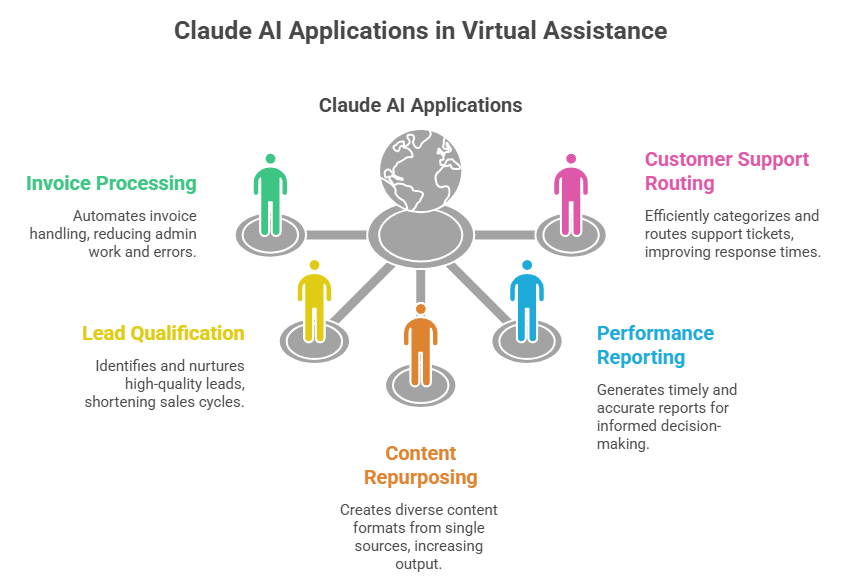
Virtual assistants use Claude AI to handle key business tasks through Skills, Computer Use, and Projects. They configure agents for invoice processing, lead qualification, content repurposing, performance reporting, and customer support routing. Research shows that automation can handle up to 80% of routine customer interactions and workflows. This delivers reliable automation with minimal human oversight for small businesses and agencies.
1. Invoice Processing (Operational)
The virtual assistant configures a Claude AI agent with a dedicated Skill and a computer uses to scan incoming PDFs, extract vendor details and amounts, cross-check against purchase orders in Google Sheets or QuickBooks, and route for approval or rejection. The agent logs everything in an audit trail and emails confirmations. This matters for businesses because it eliminates 10-15 hours of weekly admin work and reduces payment errors by over 90%.
2. Lead Qualification (Workflow-driven)
Virtual assistants set up a multi-agent system where Claude analyzes inbound form submissions or emails against ideal customer profiles stored in a Project. The agent scores leads, enriches data via browser tools, drafts personalized outreach, and books calendar slots. This matters because sales teams only receive high-quality opportunities, shortening sales cycles by 40% while maintaining brand voice.
3. Content Repurposing (Operational)
The VA creates a Skill that takes one long-form piece, breaks it into social posts, email newsletters, and blog summaries using the Project’s knowledge of brand tone. Claude then schedules via integrated tools. This matters because marketing output increases 5x without additional writers, keeping content consistent across channels.
4. Weekly Performance Reporting (Analytical)
Virtual assistants build an agent that pulls data from Google Analytics, CRM, and ad platforms using tools, analyzes trends with long-context reasoning, and generates executive summaries with charts in Google Slides. The agent flags anomalies and suggests actions. This matters because leadership receives accurate insights every Monday morning instead of waiting days for manual reports.
5. Customer Support Ticket Routing (Workflow-driven)
The VA trains Claude on past tickets via Projects and Skills. The agent reads new support emails or chat transcripts, categorizes urgency, drafts responses or escalates to humans, and updates the helpdesk. This matters because response times drop to under 30 minutes and customer satisfaction scores rise while support costs stay flat.
Tools and Systems Used Alongside Claude AI
Virtual assistants connect Claude via its API and MCP standard to Zapier or Make.com for no-code orchestration, Google Workspace or Microsoft 365 for documents and email, HubSpot or Salesforce for CRM, Slack or Teams for notifications, and QuickBooks or Xero for finance. Claude Cowork handles desktop apps directly; Skills provide native integration with Notion, Jira, and Figma. This stack keeps everything inside existing tools.
Step-by-Step Workflow Used by Virtual Assistants
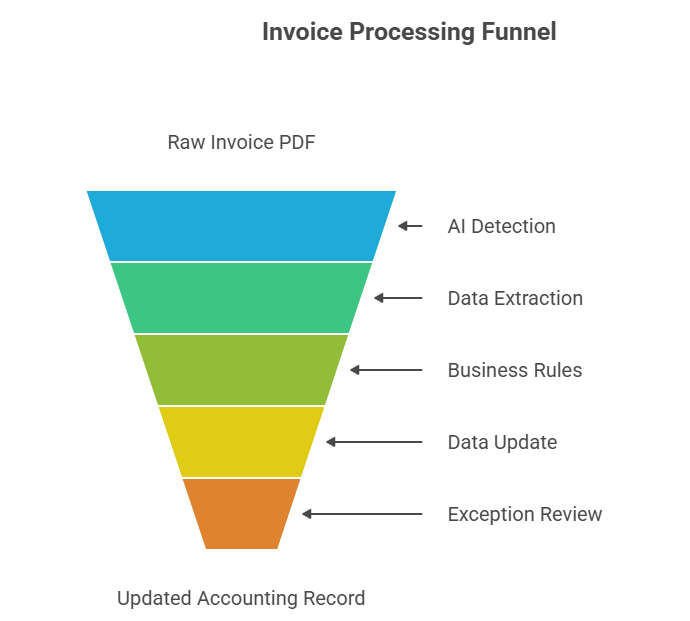
- A raw invoice PDF is received via email in a shared inbox, where the Claude AI agent automatically detects and initiates the processing of the end-to-end workflow automation.
- Claude Cowork handles desktop actions, while a Skills template and Google Sheets or QuickBooks APIs manage data processing and updates.
- The agent opens the email, extracts and verifies data, applies business rules, and posts the entry while flagging exceptions for review.
- The process results in an updated accounting record, an approval email, and a complete audit log.
- Processing time drops from 25 minutes per invoice to under 90 seconds, with the virtual assistant reviewing only exceptions (around 10% of cases).
Real Example (Use Case)
A UK digital agency with 12 staff processes 80 client reports monthly. The virtual assistant built a Claude AI agent team using Projects (brand voice + client data) and Skills (report template). The agent pulls metrics from Google Analytics and Meta Ads via tool use, analyzes trends, drafts full reports in Google Docs, and emails them. Outcome: report delivery time fell from 3 days to 4 hours; agency saved £4,200 monthly in freelancer fees and increased client retention by 25% through faster insights.
Common Challenges and Limitations
Claude agents still require human oversight for high-stakes financial or legal decisions because edge cases can trigger hallucinations. Computer use works best on standard interfaces; custom or legacy desktop apps may fail. Data privacy demands strict Project controls and enterprise plans. Long-running agents occasionally pause for clarification on ambiguous inputs, adding minor delays. Integration with highly regulated systems (banking APIs) needs extra compliance layers.
Benefits of Outsourcing to Virtual Assistants
Virtual assistants already master Claude’s prompt patterns, Skills creation, and exception handling, enabling them to design and deploy highly reliable AI agents tailored to specific business workflows. They implement agents in days instead of weeks, continuously monitor performance, and refine outputs through ongoing prompt optimization and exception management—without requiring internal teams to divert time or resources. This structured, AI for task management ensures consistent accuracy, compliance, and scalability across operations. As a result, businesses gain enterprise-grade automation at a fraction of the cost while maintaining full control over outcomes and performance.
| Benefit | In-House Approach | With TaskVirtual + Claude AI |
|---|---|---|
| Implementation Time | 8-12 weeks | 5-10 business days |
| Monthly Cost | $8,000–15,000 | $1,500–3,500 |
| Scalability | Requires new hires | Instant agent duplication |
| Oversight | Full-time management | Exception-based only |
| Maintenance | Ongoing developer work | Handled by the VA team |
| Time Saved on Routine Tasks | Minimal | 60-80% reduction |
Cost and Efficiency Comparison
In-house automation developer: $120k+ salary + 3-month build time. Manual team: full-time equivalent at $50k-70k per person with errors. VA + Claude AI: $2,000-3,500/month for full agent suite, live in 10 business days, 75% time reduction, near-zero errors on routine tasks. This approach delivers faster deployment and major cost savings for small businesses and agencies through an offshore virtual assistant service.
How Virtual Assistants Help Build AI Agents for Business Tasks
Virtual assistants help businesses turn Claude AI into practical agents that handle repeatable workflows with less manual effort. They build, test, monitor, and refine agents for tasks like invoice processing, lead qualification, reporting, and customer support.
- Virtual assistants create Claude Skills for repeatable business workflows through a wellness virtual assistant service.
- They build Projects with SOPs, brand rules, and company knowledge for context.
- They connect agents with CRMs, calendars, spreadsheets, and finance tools.
- They test prompts, set guardrails, and review outputs for accuracy and safety.
- They monitor exceptions and update agents when workflows or rules change.
- They document results, performance, and savings for better process decisions.
TaskVirtual: Your Partner in Claude AI Agent Implementation

Managing complex business automation like invoice processing, lead qualification, and performance reporting can overwhelm small teams. From configuring Claude Skills to monitoring agent outputs and handling exceptions, the process demands specialized expertise and ongoing oversight. TaskVirtual provides expert Claude AI virtual assistant services that simplify implementation by helping businesses build, deploy, and maintain reliable AI workflows with ease.
1. Expert Consultation and Review
TaskVirtual’s skilled virtual assistants assist in auditing existing processes, designing custom Claude Skills and Projects, and configuring Cowork for desktop automation. They also help refine prompts, set guardrails, and integrate with tools like Google Workspace and CRMs to ensure agents perform accurately from day one.
2. Affordable and Flexible Pricing
Hiring a full-time automation specialist can be expensive, but TaskVirtual makes it cost-effective. With pricing plans starting from just $3.12/hour to $14.99/hour, their services are budget-friendly and accessible to small businesses and agencies. This allows quick adoption of Claude AI agents without high upfront costs.
3. Comprehensive Grocery Support Solutions
From creating smart shopping lists and comparing prices across multiple platforms to handling subscriptions and reorders, TaskVirtual covers it all. Their scalable services adapt to whether you need occasional help or consistent grocery management support. (Adapted to context: From building multi-step agent workflows and tool integrations to ongoing optimization and exception handling, TaskVirtual covers full Claude AI automation needs.)
4. Ongoing Support and Quality Assurance
TaskVirtual goes beyond initial setup by offering constant monitoring, performance reviews, and prompt updates through art prompt generators. Their proactive support ensures agents run smoothly, exceptions are handled promptly, and workflows continue delivering results without disruption. This keeps Claude AI automation reliable and efficient for growing businesses.
5. Proven Track Record of Excellence
With 364 positive reviews and a 4.7-star rating on trusted VA platforms, TaskVirtual is recognised as a reliable partner worldwide. Clients count on their expertise to simplify Claude AI implementation and streamline business tasks. This proven reliability makes them a trusted choice for businesses adopting Claude AI agents.
Conclusion
Claude AI agents, operated by skilled virtual assistants, turn business tasks into reliable, scalable automation. The combination delivers measurable efficiency and cost wins for small businesses and agencies ready to move beyond chatbots to true agentic workflows. This approach enables faster growth with minimal overhead.
Key Takeaways
- Claude AI agents handle real desktop and app actions via computer use and Skills.
- Virtual assistants build and maintain these agents in 1-2 weeks at low cost.
- Operational, analytical, and workflow tasks see 60-80% time savings.
- Existing tools integrate without new software purchases.
- Human oversight stays focused on exceptions only.
FAQ Section
1. What is the difference between Claude Chat and Claude agents?
Agents use Skills, computer use, and autonomous loops for multi-step execution; Chat is single-turn.
2. Do I need coding skills to build Claude AI agents?
No—virtual assistants handle all configuration using natural language and Claude’s built-in tools.
3. How secure is business data inside Claude Projects?
Enterprise plans offer SOC 2 compliance, data encryption, and admin controls.
4. Can Claude agents work with my existing CRM and accounting software?
Yes, via API tool use or direct desktop control.
5. What happens when an agent encounters an exception?
It pauses, notifies the virtual assistant, and logs the issue for review.
For more queries, visit our website.
 Siddhartha Basu is a Technical Writer at Task Virtual. He loves online games, e-book reading, and Yoga.