
Contents
show
Outsourcing vs. Hiring In-House: A Real Cost and Capacity Comparison for Growing Businesses
Growing US businesses face a critical capacity decision every time workload spikes or new functions emerge: build an in-house team or outsource? The sticker price of a salary rarely tells the full story. Hidden burdens – benefits, recruitment, overhead, ramp-up time, and fixed capacity – often push the true cost of an employee well beyond the offer letter. Meanwhile, outsourced options (freelancers, agencies, or managed virtual teams) convert fixed costs into variable ones and scale capacity without long-term commitments.
In 2026, with tighter labor markets, rising benefits costs, and flexible work models, the outsourcing vs hiring in-house choice is less about ideology and more about total cost of ownership and operational flexibility. This guide delivers a practical total-cost formula, side-by-side comparisons of employees, freelancers, agencies, and managed teams, real founder/ecommerce/service-firm scenarios, clear conditions when in-house wins, and a decision matrix you can apply immediately. All figures draw from authoritative sources such as the Bureau of Labor Statistics and SHRM benchmarks.
The Total-Cost Formula for Accurate Comparison
Calculating true workforce expense requires looking past base pay to capture every related outlay. Businesses that skip this step routinely underestimate in-house commitments and overlook flexible alternatives. TaskVirtual provides the Virtual Assistant support that helps teams gather accurate cost data without adding permanent headcount.
1. Breaking Down the Fully Loaded Cost Components
Most founders stop at base salary and thereby understate the real burden of an in-house hire by 30 – 40 percent or more. A complete total-cost formula for a full-time US employee includes base salary plus employer payroll taxes, benefits, recruiting and onboarding amortized over time, equipment and software, workspace or overhead, management oversight time, training, and a turnover risk buffer.
According to the Bureau of Labor Statistics, private-industry employers paid an average of $46.89 per hour in total compensation in June 2026, with benefits representing roughly 30 percent of that figure. Outsourcing the virtual personal Assistant role to handle routine data collection while founders focus on the higher-level formula itself. SHRM benchmarks also show average non-executive cost-per-hire at $5,475, a figure that must be spread across the role’s expected tenure.
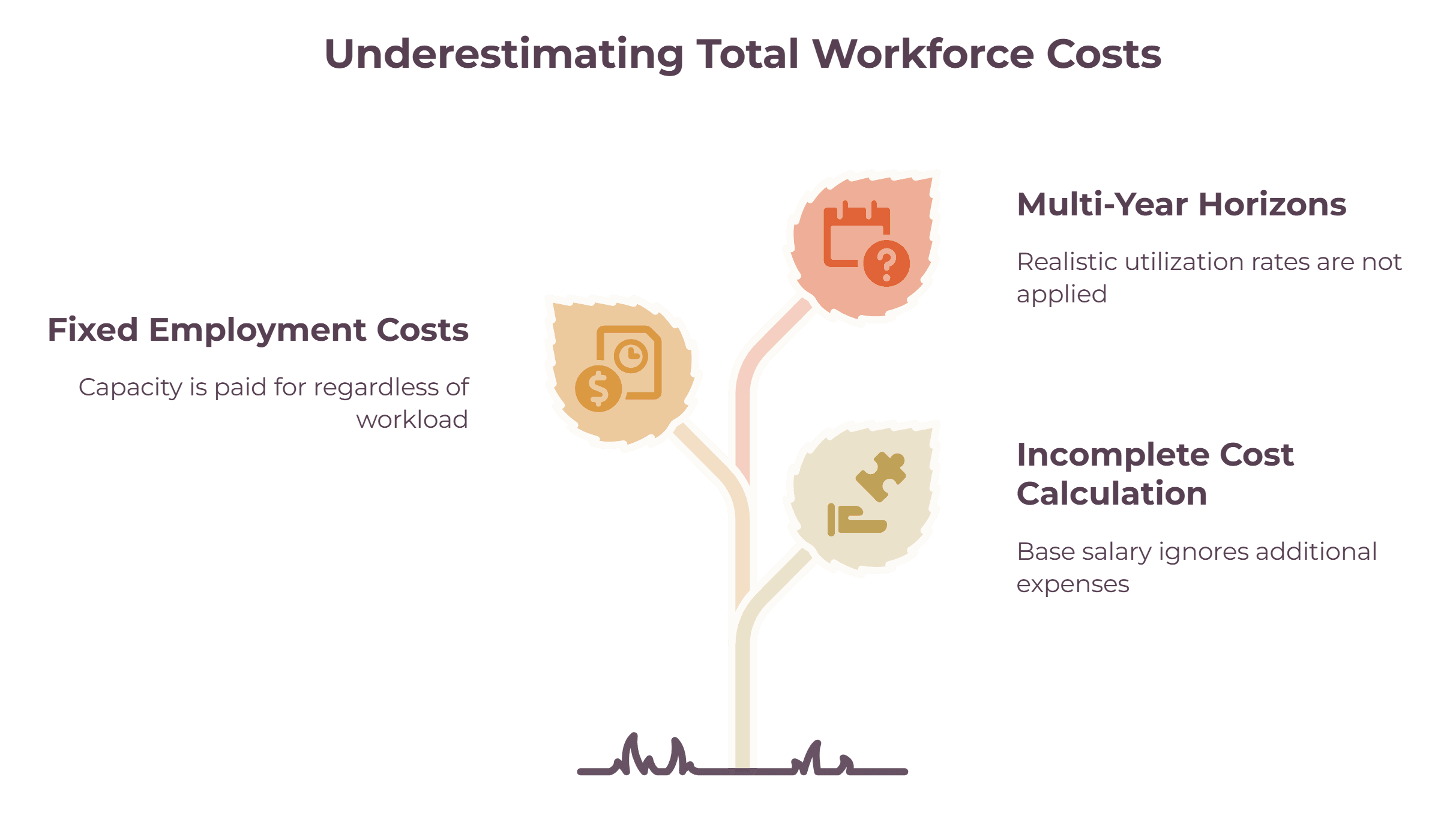
2. Fixed Employment Costs Versus Variable Service Models
Recruiting and onboarding are not one-time footnotes; early turnover multiplies their impact and extends the period of reduced productivity. Workspace, even in hybrid arrangements, equipment, software licenses, and the opportunity cost of managers spent on HR tasks further inflate the loaded number. A practical rule of thumb used by many US finance teams is a 1.25x–1.4x base-salary multiplier before adding recruiting amortization and overhead.
TaskVirtual provides the Digital Marketing insight that allows growing firms to model these multipliers against campaign-driven capacity needs. In contrast, outsourced models typically fold recruitment, benefits, equipment, and day-to-day supervision into a single monthly or hourly fee, removing employer payroll taxes, FICA matches, and long-term severance exposure.
3. Multi-Year Horizons and Utilization Reality
Capacity under an employment model remains fixed: the company pays for a full schedule whether workload fills those hours or not. Outsourced arrangements convert that fixed commitment into variable cost aligned with actual demand. When both formulas are projected over a 24–36 month horizon, and realistic utilization rates are applied, the economic picture becomes far clearer than a simple salary-versus-rate comparison.
TaskVirtual provides the Facebook Marketing & Ads expertise that helps ecommerce and service teams test these multi-year models against real advertising-driven volume swings. The difference in risk profile—permanent employment cost versus flexible service cost—often determines which path protects cash flow during growth phases.
Employee, Freelancer, Agency, and Managed Team Compared

Four distinct models sit on a spectrum of control, cost structure, and capacity flexibility. Choosing among them requires matching the nature of the work to the level of integration and predictability needed. The Instagram Marketing & Ads support lets companies pilot each model on discrete campaigns before committing long-term resources.
1. In-house employee
- Highest level of direct control and cultural integration with the core team.
- Fully loaded annual costs routinely reach 1.3–1.5 times base salary once benefits, taxes, equipment, and amortized recruiting are included.
- Capacity remains fixed; the organization pays for scheduled hours regardless of actual workload.
- Ramp-up to full productivity commonly takes three to six months and carries ongoing training expense.
- Best suited for core, ongoing roles that demand deep institutional knowledge or constant real-time collaboration; TaskVirtual provides the LinkedIn Marketing & Ads coordination that can complement internal staff on professional outreach without expanding permanent payroll.
2. Independent freelancers
- Lower fixed cost and high day-to-day flexibility because payment occurs only for hours or completed deliverables.
- Rates vary by skill and location, yet the arrangement avoids benefits, most employment taxes, and long-term commitments.
- Quality and availability can fluctuate, placing greater coordination effort on the founder or project lead.
- Ideal for project-based or specialized bursts of work where institutional knowledge transfer is secondary.
- Limited continuity of knowledge across engagements increases the risk of repeated onboarding.
3. Traditional agency
- Agencies supply vetted talent, project management, and specialized functional expertise such as marketing or accounting.
- Pricing sits higher than pure freelancers because of the agency markup and dedicated account-management layer.
- Clients gain process maturity and backup coverage but may encounter additional communication layers.
- Works well when a complete function is required without the desire to build internal capability from scratch.
- Scope changes can trigger change-order costs that erode the original budget advantage; TaskVirtual provides the virtual assistant services that agencies sometimes outsource further, creating extra hand-offs.
4. Managed outsourced or virtual team
- Dedicated full-time or part-time professionals employed by a third-party provider who work primarily for the client company.
- The provider handles recruitment, HR administration, equipment, and day-to-day supervision under a single invoice.
- US companies frequently realize 50–70 percent or greater cost reduction versus an equivalent domestic in-house role for administrative, support, or specialized functions.
- Capacity scales with relatively short notice while administrative burden remains low.
- Oversight is still required, yet the model reduces fixed employment risk; TaskVirtual provides the Social Media Marketing capacity that managed teams can deliver at predictable monthly rates.
Founder, Ecommerce, and Service-Firm Scenarios
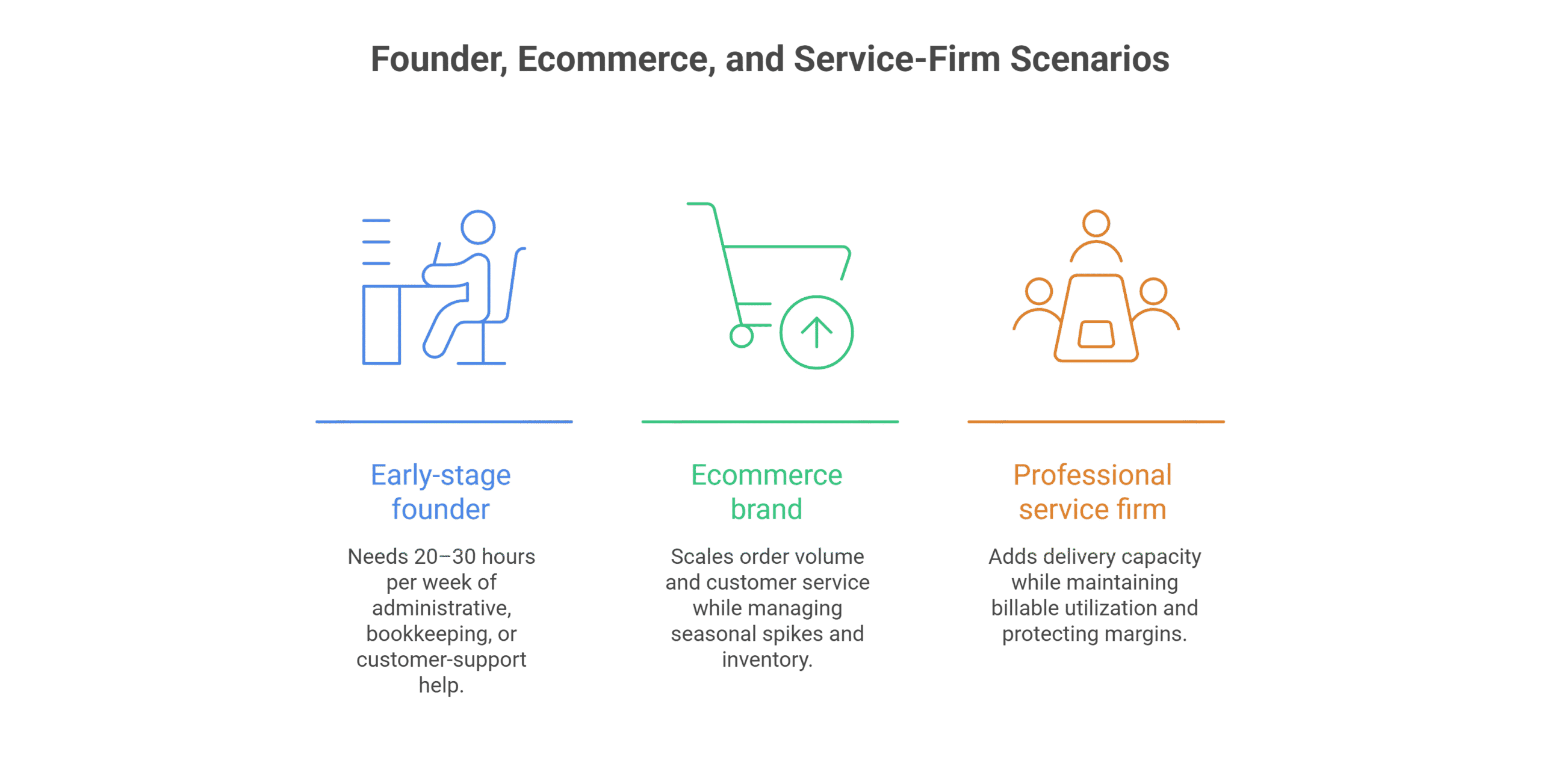
Real-world application of the cost formulas reveals different inflection points depending on company stage and demand patterns. Founders, ecommerce operators, and professional service firms each face unique utilization and cash-flow pressures. TaskVirtual provides the SEO Services that surface these patterns early through data-driven traffic and conversion analysis.
1. Early-stage founder or solopreneur scaling operations
A founder needing 20–30 hours per week of administrative, bookkeeping, or customer-support help often finds a full-time in-house hire premature. The fully loaded cost of even a mid-level admin role can exceed $70,000–$100,000 annually once benefits and overhead are included. A part-time or full-time virtual team member or managed service at a fraction of that cost frees founder time without locking in fixed payroll.
Many founders start with freelancers or a managed virtual assistant and only bring roles in-house once the function becomes core and volume justifies the fixed cost. Providing the Website Design Services that allow early-stage teams to launch professional sites without hiring permanent design staff.
2. Ecommerce brand scaling order volume and customer service
Seasonal spikes make fixed headcount expensive. An in-house customer-support team carries full benefits, training, and idle capacity in slower months. Outsourced or nearshore managed teams convert that into variable cost aligned with order volume. Accounting and inventory-related bookkeeping follow the same logic: outsourced accounting versus in-house hiring frequently shows 40–60 percent savings for growing brands that do not yet need a full controller on payroll.
The key risk is quality control and brand voice consistency—mitigated by clear SOPs, shared tools, and regular calibration calls. TaskVirtual provides the Website Development resources that keep storefronts stable during peak traffic without expanding permanent engineering headcount.
3. Professional service firm or agency adding delivery capacity
Billable utilization drives service-firm margins, so junior staff hired in-house often remain non-billable during lengthy ramp-up while still carrying full benefits and recruiting costs. Outsourcing specialized delivery or non-billable support protects those margins and keeps core client-facing talent internal.
Firms that over-hire relative to pipeline frequently find hybrid models more economical. TaskVirtual provides the Data Handling support that lets professional firms clean and organize client information without adding permanent analysts.
When In-House Hiring Wins
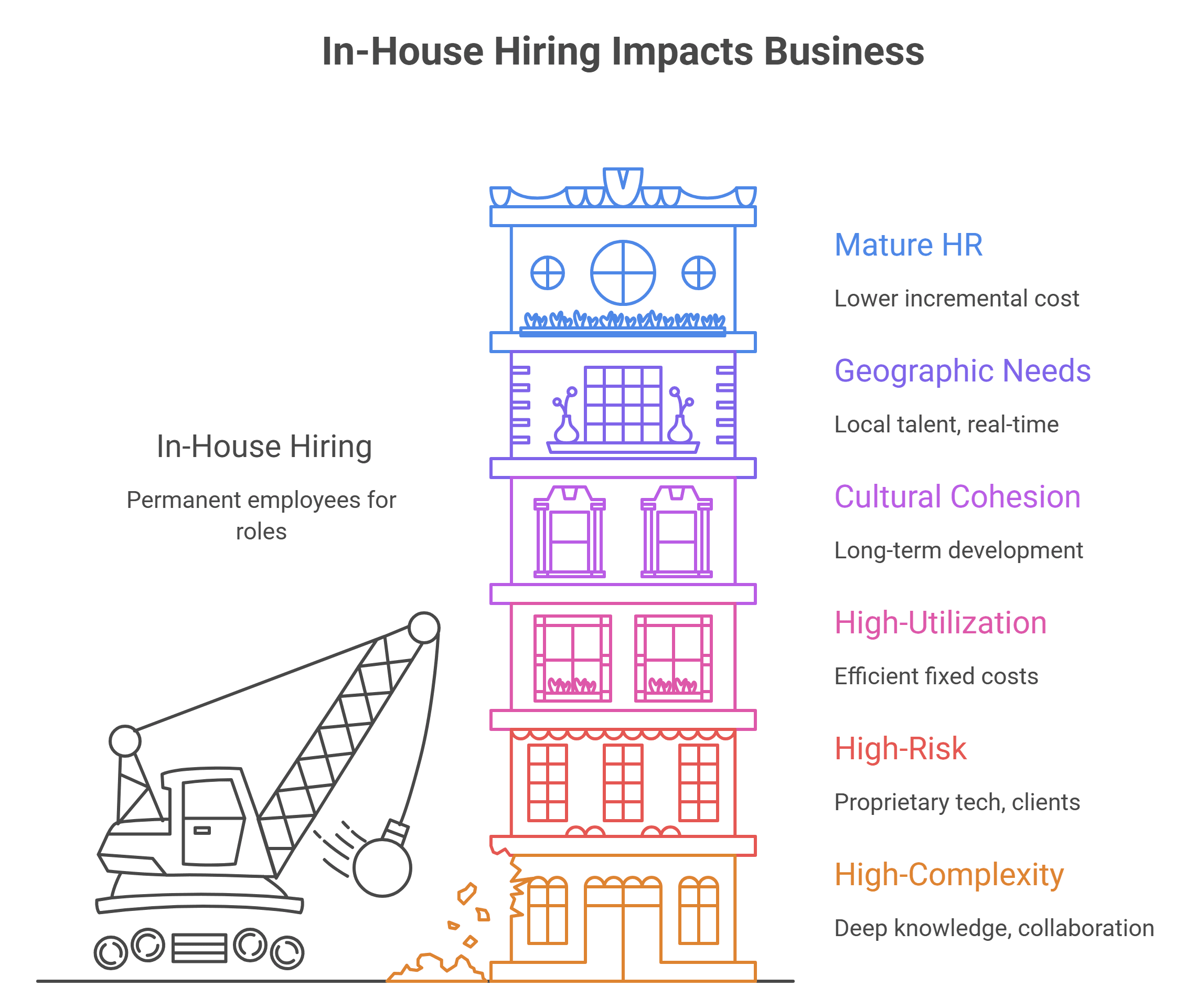
Outsourcing delivers clear advantages in flexibility and loaded-cost reduction, yet certain conditions favor permanent employees. Understanding these conditions prevents under-investment in roles that truly require deep integration. TaskVirtual provides the Virtual Receptionist coverage that can bridge gaps while leadership evaluates whether a full in-house hire is justified.
- High-complexity or high-trust work that depends on deep institutional knowledge and frequent cross-functional collaboration performs better with employees who share cultural context and overlapping schedules.
- Roles tied to proprietary technology, sensitive client relationships, or regulated processes often carry elevated risk or compliance friction when performed externally.
- Consistently high and predictable utilization near 90 percent or above makes the fixed cost of an employee more efficient than paying a flexibility premium that is rarely used.
- Long-term cultural cohesion and deliberate employee development can justify higher loaded costs when retention remains strong and institutional knowledge compounds over years.
- Geographic or same-time-zone requirements sometimes make local talent the only practical option for real-time decision-making.
- Companies that already possess mature HR infrastructure, recruiting capability, and management bandwidth experience lower incremental cost when adding headcount.
Decision Matrix: Cost, Capacity, Control, and Risk

A structured scoring approach removes emotion from the outsourcing-versus-hiring choice and surfaces the option that best matches current priorities. Weight each dimension according to cash position, growth stage, and operational complexity. TaskVirtual provides the Bookkeeping Services that generate the clean financial data needed to score cost and capacity accurately.
Use this practical matrix to score options for a specific role or function. Rate each dimension 1–5 (higher is better for your priorities) and weight according to your current stage and constraints.
| Dimension | In-House Employee | Freelancer | Agency | Managed Virtual Team |
|---|---|---|---|---|
| Fully loaded cost | Low–Medium | High | Medium | High |
| Capacity flexibility | Low | High | Medium–High | High |
| Control & integration | High | Low–Medium | Medium | Medium |
| Time-to-productivity | Medium–Low | Medium | Medium–High | Medium–High |
| Management overhead | Medium | High | Low–Medium | Low–Medium |
| Quality consistency | High (if retained) | Variable | Medium–High | Medium–High |
| Long-term knowledge | High | Low | Low–Medium | Medium |
| Risk (turnover, compliance) | Medium | Medium | Low–Medium | Low–Medium |
TaskVirtual: Your Partner in Managed Virtual Team Solutions

Building the right team capacity while controlling operational costs is one of the biggest challenges for growing businesses. Hiring full-time employees often comes with additional expenses like recruitment, benefits, training, equipment, and long-term commitments. TaskVirtual helps businesses overcome these challenges by providing reliable managed outsourced business operations that offer skilled professionals without the burden of expanding permanent in-house teams.
1. Expert Virtual Team Consultation and Workforce Support
TaskVirtual’s experienced virtual assistants help businesses identify the right support model based on workload, budget, and operational requirements. From administrative assistance and customer support to specialized business functions, their professionals integrate seamlessly with existing teams while helping companies maintain productivity and flexibility.
2. Cost-Effective Alternative to Traditional Hiring
Expanding an in-house team requires significant investment beyond salaries, including payroll costs, employee benefits, recruitment expenses, and infrastructure. TaskVirtual provides a more affordable solution with flexible pricing plans starting from just $3.12/hour to $14.99/hour, allowing businesses to access skilled support while reducing fixed employment costs.
3. Scalable Solutions for Growing Businesses
Whether a company needs part-time assistance during busy periods or dedicated ongoing support, TaskVirtual offers scalable virtual team solutions that adjust according to business demands. Their services help startups, build ecommerce brands, and professional firms increase capacity without the limitations of fixed headcount.
4. Reliable Support With Quality Assurance
TaskVirtual focuses on maintaining consistency, communication, and operational efficiency through trained professionals and structured workflows. Businesses can delegate routine and specialized tasks while maintaining quality standards, allowing internal teams to focus on strategic priorities and core growth activities.
5. Trusted Partner for Flexible Business Growth
With 364 positive reviews and a 4.7-star rating on trusted VA platforms, TaskVirtual is recognised as a dependable virtual assistance partner worldwide. Companies rely on their expertise to reduce operational costs, improve efficiency, and build flexible workforce models without the challenges of traditional hiring.
FAQ
1. What is the real cost difference between hiring an employee and outsourcing the same role?
Fully loaded in-house costs commonly run 1.3–1.5× base salary once benefits (≈30% of total compensation per BLS), taxes, recruiting, and overhead are included. Managed outsourced or virtual-team equivalents often deliver 40–70% savings depending on role and location, primarily by eliminating benefits and fixed overhead.
2. Is outsourcing always cheaper than in-house hiring?
No. When utilization is high and stable, the function is core, or collaboration intensity is extreme, in-house can be more efficient. Flexibility and lower fixed costs make outsourcing cheaper for variable or non-core work.
3. How do benefits and payroll taxes affect the comparison?
BLS data show benefits averaging about 30% of total private-industry compensation. Employer payroll taxes (FICA, unemployment, workers’ compensation) add further cost that outsourced providers absorb.
4. What about quality and control with outsourced teams?
Quality depends on provider selection, clear SOPs, shared tools, and regular performance reviews. Many companies achieve comparable or higher consistency with managed teams than with under-managed in-house hires.
5. When should a growing business start building in-house teams?
When a function becomes core to competitive advantage, utilization stays consistently high, and the company has the management bandwidth and cash runway to absorb fixed costs and ramp-up time.
6. How does outsourced recruiting compare with in-house hiring teams?
Recruitment process outsourcing or specialized agencies can lower cost-per-hire and speed for moderate hiring volumes. Building a full in-house recruiting function becomes economical only at higher sustained hiring rates.
Conclusion and Next Steps
The outsourcing vs hiring in-house decision is ultimately a total-cost and capacity question, not a binary ideology. Run the fully loaded formula, map your utilization patterns, score the decision matrix against your actual priorities, and test hybrid models. For many growing US businesses in 2026, the highest-ROI path combines a lean core in-house team with flexible outsourced or virtual-team capacity for everything else.
Start by calculating the true annual cost of your next planned hire using the formula above. Then request side-by-side proposals from two or three managed-team or agency providers for the same scope. The numbers—and the resulting capacity flexibility—usually make the choice clearer than expected.
Sources
- U.S. Bureau of Labor Statistics, Employer Costs for Employee Compensation (June 2026 and related releases)
- SHRM 2025 Benchmarking Report (cost-per-hire data)
- Additional BLS Occupational Employment and Wage Statistics and compensation trend releases
For more such content, visit our website.
 Siddhartha Basu is a Technical Writer at Task Virtual. He loves online games, e-book reading, and Yoga.