Contents
show
Claude AI Virtual Assistant for Real-Time Inventory and Supply Chain Insights
Claude AI powers advanced inventory management and supply chain optimization for small businesses. It analyzes large datasets, accurately forecasts demand, and automates decision-making when paired with virtual assistants. US and UK startups and entrepreneurs use this combination to cut costs and improve efficiency without large in-house teams.
Small businesses often face stockouts that result in lost sales or excess inventory that ties up capital. Research indicates that up to 20% of shoppers will switch to a competitor when faced with a stockout, directly impacting revenue and customer retention. Traditional methods rely on spreadsheets and manual reviews, leading to errors and delays. Claude AI changes this by processing historical sales, seasonality, and external factors quickly. Virtual assistants handle data entry, prompt engineering, and exception handling, delivering practical results within days.
| Aspect | Manual / In-House Approach | Virtual Assistant + Claude AI |
|---|---|---|
| Monthly Cost | $8,000 – $15,000 | $1,200 – $2,500 |
| Setup Time | 3–6 months | 1–2 weeks |
| Forecasting Accuracy | 70–80% | 85–95% |
| Analysis Time per Week | 20–40 hours | 2–4 hours |
| Scalability | Limited by staff | Handles growing SKUs instantly |
What This Means for Businesses
Accurate demand planning prevents lost revenue from stockouts while reducing holding costs. Procurement optimization shortens ordering cycles, while warehouse optimization lowers labor expenses. For small US/UK businesses, this translates into stronger cash flow and a competitive edge without heavy investment—many choose to have these processes handled by experienced virtual assistants to achieve faster results. Real implications include a 25–40% reduction in overstock and quicker responses to market changes.
How This Actually Works
Claude AI accepts uploaded CSV files, Excel reports, or API-connected data in its large context window (up to 1 million tokens). It identifies patterns, runs statistical forecasts, simulates scenarios, and explains reasoning step-by-step. Research shows that organizations using advanced analytics are over 65% more likely to make faster and more effective decisions, underscoring the impact of data-driven tools in operations. Virtual assistants craft precise prompts, review outputs, and integrate results into business systems. It works because Claude handles complex, interconnected data in one conversation, reducing errors common in fragmented tools. Businesses benefit from transparent logic that supports quick human approval.
Core Capabilities of Claude AI for This Use Case
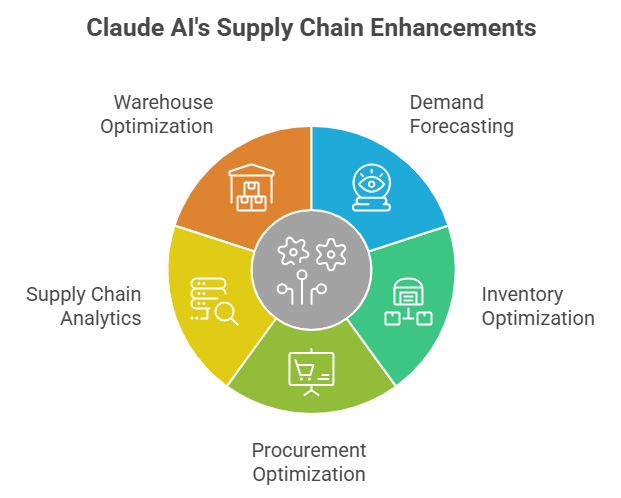
Claude AI handles key supply chain tasks by analyzing sales data for accurate demand forecasting, inventory optimization, and procurement recommendations. Virtual assistants upload CSV files; Claude generates SKU forecasts, calculates reorder points, runs ABC analysis, and simulates scenarios. This reduces overstock, shortens ordering cycles, and improves efficiency for small US/UK businesses.
1. Demand Forecasting with Claude AI
It processes 12-24 months of sales history, seasonality, promotions, and trends to generate SKU-level predictions with confidence intervals. In practice, virtual assistants upload raw data and ask for weekly or monthly forecasts. Claude outputs numbers plus narrative explanations of influencing factors. This matters because small businesses avoid both shortages that frustrate customers and overstock that wastes capital. Accuracy often reaches 85-95% with clean data, far above manual guesses.
2. Inventory Optimization and Stock Management Automation
Claude calculates economic order quantity (EOQ), safety stock levels, and performs ABC classification automatically. Virtual assistants feed current stock, lead times, and sales volatility through inside sales virtual assistant. Claude recommends reorder points and quantities while flagging slow-moving items. Businesses gain better cash flow and space utilization. This capability directly cuts carrying costs by 20-35% in typical retail or e-commerce setups.
3. Procurement Optimization
Claude reviews supplier quotes, lead times, minimum order quantities, and risk factors to rank the best options. VAs compile vendor data; Claude drafts purchase orders and suggests negotiation points. It matters for cost control—procurement cycles shrink from days to hours, and total spend drops through smarter sourcing.
4. Supply Chain Analytics and Scenario Modeling
With its massive context, Claude analyzes full datasets to build “what-if” models for disruptions, price changes, or demand spikes. Virtual assistants request specific simulations. Outputs include tables, risk assessments, and prioritized actions. This helps entrepreneurs make data-backed decisions fast, improving resilience.
5. Warehouse Optimization and Logistics Automation
Claude examines transaction logs and warehouse layouts to suggest better picking paths or slotting. VAs input operational data; Claude identifies bottlenecks. Resulting efficiency gains reduce labor hours by 10-20% and speed fulfillment.
Why Companies Use Claude AI
Claude AI delivers efficiency by turning hours of analysis into minutes. Cost reduction comes from lower staffing needs and minimized waste, with studies showing that businesses adopting AI-driven automation can reduce operational costs by up to 60%. Scalability allows growing businesses to handle thousands of SKUs without proportional headcount increases. Small teams focus on strategy while AI handles routine calculations.
Tasks Virtual Assistants Perform Using Claude AI
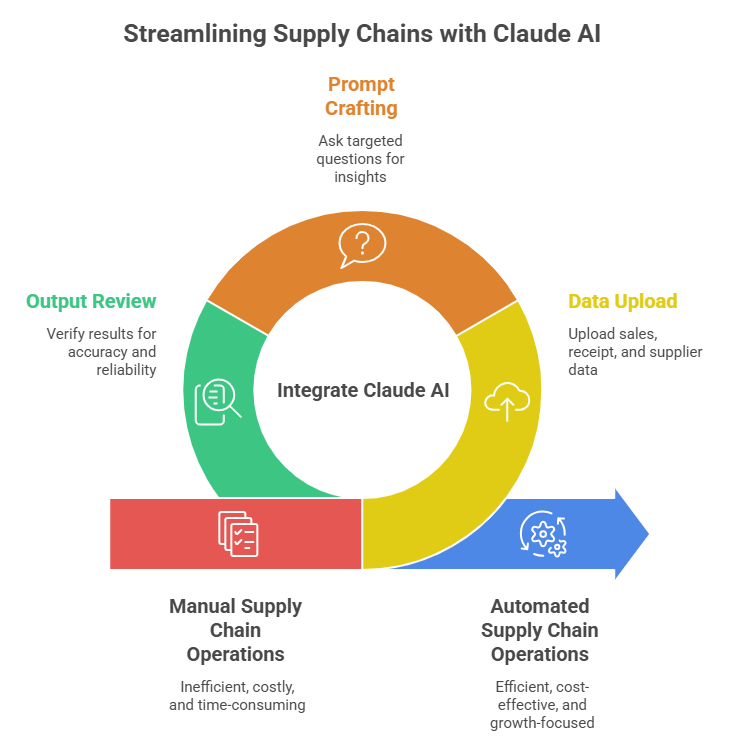
Virtual assistants integrate Claude AI into daily supply chain operations by uploading data, crafting prompts, and reviewing outputs for reliable results. They handle stock monitoring, demand financial forecasting, procurement automation, and ABC analysis through simple file uploads and targeted questions. This approach keeps inventory lean, reduces costs, and frees small US/UK businesses to focus on growth instead of manual tracking.
1. Stock Monitoring and Replenishment
The VA uploads daily sales and receipt data into Claude AI. Claude scans for low-stock items, calculates optimal reorder quantities based on lead times and demand variability, and flags urgent actions. This prevents stockouts that cause lost sales and maintains service levels without constant manual checks. Businesses keep inventory lean and customers satisfied.
2. Demand Planning and Forecasting
VAs collect and clean 12-month sales history plus external factors, then prompt Claude AI for detailed forecasts. Claude produces per-SKU predictions, trend analysis, and adjustment recommendations for seasonality or promotions. Accurate planning ensures production or purchasing aligns with actual market needs. This reduces excess inventory carrying costs significantly for startups and small agencies.
3. Procurement Workflow Automation
The VA gathers supplier quotes, delivery terms, and historical performance data. Using Claude AI, they generate ranked recommendations and draft purchase order templates with built-in cost comparisons. Faster, smarter procurement shortens cycles and lowers material costs. Businesses negotiate better and avoid rush orders.
4. Logistics and Route Optimization
VAs input shipment volumes, destinations, and carrier rates. Claude AI suggests optimized routes and alerts on potential delays using pattern recognition. Improved logistics cut transportation expenses by 10-15% while enhancing on-time delivery rates. This is critical for e-commerce entrepreneurs competing on speed.
5. ABC Analysis and Inventory Policy Setting
The VA feeds transaction data into Claude. Claude classifies items into A, B, and C categories and recommends tailored management policies for each. Focused attention on high-value SKUs improves overall control and profitability. Small businesses allocate resources efficiently instead of treating all stock equally.
Tools and Systems Used Alongside Claude AI
Common integrations include Google Sheets or Excel for initial data staging, Zapier or Make.com for automated uploads from Shopify, QuickBooks, or ERP systems. Claude’s web or API interface handles core processing. Export tools push results back to the inventory software. These connections create seamless workflows where virtual assistants trigger actions with minimal manual effort.
Step-by-Step Workflow Used by Virtual Assistants
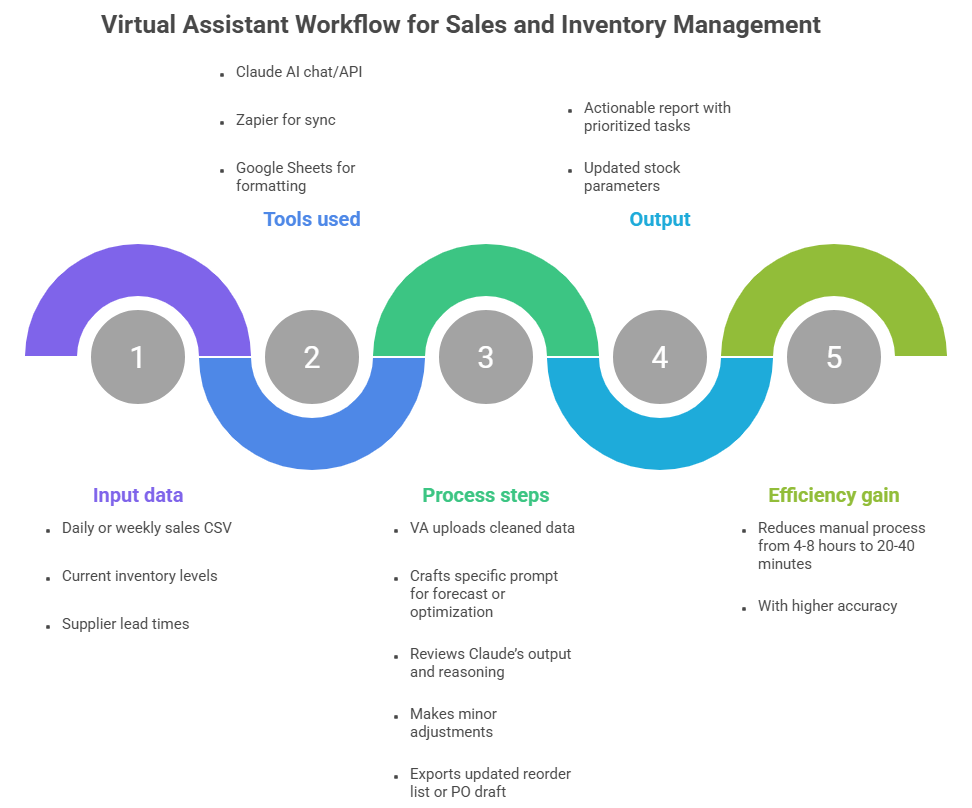
- Input starts with daily or weekly sales CSV, current inventory levels, and supplier lead times.
- Tools used include Claude AI chat/API, Zapier for sync, and Google Sheets for formatting.
- Process steps involve the VA uploading cleaned data, crafting a specific prompt for forecast or optimization, reviewing Claude’s output and reasoning, making minor adjustments, and then exporting the updated reorder list or PO draft.
- Output is an actionable report with prioritized tasks and updated stock parameters.
- Efficiency gain reduces the manual process from 4-8 hours to 20-40 minutes with higher accuracy.
Real Example (Use Case)
A UK-based e-commerce startup selling 300 SKUs in fashion accessories faced frequent overstock and occasional stockouts. They engaged a virtual assistant using Claude AI. The VA uploads sales data weekly. Claude delivered forecasts with 92% accuracy. Over three months, excess inventory dropped 42%, stockouts fell 28%, and the business saved approximately $18,000 in holding and lost sales costs. The team shifted focus from firefighting to growth activities.
Common Challenges and Limitations
Claude AI requires clean, structured data—messy or incomplete files lead to unreliable outputs. While the 1M token context helps, very large real-time streams may need additional processing layers. Occasional hallucinations can occur on sparse historical data, requiring VA validation. No native real-time database connection exists without custom API work. Seasonal spikes or black swan events still need human oversight for final decisions. Integration setup demands an initial time investment.
Benefits of Outsourcing to Virtual Assistants
Virtual assistants bring domain knowledge in AI prompting and supply chain basics. They handle repetitive data prep and review, ensuring Claude AI outputs stay practical. Outsourcing provides 24/7 coverage at a lower cost than full-time analysts. Businesses gain expertise without recruitment overhead while maintaining control through regular reporting.
Cost and Efficiency Comparison
An in-house analyst plus tools often exceeds $120,000 annually, with a slower ramp-up. Virtual assistant plus Claude AI access totals around $18,000-30,000 per year. Execution is 80-85% faster, error rates drop 30-40%, and scalability comes built-in. Small businesses achieve professional-grade optimization without fixed high salaries.
How virtual assistants help in Real-Time Inventory and Supply Chain Insights

Virtual assistants help businesses turn Claude AI outputs into practical inventory and supply chain actions. They manage data, forecasts, stock alerts, and procurement insights so teams can make faster, more accurate decisions.
- Virtual assistants upload sales, stock, and supplier data into Claude AI through virtual sales assistants.
- They clean inventory files so forecasts, reorder points, and reports stay accurate.
- They monitor stock levels, flag shortages, and prepare timely reorder lists.
- They review demand forecasts and adjust insights for seasonality and promotions.
- They compare supplier quotes, lead times, and risks for smarter procurement.
- They turn Claude AI insights into clear reports for faster supply chain decisions.
TaskVirtual: Your Partner in Supply Chain Optimization

Managing inventory levels, demand forecasts, and procurement decisions can overwhelm small business owners. From handling messy sales data to making timely reorder calls, these tasks consume hours better spent on growth. TaskVirtual provides expert virtual Claude AI assistants who use Claude AI to streamline inventory and supply chain optimization with precision and speed.
1. Expert Consultation and Review
TaskVirtual’s skilled data entry virtual assistants handle data preparation, craft effective prompts for Claude AI, and review all forecasts and recommendations. They ensure accurate demand planning, stock optimization, and procurement automation tailored to your business needs.
2. Affordable and Flexible Pricing
Hiring a full-time supply chain analyst can be expensive, but TaskVirtual makes it cost-effective. With pricing plans starting from just $3.12/hour to $14.99/hour, their services are budget-friendly and accessible to individuals, families, and businesses.
3. Comprehensive Grocery Support Solutions
From uploading sales data and generating Claude AI forecasts to automating reorder lists and scenario modeling, TaskVirtual covers full inventory and supply chain workflows. Their scalable services adapt to whether you need occasional support or daily management.
4. Ongoing Support and Quality Assurance
TaskVirtual goes beyond initial setup by providing continuous monitoring, exception handling, and weekly performance updates. Their proactive approach keeps your supply chain running smoothly with minimal disruption.
5. Proven Track Record of Excellence
With 364 positive reviews and a 4.7-star rating on trusted VA platforms, TaskVirtual is recognised as a reliable partner worldwide. Clients count on their expertise to simplify inventory management and streamline supply chain operations.
Conclusion
Claude AI, combined with virtual assistants, transforms inventory and supply chain management from reactive to proactive. Small businesses and startups achieve forecasting precision, cost savings, and operational speed that were previously out of reach.
Key Takeaways
- Claude AI enables accurate, explainable demand forecasting using large context windows.
- Virtual assistants manage data quality and workflow integration for reliable results.
- Typical outcomes include 25-40% inventory cost reductions and faster procurement.
- Setup is fast and scalable compared to building in-house teams.
- Success depends on clean data and periodic human review of AI outputs.
FAQ Section
1. How accurate is Claude AI for inventory forecasting?
With 12+ months of clean data, accuracy typically reaches 85-95%, outperforming manual methods.
2. Do businesses need technical skills to use this?
No. Virtual assistants handle prompting, data formatting, and integrations.
3. What minimum data is required to start?
Sales history, current stock levels, and supplier lead times are essential starting points.
4. Can Claude AI connect directly to Shopify or QuickBooks?
Yes, through Zapier or custom API setups managed by the VA.
5. Is business data kept secure?
Enterprise plans and NDAs with VA providers ensure data protection and compliance.
For more queries, visit our website.
 Siddhartha Basu is a Technical Writer at Task Virtual. He loves online games, e-book reading, and Yoga.