Contents
show
Can I Use ChatGPT for Social Media Strategy Planning
Social media strategy planning in 2026 requires speed, structure, and adaptability across multiple platforms. As content demands increase and algorithms evolve, marketers and businesses are turning to AI-powered tools to streamline planning and decision-making. ChatGPT has emerged as a practical assistant that supports social media strategy development by organizing ideas, improving consistency, and accelerating execution planning. Rather than replacing marketers, it enhances how strategies are built and refined.
How ChatGPT Fits Into Modern Social Media Strategy Planning
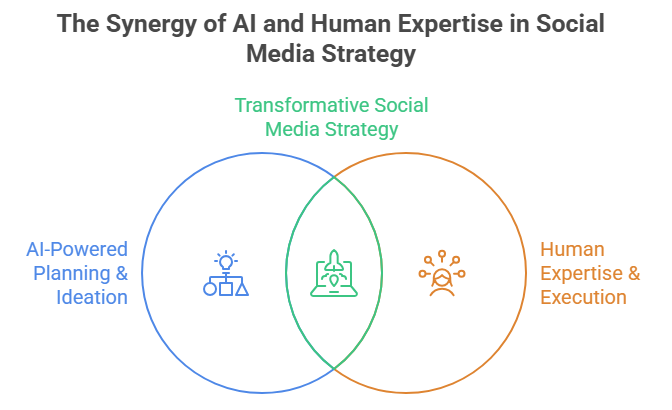
Social media strategy planning involves defining objectives, understanding audiences, selecting platforms, creating content systems, and measuring performance, and it increasingly incorporates the use of AI tools to streamline and enhance these stages. In fact, 43% of marketers say AI plays an important role in their social media strategies, underscoring the growing reliance on technology to organize ideas and improve planning efficiency. ChatGPT plays a strategic support role across these stages by acting as a planning and ideation partner. It helps transform scattered ideas into structured frameworks while allowing human expertise to guide execution and optimization. When used correctly, it becomes a central tool for building scalable and repeatable social media strategies.
How ChatGPT Supports End-to-End Social Media Strategy Development
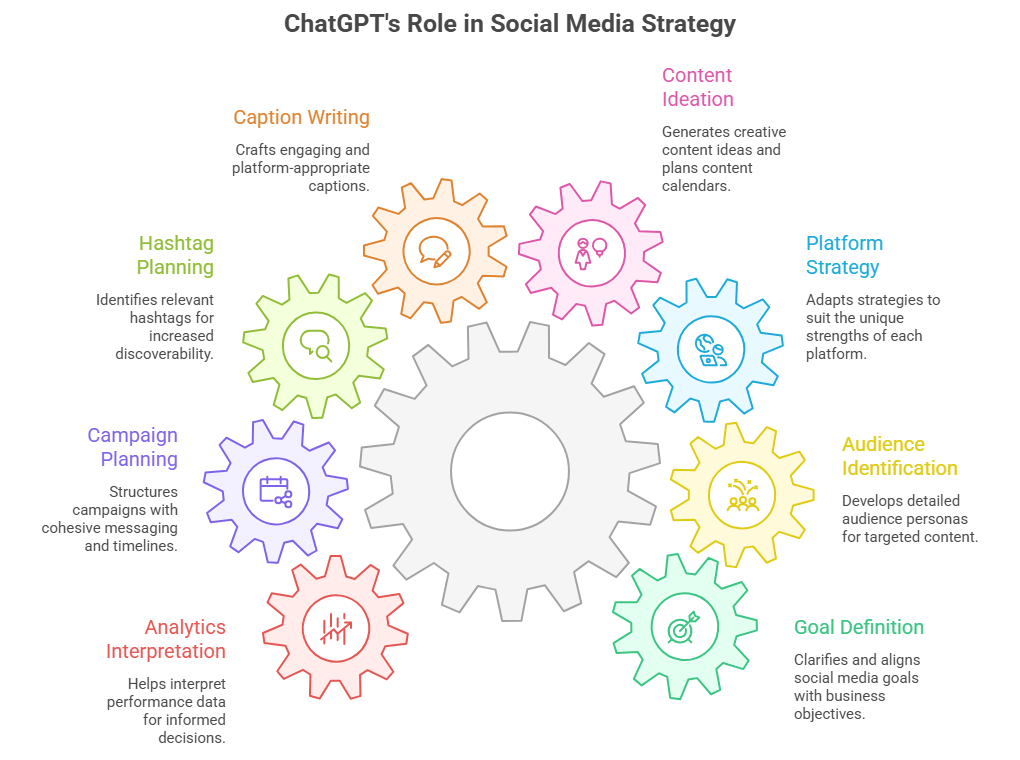
ChatGPT contributes to social media planning by bringing structure, clarity, and speed to strategic decisions. It assists with aligning content to goals, tailoring strategies to platforms, and maintaining consistency across campaigns. Instead of working in isolation, it complements human judgment and native analytics tools. This collaboration allows teams to focus more on creativity, community engagement, and performance optimization.
1. Defining Social Media Goals
ChatGPT helps clarify social media goals by translating business objectives into actionable outcomes such as awareness, engagement, traffic, or conversions. It ensures that each goal is measurable and aligned with platform-specific capabilities. By connecting goals to content types and posting cadence, it prevents unfocused or inconsistent social media activity.
2. Identifying Target Audience and Personas
ChatGPT assists in developing audience personas by outlining demographics, behaviors, motivations, and pain points. It helps segment audiences based on platforms, content preferences, and stages of the buyer journey. This structured understanding improves relevance, allowing content to speak directly to the needs and expectations of each audience group.
3. Platform-Specific Strategy Creation
Each social media platform operates with different formats, algorithms, and user intent, and ChatGPT helps adapt strategies accordingly. It outlines content approaches for platforms such as Instagram, LinkedIn, TikTok, Facebook, and X based on their strengths. This prevents one-size-fits-all posting and supports more effective platform-native content planning.
4. Content Ideation and Content Calendar Planning
ChatGPT excels at generating content ideas that align with defined goals and audience interests. It helps organize these ideas into weekly or monthly content calendars that balance educational, promotional, and engagement-driven posts. This structured approach reduces content gaps and ensures consistent publishing without creative burnout.
5. Caption Writing and Hook Creation
ChatGPT supports caption development by crafting clear, engaging, and platform-appropriate copy. It helps create strong hooks that capture attention quickly while maintaining brand tone and messaging consistency. By incorporating calls to action naturally, it improves engagement and content performance.
6. Hashtag and Keyword Planning
ChatGPT assists with identifying relevant hashtags and keywords that align with content themes and audience interests. It supports discoverability planning by grouping hashtags based on niche relevance and intent. While validation should occur in native tools, this process significantly reduces research time during planning stages.
7. Campaign and Launch Planning
ChatGPT helps structure campaigns by defining timelines, messaging sequences, and content flow. It supports product launches, seasonal promotions, and event campaigns by ensuring content progression remains cohesive. This planning reduces last-minute decision-making and improves campaign clarity.
8. Analytics Interpretation Support
Although ChatGPT does not access live dashboards, it helps interpret performance data when metrics are provided, placing results into a clear strategic context. It explains patterns in engagement, reach, clicks, and conversions, helping teams understand what is working and why. This is especially valuable because data-driven organizations are 3 times more likely to report significant improvements in decision-making, reinforcing how structured interpretation supports smarter optimization and ongoing strategy refinement.
What ChatGPT Cannot Do in Social Media Strategy
ChatGPT does not publish posts, manage accounts, or interact directly with social media platforms. It cannot access real-time analytics, monitor live engagement, or respond to comments and messages. These operational and relationship-based tasks remain dependent on humans and native platform tools.
Additionally, ChatGPT cannot guarantee viral performance or predict algorithmic outcomes. It does not replace platform insights, paid media optimization, or community management. Its role is strategic support, not platform control or execution automation.
Benefits of Using ChatGPT for Social Media Strategy Planning

Using ChatGPT introduces efficiency and structure into the social media planning process. It reduces manual workload while improving clarity and consistency across campaigns. When combined with human expertise, it becomes a scalable solution for both individuals and teams.
1. Saves Planning Time
ChatGPT accelerates strategy creation by producing structured frameworks in minutes instead of days. It reduces repetitive brainstorming and documentation work. This allows teams to allocate more time to execution and optimization.
2. Improves Consistency
ChatGPT helps maintain consistent messaging, tone, and posting cadence across platforms. It ensures that content aligns with defined pillars and brand guidelines. This consistency strengthens brand recognition and audience trust.
3. Reduces Creative Block
ChatGPT provides an ongoing source of content ideas and angles. It prevents burnout by offering fresh perspectives while staying aligned with strategy. This keeps content pipelines active and sustainable.
4. Cost-Effective Planning Support
ChatGPT reduces dependence on large teams for early-stage planning. It supports freelancers, small businesses, and startups with limited budgets. This makes professional-level strategy planning more accessible.
5. Scalable Across Platforms
ChatGPT enables quick adaptation of strategies across multiple platforms. It supports scaling content systems without duplicating effort. This is especially valuable for agencies and multi-brand operations.
ChatGPT vs Traditional Social Media Planning
| Feature | ChatGPT-Assisted Planning | Traditional Manual Planning |
|---|---|---|
| Speed | Very fast | Slow |
| Cost | Low | High |
| Structure | High | Inconsistent |
| Creativity | Strong | Depends on the team |
| Analytics Access | No | Yes |
| Execution | No | Yes |
Best results come from ChatGPT + human strategy + platform tools.
Who Should Use ChatGPT for Social Media Strategy Planning
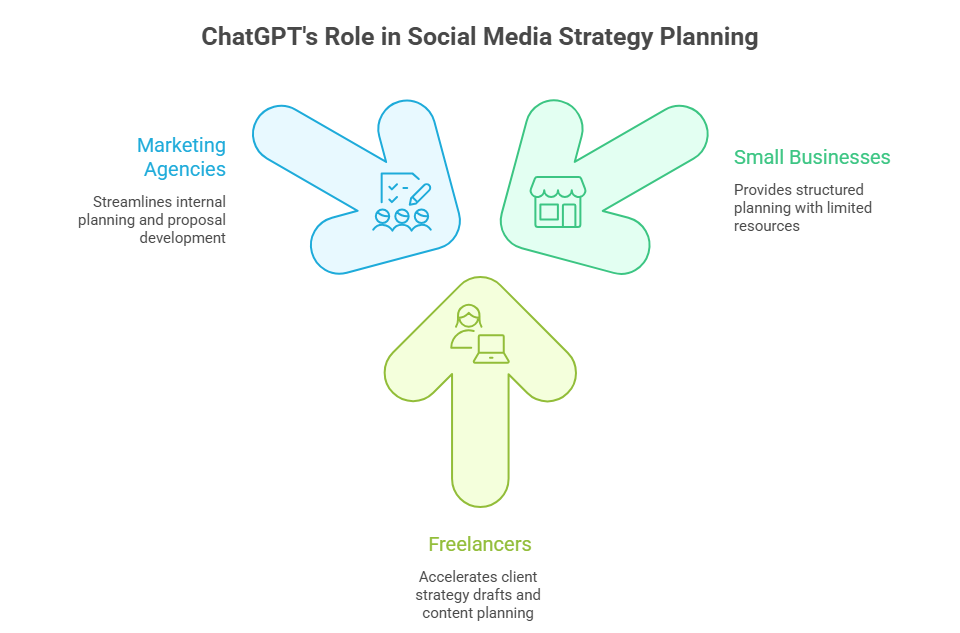
ChatGPT benefits a wide range of professionals by providing structured support without heavy resource requirements. It adapts to different experience levels and business sizes. Its flexibility makes it suitable across industries and objectives.
1. Small Businesses and Startups
Small teams benefit from ChatGPT by gaining access to structured strategy planning without hiring large marketing departments. It helps define priorities, organize content, and maintain consistency. This enables growth-focused social media activity with limited resources.
2. Freelancers, Consultants, and Virtual Assistants
Independent professionals use ChatGPT to accelerate client strategy drafts and content planning. It improves efficiency while maintaining quality and consistency. This allows them to serve more clients without increasing workload proportionally.
3. Marketing Agencies and Social Media Managers
Agencies use ChatGPT to streamline internal planning and proposal development. It supports faster strategy ideation while allowing teams to focus on execution and optimization. This improves scalability and delivery speed.
How to Use ChatGPT for Social Media Strategy (Step-by-Step)

Step 1: Define Goals & Platforms
Tell ChatGPT your business type, goals, and platforms.
Step 2: Request a Strategy Framework
Ask for content pillars, posting frequency, and engagement plan.
Step 3: Build a Content Calendar
Generate weekly or monthly calendars.
Step 4: Create Captions & Hooks
Draft post copy aligned with brand voice.
Step 5: Analyze Performance Manually
Feed metrics back into ChatGPT for insights.
Step 6: Optimize & Repeat
Refine strategy based on performance data.
Limitations to Keep in Mind
ChatGPT requires clear and well-structured prompts to deliver relevant outputs. Without guidance, results may lack brand specificity or strategic focus. Human review remains essential for alignment and accuracy.
Trend validation, competitive analysis, and real-time performance tracking must still be handled manually. Emotional intelligence, relationship building, and community engagement remain human-driven responsibilities.
TaskVirtual: Your Strategic Partner for AI-Powered Social Media Management

Building a social media strategy with ChatGPT is powerful, but consistent execution, scheduling, and performance tracking still require hands-on support. Managing content calendars, coordinating posting schedules, monitoring analytics, and maintaining brand consistency across platforms can quickly become overwhelming. TaskVirtual bridges this gap by providing skilled Virtual AI Assistants who help turn AI-driven strategies into organized, actionable social media workflows.
1. Strategic Support and Execution Assistance
TaskVirtual’s experienced virtual assistants help implement ChatGPT-based social media plans by organizing content calendars, preparing captions, managing scheduling tools, and ensuring platform-specific alignment. They support ongoing execution, so your strategy remains consistent and timely across all channels.
2. Affordable and Flexible Pricing
Hiring in-house social media staff can be costly, especially for small teams and growing businesses. TaskVirtual offers flexible pricing plans starting from just $3.12/hour to $14.99/hour, making professional social media support accessible without long-term overhead.
3. End-to-End Social Media Operations Support
From content coordination and hashtag organization to analytics reporting and campaign tracking, TaskVirtual provides comprehensive operational support. Their services scale easily, whether you need short-term assistance or continuous social media management support.
4. Reliable Ongoing Support and Quality Control
TaskVirtual ensures your social media operations stay on track through regular updates, quality checks, and proactive task management. Their structured workflows help maintain consistency and reduce errors in execution.
5. Proven Reliability and Client Trust
With 364 positive reviews and a 4.7-star rating across trusted virtual assistant platforms, TaskVirtual is recognized globally for reliability and performance. Businesses rely on their expertise to support social media strategies efficiently and professionally.
Final Answer: Can I Use ChatGPT for Social Media Strategy Planning?
Yes, ChatGPT is highly effective for social media strategy planning when used correctly. It helps define goals, plan content, write captions, structure campaigns, and analyze results. When combined with human judgment and platform analytics, ChatGPT becomes a powerful planning assistant that saves time, reduces costs, and improves consistency.
FAQ: Using ChatGPT for Social Media Strategy Planning
Yes, it can create structured plans, but execution still requires human action.
2. Is ChatGPT good for all platforms?
Yes, with platform-specific instructions.
Only if you provide the data it access live dashboards.
No. It supports planning and ideation, not relationship management.
5. Is ChatGPT useful for agencies?
Yes, it speeds up strategy drafts and client planning.
 Siddhartha Basu is a Technical Writer at Task Virtual. He loves online games, e-book reading, and Yoga.