Contents
show
Virtual Assistant vs. Full-Time Employee Total Cost Breakdown
In today’s competitive business landscape, American entrepreneurs and managers face a critical decision: hire a traditional full-time employee or opt for a virtual assistant (VA). With remote work now a permanent fixture, the virtual assistant vs full-time employee cost debate has never been more relevant. Businesses are examining the true total cost of ownership, including taxes, overhead, recruitment, training, and lost productivity.
This comprehensive guide breaks down virtual assistant vs full-time employee costs with data-driven insights and actionable advice tailored to US audiences. Whether you’re a small business owner scaling operations or a manager optimizing a team, understanding these dynamics can unlock significant cost savings—with over 41% of U.S. small businesses already leveraging VAs. This article delivers original, in-depth analysis optimized for real decision-making in 2026.
The True Cost Breakdown: Full-Time Employee vs Virtual Assistant
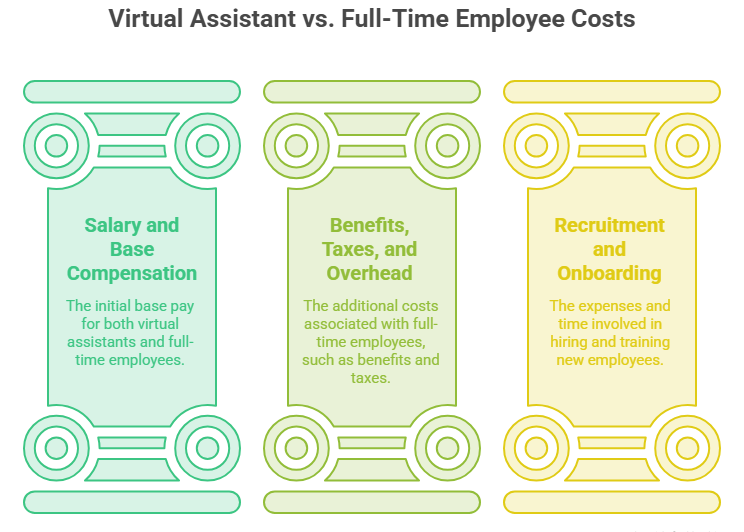
Understanding the full financial picture is essential when comparing virtual assistant vs full-time employee costs. Base salaries represent only the beginning, as hidden expenses and overhead—such as benefits averaging 20-30% of total compensation—dramatically impact the bottom line for US businesses. This section examines the key cost categories with current 2026 data to help you make informed hiring choices.
1. Salary and Base Compensation Realities
For many US businesses, the conversation starts with base pay. According to BLS data, median weekly earnings for full-time wage and salary workers reached $1,235 in Q1 2026, equating to roughly $64,220 annually. However, administrative or support roles often start lower, around $45,000–$65,000 base. Virtual assistants typically range from $8–$25 per hour for general tasks or $12,000–$80,200 annually depending on location and expertise, creating immediate base cost differences.
2. Benefits, Taxes, and Mandatory Overhead
This is where full-time employee costs balloon significantly. BLS Employer Costs for Employee Compensation data from March 2026 show private industry benefits average about 30% of total compensation on top of wages. For a $ 55,000-salary employee, expect an additional 20-40% in benefits and taxes plus office overhead of $5,000–$12,000 yearly. In contrast, virtual assistants as independent contractors require no employer-paid benefits, payroll taxes, or facility costs, delivering major savings.
3. Recruitment, Onboarding, and Hidden Hiring Expenses
Hiring a full-time employee isn’t cheap or fast. The average cost per hire reaches around $4,700, covering advertising, interviews, and background checks, while onboarding and training add substantial soft costs. New employees often take 3-6 months to reach full productivity. Virtual assistant hiring through platforms or agencies is faster with minimal upfront costs and quicker ramp-up times of 1-2 weeks.
Flexibility and Scalability Advantages
Business agility matters more than ever in 2026’s uncertain economy. Virtual assistants provide adaptable support models that traditional full-time hires cannot easily match.
- VAs support hourly, part-time, or project-based work to match exact business demand.
- They reduce cash flow pressure during slow periods and avoid layoff risks.
- Offshore VAs enable extended or near 24/7 task coverage through offshore virtual assistant services.
- US-based VAs align seamlessly with domestic hours.
- They allow quick testing of new initiatives or overflow handling.
- Ideal for seasonal businesses and startups needing flexible growth.
Productivity, Management, and Long-Term Value
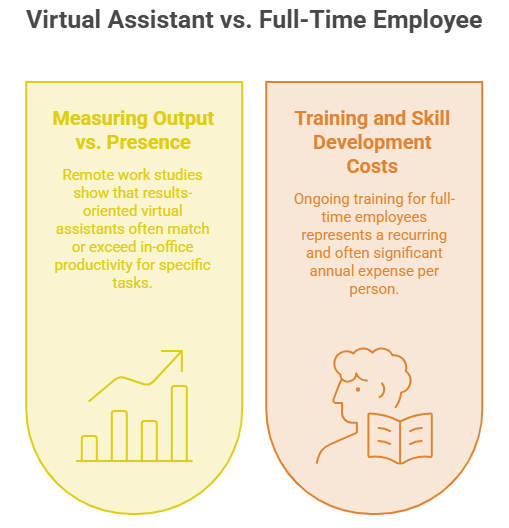
Evaluating productivity and management realities is crucial beyond raw costs when comparing virtual assistant vs full-time employee options. Many businesses discover that focused VAs deliver strong output while requiring less oversight for defined tasks—with 28% average team productivity gains reported. However, full-time employees often provide deeper integration that supports long-term strategic goals.
1. Measuring Output vs. Presence
Remote work studies show that results-oriented virtual assistants often match or exceed in-office productivity for specific tasks. Without commute distractions or office politics, VAs deliver high output per paid hour. They frequently reach peak efficiency faster due to specialized experience across multiple clients.
2. Training and Skill Development Costs
Ongoing training for full-time employees represents a recurring and often significant annual expense per person. In contrast, virtual assistants typically arrive pre-trained in essential tools like Google Workspace, project management software, and industry platforms, reducing your training burden substantially. Many reputable agencies also invest in their VAs’ continued professional development, ensuring they stay current with best practices and new technologies at no extra cost to your business.
Legal, Compliance, and Risk Considerations for US Businesses
Navigating employment regulations is a major factor in the virtual assistant vs full-time employee decision for American companies. Proper classification and risk management protect businesses from potential liabilities.
- Full-time hires require compliance with FLSA, ADA, workers’ comp, and anti-discrimination laws.
- Mistakes can result in lawsuits or IRS penalties.
- Properly classified VAs shift most employment burdens away from your business.
- Strong contracts and NDAs are essential for data and IP protection.
- Reputable VA providers offer strong cybersecurity standards.
- Agencies help simplify compliance and lower administrative risks.
Case Studies and Real-World Savings Examples

Consider a small US e-commerce business needing reliable admin support. Hiring a $50k full-time employee could total $75k–$95k+ annually when including all benefits, taxes, and overhead. A dedicated virtual assistant working equivalent hours at $15–$20 per hour might cost only $20k–$40k, generating substantial annual savings of $40k–$60k while maintaining or improving task throughput.
Larger firms have successfully scaled entire support functions with virtual assistants. This approach frees up capital for core growth activities such as product development and marketing initiatives through digital marketing campaign services. Many businesses report achieving both cost efficiency and operational flexibility through strategic VA integration.
When to Choose a Full-Time Employee vs. a Virtual Assistant

The best hiring choice depends on your business needs, role requirements, and growth stage in 2026. Many companies successfully use hybrid models with core full-time staff and virtual assistant support.
- Full-time employees suit roles needing deep company knowledge and on-site presence.
- They excel at high-stakes decisions and long-term cultural team integration.
- Businesses with a budget for full overhead prefer them for dedicated strategic talent.
- Virtual assistants work best for administrative, repetitive, or project-based tasks.
- They deliver flexibility, rapid scaling, and cost efficiency without commitments.
- VAs are ideal for quick specialized skills or seasonal business support.
TaskVirtual: Your Strategic Partner for Business Virtual Assistance

In the evolving landscape of virtual assistant vs full-time employee cost comparisons, businesses need reliable partners that deliver flexibility without compromising quality. TaskVirtual stands out by providing expert virtual assistant services tailored to administrative, operational, and specialized business needs. Their services help companies streamline daily operations, manage projects, and scale efficiently while achieving substantial cost savings.
1. Expert Business Support and Consultation
TaskVirtual’s experienced virtual assistants offer professional guidance on task prioritization, workflow optimization, and business process improvements. They handle everything from email management and scheduling to data entry and research, allowing your team to focus on high-value activities.
2. Affordable and Flexible Pricing
Hiring a full-time personal assistant can be expensive, but TaskVirtual makes it cost-effective. With pricing plans starting from just $3.12/hour to $14.99/hour, their services are budget-friendly and accessible to individuals, families, and businesses.
3. Comprehensive Virtual Assistant Solutions
TaskVirtual provides end-to-end support for administrative tasks to save time, customer service coordination, social media management, and project assistance. Their scalable solutions adapt to your business needs, whether you require occasional help or dedicated ongoing support that rivals full-time employee output at a fraction of the cost.
4. Ongoing Support and Quality Assurance
TaskVirtual ensures seamless integration with regular progress updates, performance tracking, and proactive adjustments. Their dedicated approach minimizes disruptions and maintains high standards across all assigned responsibilities.
5. Proven Track Record of Excellence
With 364 positive reviews and a 4.7-star rating on trusted VA platforms, TaskVirtual is recognised as a reliable partner worldwide. Clients count on their expertise to simplify operations and achieve measurable efficiency gains.
FAQ Section
1. How much does a virtual assistant cost compared to a full-time employee in 2026?
VAs typically cost 40-80% less overall. Full-time employees average $66k–$108k+ total; quality VAs range from $12k–$80k depending on location and expertise, with major savings on benefits and overhead.
2. Are virtual assistants as productive as full-time employees?
Yes, often more so for defined tasks due to focus and experience. Ramp-up is faster (weeks vs. months), though employees may excel in collaborative or proprietary environments.
Benefits (~30% of compensation), recruitment ($4,700+), training, office overhead, and turnover. These frequently double the base salary impact.
4. Do I need to pay taxes or benefits for a virtual assistant?
Generally, no, if properly classified as a contractor. Agencies handle their side; confirm with tax professionals for compliance.
5. How long does it take to onboard a VA vs. an employee?
VAs: 1-2 weeks. Full-time employees: 4-8+ weeks, including recruitment and full productivity ramp.
6. Can virtual assistants handle specialized or sensitive work?
Absolutely—many specialize in marketing, bookkeeping, customer support, or executive assistance. Use vetted providers with strong contracts for confidentiality.
Conclusion
The virtual assistant vs full-time employee cost comparison clearly favors VAs for many US businesses seeking efficiency and scalability in 2026. While full-time hires offer stability and integration, the true all-in costs—often 50-70% higher—make VAs a compelling choice for administrative, operational, and growth support. By leveraging flexible talent, companies can achieve substantial savings, reduce risk, and focus resources on what drives revenue.
Ready to explore options? Assess your current workload, calculate your team’s true costs using BLS and SHRM benchmarks, and trial a VA for a specific project. Many providers offer low-risk starts. Contact a reputable VA service today to transform your operations and boost your bottom line.
Sources
- U.S. Bureau of Labor Statistics (BLS) reports on wages, telework, and Employer Costs for Employee Compensation.
- Society for Human Resource Management (SHRM) benchmarking on cost per hire.
- Industry analyses from providers like Wishup, ArmaSourcing, and others are cross-referenced with official data. (Additional authoritative links embedded throughout for further reading.)
For more such content, visit our website.
 Siddhartha Basu is a Technical Writer at Task Virtual. He loves online games, e-book reading, and Yoga.