

Contents
show
How to Optimize Virtual Assistant Cost for Maximum Efficiency
In today’s fast-paced entrepreneurial landscape, business owners are drowning in administrative tasks. A virtual assistant (VA) handles email, scheduling, social media, and more. As remote work and AI tools grow, virtual assistant cost is key for scaling efficiently.
The average cost of a virtual assistant in 2026 varies widely: offshore VAs range from $7–$20 per hour, while US-based ones run $25–$75+ per hour. Businesses using VAs report an average of up to 78% cost savings compared to a full‑time US hire, underscoring the economic benefit of outsourcing support services. Monthly retainers start at $900–$2,200 offshore or $4,000–$7,000+ for US talent. This guide provides actionable insights for American businesses.
Factors Influencing Virtual Assistant Cost
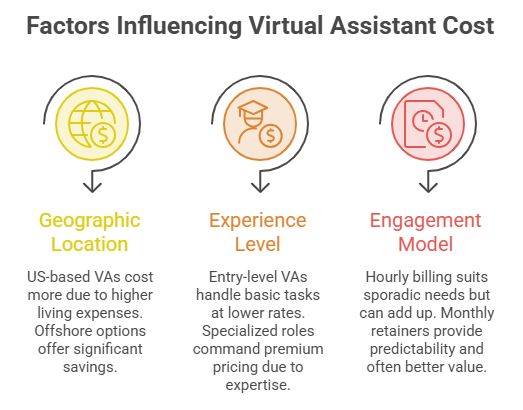
Several variables drive virtual assistant services cost in 2026, and data show that geographic location accounts for the largest share of pricing variation, with rates in the US being 4–10× higher than in offshore regions—highlighting how much location alone can influence cost structures. Location remains the biggest differentiator due to cost‑of‑living differences, followed closely by experience level and skill specialization. Engagement models, such as hourly versus monthly retainers, also significantly impact the final virtual assistant cost per hour equivalent and overall value delivered to US businesses.
1. Geographic Location and Regional Rate Variations
US-based virtual assistants typically cost more due to higher living expenses and local market standards. The average hourly rate for a US VA hovers around $24–$33. Offshore options from the Philippines, India, or LATAM countries offer significant savings, often ranging between $7–$20 per hour, with time zone alignment playing a key role in real-time collaboration.
2. Experience Level and Skill Specialization
Entry-level or general administrative VAs handle basic tasks at lower rates, typically $15–$30 per hour in the US or $7–$12 offshore. Specialized roles in marketing, bookkeeping, or technical support command premium pricing due to required expertise. Senior VAs with certifications and niche skills deliver faster results and stronger long-term value despite higher costs.
3. Engagement Model: Hourly, Part-Time, or Full-Time
Pricing structures affect the virtual assistant cost per hour equivalent. Hourly billing suits sporadic needs but can add up with platform fees. Monthly retainers provide predictability and often better value—many providers offer 80–160 hours/month packages. Full-time dedicated VAs (approx. 160 hours/month) yield the lowest effective hourly rates and strongest loyalty.
Virtual Assistant Pricing by Location in 2026
Virtual assistant pricing in 2026 reflects clear differences between domestic and international talent pools. US businesses benefit from weighing cost against factors like communication ease through email writing service and cultural fit when selecting the right option.
- US-based VAs average $25–$45/hour ($4,000–$7,000+/month full-time).
- Philippine and Indian VAs typically cost $7–$15/hour.
- LATAM nearshore VAs range from $9–$22/hour with strong time zone overlap.
- Offshore options deliver 60–80% savings versus US hires.
- Dedicated offshore retainers often run $1,300–$2,500 monthly.
- US talent offers better compliance and cultural alignment for complex work.
Common Virtual Assistant Services and Their Costs
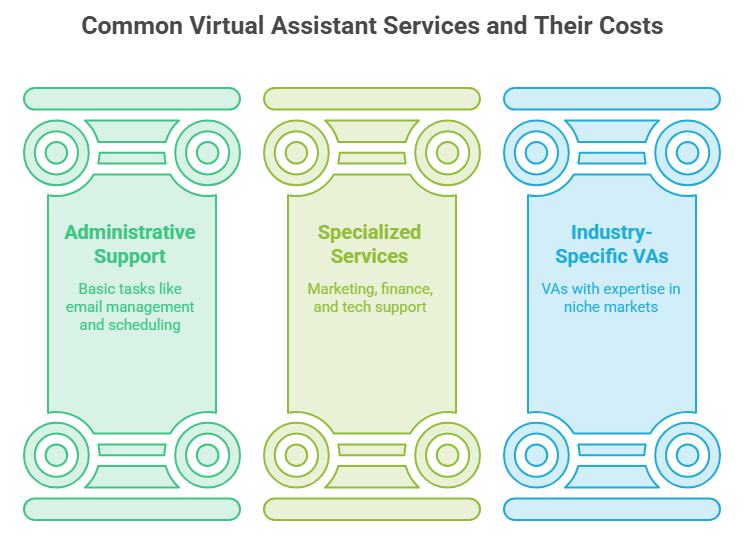
Virtual assistants offer a wide spectrum of support that can be tailored to specific business needs in 2026, with 40% of VAs now providing specialized services such as IT support, legal assistance, and medical administrative tasks—showing how VAs are expanding beyond basic admin work to high‑value functions. Costs vary based on the complexity and specialization of tasks involved. Understanding these service categories helps American entrepreneurs budget effectively for maximum productivity gains.
1. Administrative and Executive Support
Basic administrative tasks such as email management, calendar scheduling, and travel booking form the foundation of most VA services. Executive VAs go further by acting as strategic partners for complex coordination and decision support. These roles typically range from $15–$30 per hour for US-based support and $8–$15 offshore, providing essential relief for busy professionals.
2. Specialized Services: Marketing, Finance, and Tech
Content creation, SEO, and social media management often run $20–$45 per hour depending on expertise. Bookkeeping and financial tasks using tools like QuickBooks command $25–$50 per hour. Technical VAs skilled in CRM systems or task management and workflow automation deliver high-value support within similar pricing bands.
3. Industry-Specific VAs
Real estate VAs managing listings and client follow-ups average $20–$35 per hour. Healthcare and legal support require compliance knowledge and therefore carry higher rates. These specialized professionals bring domain expertise that accelerates results in niche markets.
Hiring Models: Freelance Platforms vs. Agencies vs. Dedicated Providers
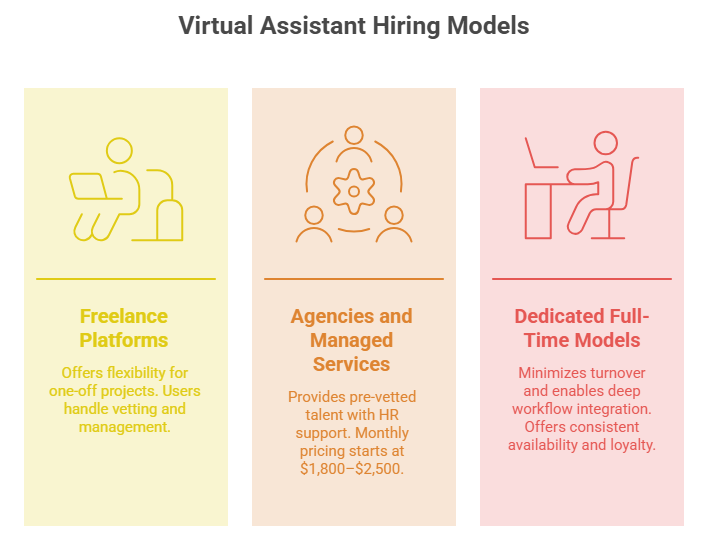
Choosing the right hiring model for a virtual assistant significantly impacts both cost and long-term success. American businesses have multiple options ranging from flexible freelance platforms to fully managed services, with nearly 60% of virtual assistants operating as self-employed or freelancers. Each model offers distinct advantages in terms of control, reliability, and support level.
1. Freelance platforms
Freelance platforms like Upwork or Fiverr provide great flexibility for one-off projects or variable workloads. Median rates globally fall around $10–$20 per hour, though quality varies widely. Users must handle their own vetting, ongoing management, and performance oversight.
2. Agencies and managed services
Agencies deliver pre-vetted and trained talent along with replacement guarantees and HR support. Monthly pricing often starts at $1,800–$2,500 for dedicated offshore support. These providers frequently include AI tool proficiency and structured onboarding for smoother integration.
3. Dedicated full-time models
Dedicated full-time models minimize turnover and enable deep workflow integration over time. They typically offer the best value through consistent availability and loyalty. This approach works particularly well for growing businesses needing reliable long-term support.
Calculating ROI: Is a Virtual Assistant Worth the Cost?
Determining the return on investment helps justify the cost of a virtual assistant for US businesses. Many owners find that time savings and productivity gains quickly outweigh expenses. Here are key insights into the financial benefits.
- VAs deliver up to 13% higher productivity (Stanford research).
- Entrepreneurs often reclaim 13–15 hours per week.
- Savings vs. in-house hires reach 60–78%.
- ROI typically appears within 3–4 weeks through paid social marketing.
- Delegating 20 admin hours at $100/hour owner rate adds major value.
- The $6.5 billion VA market in 2026 shows strong adoption.
How to Choose the Right Virtual Assistant for Your Budget

Define clear tasks and outcomes first. Assess communication style, test with a small project, and prioritize cultural fit and tool proficiency. Request references, trial periods, and clear contracts outlining scope, hours, and KPIs. Consider providers offering training in AI tools for future-proofing.
Future Trends in Virtual Assistant Pricing (2026 and Beyond)
AI integration is boosting VA productivity in 2026, with some professionals reporting up to 2.4 times efficiency gains. This advancement helps stabilize or slightly lower effective costs while dramatically increasing delivered value. Subscription-based models and specialized service niches are expected to dominate the market moving forward.
Demand for bilingual and tech‑savvy virtual assistants continues to rise as businesses adopt more sophisticated tools, with 36% of virtual assistants now offering AI tool integration services—a sign of tech‑enabled productivity demand in 2025. Pricing will likely revolve around hybrid human‑AI teams that offer enhanced capabilities. US companies that embrace these trends position themselves for greater scalability and competitive advantage.
How Virtual Assistants Help Businesses Grow

Virtual assistants empower American businesses to scale efficiently by handling time-consuming tasks and allowing owners to focus on high-impact activities. They provide flexible support that drives productivity, reduces costs, and supports sustainable expansion in 2026’s competitive market.
- Frees up 13–15 hours per week for strategic planning and revenue generation.
- Delivers 60–80% cost savings compared to hiring full-time in-house staff.
- Boosts productivity by up to 13% through specialized task handling like calendar management.
- Enables faster business scaling without the overhead of office space or benefits.
- Supports specialized functions like marketing and bookkeeping to accelerate growth.
- Improves work-life balance and reduces burnout for entrepreneurs and teams.
TaskVirtual: Your Partner in Virtual Assistant Services

TaskVirtual offers reliable virtual assistant services that help American businesses and professionals reclaim valuable time. From administrative support to specialized tasks like marketing and bookkeeping, their team integrates seamlessly into your workflow. They provide flexible, high-quality assistance tailored to 2026 business needs while maintaining competitive pricing.
1. Expert Virtual Assistant Consultation
TaskVirtual’s experienced professionals assist with everything from email management and scheduling to advanced marketing, finance, and technical support. They help businesses select the right service mix and optimize processes using modern tools like Google Workspace, AI automation, and CRM systems for maximum efficiency.
2. Affordable and Flexible Pricing
Hiring a full-time personal assistant can be expensive, but TaskVirtual makes it cost-effective. With pricing plans starting from just $3.12/hour to $14.99/hour, their services are budget-friendly and accessible to individuals, families, and businesses.
3. Comprehensive Virtual Assistant Solutions
TaskVirtual covers a full range of services, including administrative support, specialized marketing and finance tasks, and industry-specific needs such as real estate or executive coordination. Their scalable options adapt to both occasional project-based help and consistent full-time equivalent support, aligning perfectly with various engagement models.
4. Ongoing Support and Quality Assurance
TaskVirtual provides continuous updates, proactive communication, and reliable performance monitoring. Their support ensures tasks are completed accurately and on time, helping businesses maintain productivity without the stress of managing remote teams.
5. Proven Track Record of Excellence
With 364 positive reviews and a 4.7-star rating on trusted VA platforms, TaskVirtual is recognised as a reliable partner worldwide. Clients count on their expertise to simplify operations and streamline everyday business tasks.
FAQ Section
1. What is the average cost of a virtual assistant in 2026?
US-based averages $25–$45/hour or $4,000–$7,000/month full-time equivalent. Offshore options average $7–$20/hour or $1,300–$2,500/month.
2. How much does a virtual assistant cost per hour?
Rates range from $7–$15 offshore to $25–$75+ US, depending on skills and location.
3. Are low-cost virtual assistants reliable?
Yes, when vetted through reputable agencies. Many offshore providers deliver high-quality, trained talent at lower rates due to regional economics.
4. What factors affect virtual assistant services’ cost the most?
Location, experience/specialization, and engagement model (hourly vs. retainer).
5. Can hiring a VA save money compared to a full-time employee?
Absolutely—savings of 60–78% are common through reduced overhead.
6. How do I calculate the ROI of a virtual assistant?
Compare their cost against hours saved multiplied by your hourly value, plus productivity gains and avoided hiring expenses. Most businesses break even quickly.
Conclusion
Understanding virtual assistant costs in 2026 empowers smarter scaling decisions. Whether opting for affordable offshore support or premium US talent, the right VA delivers time freedom, cost efficiency, and growth acceleration that far outweigh the investment. Start small, measure results, and adjust as your needs evolve. Ready to reclaim your time? Explore vetted providers or post your requirements on platforms today—your future self (and bottom line) will thank you.
Sources
- US Bureau of Labor Statistics (BLS) data on administrative wages.
- ZipRecruiter, Indeed, and industry reports (2026 salary data).
- Wishup, VA Masters, and market analyses for industry sizing and trends.
- Stanford University and productivity studies.
- Various provider guides and aggregator reports (2025–2026).
For more such content, visit our website.
 Siddhartha Basu is a Technical Writer at Task Virtual. He loves online games, e-book reading, and Yoga.