Contents
show
How a Virtual Accounts Receivable Assistant Reduces Days Sales Outstanding
In today’s high-interest-rate environment, cash flow is king for American businesses. Many companies watch receivables sit unpaid for 45, 60, or even 90+ days, tying up working capital. A virtual accounts receivable assistant combines human expertise with modern tools to accelerate collections and lower DSO.
A virtual AR assistant is a skilled remote professional specialising in invoice management, collections, dispute resolution, and reporting. These assistants operate on flexible, cost-effective models that are often 40-70% cheaper than full-time hires. With late payments affecting over half of B2B invoices, businesses turn to virtual solutions for faster results.
What Is Days Sales Outstanding (DSO) and Why It Matters
Days Sales Outstanding (DSO) is a critical metric that shows how quickly a business collects payments after a sale. It directly impacts liquidity and financial health for US companies, especially since more than 55% of B2B invoices are paid late. Understanding and reducing DSO helps free up cash for growth and operations.
1. Understanding the DSO Formula and Benchmarks
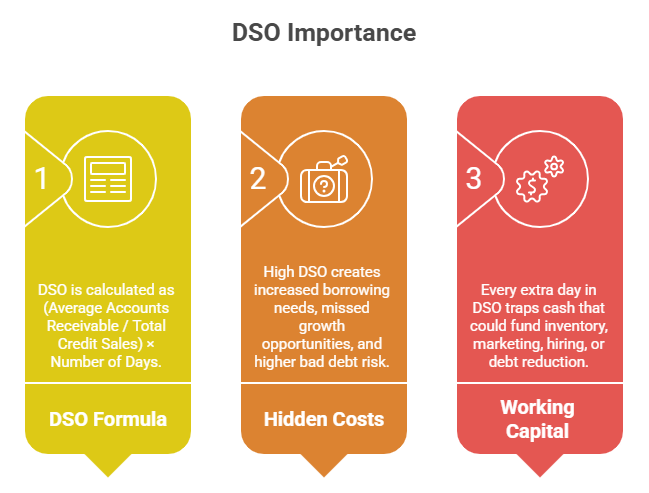
DSO is calculated as (Average Accounts Receivable / Total Credit Sales) × Number of Days. Industry benchmarks vary significantly, with retail and e-commerce often achieving 5-30 days while manufacturing, construction, and healthcare commonly see 45-70+ days. Top US performers consistently collect 18+ days faster than the median average of 36-43 days, highlighting the competitive advantage of efficient AR processes.
2. The Hidden Costs of High DSO for US Businesses
High DSO creates increased borrowing needs, missed growth opportunities, and higher bad debt risk. Small businesses face an average of $17,500 in unpaid invoices, with many remaining outstanding over 30 days late. Late payments also strain supplier relationships, damage credit scores, and divert valuable management time from core operations.
3. How DSO Impacts Working Capital and Profitability
Every extra day in DSO traps cash that could fund inventory, marketing, hiring, or debt reduction. This often forces growing companies to rely on expensive short-term financing at high interest rates. Lower DSO turns accounts receivable into a strategic advantage, improving overall profitability and financial stability.
Key Challenges in Traditional Accounts Receivable Management
Traditional AR management struggles with outdated processes that slow collections and increase errors. In fact, 59% of US businesses link poor cash flow to manual AR processes. Many US businesses face rising DSO due to manual workloads and limited visibility.
- Manual processes rely on spreadsheets and email, leading to human errors and delayed follow-ups.
- Inefficient collections become reactive without systematic reminders or prioritisation.
- Lack of real-time visibility prevents accurate cash flow forecasting.
- Scaling issues arise as revenue grows without proportional staff increases.
- High full-time staff costs ($45k–$65k+ plus benefits) limit AR capacity.
- Poor dispute handling allows small issues to escalate into major payment delays.
How a Virtual Accounts Receivable Assistant Reduces DSO
A virtual accounts receivable assistant delivers expert support to streamline AR processes and speed up payments. These professionals use proven strategies and tools tailored for US businesses. In fact, companies leveraging virtual AR support often achieve 20-40% reductions in DSO within the first few months. They consistently help reduce DSO by addressing the root causes of delays.
1. Automated Invoice Creation and Delivery
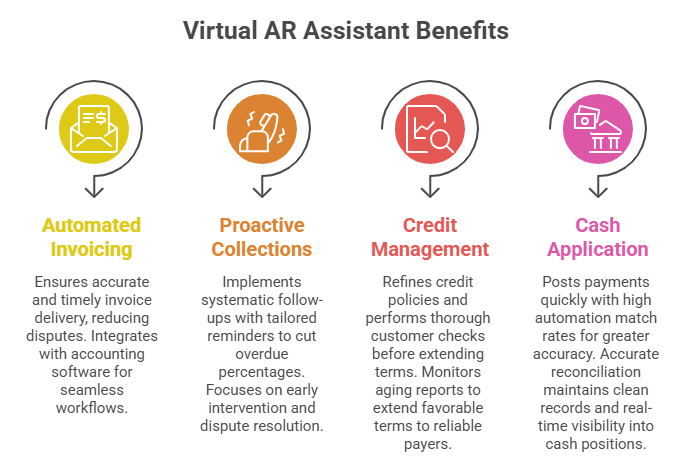
Virtual AR assistants ensure invoices are accurate, complete, and sent promptly on the same day as delivery or service completion. They integrate with accounting software like QuickBooks and Xero online accounting for seamless workflows and error-free processing. This reduces disputes from the outset and significantly improves customer payment speed.
2. Proactive Collections and Dunning Strategies
Virtual assistants implement systematic follow-ups with timed email, phone, and SMS reminders tailored to customer behavior. They focus on early intervention to cut overdue percentages significantly and maintain positive relationships. Dispute resolution expertise quickly resolves issues and prevents further delays.
3. Credit Management and Risk Assessment
Virtual professionals refine credit policies and perform thorough checks on customers before extending terms. They monitor aging reports regularly to extend favorable terms only to reliable payers. This preventive approach reduces future bad debts effectively while supporting healthy sales growth.
4. Cash Application and Reconciliation
Assistants post payments quickly with high automation match rates of 95%+ for greater accuracy. Accurate reconciliation maintains clean records and real-time visibility into cash positions. This eliminates unapplied cash problems that delay reporting and financial decision-making.
Technology Integration: AI and Tools Amplifying Virtual Assistants

AI and modern tools greatly enhance the effectiveness of virtual AR assistants. Integration creates efficient, scalable processes for US businesses. These technologies deliver measurable DSO improvements.
- AI-powered predictive scoring and automated dunning speed collections.
- Seamless ERP integration with QuickBooks, Xero, and NetSuite ensures data accuracy.
- Real-time dashboards provide ageing reports and cash flow forecasts.
- Chatbots handle routine queries while humans manage complex issues.
- Enterprise security standards like SOC 2 protect financial data.
- Analytics enable continuous optimisation of AR performance.
Real-World Benefits and Quantifiable ROI
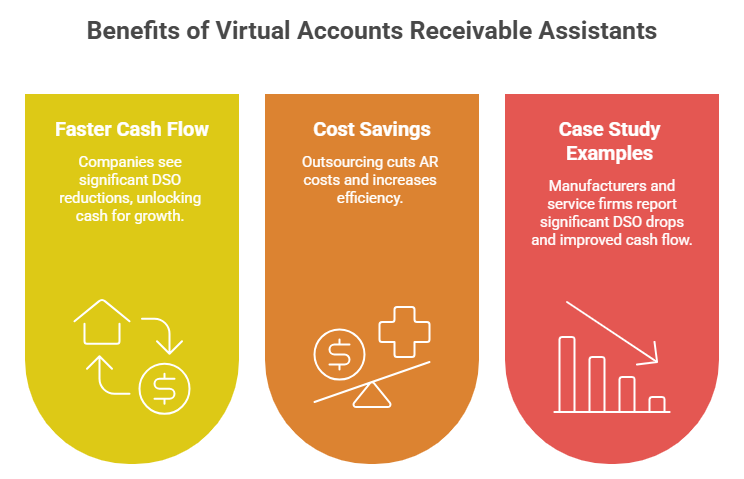
Virtual accounts receivable assistants deliver fast, measurable financial improvements for US companies. Businesses gain better cash flow and lower operational costs. ROI appears quickly through reduced DSO and freed working capital.
1. Faster Cash Flow and Working Capital Release
Companies see 15-40% DSO reductions after implementing virtual AR support. For a $25M revenue business with 60-day DSO, a 12-20 day improvement unlocks hundreds of thousands in cash. This releases capital for growth initiatives such as expanding inventory, hiring talent, or investing in marketing without taking on additional debt.
2. Cost Savings and Productivity Gains
Outsourcing cuts AR costs by 40-70% compared to in-house staff while delivering higher efficiency. Finance teams save 40-60% time on routine tasks, allowing them to focus on higher-value work like strategic financial planning and analysis. Scalability without permanent hires supports business peaks efficiently.
3. Case Study Examples (Aggregated)
Manufacturers and service firms report 20-33% DSO drops within the first few months of engagement. Past-due invoices decrease by 22% on average while collection rates improve. Overall, cash flow improves significantly with virtual AR assistance, enabling stronger financial stability and business growth.
Implementing a Virtual Accounts Receivable Assistant: Step-by-Step
Successful implementation requires clear planning and the right partner selection. Virtual AR solutions integrate smoothly with existing processes. US businesses achieve strong results with structured onboarding.
- Assess current AR with DSO audit and ageing report review.
- Choose partners with AR expertise, software proficiency, and strong references.
- Map processes and run parallel operations for 30-60 days.
- Set clear KPIs, SLAs, and DSO reduction targets.
- Provide policy training and customer nuance details.
- Review performance regularly for ongoing optimisation.
Potential Challenges and How to Overcome Them
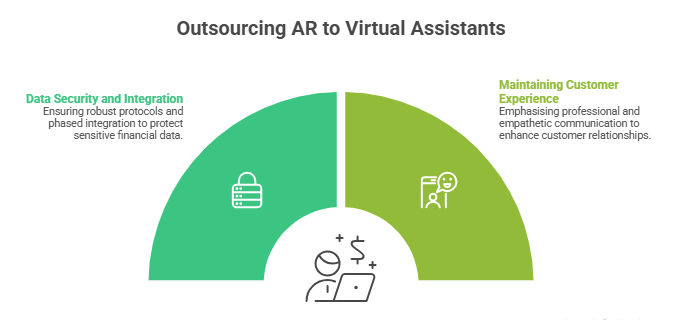
Accounting outsourcing services to virtual assistants involve manageable challenges that providers address effectively. Proper planning ensures smooth transitions for US businesses. Focus remains on security, experience, and results.
1. Data Security and Integration Concerns
Choose providers with robust protocols, SOC 2 compliance, and NDAs to ensure top-level protection. Conduct thorough audits and implement phased integration to minimise risks and avoid disruptions. This approach effectively protects sensitive financial data throughout the entire process.
2. Maintaining Customer Experience
Emphasise professional and empathetic communication in all customer interactions. Virtual assistants improve consistency and speed of resolutions while maintaining a positive tone. This often enhances customer relationships compared to internal handling and reduces friction during collections.
How Virtual Assistants Help with Accounts Receivable Service

Virtual assistants provide specialised expertise that transforms traditional AR operations into efficient, proactive processes. They help businesses reduce DSO while maintaining strong customer relationships and compliance.
- VA handles timely invoice generation with proper documentation to minimise disputes.
- Execute consistent follow-up sequences via email, phone, and SMS for faster collections.
- Resolve payment disputes and deductions quickly to prevent delays in cash inflow.
- Perform credit checks and monitor customer risk to maintain healthy receivables.
- Ensure precise cash application and bank reconciliation for accurate financial records.
- Deliver real-time reports and ageing analysis to support better financial decisions.
TaskVirtual: Your Partner in Accounts Receivable Management

Managing accounts receivable, chasing payments, and maintaining healthy cash flow can overwhelm growing US businesses. From manual invoicing to delayed collections, these tasks drain time and tie up capital. TaskVirtual provides expert virtual accounts receivable assistants that streamline AR processes, reduce DSO, and accelerate cash inflows.
1. Expert Consultation and Review
askVirtual’s skilled virtual assistants handle invoice creation, proactive collections, dispute resolution, and credit management to ensure faster payments and lower DSO. They work closely with your team to review current processes and implement best practices tailored to your business needs.
2. Affordable and Flexible Pricing
Hiring a full-time AR specialist can be expensive, but TaskVirtual makes it cost-effective. With pricing plans starting from just $3.12/hour to $14.99/hour, their services are budget-friendly and accessible to US businesses of all sizes.
3. Comprehensive AR Support Solutions
From automated invoicing and dunning strategies to cash application, real-time reporting, and risk assessment, TaskVirtual covers complete accounts receivable needs with scalable support. VA’s solutions integrate seamlessly with tools like QuickBooks and Xero.
4. Ongoing Support and Quality Assurance
TaskVirtual delivers continuous monitoring, performance updates, and optimisation to maintain low DSO and smooth cash flow without disrupting your operations. They provide regular reports and proactive adjustments to deliver consistent results.
5. Proven Track Record of Excellence
With 364 positive reviews and a 4.7-star rating on trusted VA platforms, TaskVirtual is recognised as a reliable partner. Clients count on their expertise to cut DSO and strengthen financial health.
FAQ Section
1. What is a virtual accounts receivable assistant?
A remote specialist or team handling invoicing, collections, disputes, and AR reporting, often using advanced tools for efficiency.
2. How quickly can a virtual AR assistant reduce DSO?
Many businesses see measurable improvements in 30-90 days, with 15-30%+ reductions common within six months.
3. How much does a virtual accounts receivable assistant cost?
Rates typically offer 40-70% savings versus full-time hires, often $20-50/hour or project-based.
4. Will a virtual assistant integrate with my accounting software?
Yes—experienced providers work with QuickBooks, Xero, NetSuite, and others.
5. Is it secure to outsource accounts receivable?
Reputable firms use enterprise-grade security, compliance certifications, and NDAs.
6. Can small businesses benefit from virtual AR assistance?
Yes. Small businesses facing $17,500+ in unpaid invoices gain professional support without full-time costs.
Conclusion
A virtual accounts receivable assistant transforms AR from a cash flow drain into a strategic asset. These solutions lower DSO, accelerate payments, reduce costs, and free teams for growth. In 2026, optimising working capital remains essential for competitiveness.
Sources
- CreditPulse, Kaplan Collection Agency, ResolvePay, and industry surveys on DSO benchmarks (2025-2026 data).
- Billtrust/Wakefield Research on AI/AR automation impacts.
- QuickBooks Intuit Small Business Late Payments Report 2025.
- Hackett Group Working Capital surveys.
- Additional data from Atradius, Gartner, and BLS occupational reports.
For more such content, visit our website.
 Siddhartha Basu is a Technical Writer at Task Virtual. He loves online games, e-book reading, and Yoga.