Contents
show
Is Grok 3 Better Than ChatGPT?
Grok 3 and ChatGPT represent two different approaches to modern AI interaction, each built with distinct priorities and user expectations. Whether Grok 3 is better than ChatGPT depends on your specific use case and the kind of output you expect from an AI assistant, and understanding those differences is essential before choosing one over the other. Both systems are powerful, but they serve slightly different audiences and problem types.
Grok 3 often excels in real-time data awareness, social context, and fast conversational replies, while ChatGPT continues to lead in structured content creation, deep reasoning, and professional workflows. Grok 3 may be better for context-aware, up-to-date interactions; ChatGPT is often better for long-form writing, analytical tasks, and controlled outputs.
What Are Grok 3 and ChatGPT?
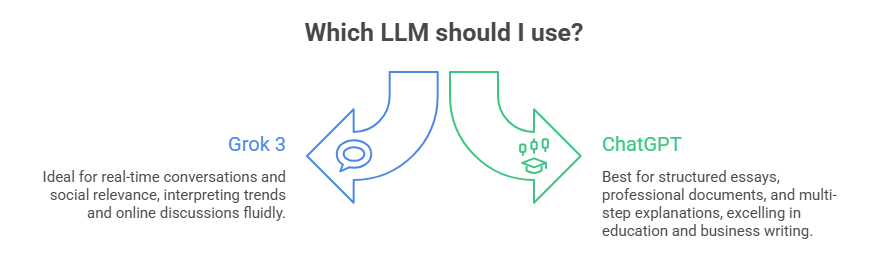
Both Grok 3 and ChatGPT are large language models designed to understand and generate human-like text, yet they reflect different design philosophies. Grok 3 focuses heavily on immediacy and social relevance, while ChatGPT emphasizes depth, structure, and reliability. Understanding their core identities helps clarify which tool fits which scenario.
1. Grok 3
Grok 3 is developed by xAI with an emphasis on real-time understanding and cultural awareness. It is designed to engage in dynamic conversations that feel current and socially informed, and this aligns with broader user expectations—72% of customers want immediate service, reinforcing why speed and freshness matter in conversational systems. The model aims to interpret trends, online discussions, and evolving contexts more fluidly than traditional systems.
2. ChatGPT
ChatGPT is created by OpenAI and optimized for comprehensive language generation and reasoning. It excels at producing structured essays, professional documents, and multi-step explanations. The platform is widely used for education, business writing, coding assistance, and analytical work.
Key Differences: Grok 3 vs ChatGPT
| Feature | Grok 3 | ChatGPT |
|---|---|---|
| Real-Time Awareness | Often strong | Limited or browser-enabled |
| General Knowledge | Good | Extensive training data |
| Language Generation Quality | High | Very high |
| Creative Writing | Good | Excellent |
| Reasoning & Logical Structure | Competitive | Strong |
| Professional Workflow Support | Improving | Very strong |
| API & Ecosystem Tools | Emerging | Mature/Integrated |
How Grok 3 Works
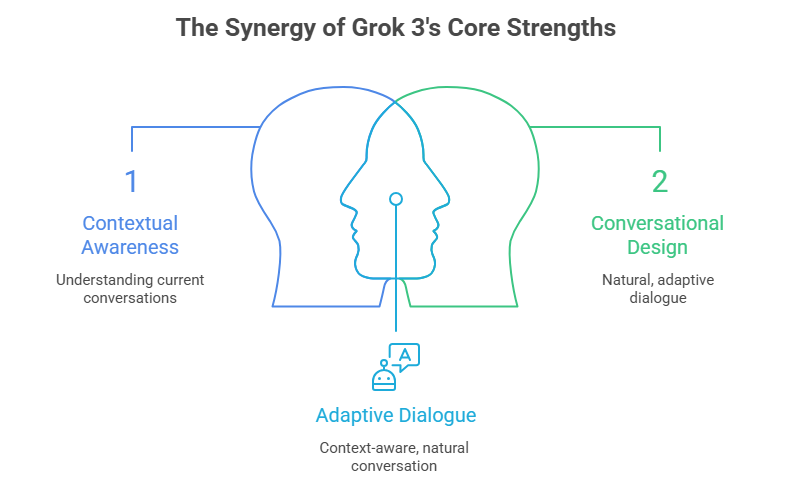
Grok 3 is engineered to operate with a strong sense of immediacy and conversational relevance, drawing from contextual signals and recent discourse. The model emphasizes quick interpretation rather than long analytical processing. Its architecture favors interaction that feels current and socially aware.
1. Contextual Awareness
Grok 3 is built to interpret ongoing conversations and cultural signals with minimal delay. It attempts to align responses with the tone of current online discussions. This makes it particularly useful for topics that evolve quickly.
2. Conversational Design
The system prioritizes dialogue that resembles natural human exchange. Responses are typically short, direct, and adaptive to follow-up questions. The goal is to maintain momentum rather than produce lengthy reports.
3. Trend Orientation
Grok 3 places importance on understanding digital culture and social narratives. It is tuned to recognize slang, memes, and platform-specific behavior. This orientation supports users seeking contemporary insight.
How ChatGPT Works

ChatGPT is structured around deep language modeling and logical consistency, focusing on producing well-organized and reliable text. It processes prompts through layered reasoning steps designed to maintain coherence. The system is optimized for tasks that require detail and planning.
1. Knowledge Synthesis
ChatGPT draws from extensive training data to generate comprehensive explanations. It connects concepts across domains to produce structured arguments. This makes it suitable for education and research support.
2. Multi-Step Reasoning
The model excels at breaking problems into logical sequences. It can outline strategies, compare options, and refine drafts through iteration. Such capabilities support professional and academic workflows.
3. Content Structuring
ChatGPT is designed to produce formatted documents, outlines, and reports, and a survey found that 70% of business owners say AI speeds up content generation processes like writing and structuring communication, underscoring how structured output supports efficiency.
When Grok 3 Is Better Than ChatGPT
Grok 3 becomes the stronger option in situations where immediacy and cultural sensitivity matter most. Users who value quick reactions over polished structure often prefer it. The platform fits scenarios driven by conversation rather than documentation.
1. You Need Real-Time Context
Grok 3 can reflect ongoing discussions and recent developments more naturally. It is helpful when answers must align with the latest online sentiment.
2. You Want Fast, Conversational Interactions
The model delivers rapid, informal dialogue without heavy formatting. It suits brainstorming and casual Q&A better than formal reporting.
3. You Ask for Social or Era-Specific Context
Grok 3 interprets cultural references and platform trends with ease. It adapts to the language of specific communities.
When ChatGPT Is Better Than Grok 3
ChatGPT is preferable when the task requires depth, organization, and reliability. It is designed for users who need finished content rather than quick opinions. Professional environments often benefit more from this approach.
1. You Need Structured Long-Form Content
ChatGPT produces essays, guides, and narratives with clear introductions and conclusions. It maintains coherence over thousands of words.
2. You Require Deep Reasoning or Logical Outputs
Complex comparisons and technical explanations are handled methodically. The model can evaluate evidence and present balanced arguments.
3. You Use Professional Workflows
ChatGPT integrates smoothly with research, coding, and documentation processes. It supports templates, revisions, and style control.
4. You Need Higher Content Quality Control
The system offers stronger consistency and refinement tools. Outputs can be edited and standardized for publication.
Example Scenarios
Different tasks reveal the contrast between the two platforms, and observing practical use cases clarifies their personalities. Neither model wins every category, so the scenario defines the winner. The following comparisons illustrate typical outcomes.
1. Social Trend Understanding
Grok 3 is likely to capture the mood of online conversations and current memes, offering interpretations that feel native to social platforms, while ChatGPT explains trends through historical and analytical lenses. For discussions about digital culture, immediacy matters more than structure.
2. Writing a Deep SEO Blog Article
ChatGPT excels at outlining keywords, headings, and internal logic, producing ready-to-publish drafts, whereas Grok 3 may generate engaging but less organized text. Long-form optimization favors ChatGPT’s planning abilities.
3. Real-Time Q&A on Current Events
If connected to recent data, Grok 3 can reference developments with greater freshness, while ChatGPT relies on established knowledge unless browsing tools are enabled. For breaking news, Grok 3 usually feels more relevant.
Strengths and Weaknesses
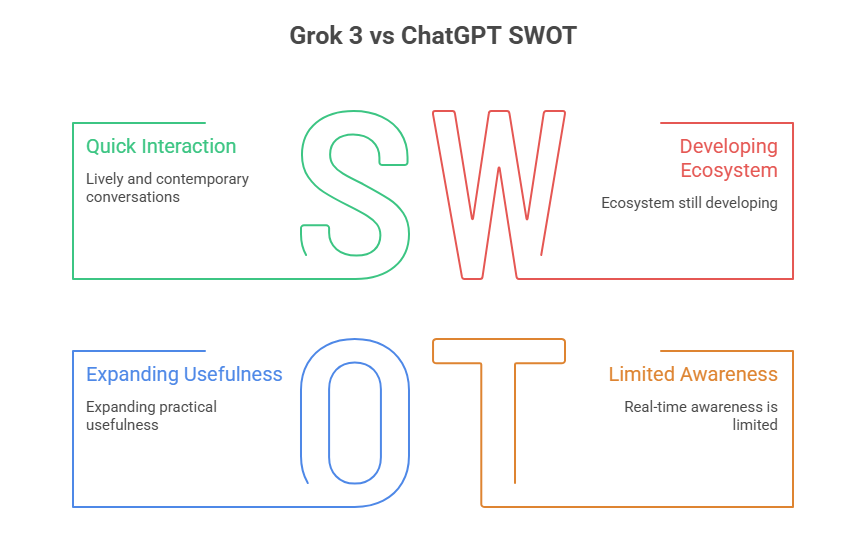
Grok 3 thrives on quick interaction and cultural fluency, making conversations feel lively and contemporary, and it adapts well to informal prompts that resemble social media dialogue. The system handles nuance and humor with flexibility, which appeals to users exploring opinions rather than writing reports, and a global Capgemini study reports that 68% of users value AI tools most for conversational responsiveness and ease of interaction, reinforcing this design direction. Its design encourages exploration over perfection. Long structured writing may require heavy editing, and the ecosystem around Grok 3 is still developing compared with established platforms. Output formatting can be inconsistent when tasks demand academic or corporate standards, and guardrails vary by implementation.
ChatGPT’s greatest strength lies in generating organized, professional content suitable for business, education, and technical fields, and it follows complex instructions with reliability. The platform supports iteration, summaries, and multi-step reasoning better than most conversational models. Its mature integrations expand practical usefulness. Without browsing tools, real-time awareness is limited, and responses can feel formal compared with more casual assistants. The model sometimes prioritizes structure over spontaneity, which may not suit fast social chats.
Integration & Workflow Considerations
Choosing between the two often depends on how the AI fits into daily processes rather than raw intelligence. Tools surrounding the model can matter as much as the model itself. Organizations usually evaluate ecosystem maturity alongside answer quality.
1. Content Pipelines
ChatGPT connects smoothly to SEO tools, document editors, and coding environments, enabling end-to-end production, while Grok 3 currently focuses more on interaction than pipeline automation.
2. Research and Ideation
Grok 3 is excellent for gathering quick impressions and gauging public mood, whereas ChatGPT organizes that material into reports, outlines, and presentations.
3. Collaboration
Teams often use Grok 3 for brainstorming and ChatGPT for final drafting, demonstrating how the two systems can complement each other rather than compete.
TaskVirtual: Your Partner in AI and Digital Productivity

Adopting tools like Grok 3 and ChatGPT can transform the way individuals and businesses handle daily digital work, yet managing these technologies effectively requires time and expertise. From content creation and research to prompt management and workflow organization, many users struggle to convert AI potential into real productivity. TaskVirtual delivers professional AI Online Assistance services that help you integrate AI tools smoothly into everyday operations without complexity.
1. Expert Guidance and AI Task Support
TaskVirtual’s virtual assistants help structure prompts, organize AI-generated content, and manage editing workflows so that outputs from Grok 3 or ChatGPT become immediately usable. They assist with research coordination, document formatting, and task automation to improve efficiency.
2. Affordable and Flexible Pricing
Hiring in-house specialists can be costly, but TaskVirtual offers a practical alternative with pricing from just $3.12/hour to $14.99/hour. This flexible model allows individuals, startups, and enterprises to access skilled support without long-term commitments.
3. End-to-End Digital Assistance
From managing AI-based writing projects and scheduling posts to handling data organization and online research, TaskVirtual provides comprehensive support. Services scale easily, whether you need occasional help or dedicated virtual staff.
4. Continuous Support and Quality Control
TaskVirtual ensures consistent monitoring of tasks, revisions, and deadlines, helping you refine AI-generated material into professional-grade work. Their assistants maintain communication and updates so projects remain on track.
5. Trusted by Global Clients
With 364 positive reviews and a 4.7-star rating on leading VA platforms, TaskVirtual is recognized as a dependable digital partner. Businesses rely on their expertise to streamline AI adoption and everyday online responsibilities.
Final Answer: Is Grok 3 Better Than ChatGPT?
The question has no universal answer because the two platforms are optimized for different definitions of “better.” Grok 3 feels superior when users need immediacy, social awareness, and rapid conversation, while ChatGPT outperforms when tasks demand structured writing, deep reasoning, and professional polish, so the best choice depends entirely on whether the goal is insight in the moment or carefully crafted content.
FAQ: Grok 3 vs ChatGPT
1. Is Grok 3 faster than ChatGPT?
Grok 3 often feels faster in conversational interactions.
2. Does Grok 3 access live web data?
In many implementations, it leverages recent or contextual data; ChatGPT requires plugins for similar access.
3. Is ChatGPT better for essays and reports?
Yes — ChatGPT’s structured writing and refinement tools are more mature.
4. Can they be used together?
Yes — many users combine Grok 3 for trend/context and ChatGPT for structured content.
5. Are their outputs similar?
Both generate language responses, but tone and focus differ based on training and design.
 Siddhartha Basu is a Technical Writer at Task Virtual. He loves online games, e-book reading, and Yoga.