Contents
show
Is Gemini Better Than Google Assistant
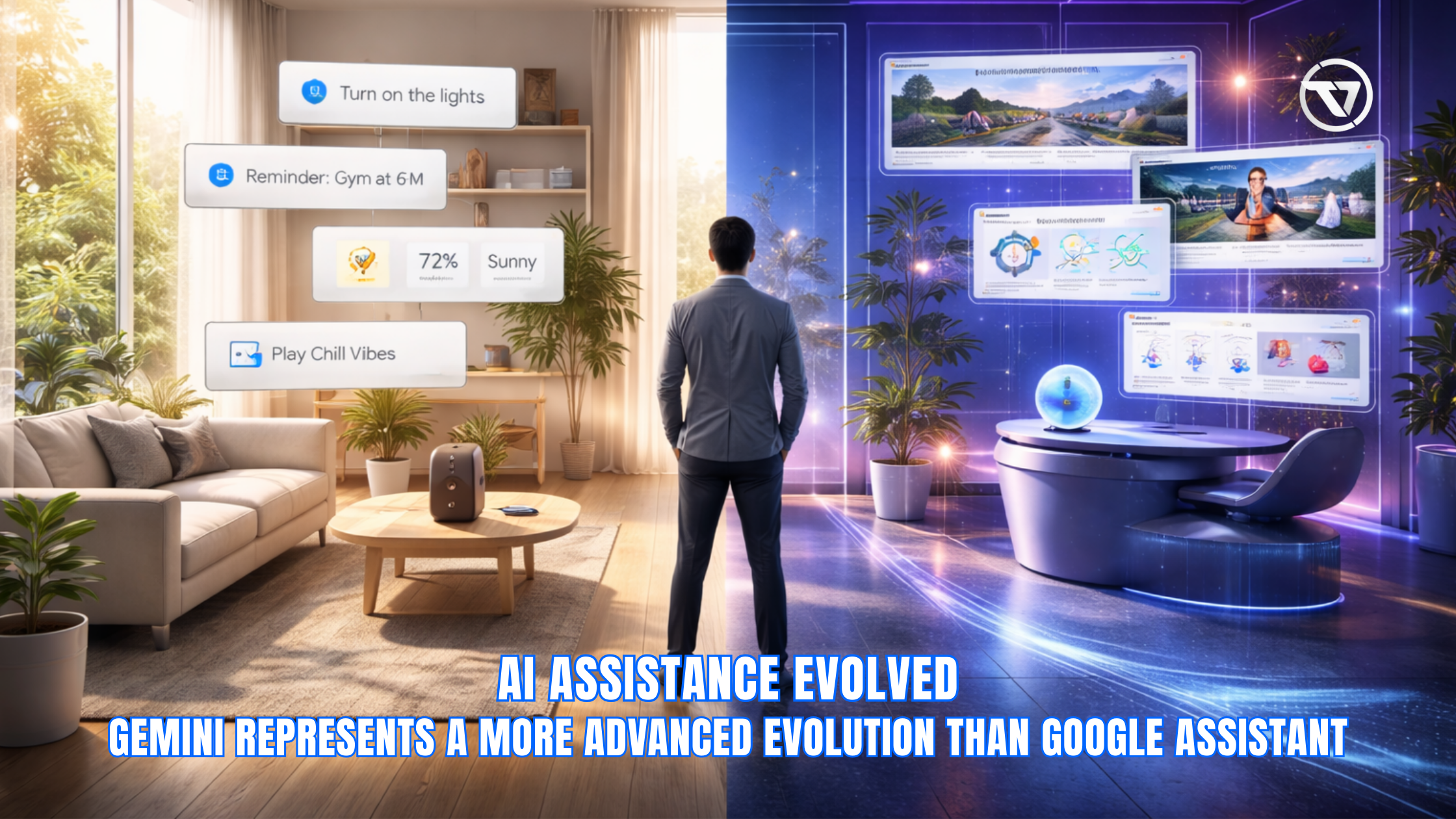
Whether Gemini is better than Google Assistant depends on how you define better. Gemini excels in generative tasks like deep language understanding, creative problem-solving, and long-form assistance, whereas Google Assistant excels in everyday device control, personal tasks, and real-time context awareness. In many cases, they complement one another rather than directly replace each other.
What Is Gemini, and What Is Google Assistant?
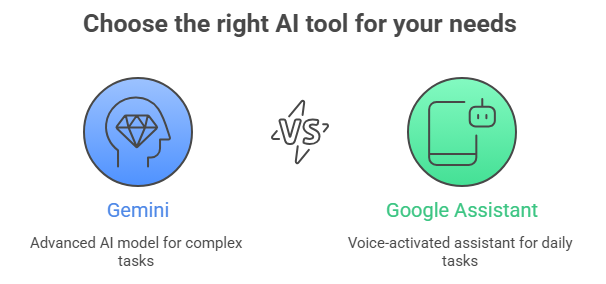
Gemini is Google’s advanced AI model designed for rich language tasks such as writing, reasoning, research, and extended conversation. It is built to handle complex prompts, synthesize information from multiple contexts, and assist users with detailed explanations, structured insights, and creative or analytical outputs. Beyond simply responding to queries, Gemini can support workflows, generate long-form text, interpret nuanced requests, and adapt conversationally over time, making it highly suited for knowledge-intensive and ideation-driven use cases across personal, academic, and professional environments. In 2025, the Gemini app surpassed 650 million monthly active users worldwide, reflecting its broad adoption as a general-purpose AI assistant in everyday digital interactions.
Google Assistant, on the other hand, is a voice-activated intelligent personal assistant embedded across Android devices, Wear OS, Nest smart home products, and other connected platforms. It is optimized for everyday operational support — executing commands, handling reminders, enabling navigation, initiating calls, controlling smart devices, and responding to context-aware prompts using real-time device and environmental data. Instead of focusing on generative reasoning, Google Assistant emphasizes reliability in daily tasks, quick actions, and seamless integration with the user’s digital ecosystem. Although both technologies leverage AI, Gemini functions primarily as a language and reasoning engine, while Google Assistant operates as an execution-centric assistant designed to integrate tightly with hardware and daily activities. As of 2025, Google Assistant is used by more than 500 million users globally each month, highlighting its widespread presence across phones and smart devices.
Key Differences: Gemini vs Google Assistant
Before comparing features in detail, it is important to recognize that Gemini and Google Assistant are purpose-built for different categories of interaction. Gemini is oriented toward cognitive, generative, and analytical engagement, whereas Google Assistant is designed to support hands-free operation and task execution. Their strengths diverge because they solve different user needs, even though both exist within the same broader ecosystem.
Feature Comparison:
| Feature | Gemini | Google Assistant |
|---|---|---|
| Core Strength | Deep generative AI, reasoning, writing, and research | Task execution, real-world control, contextual actions |
| Best For | Complex questions, content generation, creative tasks | Hands-free device control, alarms, navigation, calls |
| Integration | Models tied to Google products/AI workflows | Built into devices, wearables, and smart speakers |
| Conversational Depth | High (long chats, nuanced understanding) | Medium (quick, task-oriented interaction) |
| Real-Time Context | Limited phone/device sensors | Full access to calendars, apps, location, and reminders |
| Offline Capability | Limited or cloud-based only | Supports some offline commands |
| Voice Interaction | Possible via UI integrations | Core focus |
When Gemini Is Better Than Google Assistant
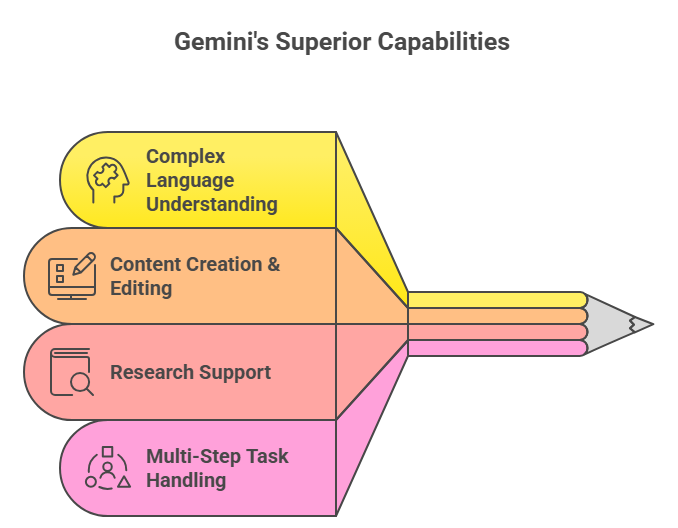
Gemini stands out in scenarios where intelligence, reasoning depth, and conversational continuity matter more than real-world command execution. It is especially effective when the user requires structured thinking support, ideation, exploration of concepts, or detailed written and creative outputs rather than quick operational actions. In such environments, Gemini behaves more like a digital collaborator than a utility assistant.
1. Complex Language & Understanding
Gemini is stronger at deep conversation, long reasoning, summarizing content, and answering nuanced questions. It can elaborate on complex subjects, adapt explanations to different levels of understanding, and provide examples or structured breakdowns that reflect deeper comprehension. For instance, when asked to explain emerging technologies or conceptual frameworks, Gemini is capable of contextualizing information, simplifying advanced topics, and sustaining extended dialogue that supports learning and clarity.
2. Content Creation & Editing
Gemini can produce articles, scripts, emails, stories, and professional copy — something Google Assistant does not do. It supports drafting, refining, and iterating on text-based content across a wide range of styles and tones, making it valuable for marketing tasks, academic writing, storytelling, and business communications. Because it can maintain context across longer passages, Gemini assists with rewriting, restructuring, and improving content while preserving intent and coherence.
3. Research Support
Gemini handles research tasks more effectively by synthesizing information and presenting structured answers. Rather than merely surfacing links, it can summarize themes, highlight contrasts, and organize relevant insights into meaningful formats. This makes Gemini well-suited for brainstorming, exploring knowledge domains, comparing concepts, or supporting early-stage decision analysis where interpretation and synthesis matter as much as retrieval.
4. Multi-Step Tasks within Conversation
When interaction requires memory, continuity, or extended dialogue — such as planning a project, outlining initiatives, or mapping steps in a process — Gemini is more capable. It maintains conversational state, revisits earlier context, and refines outputs incrementally across turns, enabling collaborative thinking rather than one-off command execution.
When Google Assistant Is Better Than Gemini
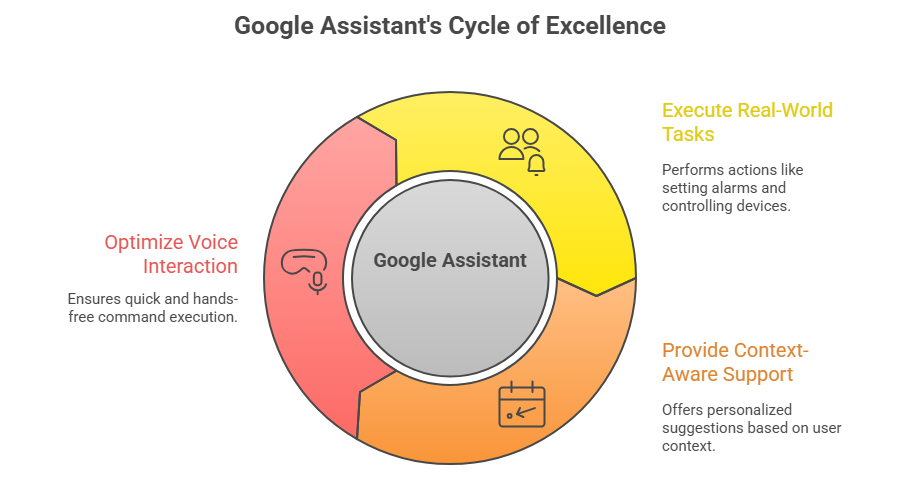
Google Assistant outperforms Gemini when the objective is to act in the physical or digital environment rather than discuss or analyze information. It is built around immediacy, responsiveness, and seamless integration with apps, sensors, and smart devices, making it especially effective in daily routine management and hands-free operational tasks. Its strength lies not in conversation depth but in reliable, frictionless execution.
1. Real-World Task Execution
Google Assistant performs actions such as setting alarms, sending messages, making calls, opening apps, navigating with Maps, and controlling smart home devices, executing them instantly through natural voice or tap commands. According to global usage trends, 56% of consumers use voice assistants on their smartphones, underscoring how frequently users rely on assistant-based execution of everyday tasks. It is wired into system-level capabilities, meaning it not only interprets instructions but also carries them out across the user’s ecosystem, whereas Gemini may guide or explain how to perform these tasks but does not natively trigger device-level outcomes.
2. Context-Aware Daily Support
Google Assistant leverages calendars, reminders, locations, and real-time device signals to deliver proactive, personalized support. It understands routines, travel patterns, and scheduling behavior, allowing it to surface timely prompts and contextual suggestions that reflect what the user is doing in the moment. Gemini, by contrast, focuses primarily on conversation and reasoning rather than situational awareness.
3. Voice-First Interaction
Google Assistant is optimized for spoken commands and fully hands-free use across phones, wearables, vehicles, and home devices. Its latency, response style, and interaction model are engineered around quick responses and immediate execution, supporting environments where the user cannot or does not wish to engage through text.
Example Scenarios: Gemini vs Google Assistant
To understand how these tools differ in real-world situations, it is helpful to look at practical use cases where each one demonstrates its strengths. The examples below illustrate how Gemini excels in cognitive and generative contexts, while Google Assistant proves superior in operational and task-driven environments where immediacy and device integration matter most.
Scenario 1: Create a Marketing Plan
Gemini generates a detailed marketing plan with structured steps, campaign concepts, messaging ideas, audience segmentation insights, and execution frameworks that can be refined through conversation. It helps brainstorm strategies, outline deliverables, and expand creative direction in a way that mirrors collaborative planning. Google Assistant, by comparison, is not designed to compose strategic content or iterate through conceptual material at this depth.
Scenario 2: Set a Morning Alarm
Google Assistant responds instantly to “Set alarm for 7:00 AM” and configures the device alarm systemwide without further interaction, ensuring the task is executed reliably and immediately. Gemini may describe how to set an alarm or suggest routines, but it does not activate hardware-level controls or engage directly with the device’s alarm functions, making Assistant the clear functional choice here.
Scenario 3: Answer a Complex Question
When asked, “Explain the economic impact of AI in healthcare,” Gemini produces a thorough, structured explanation covering industry efficiency, cost-reduction mechanisms, innovation effects, workforce implications, and policy considerations, often supported by synthesized reasoning and scenario perspectives. Google Assistant will generally return a brief overview or route the user to external web resources rather than generating deep interpretive content.
Scenario 4: Control Smart Lights
Google Assistant executes “Turn off living room lights” instantly by interfacing with compatible smart home systems, providing immediate, hands-free device control. Gemini does not manage device automation directly, meaning it cannot manipulate connected systems or perform environmental actions without intermediary integration.
Integration: When They Work Best Together
In many cases, Gemini and Google Assistant are complementary rather than competitive. Users may rely on Google Assistant to manage routine operational tasks such as reminders, alarms, navigation, or smart home control, while turning to Gemini for strategic thinking, writing assistance, planning, learning, and creative exploration. Each fills a distinct functional niche, resulting in a more complete digital support ecosystem when both are used in tandem.
For example, a user might ask Google Assistant to schedule meetings, set event reminders, or initiate communications, while using Gemini to draft presentation scripts, analyze research findings, or develop project outlines referenced by those same scheduled activities. Together, they create a layered experience in which Assistant handles execution and immediacy, while Gemini delivers reasoning, context building, and conceptual elaboration.
Limitations to Consider
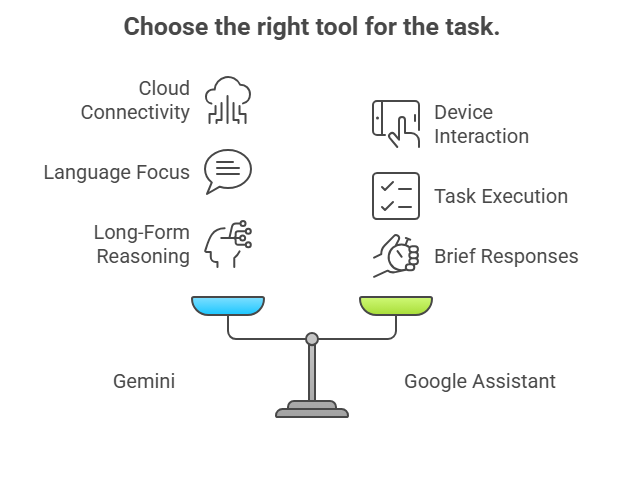
Although both platforms are powerful, each comes with constraints that shape how and where it performs best. Understanding these limitations helps users align expectations and choose the right tool for the right context, rather than assuming either technology functions as a complete replacement for the other.
1. Gemini
Gemini relies primarily on cloud connectivity, meaning it typically requires an internet connection to operate effectively, and its capabilities are centered on language, reasoning, and content rather than environmental or device-level awareness. It is not inherently tied to sensors, calendars, or physical controls unless those capabilities are integrated through external systems, which limits its role in direct execution tasks compared with Google Assistant.
2. Google Assistant
Google Assistant is less sophisticated in long-form reasoning or creative generation, offering relatively brief responses and limited contextual memory in extended discussions. Its design prioritizes immediacy, task execution, and environmental interaction rather than narrative depth or analytical complexity, meaning it excels operationally but is not suited for writing-intensive or research-oriented workflows.
TaskVirtual: Enhancing Productivity with Human-Assisted Digital Support

As users adopt tools like Gemini and Google Assistant to streamline work, research, and daily routines, there are still many situations where human-guided support adds an extra layer of efficiency and clarity. TaskVirtual provides professional virtual AI assistance services that complement AI tools by helping individuals and businesses manage digital workflows, organize online activities, and coordinate tasks that benefit from human judgment alongside intelligent automation.
1. Strategic Workflow Assistance
TaskVirtual’s experienced virtual assistants help users leverage platforms like Gemini for content research, writing, and planning while also coordinating practical activities that Google Assistant supports, such as scheduling or reminders. They review tasks, structure priorities, and execute actions smoothly across apps and tools.
2. Affordable and Flexible Pricing
Instead of hiring a full-time administrative resource, users can access expert support at a fraction of the cost. TaskVirtual offers flexible plans ranging from $3.12/hour to $14.99/hour, making dedicated assistance accessible for entrepreneurs, teams, and busy professionals seeking dependable task management.
3. End-to-End Digital Task Support
TaskVirtual organizes project documentation and manages online communications to support research follow-ups and coordination tasks. Also, it bridges the gap between AI recommendations and real-world execution. Their services scale easily based on workload, ensuring continuity and productivity without operational friction.
4. Consistent Monitoring and Quality Assurance
TaskVirtual provides ongoing support through on-time updates, status tracking, and workflow supervision, ensuring tasks remain aligned with goals and schedules. Their proactive approach helps users stay focused on priorities while professionals handle repetitive or time-consuming tasks.
5. Trusted by Users Worldwide
With 364 positive reviews and a 4.7-star rating across leading virtual assistant platforms, TaskVirtual is recognized for reliability, consistency, and high-quality service delivery. Clients rely on their expertise to extend the value of AI tools and achieve more organized and efficient digital operations.
Final Verdict: Is Gemini Better Than Google Assistant?
The answer ultimately depends on your needs: Gemini is better when you require smart conversation, creative output, structured reasoning, research synthesis, or long-form assistance, while Google Assistant is better when you need hands-free device control, reminders, navigation, communications, and real-world task execution. Engineers designed them for fundamentally different purposes, and they deliver the greatest value when used together as complementary components of the same digital experience.
FAQ: Is Gemini Better Than Google Assistant?
1. Is Gemini replacing Google Assistant?
No — they serve different roles. Gemini enhances AI functionality, while Assistant executes tasks.
2. Can Gemini control my devices?
Not directly — Google Assistant controls devices.
3. Does Gemini understand context like daily schedules?
Only if your system or app integrates your data, it’s not native like Google Assistant.
4. Are Gemini and Assistant free to use?
Basic use is free; some features may require subscriptions.
5. Which should I use for work productivity?
Gemini for deep writing and planning
Google Assistant for reminders, calls, and real-time tasks
 Siddhartha Basu is a Technical Writer at Task Virtual. He loves online games, e-book reading, and Yoga.