
Contents
show
How a Wellness Virtual Assistant Can Boost Your Growing Business
A wellness virtual assistant is a remote professional who supports wellness businesses—such as health coaches, fitness trainers, and holistic practitioners—by managing administrative, operational, and client-facing tasks. They enable business owners to focus on service delivery while ensuring consistent backend operations.
Wellness entrepreneurs often start with a clear mission—helping clients improve their health—but quickly encounter operational bottlenecks. Scheduling sessions, responding to client inquiries, managing records, and handling marketing tasks can consume significant time, which is one reason 59% of businesses now use outsourcing to reduce operational workload and focus on core activities. As demand grows, these responsibilities become unsustainable for a single person. This is where a virtual assistant for wellness business operations becomes a practical solution. Instead of hiring full-time staff, businesses can outsource specific workflows to a remote wellness virtual assistant, maintaining flexibility while improving efficiency.
What This Means for Businesses
A wellness business virtual assistant functions as an operational extension of the business. Rather than handling isolated tasks, they support entire workflows—client onboarding, appointment management, and communication systems.
For example:
- A virtual assistant for wellness coaches can manage weekly client check-ins and scheduling.
- A virtual assistant for fitness coaches can handle program delivery logistics and follow-ups.
- A virtual assistant for holistic health business owners can organize client records and appointment systems.
This model allows businesses to scale services without proportionally increasing internal workload.
Why Companies Outsource This Task
Outsourcing to a wellness administrative virtual assistant addresses several operational constraints:
- Time limitations often force founders to spend excessive time on administrative work. This reduces the time available for delivering client services and growing the business.
- Inconsistent processes often arise from relying on manual systems. This can result in missed appointments and delayed responses to clients.
- Growth bottlenecks occur when there is no operational support in place. This makes it difficult to handle increasing client volume efficiently.
- Cost constraints limit the ability of small businesses to hire full-time staff. This makes it challenging to build internal support for daily operations.
For many, choosing to hire a wellness virtual assistant is a strategic decision to improve operational efficiency while maintaining cost control.
Tasks Virtual Assistants Perform
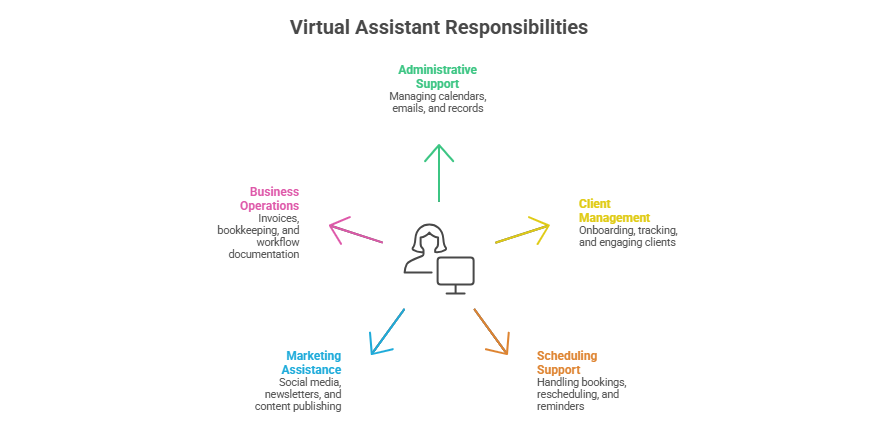
A dedicated wellness virtual assistant typically handles recurring, process-driven responsibilities that keep daily operations running smoothly. Notably, 24% of small businesses outsource to increase efficiency, reflecting a clear shift toward delegating routine operations. These tasks are structured to support both administrative efficiency and client experience. By managing routine workflows, they help wellness businesses maintain consistency and scalability.
1. Administrative Support
Administrative support includes managing calendars, scheduling appointments, and organizing daily priorities. It also involves handling email inboxes to ensure timely responses and proper communication flow. Additionally, virtual assistants maintain accurate records through data entry and system updates.
2. Client Management
Client management focuses on onboarding new clients through structured intake processes and documentation. Virtual assistants update CRM systems to track client progress and maintain organized records. They also manage follow-ups and reminders to ensure consistent client engagement.
3. Scheduling Support
Scheduling support involves managing bookings through online platforms and coordinating appointment availability. Virtual assistants handle rescheduling requests and cancellations to avoid disruptions. They also set up automated reminders to reduce no-shows and improve attendance rates.
4. Marketing Assistance
Marketing assistance includes scheduling social media content and maintaining a consistent posting calendar. Virtual assistants coordinate newsletters and assist in organizing email campaigns. They also format and publish content across platforms to maintain brand presence.
5. Business Operations
Business operations support includes tracking invoices and assisting with basic bookkeeping processes. Virtual assistants generate reports to monitor performance and business metrics. They also document workflows to ensure processes remain standardized and scalable.
Tools Professional Virtual Assistants Use

A remote wellness virtual assistant uses a structured set of digital tools to manage operations efficiently across multiple workflows. These tools enable consistency in scheduling, communication, and client management. By leveraging standardized platforms, virtual assistants ensure accuracy, automation, and seamless coordination.
1. Scheduling Tools
Scheduling tools such as Calendly, Acuity Scheduling, and Google Calendar are used to automate appointment bookings and manage availability. These platforms help streamline scheduling processes and reduce manual intervention through automated reminders.
2. Client Management Systems (CRM)
Client management systems like HubSpot, Practice Better, and HoneyBook centralize client data and track interactions efficiently. They allow virtual assistants to manage onboarding, communication, and client records within a single system.
3. Communication Tools
Communication tools, including Slack, Zoom, and Gmail, facilitate real-time collaboration and structured communication. They ensure smooth coordination between business owners and virtual assistants across different time zones.
4. Project Management
Project management tools such as Trello, Asana, and ClickUp help organize tasks and monitor workflow progress. These platforms improve accountability by providing visibility into ongoing and completed tasks.
5. Marketing Tools
Marketing tools like Mailchimp, ConvertKit, and Buffer are used to manage email campaigns and schedule social media content. They support consistent outreach and audience engagement through automated marketing workflows.
Step-by-Step Workflow Used by Virtual Assistants
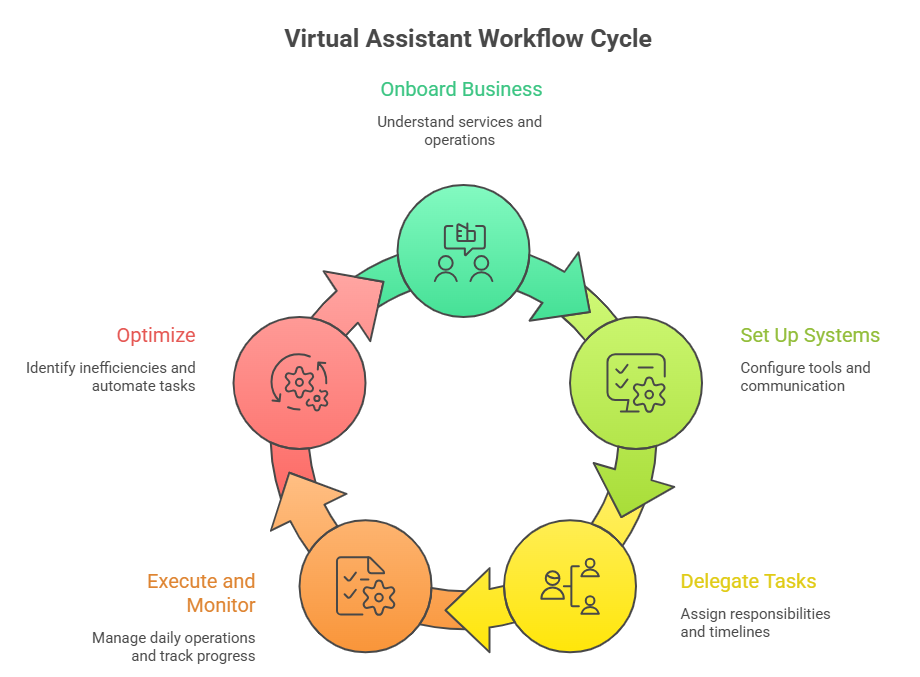
A professional virtual assistant for wellness entrepreneurs follows a structured workflow to ensure operational consistency and efficiency. Studies show that 77% of high-performing organizations rely on standardized processes to maintain efficiency and consistency, emphasizing the value of structured workflows. This approach allows tasks to be managed systematically while maintaining quality and accountability. By implementing clear processes, virtual assistants support scalable and repeatable business operations.
1. Onboarding the Business
During onboarding, the virtual assistant reviews the services offered and gains a clear understanding of business operations. They map existing processes and identify repetitive tasks that can be streamlined or delegated.
2. Setting Up Systems
The assistant configures scheduling tools and organizes CRM systems to centralize business activities. They also establish communication channels to ensure smooth coordination between all stakeholders.
3. Task Delegation
Clear responsibilities are defined to avoid confusion and ensure accountability across workflows. Recurring tasks are assigned with structured timelines and expectations.
4. Execution and Monitoring
Daily operations such as email management, scheduling, and updates are handled consistently. Task progress is tracked, and regular updates are shared to maintain transparency.
5. Optimization
The assistant identifies inefficiencies within existing workflows and suggests improvements. Repetitive tasks are automated, and processes are refined to enhance long-term productivity.
Common Challenges Businesses Face

Before outsourcing, wellness businesses often encounter:
- Manual scheduling errors often occur when processes are not automated. This can lead to missed appointments and scheduling conflicts.
- Delayed client responses often occur due to unmanaged communication workflows. This negatively impacts the overall customer experience.
- Disorganized data management often results from using multiple unintegrated tools. This leads to inefficiencies and difficulty in accessing accurate information.
- Burnout from multitasking across operations and service delivery
- Lack of standardized processes creates inconsistency in daily operations. This makes it difficult to maintain efficiency and deliver a reliable client experience.
Benefits of Outsourcing to Virtual Assistants
| Area | Without VA | With Wellness Virtual Assistant |
|---|---|---|
| Time Management | The founder handles everything | Tasks distributed efficiently |
| Client Experience | Delayed responses | Prompt communication |
| Scheduling | Manual and error-prone | Automated and reliable |
| Cost | High (full-time hire) | Flexible, lower cost |
| Scalability | Limited capacity | Easier to scale operations |
Key Benefits
- Improved operational efficiency helps streamline daily business activities. This enables faster execution of tasks and better overall productivity.
- Reduced administrative workload allows business owners to delegate routine tasks. This frees up time to focus on core activities and growth.
- Better client engagement ensures consistent and timely communication with clients. This helps build stronger relationships and improves client satisfaction.
- Cost-effective scaling allows businesses to grow without significantly increasing fixed expenses. This supports expansion while maintaining financial efficiency.
- More focus on core services allows business owners to prioritize their primary offerings. This improves service quality and overall business performance.
For US and UK businesses, working with a US-based wellness virtual assistant or globally distributed talent provides flexibility in time zones and cost structures.
TaskVirtual: Your Partner in Wellness Virtual Assistant Services

Managing a wellness business involves more than delivering services—it requires consistent scheduling, client communication, and operational coordination. TaskVirtual provides wellness virtual assistant services that handle these critical backend functions, allowing business owners to focus on client outcomes and business growth.
1. Expert Consultation and Workflow Setup
TaskVirtual’s virtual assistants evaluate your current operations, including scheduling systems, client onboarding processes, and communication workflows. They help streamline appointment management, organize client databases, and implement structured processes tailored to wellness businesses.
2. Affordable and Flexible Pricing
Hiring in-house administrative staff can significantly increase operational costs. TaskVirtual offers flexible pricing models ranging from $3.12/hour to $14.99/hour, making it a practical option for startups, small businesses, and scaling wellness brands.
3. Comprehensive Wellness Support Solutions
From managing bookings and cancellations to maintaining CRM systems and handling client follow-ups, TaskVirtual delivers end-to-end support. Whether you are a health coach, fitness trainer, or holistic practitioner, their services adapt to your workflow requirements.
4. Ongoing Operational Support and Optimization
TaskVirtual ensures continuity by providing regular updates, monitoring task execution, and identifying areas for improvement. Their assistants proactively manage schedules, track client interactions, and maintain organized systems to prevent operational gaps.
5. Proven Track Record of Excellence
With 364 positive reviews and a 4.7-star rating on trusted VA platforms, TaskVirtual has established itself as a reliable partner for businesses worldwide. Their consistent service quality supports wellness entrepreneurs in maintaining professional and efficient operations.
Conclusion
A wellness virtual assistant is not just an administrative resource—it is a strategic operational partner. By handling scheduling, client management, and routine tasks, they enable wellness professionals to focus on delivering high-quality services. For small businesses and growing wellness brands, outsourcing these functions provides a clear pathway to scale sustainably without overextending internal capacity.
Key Takeaways
- A wellness virtual assistant supports both administrative and client-facing workflows.
- Outsourcing improves efficiency and reduces operational burden.
- Structured tools and workflows are essential for successful delegation.
- Virtual assistants enable scalable growth without high fixed costs.
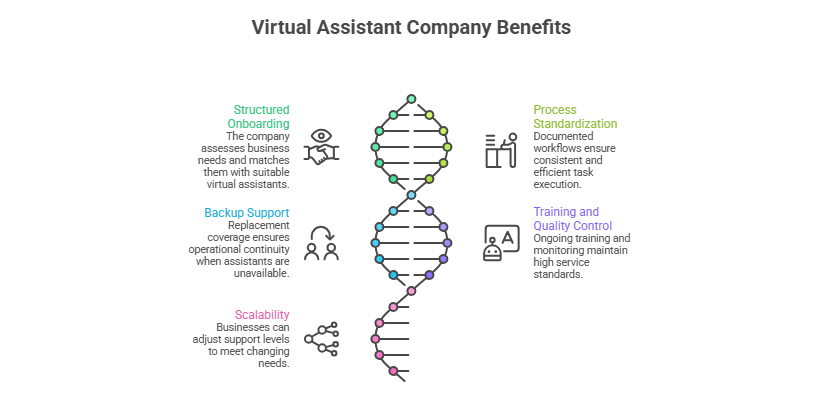
- Working with a VA company adds reliability and process standardization.
FAQ Section
1. What does a wellness virtual assistant do?
They manage administrative tasks, scheduling, client communication, and operational workflows for wellness businesses.
2. How much does a wellness virtual assistant cost?
Costs vary based on experience and location, but many businesses find them more affordable than hiring full-time staff.
3. Can a virtual assistant handle client communication?
Yes, many VAs manage emails, follow-ups, and CRM updates as part of client management.
4. Are wellness virtual assistants suitable for small businesses?
Yes, they are particularly useful for small businesses that need flexible and cost-effective support.
5. Do I need technical tools before hiring a VA?
Basic tools like scheduling software and email systems help, but many VAs can assist in setting these up.
 Siddhartha Basu is a Technical Writer at Task Virtual. He loves online games, e-book reading, and Yoga.