
Contents
show
How Claude AI Pricing Powers Cost-Effective Technical Support with VA
Claude AI pricing includes both subscription access and API-based usage. The Anthropic Claude Pro plan costs $20/month (or $17/month annually) for interactive use via claude.ai, while API pricing follows a pay-as-you-go model. Models like Sonnet 4.6 and Opus 4.6 are priced per million tokens, with clear input/output cost structures that scale with usage. Features such as prompt caching and batch processing can significantly reduce costs—by as much as 90% in some cases—making the platform efficient for high-volume or repetitive workloads.
For small businesses and startups, especially in the US and UK, Claude offers a practical alternative to hiring full-time developers or maintaining round-the-clock support teams. Its strong performance in coding, debugging, and technical reasoning allows virtual assistants to handle complex tasks quickly and accurately, delivering up to 80% time savings on typical technical work. By understanding Claude Pro pricing, API token costs, and differences between Sonnet and Opus tiers, organizations can assess whether integrating Claude into workflows delivers better ROI compared to traditional in-house solutions.
| Aspect | In-House Developer Approach | VA + Claude AI Approach |
|---|---|---|
| Monthly Cost (est.) | $8,000–$12,000 (salary + benefits for mid-level engineer) | $800–$2,500 (VA hours + Claude Pro/API usage) |
| Resolution Speed | 2–5 business days per ticket | 4–12 hours per ticket |
| Scalability | Fixed headcount; hiring delays | On-demand; scales with project volume |
| Expertise Access | Single developer’s skill set | Claude’s frontier coding + VA oversight |
| Overhead | Recruiting, training, and tools | Minimal; VA handles prompt engineering & review |
What This Means for Businesses
For US and UK startups and agencies, the combination delivers technical support without the fixed overhead of a full engineering team. A single VA using Claude can handle multiple clients’ coding requests simultaneously, turning sporadic tickets into predictable, billable deliverables. Claude AI pricing transparency—clear token rates and subscription tiers—eliminates surprise costs, allowing finance teams to forecast accurately. Agencies gain a competitive edge by offering “AI-augmented” support at lower rates than competitors who rely on offshore developers or manual processes. The real-world implication is faster iteration cycles, reduced technical debt, and the ability to maintain high service levels during growth spurts or seasonal spikes.
How This Actually Works
At its core, Claude processes tasks through a large-context transformer architecture trained on vast code and technical datasets. When a VA pastes error logs, code snippets, or system diagrams into Claude (via claude.ai or the API), the model analyzes the full context—often hundreds of thousands of tokens—and returns reasoned solutions rather than generic replies.
Claude AI processes tasks by first understanding intent through natural-language prompts, then generating structured outputs (code blocks, step-by-step fixes, or test cases). It excels because its 200K–1M token context window (depending on model and plan) allows it to retain entire repositories or ticket histories in one session, unlike smaller-context models that lose nuance. Research shows AI coding tools can improve developer productivity by 35-40% in many real-world scenarios, reinforcing their effectiveness in accelerating technical workflows. In business workflows, this means virtual assistants spend less time reformulating questions and more time validating outputs, creating a seamless loop between client request, AI reasoning, and human delivery.
Core Capabilities of Claude AI for This Use Case
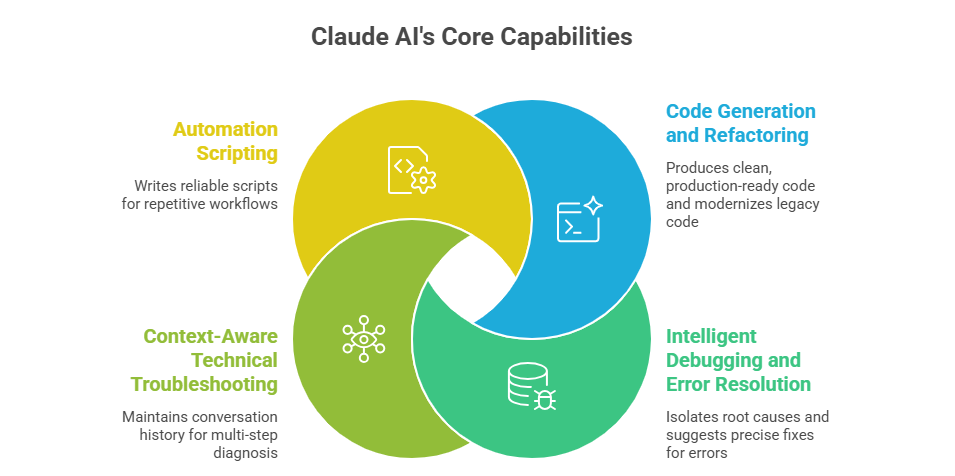
Claude’s strengths for coding and technical support stem directly from its reasoning depth and code fluency. These capabilities allow virtual assistants to handle complex technical tasks efficiently using Claude AI. Businesses benefit from faster delivery, lower costs, and scalable support without maintaining a large in-house development team.
1. Code Generation and Refactoring
Claude produces clean, production-ready code in languages such as Python, JavaScript, React, and SQL. A VA uploads a legacy module and requests modernization; Claude outputs refactored code with comments and performance notes. In practice, VAs iterate by feeding back test failures until the code passes. This matters because businesses ship features faster without maintaining specialized developers for every stack.
2. Intelligent Debugging and Error Resolution
Given stack traces, logs, or API responses, Claude isolates root causes and suggests precise fixes—including environment-specific adjustments. VAs copy console output into a new chat, ask Claude to simulate the error, and receive a ranked list of probable causes with reproduction steps. Businesses benefit through dramatically lower mean-time-to-resolution (MTTR), preventing small bugs from escalating into customer churn.
3. Context-Aware Technical Troubleshooting
Claude maintains conversation history across long sessions, enabling multi-step diagnosis (e.g., “the database query works locally but fails in staging—why?”). VAs chain prompts with prior outputs to build diagnostic trees. This capability reduces back-and-forth with clients and delivers solutions that account for the full system architecture.
4. Automation Scripting for Repetitive Workflows
Claude writes reliable scripts for data migration, CI/CD pipelines, or monitoring alerts. VAs specify parameters once; Claude generates, tests syntax, and suggests error-handling. The result is scalable automation that frees internal teams for strategic work.
Why Companies Use Claude AI
Companies adopt Claude because it slashes engineering costs while preserving quality. A Sonnet 4.6 API call for a typical debugging session costs pennies, versus hundreds of dollars in developer time. Claude Pro pricing gives VAs unlimited interactive access for $20/month, while pay-as-you-go API pricing with caching keeps high-volume work economical. Scalability is immediate—no recruitment cycles—and output consistency exceeds junior developers on repetitive tasks. Limitations around edge-case novelty are offset by VA review, creating a hybrid model that is both cheaper and faster than in-house alternatives.
Tasks Virtual Assistants Perform Using Claude AI
Virtual assistants monitor client repositories for deprecated libraries or security vulnerabilities, feed the codebase into Claude, and generate updated dependency patches with migration notes. Studies indicate that over 60% of data breaches are linked to unpatched vulnerabilities, highlighting the importance of proactive dependency management. This matters because businesses stay compliant and secure without dedicating internal bandwidth to ongoing maintenance tasks.
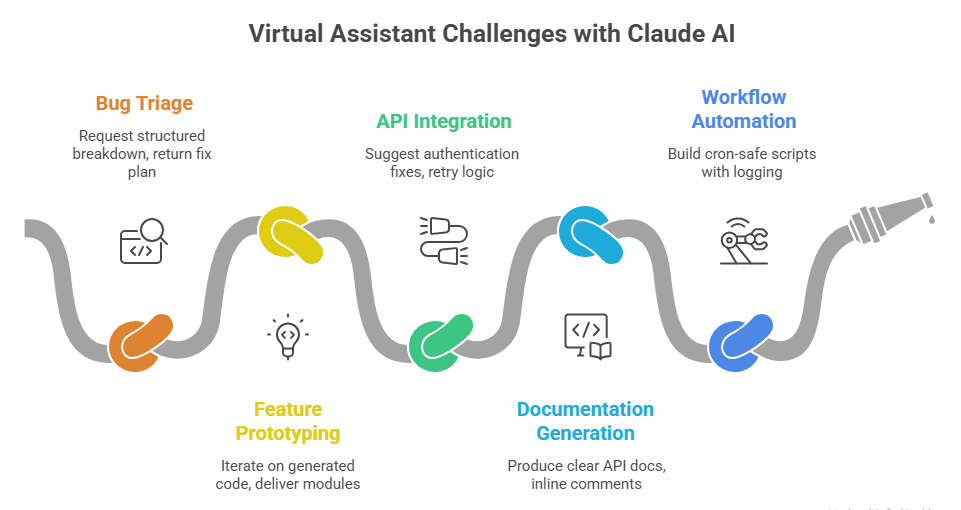
1. Bug triage and root-cause analysis
When clients submit support tickets with logs, VAs upload the files to Claude, request a structured breakdown, and return a prioritized fix plan complete with reproduction steps. The business gains faster ticket closure and higher customer satisfaction scores.
2. Feature prototyping and implementation
Startups request quick MVPs or API endpoints; VAs prompt Claude with requirements and architecture constraints, iterate on generated code, and deliver testable modules. This accelerates time-to-market for new offerings without expanding the core team.
3. API integration troubleshooting
VAs handle third-party API failures by providing Claude with endpoint documentation and error payloads; Claude suggests authentication fixes or retry logic. Agencies retain clients longer because integrations remain reliable without constant developer intervention.
4. Technical documentation generation
VAs ask Claude to produce clear API docs or inline comments from existing codebases. The output is consistent and searchable, reducing onboarding time for new hires or contractors.
5. Workflow automation scripting
For repetitive operational tasks (data syncs, report generation), VAs instruct Claude to build cron-safe scripts with logging and alerts. Businesses achieve operational efficiency without purchasing additional no-code tools.
Tools and Systems Used Alongside Claude AI
Virtual assistants combine Claude with GitHub for version control and pull-request reviews, Jira or Linear for ticket tracking, Slack for real-time client handoffs, and Google Drive or Notion for sharing generated documentation. Zapier or Make.com connects Claude API outputs to client CRMs or monitoring dashboards. Some VAs use VS Code with Claude extensions for live editing sessions. These integrations ensure Claude outputs move seamlessly from diagnosis to deployment without manual copy-paste friction.
Step-by-Step Workflow Used by Virtual Assistants

- A client submits a ticket (e.g., “Payment gateway failing on mobile checkout”) with logs and a repo link.
- Tools used include Claude Pro or API, GitHub, Jira, and screen-sharing if needed.
- Process steps include: (1) VA uploads artifacts to Claude and crafts a precise prompt; (2) Claude returns diagnosis and code fix; (3) VA tests in staging and iterates if needed; (4) VA documents the solution and creates a pull request.
- Output includes deployable code, an updated ticket with resolution notes, and a client-ready summary.
- Tasks that took 8–16 hours now complete in 2–4 hours, with Claude handling ~80% of reasoning and VAs providing the final 20% validation.
Real Example (Use Case)
A UK-based e-commerce startup (12 employees) experienced recurring Stripe webhook failures during peak sales. Their single developer was overwhelmed. The company engaged a virtual assistant team using Claude Pro and API. The VA uploaded webhook logs and schema, prompted Claude Sonnet 4.6 for signature validation and retry logic, generated a Node.js middleware patch, tested it locally, and submitted a pull request—all within six hours. Result: webhook success rate rose from 72% to 99.8%, cart abandonment dropped 18%, and the startup saved approximately $4,200 in developer hours over the next quarter while paying only $340 in VA time plus negligible API costs.
Common Challenges and Limitations
Claude can hallucinate edge-case syntax or miss proprietary framework quirks, requiring VA code review before deployment. Large codebases may exceed even 1M-token limits without careful chunking. API costs accumulate with very high-volume debugging (though caching mitigates this). Data privacy concerns arise when sharing sensitive source code; Anthropic’s policies help, but clients with strict compliance needs must use enterprise plans. Finally, Claude lacks live execution environments, so VAs must still run and verify code in the client infrastructure.
Benefits of Outsourcing to Virtual Assistants
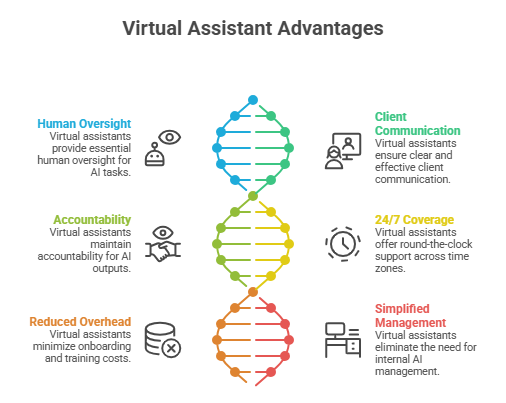
Virtual assistants provide the essential human layer—prompt engineering, output validation, client communication, and accountability—that pure AI cannot; they translate business requirements into optimized prompts for Anthropic Claude, refine outputs for clarity and usability, catch subtle logical or contextual errors the model may miss, and maintain continuity across tickets by tracking context and prior decisions, while outsourcing adds 24/7 coverage across time zones, reduces onboarding and training overhead, eliminates the need to manage Claude pricing or API integrations internally, and delivers a single, accountable point of contact for consistent, scalable, and business-aligned technical support.
Cost and Efficiency Comparison
In-house coding support typically costs $90,000–$150,000 annually per engineer plus overhead, whereas a VA + Anthropic Claude AI setup costs $15–$35/hour for VA time plus $20/month for Claude Pro or API usage (Sonnet 4.6 at $3 input / $15 output per million tokens), keeping total spend for ~40 hours/month under $2,000; this model delivers 3–5× faster resolution, handles 3–5× more tickets without added headcount, and offers flexible scaling via Pro (interactive) or API (automation) with predictable subscription pricing and cost-efficient token usage.
When Businesses Should NOT Use Claude AI
Avoid Claude for highly regulated industries requiring air-gapped environments or zero-trust code review. Extremely niche legacy systems (e.g., obscure mainframe COBOL) may exceed Claude’s training data, producing unreliable output. Real-time, low-latency applications needing sub-second responses favor lighter models or on-premise solutions. Finally, companies without technical oversight risk deploying unverified code; a baseline internal reviewer or senior consultant remains essential.
How a Virtual Assistant Company Helps
A specialized VA company onboards clients with a discovery call to map tech stacks and security requirements. They assign VAs trained on Claude best practices, configure secure API keys or shared Pro workspaces, and establish review gates before any code reaches production. Ongoing support includes monthly Claude AI pricing audits, prompt-library maintenance, and integration health checks. The company handles escalation to human developers when Claude limits are reached, ensuring seamless service delivery without burdening the client’s internal team.
TaskVirtual: Your Partner in AI-Augmented Technical Support

Managing coding demands and technical support tickets can overwhelm small teams, pulling focus from core business growth. From debugging complex issues to implementing new features, the constant need for reliable technical help drains resources and delays progress. TaskVirtual provides expert virtual Claude AI assistant services that integrate Claude AI for efficient coding and technical support, helping businesses handle development tasks and troubleshooting without expanding their in-house team.
1. Expert Consultation and Review
TaskVirtual’s skilled virtual assistants work directly with your tech stack, using Claude AI to analyze code, diagnose issues, and generate accurate solutions. They review outputs for quality, test implementations in staging, and ensure every deliverable aligns with your business requirements and security standards.
2. Affordable and Flexible Pricing
Hiring a full-time developer can be expensive, but TaskVirtual makes expert technical support cost-effective. With pricing plans starting from just $3.12/hour to $14.99/hour, their services are budget-friendly and accessible to startups, agencies, and growing businesses.
3. Comprehensive Technical Support Solutions
From code refactoring and bug resolution to API integrations and automation scripting, TaskVirtual covers a wide range of needs using Claude AI’s capabilities. Their scalable services adapt to whether you require occasional troubleshooting or consistent technical workflow management.
4. Ongoing Support and Quality Assurance
TaskVirtual goes beyond one-off fixes by providing continuous monitoring, prompt optimization, and follow-up validation. Their proactive approach ensures technical issues are resolved quickly, documentation stays updated, and your systems run smoothly with minimal downtime.
5. Proven Track Record of Excellence
With 364 positive reviews and a 4.7-star rating on trusted VA platforms, TaskVirtual is recognised as a reliable partner worldwide. Clients count on their expertise to simplify coding and technical support while leveraging Claude AI for faster, higher-quality results.
Conclusion
Pairing Claude AI with virtual assistants transforms coding and technical support from expensive bottlenecks into scalable, affordable capabilities. With transparent Claude AI pricing and targeted workflows, small businesses and agencies achieve enterprise-grade technical output at startup-friendly costs. The model succeeds because VAs supply judgment while Claude supplies speed and depth—creating outcomes neither could deliver on its own.
Key Takeaways
- Claude AI pricing (Pro at $20/month and Sonnet 4.6 API at $3/$15 per million tokens) makes high-quality coding assistance accessible without full-time developer salaries.
- Virtual assistants amplify Claude’s 1M-token context and reasoning strengths through structured prompting and human validation.
- Typical workflows cut resolution time from days to hours while maintaining security and quality controls.
- The hybrid approach scales on demand and integrates easily with GitHub, Jira, and Slack.
- Success depends on clear processes, prompt discipline, and selective use. Claude excels at most tasks but still requires oversight for production deployment.
FAQ Section
1. What is the current Claude AI Pro pricing, and what does it include?
Claude Pro by Anthropic costs $20/month ($17/month annually) and includes higher message limits plus priority access to Sonnet and Opus models.
2. How does Claude API pricing compare to OpenAI for coding tasks?
Claude Sonnet 4.6 costs $3 input / $15 output per million tokens and typically delivers stronger reasoning-per-dollar for coding, especially with prompt caching.
3. Which Claude model offers the best value for technical support—Sonnet or Opus?
Claude Sonnet 4.6 offers the best cost-performance for most coding tasks, while Opus 4.6 ($5/$25) is suited for complex, high-reasoning workloads.
4. Can virtual assistants keep Claude AI costs predictable for ongoing support?
Yes—VAs manage costs via Anthropic’s dashboard, prompt caching, and Sonnet-first usage, typically keeping API spend under $500/month at moderate scale.
5. Is sharing code with Claude AI secure for business use?
Yes—Anthropic does not train on API or Pro data, with enterprise controls plus VA safeguards like NDAs and data minimization ensuring security.
 Siddhartha Basu is a Technical Writer at Task Virtual. He loves online games, e-book reading, and Yoga.