Contents
show
How a Virtual Teaching Assistant Enhances Online Education
A virtual teaching assistant is a remote academic support professional who helps educators, instructors, and institutions manage course-related tasks. They assist with grading support, student communication, content organization, scheduling, research assistance, and learning management system (LMS) administration, enabling teachers to focus on instruction and student engagement. According to a recent study, 57 % of students reported that virtual teaching assistants were useful in answering learning-related questions, demonstrating growing acceptance of virtual academic support in education systems.
What Is a Virtual Teaching Assistant?
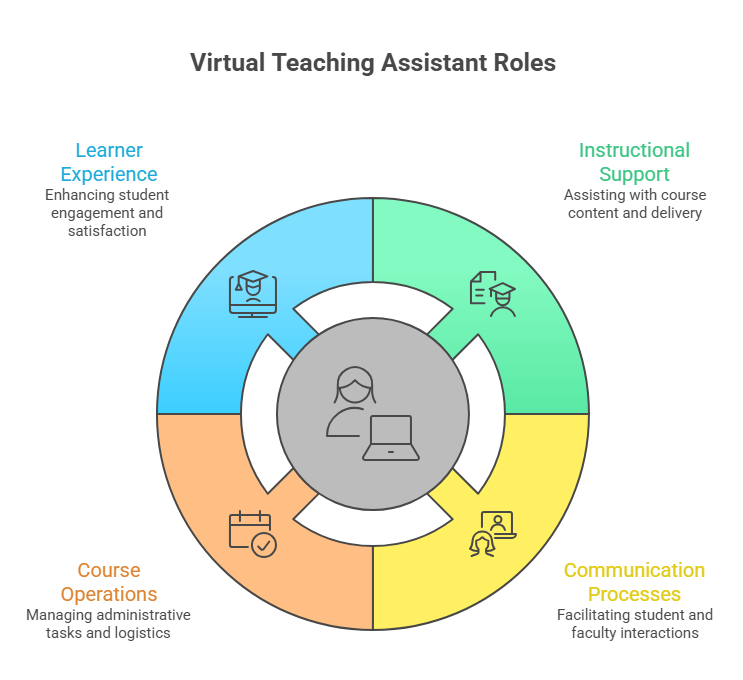
A virtual teaching assistant is a remote academic support specialist who collaborates with educators, institutions, and course creators in fully digital learning environments. Unlike a traditional online teaching assistant working within campus infrastructure, this role operates from any location while supporting instructional workflows, communication processes, and course operations. The position has become essential across universities, coaching businesses, corporate training programs, and digital academies due to the rapid expansion of online education.
These professionals function as remote teaching assistants dedicated to improving efficiency, organization, and learner experience. They integrate into instructional ecosystems by handling structured academic tasks, coordinating digital resources, and maintaining course continuity. In fact, institutions that implemented automated support tools like virtual assistants saw a 25 % increase in student interactions and higher satisfaction rates within one year, highlighting how structured support can enhance engagement and operational quality.
What Does a Virtual Teaching Assistant Do?
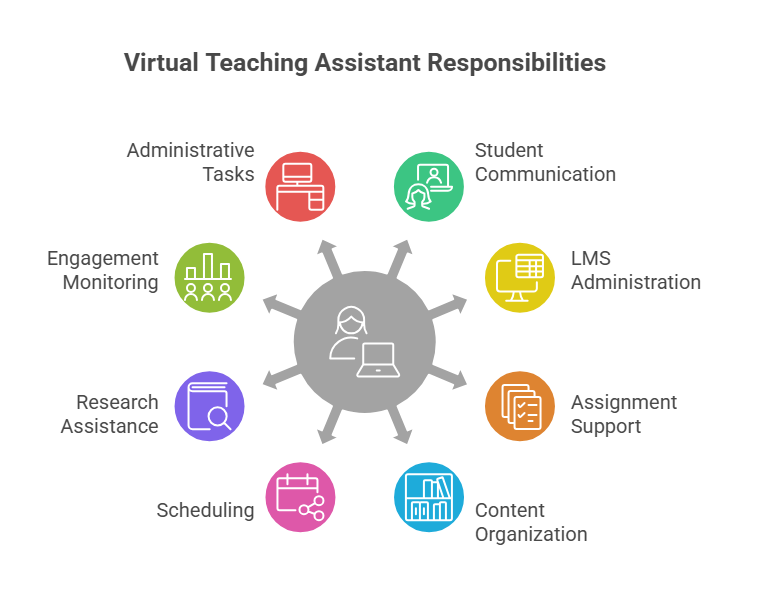
The scope of responsibilities spans academic coordination, learner interaction, and digital course operations rather than simple administrative assistance. A qualified academic virtual assistant helps maintain alignment between instructional resources, communications, and timelines to ensure course stability. This structured support enables educators to focus more on teaching effectiveness, curriculum strategy, and student engagement.
1. Student Communication and Support
A virtual assistant for teachers frequently manages learner-facing interactions, ensuring consistent and timely responses. They address student queries, distribute updates, moderate discussions, and reinforce assignment deadlines through structured communication channels. This proactive involvement improves learner confidence, reduces confusion, and strengthens the overall academic experience.
2. Learning Management System (LMS) Administration
An e-learning virtual assistant maintains course integrity within platforms such as Moodle, Canvas, Blackboard, or Teachable. They upload materials, organize modules, update resources, configure permissions, and monitor digital activity to ensure seamless access. Proper LMS management directly influences course usability, navigation clarity, and student retention.
3. Assignment and Grading Support
A virtual teaching assistant for grading works within instructor-defined parameters to streamline evaluation workflows. They track submissions, organize assessment records, format feedback, and apply rubrics under supervision. This structured support accelerates grading cycles while preserving academic consistency and accuracy.
4. Content Organization and Course Preparation
A virtual assistant for online classes helps transform raw instructional material into structured learning assets. Responsibilities often include formatting presentations, organizing lecture notes, refining documents, and aligning resources with course objectives. Clear content architecture enhances engagement, comprehension, and instructional professionalism.
5. Scheduling and Calendar Management
Time coordination represents a critical operational function in digital education environments. These assistants manage class schedules, office hours, meetings, live sessions, and deadline tracking to prevent conflicts. Effective scheduling safeguards instructional flow and reduces logistical disruptions.
6. Research and Academic Assistance
A remote academic assistant may contribute to research-intensive workflows by compiling information, organizing references, summarizing literature, and preparing educational resources. Their involvement reduces cognitive load for instructors engaged in curriculum design or scholarly work. This function is particularly valuable in higher education and specialized training programs.
7. Student Engagement Monitoring
Data-driven insights help educators identify patterns of participation, progress, and potential disengagement. A virtual teaching assistant for student support often monitors attendance, assignment completion, and activity metrics. These observations enable early intervention strategies for at-risk learners.
8. Administrative and Documentation Tasks
Academic programs generate substantial documentation requiring precision and consistency. Assistants handle data entry, record maintenance, report preparation, and document formatting to preserve organizational accuracy. Administrative efficiency contributes directly to institutional reliability and workflow stability.
Skills Required for a Virtual Teaching Assistant

Effectiveness in this role depends on communication precision, digital fluency, and structured task management capabilities. Because these assistants operate within academic workflows, accuracy and consistency are non-negotiable competencies. High-performing professionals combine interpersonal clarity with technical confidence and organizational discipline.
1. Communication and Interaction Competence
Clear, professional communication is foundational for managing learner interactions and instructor coordination. Assistants must convey information accurately, maintain tone consistency, and respond efficiently across digital channels. Strong interaction skills minimize misunderstandings and foster a reliable learning environment.
2. Organizational and Workflow Management
Course operations involve multiple moving components, including materials, deadlines, assessments, and student communications. Effective assistants demonstrate advanced prioritization ability, systematic tracking practices, and attention to procedural detail. Organizational rigor directly supports course stability and instructional efficiency.
3. Technical and Platform Proficiency
Digital learning ecosystems rely heavily on LMS platforms, collaboration tools, and productivity software. A capable online teaching assistant understands platform navigation, resource structuring, access configuration, and troubleshooting fundamentals. Technical confidence ensures operational continuity and reduces instructor dependency.
Benefits of Hiring a Virtual Teaching Assistant
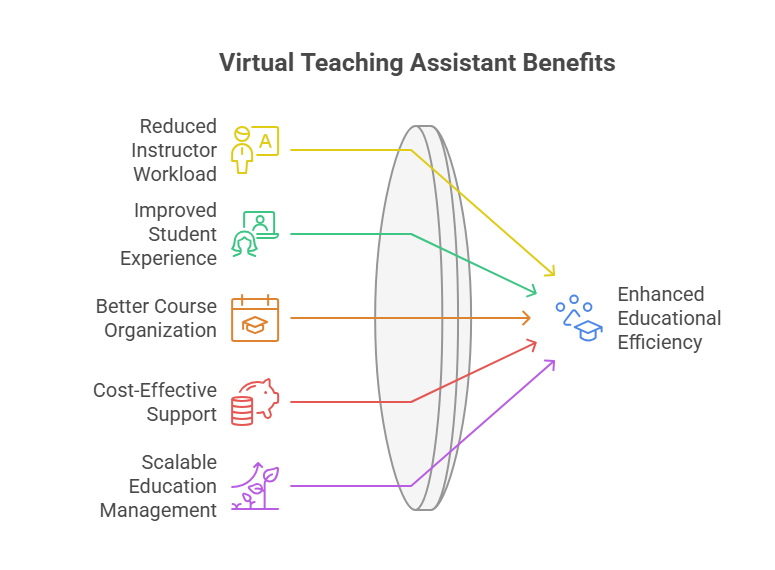
Integrating remote academic support into instructional systems generates measurable improvements in efficiency, learner satisfaction, and course management quality. Institutions and independent educators increasingly adopt this model to streamline digital teaching operations without expanding fixed overhead. The advantages extend across workload distribution, student experience, and scalability.
1. Reduced Instructor Workload
Delegating operational and coordination tasks allows educators to concentrate on instruction and course development. Administrative friction decreases substantially.
2. Improved Student Experience
Structured communication, timely responses, and organized resources create a more predictable learning environment. Students benefit from greater clarity and support.
3. Better Course Organization
Systematic handling of materials, assignments, and deadlines improves course coherence. Well-managed courses typically achieve higher completion rates.
4. Cost-Effective Academic Support
Remote support structures reduce staffing and infrastructure costs compared to traditional arrangements. This makes affordable virtual teaching assistant solutions particularly attractive.
5. Scalable Education Management
Remote academic support adapts efficiently to enrollment growth and program expansion. Scalability becomes operationally feasible without proportional cost increases.
Virtual Teaching Assistant vs Traditional Teaching Assistant
| Aspect | Virtual Teaching Assistant | Traditional Teaching Assistant |
|---|---|---|
| Work Environment | Remote | In-person |
| Flexibility | High | Limited |
| Cost | Lower | Higher |
| Accessibility | Global | Location-bound |
| Scalability | Easy | Restricted |
Virtual assistants offer greater operational flexibility.
Who Should Hire a Virtual Teaching Assistant?

Digital education providers represent the primary beneficiaries of remote instructional support models, particularly when course operations become complex or resource-intensive. Online educators, training organizations, academic institutions, and coaching businesses frequently rely on specialized assistance to maintain instructional quality while managing growth. A virtual assistant for teachers becomes especially valuable when instructional demands exceed available administrative capacity.
Universities, colleges, independent course creators, and schools implementing online or blended programs often engage structured remote support to coordinate materials, deadlines, learner interactions, and digital workflows. Organizations seeking a virtual teaching assistant USA solution or a US-based virtual teaching assistant may prioritize regional familiarity, regulatory alignment, or time-zone compatibility. Professors, corporate training departments, and EdTech platforms also benefit from academic virtual assistant roles designed to preserve course consistency, participant engagement, and reporting accuracy.
TaskVirtual: Specialized Support for Modern Online Education

Managing digital courses involves far more than delivering lectures, as instructors must continuously coordinate materials, student communication, assessments, and platform administration. These operational demands often create bottlenecks that reduce teaching efficiency and limit course scalability. TaskVirtual addresses these challenges by providing structured virtual teaching assistance specifically for online learning environments.
1. Expert Academic Assistance and Consultation
TaskVirtual’s assistants support educators by organizing course workflows, managing instructional resources, and maintaining communication channels. They help align academic processes with institutional or instructor guidelines to ensure operational consistency. This structured approach improves course stability while reducing administrative friction.
2. Affordable and Flexible Pricing
Building an in-house academic support team can be costly and operationally restrictive. TaskVirtual offers flexible engagement models with pricing plans ranging from $3.12/hour to $14.99/hour, making professional assistance accessible across different budgets. This cost structure allows institutions and course creators to scale support without significant overhead expansion.
3. Comprehensive Course Support Solutions
TaskVirtual delivers assistance across multiple academic functions, including learner communication, scheduling coordination, LMS management, grading workflows, and documentation handling. Their services adapt to varying instructional formats such as self-paced courses, live sessions, and blended programs. This versatility ensures educators receive targeted support aligned with their teaching model.
4. Ongoing Operational Support and Quality Focus
Effective course management requires continuous monitoring rather than isolated administrative intervention. TaskVirtual assistants provide regular updates, maintain academic records, and help ensure deadlines, resources, and student interactions remain synchronized. This proactive involvement minimizes disruptions and enhances learner experience.
5. Proven Reliability and Client Confidence
TaskVirtual has established a strong reputation within the virtual assistance ecosystem through consistent service delivery. With 364 positive reviews and a 4.7-star rating across recognized VA platforms, the company is widely regarded as a dependable academic support provider. Clients rely on their structured assistance to improve educational workflows and operational efficiency.
Final Answer: What Is a Virtual Teaching Assistant?
A virtual teaching assistant is a remote academic support professional who enhances digital education environments through structured operational, administrative, and learner-support functions. These specialists assist with communication management, LMS administration, grading workflows, research activities, content organization, and scheduling coordination. Their involvement strengthens instructional efficiency, improves learner experience, and enables educators to focus on high-impact teaching responsibilities.
From universities to course businesses, institutions increasingly hire virtual teaching assistant professionals to modernize educational workflows and reduce operational strain. Whether functioning as an online teaching assistant, academic virtual assistant, or remote academic assistant, the role remains fundamentally supportive rather than instructional. As digital learning ecosystems continue to expand, virtual teaching assistant services have become a strategic resource for sustainable, scalable education delivery.
FAQ: Virtual Teaching Assistant
1. Can a virtual teaching assistant help with grading?
Yes, under instructor supervision and guidelines.
2. Are virtual teaching assistants suitable for universities?
Yes. Many institutions use remote academic support staff.
3. Do virtual teaching assistants need subject expertise?
For specialized roles, subject familiarity is beneficial.
4. Is hiring a virtual teaching assistant cost-effective?
Yes. It reduces overhead and increases efficiency.
5. Can course creators use virtual teaching assistants?
Yes. They are widely used in online education businesses.
 Siddhartha Basu is a Technical Writer at Task Virtual. He loves online games, e-book reading, and Yoga.