Contents
show
Virtual Assistant Skills: Essential Abilities Every Successful VA Must Have
Virtual assistant (VA) skills form the foundation of professional remote support. These skills enable virtual assistants to deliver a range of administrative, technical, and creative services to individuals, entrepreneurs, and organizations. Whether offering general help or specialized expertise, a strong skill set determines the value and reliability a VA provides. This guide explains what VA skills are, how they function in real-life tasks, why they matter, and how you can strengthen them.
What Are Virtual Assistant Skills?

Virtual assistant skills are the combined professional abilities a VA uses to support clients across various industries and business environments. These skills include communication, organization, technical software knowledge, customer service, and creative capabilities. A VA applies these skills to carry out daily responsibilities such as scheduling, correspondence, project coordination, content creation, and task management — and notably, businesses using virtual assistants report an average 28% increase in team productivity.
These abilities are essential for VAs working in areas like administration, marketing, social media, real estate, e-commerce, and executive support. The more diverse and refined a VA’s skill set is, the more adaptable they become in meeting a client’s needs. Strong skills also help VAs stand out in a competitive market and build lasting relationships with clients.
How Virtual Assistant Skills Work in Real-Life Tasks

Virtual assistant skills translate into practical actions that keep operations running efficiently. These skills help a VA handle remote responsibilities with consistency and autonomy. They support clients in managing tasks that save time, reduce workload, and increase productivity. Below is an explanation of how these skills are applied in day-to-day work.
1. Administrative Support
Administrative support involves managing schedules, coordinating communications, and maintaining organized workflows. These tasks rely on a VA’s ability to prioritize, track deadlines, and maintain structured systems. Through effective organization, a VA ensures that calendars, reminders, and inboxes remain orderly and up to date.
2. Communication & Coordination
Communication and coordination include interacting with clients, teams, and vendors using digital channels. This skill involves delivering clear messages, maintaining timely responses, and handling inquiries professionally. A VA uses communication tools to relay updates, clarify expectations, and support smooth collaboration.
3. Technical Support
Technical support requires operating software platforms such as Google Workspace, Slack, CRM systems, and project management tools. A VA uses these tools to organize information, facilitate teamwork, and improve operational efficiency. Through tech proficiency, VAs troubleshoot issues, streamline workflows, and keep digital environments functioning effectively.
4. Social Media Management
Social media management involves planning, creating, and scheduling content across various platforms. A VA also engages with audiences by responding to comments and monitoring analytics to assess performance. These tasks require creativity, consistency, and an understanding of how online engagement drives brand visibility — for example, brands saw a 20% jump in average inbound engagements, rising from 70% to 83% year-over-year.
5. Customer Service
Customer service focuses on addressing questions, resolving issues, and supporting customers through chat, email, or calls. A VA ensures a positive experience by delivering professional responses and assisting users promptly. This role requires patience, empathy, and strong communication skills.
6. Data Entry & Documentation
Data entry and documentation require precision in recording information, maintaining spreadsheets, and updating databases. A VA ensures accuracy by verifying details and keeping files organized. This responsibility supports businesses in maintaining clear and reliable records.
7. Content Creation
Content creation involves writing, editing, or designing digital assets such as blog posts, social media graphics, or promotional materials. A VA uses writing skills, basic design tools, and simple editing software to create polished content. These tasks help clients present consistent and high-quality messages.
Key Virtual Assistant Skills You Must Have

Virtual assistants rely on a range of skills that combine interpersonal strengths with technical capabilities. These abilities help them deliver value, manage complex workloads, and meet client expectations consistently. The strongest VAs develop a balanced mix of soft and hard skills.
1. Communication Skills
Communication skills support clear writing, professional messaging, and effective collaboration. A VA must express ideas concisely and respond to clients with clarity and confidence. These abilities ensure smooth interactions and minimize misunderstandings.
2. Time Management
Time management enables a VA to organize tasks, prioritize deadlines, and maintain productivity. By structuring workloads and managing schedules, a VA can support multiple clients efficiently. This skill ensures the timely completion of work and reliable performance.
3. Organization
Organization involves creating systems that keep files, schedules, and workflows orderly. A VA uses structured processes to manage large amounts of information. When the organization is strong, tasks remain clear and manageable.
4. Tech-Savviness
Tech-savviness refers to the ability to use remote tools like Google Workspace, Canva, Trello, Shopify, and CRM platforms. A VA learns these applications to improve communication, productivity, and digital content management. Mastering them allows a VA to work more efficiently.
5. Customer Service Skills
Customer service requires handling inquiries with professionalism and empathy. A VA resolves issues, provides accurate information, and maintains a positive tone — and research shows that 73% of consumers will switch to a competitor after multiple bad experiences, underlining the importance of excellent support.
6. Problem-Solving
Problem-solving means analyzing issues independently, finding solutions, and adapting quickly. A VA uses this skill to overcome obstacles in tasks, communication, or workflows. It supports smoother operations and reduces reliance on client instructions.
7. Attention to Detail
Attention to detail ensures accurate data entry, clear communication, and error-free documents. A VA double-checks work and maintains consistency throughout tasks. This skill helps protect clients from mistakes and improves overall quality.
8. Social Media Skills
Social media skills include planning content, creating graphics, writing captions, and tracking analytics. A VA uses these abilities to grow online engagement and maintain a consistent posting schedule. These skills support brand visibility and digital marketing goals.
9. Content Writing
Content writing involves producing blog posts, emails, product descriptions, or website copy. A VA uses strong grammar, clear messaging, and audience awareness to create effective content. This skill contributes to brand storytelling and communication.
10. Bookkeeping Basics
Bookkeeping basics include tracking expenses, preparing invoices, and supporting software entries. A VA may use QuickBooks or Xero to help clients manage finances accurately. These skills support financial organization and reporting.
11. Research Skills
Research skills involve gathering information, evaluating sources, and compiling relevant findings. A VA uses these abilities for competitive analysis, market research, and content support. Research ensures accurate insights for decision-making.
12. Adaptability & Learning Ability
Adaptability allows a VA to respond to new tools, client requests, and changing workflows. Continuous learning supports growth and real-time skill improvement. This flexibility ensures long-term success in a fast-changing remote environment.
Benefits of Having Strong Virtual Assistant Skills
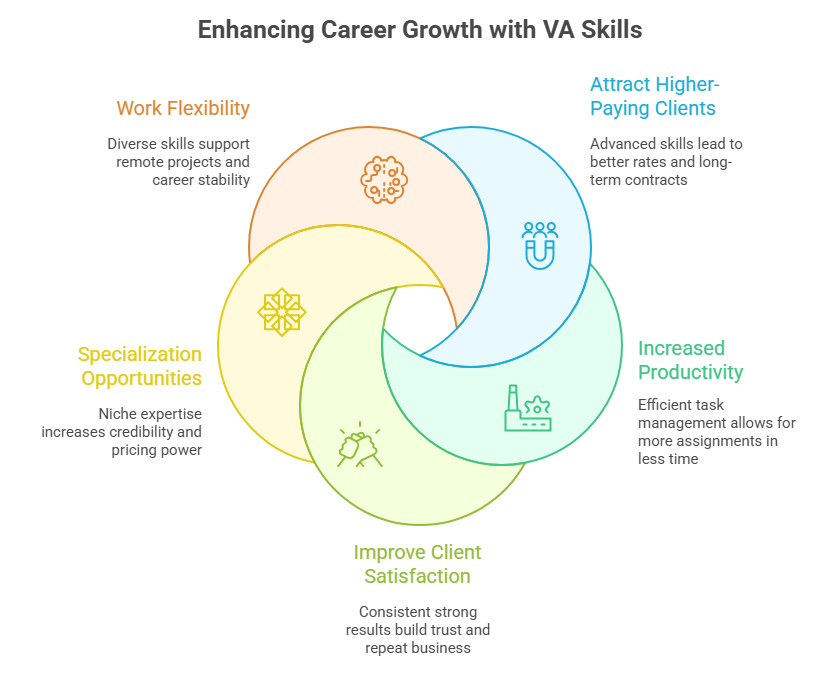
Developing strong VA skills unlocks multiple advantages that help professionals grow their careers. These benefits support client relationships, job performance, and earning potential. With the right skills, a VA can stand out among competitors and deliver lasting value.
1. Attract Higher-Paying Clients
Advanced skills help VAs offer specialized support and deliver higher-quality outcomes. When clients see strong performance, they view the VA as a valuable partner. This leads to better rates and long-term contracts.
2. Increased Productivity
A skilled VA manages tasks efficiently and organizes workloads effectively. This allows them to complete more assignments in shorter timeframes. High productivity enhances reliability and client satisfaction.
3. Improve Client Satisfaction
Consistently strong results help build trust and strengthen professional relationships. Clients appreciate timely responses, accurate work, and proactive solutions. Positive experiences lead to repeat business and referrals.
4. Specialization Opportunities
Strong skills enable VAs to choose niches such as real estate, e-commerce, or social media. Specialization increases credibility and allows for higher pricing. Niche expertise positions a VA as a subject-matter resource.
5. Work Flexibility
A broad skill set gives VAs more options for remote projects and client types. This flexibility supports long-term career stability. VAs can adapt to diverse industries and environments.
Virtual Assistant Skills vs General Administrative Skills
| Feature | Virtual Assistant Skills | General Admin Skills |
|---|---|---|
| Work Environment | Remote | In-office |
| Tech Tools | High digital reliance | Limited tools |
| Flexibility | Very flexible | Fixed hours |
| Task Range | Wide variety (digital, admin, creative) | Mainly administrative |
| Specialized Niches | Available | Less common |
| Communication | Digital-first | In-person + email |
Who Needs Strong Virtual Assistant Skills?

Virtual assistant skills benefit individuals working independently, supporting executives, or managing specialized niches. These skills enable professionals to handle tasks confidently and contribute to operational efficiency.
1. Freelance Virtual Assistants
Freelance VAs need strong skills to deliver consistent results and attract clients. Their abilities determine the range of tasks they can offer. Skill strength influences competitiveness and long-term success.
2. Executive Virtual Assistants
Executive VAs rely on communication, scheduling, and management abilities. They handle sensitive tasks and coordinate high-level responsibilities. Professionalism and accuracy are essential in this role.
3. E-commerce Virtual Assistants
E-commerce VAs manage product listings, track orders, and support customer inquiries. They use platforms like Shopify or WooCommerce to organize online operations. These skills help maintain smooth store performance.
4. Social Media Virtual Assistants
Social media VAs plan content, monitor engagement, and analyze performance metrics. They support brand visibility across digital platforms. Creativity and consistency are key.
5. Real Estate Virtual Assistants
Real estate VAs work with CRM tools, MLS listings, and lead management systems. They help agents schedule appointments and follow up with prospects. Strong organizational skills support the fast pace of real estate workflows.
6. Administrative Virtual Assistants
Administrative VAs manage email, calendars, and documentation tasks. Their organization and communication skills ensure that daily operations run smoothly. Clear structure is critical in this role.
How to Improve Your Virtual Assistant Skills

Skill improvement requires ongoing learning, practice, and adaptability. The more a VA invests in professional development, the more valuable they become. Continuous growth ensures readiness for evolving industry needs.
Step 1: Take Online Courses
Training in tools like Canva, Asana, QuickBooks, HubSpot, and Google Workspace enhances proficiency. Courses offer guided learning and structured practice. Certifications also help establish credibility.
Step 2: Practice Daily
Regular practice strengthens confidence and builds mastery. Applying skills through mock projects or real tasks helps reinforce learning. Daily use makes skills more natural and efficient.
Step 3: Learn New Tools
Digital tools change rapidly, and VAs must stay updated. Exploring new platforms expands capabilities and improves problem-solving. Adaptation helps maintain competitiveness.
Step 4: Ask for Client Feedback
Feedback identifies strengths and areas for improvement. Clients offer insight into performance expectations and professional standards. Using feedback helps refine skills and work quality.
Step 5: Specialize
Choosing a niche helps VAs deepen expertise and provide targeted value. Specialization increases demand and allows for higher pricing. Focus strengthens professional identity.
Limitations of Virtual Assistant Skills
Virtual assistant skills are valuable, but they also require ongoing commitment. Some skills do not apply to every niche, and learning curves vary. Awareness of these limitations helps VAs plan growth realistically.
1. Skill Gaps Require Continuous Learning
Technology evolves quickly, requiring regular updates to a VA’s knowledge. Without continuous learning, skills become outdated. Ongoing training maintains relevance.
2. Not All Skills Fit Every Niche
Different industries require specific tools or processes. A VA may need specialized training depending on the sector it supports. Tailoring skills strengthen niche success.
3. Initial Learning Curve
Beginners may find digital tools and multitasking challenging. Time and practice help build competence. Consistent effort reduces the learning burden.
TaskVirtual: Your Trusted Partner for Professional VA Support

Managing business operations, digital workflows, and daily administrative duties can become overwhelming without the right support. Many professionals struggle to balance scheduling, documentation, communication, and online task management. TaskVirtual offers dedicated virtual assistant services that streamline these responsibilities and help clients operate more efficiently in the remote workspace.
1. Expert Consultation and Review
TaskVirtual’s experienced VAs provide tailored support by reviewing your ongoing tasks, identifying workflow gaps, and helping select the best tools and processes for your operations. They assist with organizing schedules, maintaining documentation, coordinating communication, and ensuring your digital tasks are handled with accuracy and structure.
2. Affordable and Flexible Pricing
Hiring in-house support can be costly, but TaskVirtual delivers high-quality virtual assistance at accessible rates. With pricing plans starting between $3.12/hour and $14.99/hour, clients gain professional service without exceeding budget limits. Their flexible hourly options make it suitable for small businesses, entrepreneurs, and large teams alike.
3. Comprehensive Virtual Assistance Solutions
TaskVirtual offers an extensive suite of services, including administrative support, social media assistance, research, data management, customer communication, and content support. Whether you need help occasionally or daily, their scalable approach ensures you receive exactly the level of assistance your business requires.
4. Ongoing Support and Quality Assurance
Beyond completing tasks, TaskVirtual provides consistent updates, proactive communication, and routine progress monitoring. Their team ensures tasks are carried out on time and align with your business goals, offering a reliable extension of your operations with minimal oversight needed.
5. Proven Track Record of Excellence
With 364 positive reviews and an impressive 4.7-star rating, TaskVirtual is recognized globally as a dependable partner for virtual assistance. Their clients value their professionalism, accuracy, and ability to simplify complex workflows, making them a leading choice for remote support services.
Final Thoughts on Virtual Assistant Skills
Virtual assistant skills form the backbone of a successful VA career or business. By developing communication, organization, technology, customer support, and niche-specific strengths, VAs can become indispensable partners for clients. Whether beginning the journey or advancing expertise, skill development leads to better opportunities, higher income, and long-term stability.
FAQ: Virtual Assistant Skills
1. What skills does a virtual assistant need?
A VA needs communication, organization, technical ability, customer service, problem-solving, and social media skills.
2. Can I become a VA with no experience?
Yes. Most skills can be learned through online courses, practice, and hands-on training.
3. Which tools should a VA know?
Google Workspace, Canva, CRM platforms, Asana, Zoom, email marketing tools, and data entry applications.
4. Do virtual assistants need certification?
Certification is optional but helps build credibility and strengthen a portfolio.
5. Can I specialize as a VA?
Yes. Niches include social media, real estate, e-commerce, bookkeeping, executive assistance, and more.
 Siddhartha Basu is a Technical Writer at Task Virtual. He loves online games, e-book reading, and Yoga.