

Contents
show
Virtual Assistant Roles: Key Responsibilities and Business Functions
Virtual assistant roles vary widely across industries and business needs. A virtual assistant (VA) can handle administrative support, customer service, marketing, sales assistance, technical tasks, bookkeeping, research, and more. Businesses use virtual assistants to reduce workload, increase efficiency, and scale operations without hiring full-time staff.
What Are Virtual Assistant Roles?
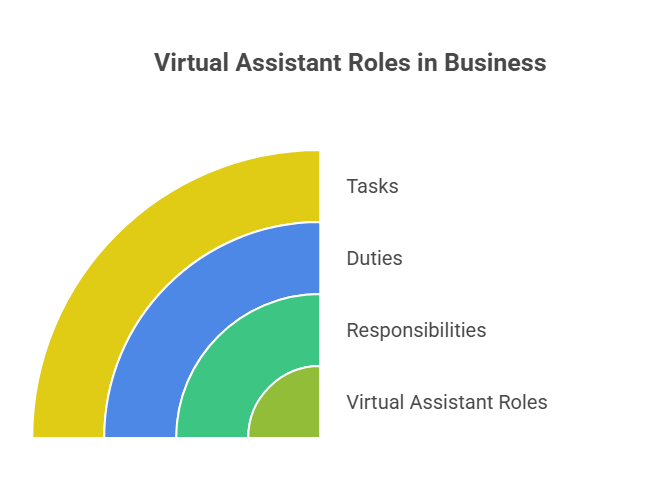
Virtual assistant roles define the scope of work a VA performs within a business environment. In 2025, an estimated 40 million people work as human virtual assistants globally, handling everything from scheduling and customer support to marketing and project management, highlighting their widespread operational relevance. These roles represent structured groupings of virtual assistant responsibilities, virtual assistant duties, and virtual assistant tasks that support operational continuity, workflow efficiency, and business scalability while clarifying expectations, competencies, and performance outcomes.
In modern work structures, virtual assistant job roles extend far beyond basic administrative support. Organizations now depend on remote assistant roles to sustain distributed operations, coordinate digital workflows, and provide specialized assistance without the constraints of traditional hiring. Understanding the types of virtual assistants available — ranging from general administrative support providers to niche technical and industry-focused specialists — allows businesses to design efficient virtual assistant positions aligned with measurable business objectives. Clearly defined VA roles and responsibilities also reduce operational friction, simplify onboarding, and improve accountability across teams.
Main Categories of Virtual Assistant Roles
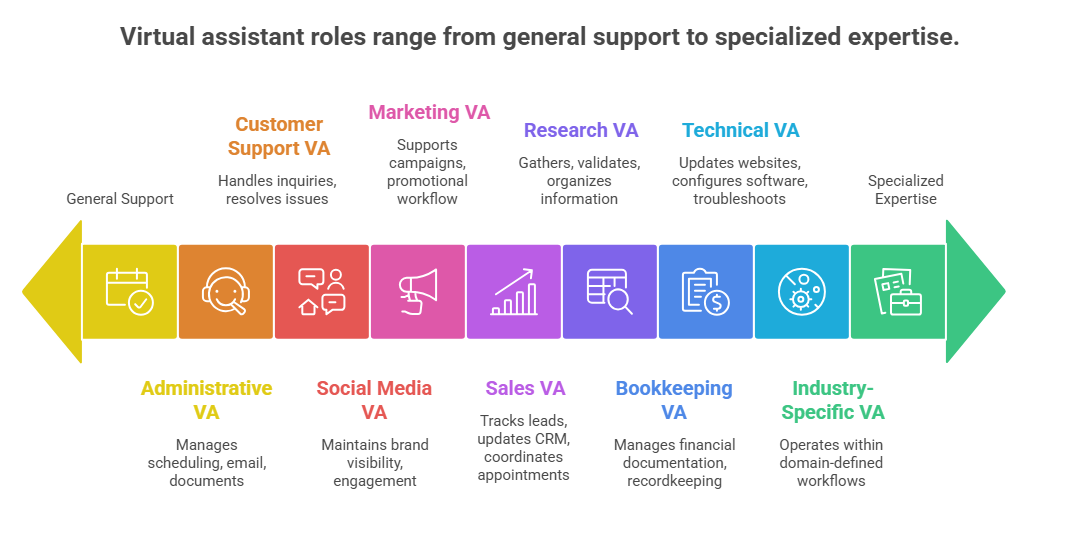
Virtual assistants operate across multiple functional domains, each representing distinct operational priorities and competency requirements. Categorizing common virtual assistants role improve workforce planning and delegation efficiency. Businesses benefit most when virtual assistant duties are aligned with structured business functions rather than loosely assigned tasks.
1. Administrative Virtual Assistant Roles
Administrative virtual assistant roles support core coordination and organizational processes that sustain daily operations. These assistants manage scheduling, email handling, document preparation, and structured data entry while maintaining procedural consistency. Their contribution primarily reduces managerial workload and improves workflow stability.
2. Customer Support Virtual Assistant Roles
Customer support roles concentrate on client interaction management and service responsiveness. Responsibilities typically include handling inquiries, resolving issues, managing tickets, and maintaining communication continuity across channels. These assistants directly influence customer satisfaction and retention outcomes.
3. Social Media Virtual Assistant Roles
Social media VAs focus on maintaining brand visibility and engagement across digital platforms. Assistants coordinate posting schedules, audience interactions, caption writing, and basic analytics tracking. Their work ensures consistency and structured communication within social ecosystems.
4. Marketing Virtual Assistant Roles
5. Sales Virtual Assistant Roles
Sales virtual assistant roles provide operational support for revenue-generation systems and pipeline management. Assistants handle lead tracking, CRM updates, follow-ups, and appointment coordination. Their structured involvement improves sales process efficiency and administrative accuracy.
6. Research Virtual Assistant Roles
Research virtual assistant role emphasizes information gathering, validation, and structured data organization. Assistants conduct market analysis, competitor tracking, and database development to support decision-making. Precision and analytical discipline define performance effectiveness.
7. Bookkeeping Virtual Assistant Roles
A bookkeeping VA role manages financial documentation and transactional recordkeeping processes. Typical virtual assistant tasks include expense tracking, invoice coordination, and payment follow-ups. Accuracy and confidentiality remain critical within these responsibilities.
8. Technical Virtual Assistant Roles
Technical VA roles address digital infrastructure, automation, and system-support functions. Assistants perform website updates, software configuration, and basic troubleshooting. These roles require platform familiarity and problem-solving competence.
9. Industry-Specific Virtual Assistant Roles
Industry-specialized assistants operate within domain-defined workflows requiring contextual expertise. Examples include real estate virtual assistant roles, legal roles, healthcare virtual assistant roles, and ecommerce virtual assistant roles. Specialization improves operational alignment and execution reliability.
Why Businesses Define Virtual Assistant Roles Clearly

Clearly structured virtual assistant roles and responsibilities improve delegation accuracy, reduce miscommunication, and enhance performance measurement. Precise virtual assistant job descriptions help organizations avoid role ambiguity, minimize redundant assignments, and establish consistent workflows. When expectations are documented and aligned with business functions, virtual assistant duties become easier to monitor, evaluate, and optimize. Conversely, poorly defined virtual assistant positions often result in inefficiencies, missed deliverables, and unnecessary management overhead.
Benefits of Hiring Virtual Assistants Across Different Roles
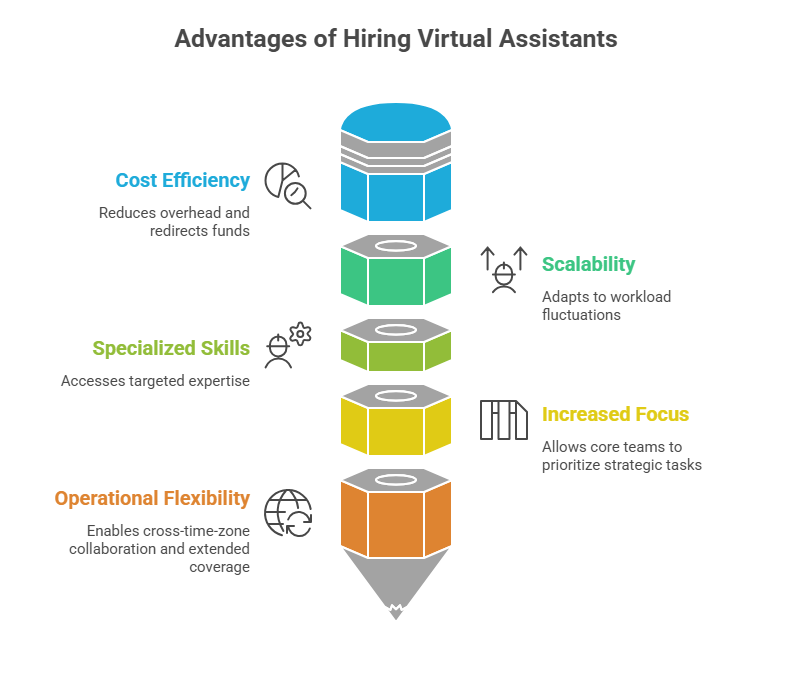
Virtual assistants represent a scalable resource model capable of adapting to diverse operational requirements. Their distributed nature enables organizations to allocate expertise dynamically without long-term staffing constraints. Businesses leveraging common virtual assistant roles frequently observe improvements in efficiency, cost control, and execution speed. Several advantages explain the growing reliance on remote virtual assistant roles.
1. Cost Efficiency
Virtual assistant positions typically operate on flexible cost structures, eliminating expenses associated with full-time employment. Businesses reduce overhead related to infrastructure, benefits, and fixed salaries. Financial resources can therefore be redirected toward growth initiatives and strategic investments.
2. Scalability
Virtual assistant job roles can expand or contract in response to workload fluctuations or business cycles. This elasticity supports operational adaptability without restructuring internal teams. Organizations gain workforce flexibility while preserving budget stability.
3. Access to Specialized Skills
The diversity of types of virtual assistants enables businesses to engage professionals with targeted competencies. Technical virtual assistant roles, marketing virtual assistant duties, and bookkeeping specialists deliver higher task accuracy within defined domains. Specialization reduces training burdens and accelerates productivity.
4. Increased Focus for Core Teams
Delegating virtual assistant tasks allows internal personnel to prioritize strategic and revenue-generating activities. Routine coordination and an administrative virtual assistant’s duties absorb operational workload. Improved focus enhances organizational effectiveness and decision quality.
5. Operational Flexibility
Remote VA roles support cross-time-zone collaboration and extended service coverage. Businesses maintain continuity without geographic restrictions or rigid schedules. Operational flexibility improves responsiveness and workflow resilience.
Virtual Assistant Roles vs Traditional Employee Roles
| Aspect | Virtual Assistant Roles | Traditional Roles |
|---|---|---|
| Location | Remote | On-site |
| Flexibility | High | Limited |
| Cost Structure | Variable | Fixed |
| Scalability | Easy | Difficult |
| Hiring Speed | Fast | Slower |
Virtual roles offer greater adaptability.
Common Mistakes When Defining Virtual Assistant Roles

Role design errors frequently reduce the effectiveness of virtual staffing strategies. Misaligned expectations and inadequate structure generate avoidable inefficiencies. Recognizing common pitfalls improves virtual assistant management outcomes.
1. Role Overload and Task Fragmentation
Assigning excessive or unrelated virtual assistant duties often reduces output quality and productivity. Concentrated virtual assistant job roles produce more consistent and measurable results. Structured task allocation preserves efficiency.
2. Ignoring Skill Specialization
Failing to align virtual assistant responsibilities with expertise leads to slower execution and higher error rates. Gallup research indicates employees who use their strengths daily are 18% more productive, explaining why specialized virtual assistant career roles often outperform generalized assignments. Skill alignment remains a primary performance determinant.
3. Lack of Systems and Documentation
Absence of workflows, SOPs, and structured communication channels generates confusion and inconsistent deliverables. Documented virtual assistant job descriptions stabilize expectations and processes. Systems-based management improves reliability.
TaskVirtual: Structured Support Across Virtual Assistant Functions

Managing operational workloads across administrative, customer support, marketing, research, and technical processes often creates coordination strain for growing businesses. Fragmented tools, repetitive tasks, and time-sensitive workflows can reduce productivity and distract internal teams from strategic priorities. TaskVirtual delivers structured virtual assistance by providing reliable, process-driven remote support aligned with real business functions.
1. Operationally Aligned Virtual Assistant Support
TaskVirtual’s assistants integrate directly into established business workflows, supporting administrative roles, customer support roles, marketing virtual assistant roles, and technical assistant roles. Rather than performing isolated tasks, assistants follow documented processes and measurable objectives. This approach improves consistency, turnaround times, and operational visibility.
2. Affordable and Flexible Pricing
Maintaining full-time staff for fluctuating workloads is frequently cost-inefficient for many organizations. TaskVirtual offers adaptable engagement models with pricing ranging from $3.12/hour to $14.99/hour, enabling businesses to scale assistance without long-term commitments. Flexible cost structures support startups, small businesses, and distributed teams.
3. Multi-Function Virtual Assistant Coverage
Businesses often require assistance across multiple functional categories rather than a single narrow specialization. TaskVirtual supports a broad spectrum of virtual assistant duties, including coordination tasks, client communication management, research activities, bookkeeping processes, and digital system support. This flexibility simplifies workforce planning while maintaining role clarity.
4. Process Consistency and Quality Control
Operational reliability depends on structured execution rather than ad-hoc task handling. TaskVirtual emphasizes repeatable workflows, documentation adherence, and performance monitoring to maintain service stability. Continuous oversight reduces variability and improves long-term efficiency.
5. Demonstrated Service Reliability
Service credibility is best evaluated through performance history and user feedback. TaskVirtual maintains 364 positive reviews and a 4.7-star rating across recognized VA platforms, reflecting consistent client satisfaction. Businesses rely on predictable support outcomes and communication discipline.
Final Answer:
These roles define structured groupings of responsibilities performed by remote professionals supporting administrative, technical, operational, and industry-specific functions. These roles clarify virtual assistant duties, competency expectations, and performance objectives, enabling organizations to delegate work systematically and scale operations efficiently. Well-defined virtual assistant roles and responsibilities enhance productivity, reduce overhead, and improve workflow continuity. As remote work ecosystems continue to expand, virtual assistant positions increasingly represent a strategic workforce solution rather than a purely administrative resource.
FAQ: Virtual Assistant Roles
1. Can one virtual assistant handle multiple roles?
Yes, but productivity improves when tasks align with their expertise.
2. What is the most common VA role?
Administrative support remains the most widely used.
3. Are specialized VA roles better?
Yes. Specialized VAs often deliver higher efficiency and accuracy.
4. How do I choose the right VA role for my business?
Identify repetitive tasks and match them to VA skill sets.
5. Do VA roles vary by industry?
Yes. Many VAs specialize in industry-specific workflows.
 Siddhartha Basu is a Technical Writer at Task Virtual. He loves online games, e-book reading, and Yoga.