

Contents
show
Is Claude AI Better for Blog Writing? A Clear Comparison
As AI-powered writing tools continue to evolve in 2025, bloggers, marketers, and content teams are increasingly asking whether Claude AI is genuinely better for blog writing than other popular options. The answer is not absolute, but Claude AI has carved out a strong position for writers who value depth, structured reasoning, and tone precision over quick, surface-level drafts. Rather than positioning Claude AI as a universal replacement for all writing tools, it is more accurate to evaluate how well it performs against specific blog-writing requirements such as long-form clarity, factual reliability, SEO adaptability, and workflow compatibility. Understanding these factors helps content creators determine whether Claude AI aligns with their editorial and business goals.
What Is Claude AI?
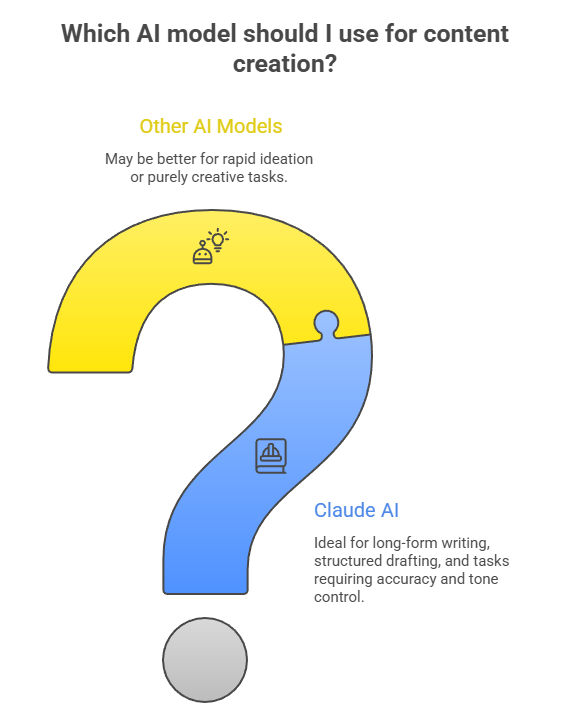
Claude AI is a generative artificial intelligence developed by Anthropic, with a strong emphasis on ethical reasoning, safety, and reliable language understanding. It is designed to generate coherent, context-aware responses that prioritize logical consistency and reduced hallucinations, making it especially useful for long-form and structured writing tasks. Unlike models that optimize primarily for speed or creativity, Claude AI focuses on maintaining clarity across extended content and adhering closely to user instructions. As a result, it is often chosen for use cases where accuracy, tone control, and depth of explanation are more important than rapid ideation alone, especially as an estimated 51 % of marketers now use generative AI for content creation tasks where consistency and relevance are priorities.
Many writers and teams rely on Claude AI for long-form writing projects, structured drafting processes, complex explanations, and content that requires a carefully controlled tone. Its ability to maintain coherence across lengthy articles makes it suitable for educational materials, professional blogs, and thought leadership content. Additionally, Claude AI’s emphasis on reasoning and safety reduces the likelihood of introducing misleading or illogical statements, although human review remains essential. These qualities position Claude AI as a strong candidate for serious blog writing rather than purely creative experimentation.
What Is Blog Writing in This Context?
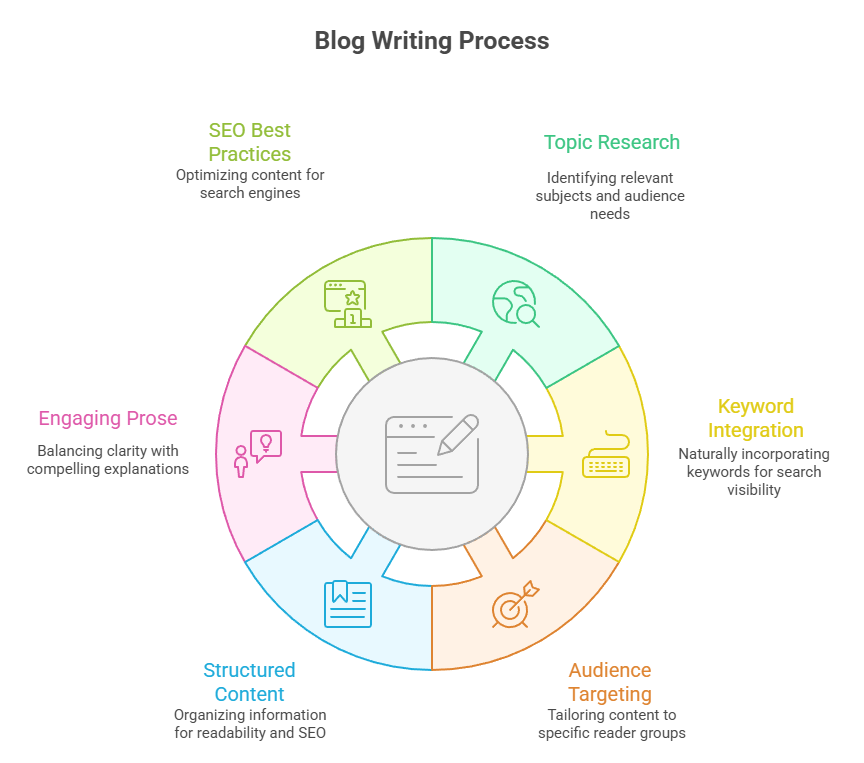
In this context, blog writing refers to a structured content creation process that balances audience engagement, informational value, and search engine visibility. It is not limited to simply producing readable text, but instead involves research, organization, optimization, and consistency. Successful blog writing requires aligning content with audience intent while maintaining clarity, credibility, and relevance across the entire article.
1. Topic Research
Topic research forms the foundation of effective blog writing by ensuring that content addresses real audience needs and search intent. It involves identifying relevant subjects, understanding reader questions, and evaluating competitive content to find gaps or opportunities. Strong research helps ensure that blog posts are not only informative but also strategically positioned to attract and retain readers.
2. Keyword Integration
Keyword integration ensures that blog content aligns with search engine queries without sacrificing readability. This process involves placing primary and secondary keywords naturally within headings, body text, and metadata. When executed correctly, keyword integration improves discoverability while maintaining a smooth and engaging reading experience, particularly since pages that include relevant keywords in strategic on-page elements are shown to achieve significantly higher visibility in search results, with on-page SEO contributing to improved rankings in over 60 % of cases.
3. Audience Targeting
Audience targeting focuses on tailoring content to a specific reader group based on demographics, expertise level, and intent. This includes selecting appropriate language complexity, tone, and examples that resonate with the intended audience. Effective audience targeting increases engagement and reduces bounce rates by making content feel relevant and accessible.
4. Structured Content
Structured content improves readability by organizing information into logical sections with headings, subheadings, and clear transitions. This structure helps readers scan and navigate the article efficiently while also supporting SEO best practices. Well-structured blogs are easier to consume and more likely to retain reader attention.
5. Engaging and Informative Prose
Engaging and informative prose balances clarity with interest by combining useful information with compelling explanations. It avoids unnecessary fluff while still maintaining a conversational or authoritative tone suited to the topic. This balance encourages readers to continue reading and trust the content.
6. SEO Best Practices
SEO best practices ensure that blog content is optimized for search engines without compromising quality. This includes proper heading usage, internal linking, meta descriptions, and page performance considerations. Applying SEO best practices consistently improves long-term visibility and organic traffic potential.
Key Criteria: Claude AI for Blog Writing

Evaluating Claude AI for blog writing requires examining how well it performs across the core criteria that define high-quality blog content. These criteria include writing depth, SEO adaptability, tone consistency, creativity, accuracy, and workflow compatibility. Each of these elements plays a critical role in determining whether Claude AI is the right tool for a particular blogging strategy.
1. Quality of Writing and Depth
Claude AI is widely recognized for producing clear, logically structured writing that maintains coherence across long articles. Its responses often demonstrate strong narrative flow and thoughtful explanations, making it well suited for educational, technical, or analytical blogs. This depth allows writers to develop complex ideas without sacrificing clarity or reader comprehension.
2. SEO Optimization and Keyword Integration
Claude AI can incorporate keywords naturally into blog content while maintaining readability and relevance. It is capable of generating SEO-friendly headings, meta descriptions, and related keyword suggestions when prompted correctly. However, its effectiveness depends on external SEO tools and human oversight to ensure optimal keyword strategy and ranking performance.
3. Tone and Voice Control
Tone and voice control is one of Claude AI’s strongest features, allowing writers to specify professional, conversational, persuasive, or neutral styles with consistency. This capability is especially valuable for brands that require strict adherence to editorial guidelines. By maintaining a uniform voice across sections, Claude AI supports stronger brand identity and reader trust.
4. Creativity and Variation
Claude AI can generate creative variations such as alternative headlines, examples, analogies, and narrative approaches. While it may not always prioritize novelty over structure, it offers sufficient flexibility to keep blog content engaging and dynamic. This balance supports reader interest without compromising clarity or focus.
5. Accuracy and Minimizing Hallucinations
Claude AI places a strong emphasis on reasoning and factual grounding, which helps reduce the frequency of hallucinated or illogical claims. Its responses tend to be cautious and well-qualified, particularly in complex or sensitive topics. Despite this strength, fact-checking remains necessary to ensure complete accuracy before publication.
6. Workflow and Ease of Use
Claude AI integrates well into a variety of writing workflows through prompt flexibility and API access. It supports collaborative drafting, iterative editing, and structured content generation. These features make it suitable for both individual writers and content teams working within established editorial processes.
Comparison: Claude AI vs Other Popular Blog Writing Tools
| Feature | Claude AI | ChatGPT | Other AI Writers (Jasper, Write sonic) |
|---|---|---|---|
| Writing Quality | Excellent | Excellent | Good–Excellent |
| Logical Reasoning | Strong | Strong | Variable |
| Hallucination Control | Better | Moderate | Moderate |
| SEO Integration | Needs external tools | Needs external tools | Often built-in |
| Tone Control | Strong | Strong | Strong |
| Pricing Flexibility | Competitive | Competitive | Varies |
| Customization | High | High | Moderate |
When Claude AI Is Better for Blog Writing

Claude AI is particularly effective when blog writing requires depth, precision, and structured reasoning. It performs well in scenarios where the content must explain complex concepts clearly and maintain consistency across long sections. Writers producing technical, educational, or business-focused blogs often benefit from Claude AI’s careful approach to language and logic.
Additionally, Claude AI excels when tone consistency and factual reliability are critical. Brands that prioritize authority and clarity over rapid content generation find value in its controlled output. Its ability to generate multiple structured drafts also supports iterative refinement and editorial review processes.
When Claude AI May Not Be the Best Choice
Claude AI may be less suitable for users who require fully integrated SEO scoring, drag-and-drop campaign builders, or built-in publishing analytics within the same platform. Some AI writing tools combine content generation with keyword scoring, performance tracking, and direct CMS integration, which can streamline high-volume marketing workflows. In such cases, Claude AI may need to be paired with additional tools to achieve the same level of operational efficiency.
How to Use Claude AI for Best Blog Results
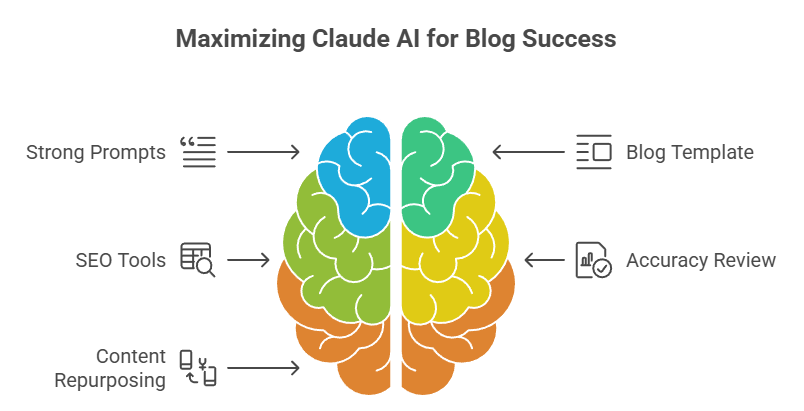
To maximize Claude AI’s effectiveness for blog writing, it is important to approach content creation strategically rather than relying on generic prompts. Clear instructions, structured templates, and complementary tools significantly enhance output quality. When used thoughtfully, Claude AI can function as a powerful drafting and ideation partner rather than a standalone solution.
1. Start With Strong Prompts
Strong prompts provide Claude AI with clear direction regarding topic, audience, tone, and objectives. Including target keywords, desired length, and SEO goals helps align the output with publishing requirements. Well-defined prompts reduce the need for extensive revisions and improve content relevance.
2. Use a Blog Template
Using a predefined blog template helps maintain consistency and readability across posts. Templates typically include titles, introductions, headings, bullet alternatives, conclusions, and calls to action. This structure allows Claude AI to organize information more effectively and support SEO best practices.
3. Add SEO Tools
SEO tools such as keyword research platforms and on-page optimization plugins complement Claude AI’s writing capabilities. Running drafts through these tools helps refine keyword placement, heading structure, and overall optimization. This combination improves search visibility without compromising content quality.
4. Review for Accuracy
Despite Claude AI’s emphasis on reasoning, human review remains essential for verifying facts, statistics, and references. Reviewing content before publication ensures accuracy and protects credibility. This step is particularly important for data-driven or industry-specific blogs.
5. Repurpose Content
Claude AI can efficiently repurpose blog content into social posts, email newsletters, slide decks, and FAQs. Repurposing extends the reach and value of each blog post across multiple channels. This approach supports content marketing efficiency and audience engagement.
TaskVirtual: Smart Support for AI-Driven Blog Writing

Managing AI-assisted blog production involves more than generating text; it requires prompt refinement, content review, SEO coordination, formatting, and publishing consistency. TaskVirtual helps content creators, marketers, and agencies streamline their blog-writing workflows by providing skilled Virtual AI Assistants who support every stage of AI-powered content creation. From organizing prompts and editing drafts to coordinating SEO inputs and preparing content for publication, TaskVirtual ensures that AI tools like Claude AI are used efficiently and effectively.
1. Expert Content Assistance and Review
TaskVirtual’s virtual assistants help refine AI prompts, review AI-generated drafts, and align content with brand tone and editorial guidelines. They assist with formatting, structuring sections, and preparing blogs for SEO tools or CMS platforms. This support ensures AI-generated blogs are polished, consistent, and publication-ready.
2. Affordable and Flexible Pricing
Hiring in-house editorial support can be costly, but TaskVirtual offers a cost-effective alternative. With pricing plans ranging from $3.12/hour to $14.99/hour, businesses and individual creators can scale support based on workload without long-term commitments. This flexibility makes professional content assistance accessible at any stage of growth.
3. End-to-End Blog Workflow Support
TaskVirtual supports the entire blog lifecycle, including topic research coordination, keyword placement checks, content repurposing, and scheduling. Whether you publish occasionally or manage high-volume content calendars, their services adapt to your workflow. This ensures consistency and efficiency across all blog projects.
4. Ongoing Support and Quality Assurance
Beyond one-time tasks, TaskVirtual provides continuous assistance with revisions, updates, and performance-driven content adjustments. Their proactive approach helps maintain quality standards while reducing the operational burden on internal teams. This allows creators to focus on strategy rather than execution details.
5. Proven Track Record of Excellence
With 364 positive reviews and a 4.7-star rating on trusted virtual assistant platforms, TaskVirtual is recognized as a reliable global partner. Clients rely on their expertise to support content operations, streamline AI usage, and maintain consistent publishing standards.
Final Verdict: Is Claude AI Better for Blog Writing?
Claude AI can be better for blog writing when depth, coherence, tone control, and logical accuracy are top priorities. Its strength lies in producing structured, thoughtful content that maintains consistency across long-form articles. For writers and teams focused on quality-driven blogging, Claude AI offers clear advantages over tools optimized primarily for speed or surface-level output.
However, whether Claude AI is the best choice depends on workflow requirements and content goals. For SEO-heavy campaigns or high-volume publishing, tools with integrated optimization and analytics may offer greater efficiency. The most effective approach often involves using Claude AI alongside SEO tools, editorial review, and structured support systems to achieve optimal results.
FAQ: Is Claude AI Better for Blog Writing?
1. Is Claude AI good for SEO blogs?
Yes, but it works best when paired with SEO tools for keyword optimization and ranking performance.
2. Can Claude AI write long blogs?
Yes, Claude AI is capable of producing long-form content with strong structure and clarity.
3. Does Claude AI reduce factual errors?
Often yes, due to its reasoning focus, but fact-checking is still required.
4. Is Claude AI easier to use than other AI tools?
Ease of use depends on workflow preferences, but many users find it intuitive and flexible.
5. Can Claude AI replace human editors?
No, human review remains essential for accuracy, tone, and final polish.
 Siddhartha Basu is a Technical Writer at Task Virtual. He loves online games, e-book reading, and Yoga.