

Contents
show
How to Analyse a Digital Marketing Campaign
Analysing a digital marketing campaign is a structured process that determines whether marketing efforts delivered measurable business value or simply generated surface-level engagement. When campaigns are analysed effectively, 88 percent of marketers report that using analytics and measurement tools improves decision-making and campaign performance, highlighting how data-driven approaches outperform guesswork and intuition. Analysing a digital marketing campaign is a structured process that determines whether marketing efforts delivered measurable business value or simply generated surface-level engagement. When campaigns are analysed effectively, 88% of marketers report that using analytics and measurement tools improves decision-making and campaign performance, highlighting how data-driven approaches outperform guesswork and intuition.
Campaign analysis is not a one-time activity but an ongoing discipline that supports continuous improvement, enabling organizations to justify marketing investments, improve efficiency, and make data-informed decisions rather than relying on assumptions. When approached correctly, campaign analysis transforms raw performance data into actionable insights that drive long-term marketing effectiveness.
What Are The Steps To Perform Analysing
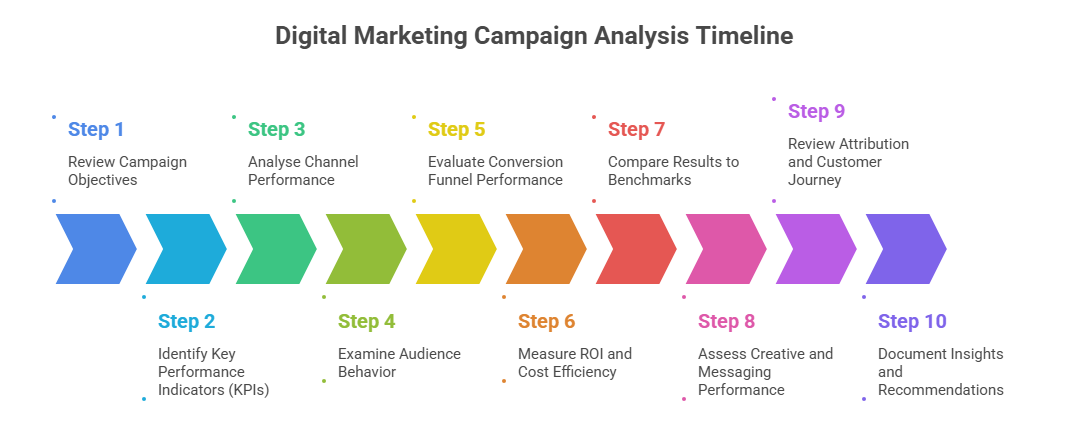
Analysing a digital marketing campaign requires a structured, step-by-step approach that evaluates performance from strategy through execution and outcomes. The process involves reviewing objectives, selecting the right KPIs, analysing channels and audiences, measuring conversions and ROI, and documenting insights for optimization. Steps 1 through 10 collectively provide a comprehensive framework to assess campaign effectiveness, identify gaps, and improve future digital marketing performance.
Step 1: Review Campaign Objectives
The first step in analysing a digital marketing campaign is to revisit the original objectives that defined success. These objectives may include increasing brand awareness, driving website traffic, generating qualified leads, boosting conversions, or improving customer retention. Aligning analysis with these goals ensures that performance evaluation remains focused on outcomes that matter to the business.
Step 2: Identify Key Performance Indicators (KPIs)
Once objectives are clear, the next step is identifying the KPIs that accurately measure progress toward those goals. According to recent industry data, 67% of marketers list views, engagement, or leads/clicks among their most important KPIs, demonstrating that clearly defined performance indicators matter greatly in evaluating campaign success. KPIs convert strategic intent into quantifiable metrics, enabling objective performance evaluation and comparison. Selecting the right KPIs ensures that analysis focuses on meaningful indicators rather than vanity metrics.
1. Awareness KPIs
Awareness KPIs assess how effectively the campaign increased brand visibility among the target audience. Metrics such as impressions, reach, brand mentions, and video views indicate how widely the campaign message was distributed and how often users were exposed to it. These KPIs are particularly relevant for top-of-funnel campaigns focused on exposure rather than immediate action.
2. Engagement KPIs
Engagement KPIs measure how users interact with campaign content after initial exposure. Metrics such as click-through rate, likes, shares, comments, time on site, and bounce rate reveal how relevant and compelling the messaging was to the audience. Strong engagement signals message alignment, while weak engagement often highlights targeting or creative issues.
3. Conversion KPIs
Conversion KPIs track actions that directly support business objectives. Leads generated, conversion rate, cost per conversion, and sales volume show how effectively the campaign moved users from interest to action. These metrics are essential for evaluating campaign efficiency and goal achievement.
4. Revenue KPIs
Revenue KPIs measure the financial impact of the campaign. Metrics such as return on ad spend, customer acquisition cost, and total revenue generated determine whether marketing spend produced acceptable returns. These KPIs are critical for assessing profitability and long-term sustainability.
Step 3: Analyse Channel Performance
Channel performance analysis evaluates how each marketing channel contributed to overall campaign results. Reviewing paid advertising, social media, email marketing, SEO, content marketing, and influencer efforts helps identify which channels delivered the most value. These insights guide smarter budget allocation and channel prioritization in future campaigns.
Step 4: Examine Audience Behavior
Audience behavior analysis reveals how users interacted with the campaign across different segments. Reviewing demographics, geographic data, device usage, and engagement patterns helps assess targeting accuracy and message relevance. Discrepancies such as high traffic with low engagement often indicate misalignment between audience expectations and campaign content.
Step 5: Evaluate Conversion Funnel Performance
Funnel analysis tracks how users progress from initial interaction to final conversion. Reviewing landing page performance, form completion rates, checkout behavior, and abandonment points highlights where users disengaged. Identifying these drop-offs enables targeted optimization to improve conversion efficiency.
Step 6: Measure ROI and Cost Efficiency
Measuring return on investment determines whether the campaign delivered financial value. Calculating ROI using revenue and total cost provides a clear assessment of profitability. Cost metrics such as cost per lead and cost per acquisition further clarify how efficiently marketing resources were used.
Step 7: Compare Results to Benchmarks
Benchmarking places campaign performance in the proper context. Comparing results against industry standards, historical campaigns, and pre-campaign baselines helps determine whether outcomes exceeded or fell short of expectations. This comparison supports realistic performance evaluation and informed decision-making.
Step 8: Assess Creative and Messaging Performance
Creative analysis evaluates how different messages and formats performed. Reviewing headlines, ad copy, visuals, videos, calls to action, and content types identifies which elements resonated most with the audience. These insights inform future creative development and messaging strategy.
Step 9: Review Attribution and Customer Journey
Attribution analysis explains how conversions occurred across multiple touchpoints. Evaluating first-click, last-click, and multi-touch models clarifies how channels contributed throughout the customer journey. This understanding supports more accurate budget allocation and strategic planning.
Step 10: Document Insights and Recommendations
The final step is consolidating findings into actionable insights. Documenting key successes, performance gaps, audience learnings, and optimization opportunities ensures analysis informs future campaigns. This process creates a continuous improvement loop that strengthens marketing effectiveness over time.
Benefits of Analysing Digital Marketing Campaigns

Analysing digital marketing campaigns provides long-term strategic and operational benefits. It ensures marketing decisions are data-driven, improves efficiency, and strengthens accountability. Consistent analysis also enables organizations to adapt more effectively to changing market conditions.
1. Improved Strategic Decision-Making
Campaign analysis reveals which strategies and tactics deliver results. This clarity enables marketers to refine targeting, messaging, and channel selection with confidence. Better decisions lead to stronger alignment between marketing activity and business objectives.
2. Better Budget Optimization
Detailed performance insights highlight which investments generate the highest returns. This allows organizations to reallocate budgets toward high-performing channels and reduce waste. Over time, budget optimization improves overall ROI and marketing sustainability.
3. Enhanced Audience Understanding
Analysing audience behavior deepens insight into customer needs and preferences. These learnings support more relevant targeting and personalization. Enhanced audience alignment leads to increased engagement, conversions, and customer satisfaction.
Common Mistakes in Campaign Analysis
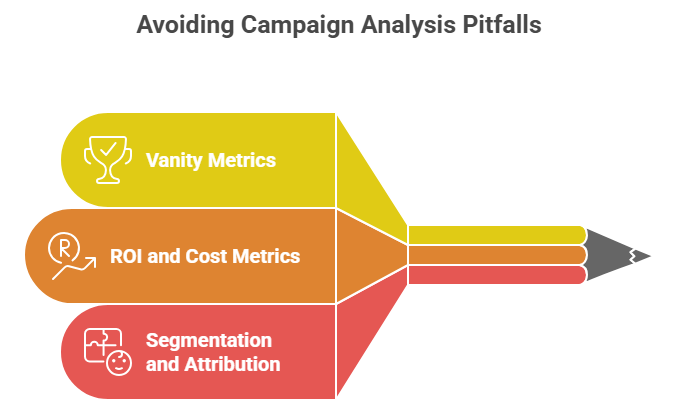
Avoidable errors can undermine campaign analysis. Recognizing and addressing these mistakes ensures insights remain accurate and actionable. A disciplined approach is essential for meaningful evaluation.
1. Overreliance on Vanity Metrics
Metrics such as impressions and likes offer limited insight on their own. Without connection to conversions or revenue, they can create misleading conclusions. Effective analysis prioritizes metrics tied to business outcomes.
2. Ignoring ROI and Cost Metrics
Focusing solely on engagement while ignoring cost efficiency leads to an incomplete evaluation. ROI, cost per lead, and cost per acquisition are essential for assessing sustainability. Financial metrics ensure campaigns deliver real business value.
3. Lack of Segmentation and Attribution
Analysing aggregated data hides performance differences across audiences and channels. Ignoring attribution oversimplifies the customer journey. Both issues reduce the accuracy and usefulness of insights.

TaskVirtual: Reliable Virtual Assistance for Digital Marketing Analysis

Managing digital marketing campaigns generates large volumes of data across multiple platforms, making analysis time-consuming and complex. From collecting performance reports to monitoring KPIs and preparing insights for stakeholders, the analytical workload can quickly overwhelm marketing teams. TaskVirtual provides professional virtual marketing assistants to help businesses to manage digital marketing analysis tasks efficiently and accurately.
1. Campaign Reporting and Performance Review Support
TaskVirtual’s experienced virtual assistants assist with compiling campaign performance data from ad platforms, analytics tools, and CRM systems. They help organise KPIs, prepare structured reports, and track trends across channels to support informed marketing decisions.
2. Affordable and Flexible Pricing
Hiring in-house analytical support can be costly, but TaskVirtual offers a cost-effective alternative. With pricing plans ranging from $3.12/hour to $14.99/hour, businesses can access skilled assistance without long-term commitments or overhead costs.
3. Data Management and KPI Tracking Assistance
From maintaining KPI dashboards to updating performance spreadsheets and benchmarking results, TaskVirtual supports consistent and accurate data management. Their services scale easily to support one-time campaign reviews or ongoing analysis needs.
4. Ongoing Support and Quality Assurance
TaskVirtual provides continuous support throughout campaign lifecycles, ensuring reports are updated, metrics are tracked accurately, and insights are delivered on time. Their quality-driven approach helps reduce errors and improve reporting reliability.
5. Trusted by Businesses Worldwide
With 364 positive reviews and a 4.7-star rating across leading virtual assistant platforms, TaskVirtual is recognised as a dependable partner. Businesses rely on their expertise to streamline marketing operations and support data-driven growth.
Final Answer: How to Analyse a Digital Marketing Campaign
To analyse a digital marketing campaign effectively, marketers must align performance evaluation with clearly defined objectives and track KPIs that reflect meaningful business outcomes. This includes analysing channel performance, audience behavior, funnel efficiency, creative effectiveness, and attribution models to understand how results were achieved. By measuring ROI, comparing performance against benchmarks, and documenting actionable insights, campaign analysis becomes a strategic tool that drives optimization, accountability, and sustainable business growth.
FAQ: Analysing Digital Marketing Campaigns
1. How often should I analyse a campaign?
Monitor performance regularly and perform a full analysis after completion.
2. What tools are best for campaign analysis?
Google Analytics, ad platform dashboards, CRM systems, and marketing automation tools.
3. Are impressions and likes enough to measure success?
No. They provide context but must be tied to conversions and ROI.
4. Should small businesses analyse campaigns differently?
The framework remains the same, but KPIs should match budget and scale.
5. What is the most important metric in campaign analysis?
It depends on the goal, but ROI and conversion performance are often critical.
 Siddhartha Basu is a Technical Writer at Task Virtual. He loves online games, e-book reading, and Yoga.