Contents
show
How Does Perplexity AI Differ From Traditional Search Engines?
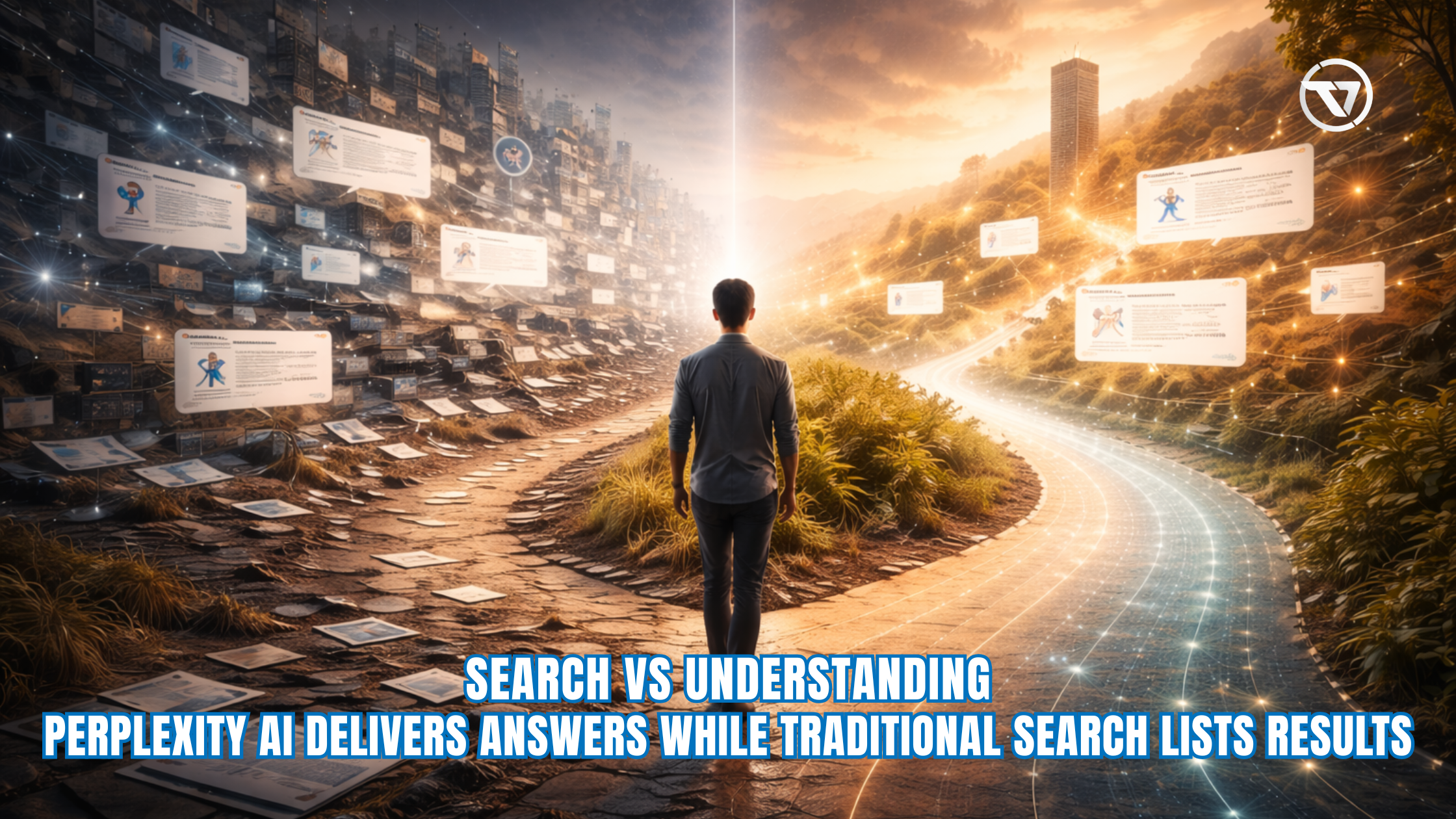
Perplexity AI differs from traditional search engines by shifting the core purpose of search from finding links to delivering answers. Instead of presenting users with a ranked list of web pages and requiring them to manually evaluate multiple sources, Perplexity AI interprets the intent behind a question and generates a concise, structured response supported by citations. Traditional search engines prioritize indexing, ranking, and monetization through ads, while Perplexity AI emphasizes comprehension, synthesis, and research efficiency. This fundamental difference makes Perplexity AI better suited for users who want immediate, context-aware insights rather than broad web discovery.
What Is Perplexity AI?
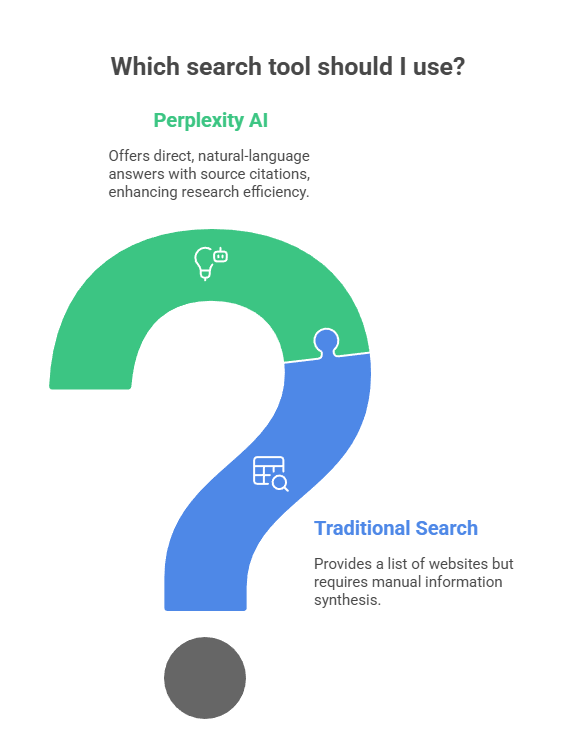
Perplexity AI is an AI-powered search and answer engine designed to provide direct, natural-language responses to user queries. It combines large language models with real-time or near-real-time web data to interpret questions, retrieve relevant information, and synthesize that information into a single, coherent answer. Rather than functioning as a directory of websites, Perplexity AI operates as an intelligent research assistant that understands context, intent, and nuance in user queries, reflecting broader industry trends where traditional search engine volume is expected to decline by 25% by 2026 as users increasingly adopt AI chatbots and virtual agents for information needs.
Unlike traditional search tools, Perplexity AI presents answers alongside source citations, allowing users to verify information without navigating away from the page. This approach reduces friction in the research process and supports fact-based decision-making. By summarizing insights from multiple sources and enabling conversational follow-up questions, Perplexity AI transforms search into an interactive and iterative experience rather than a static query-response model.
What Are Traditional Search Engines?
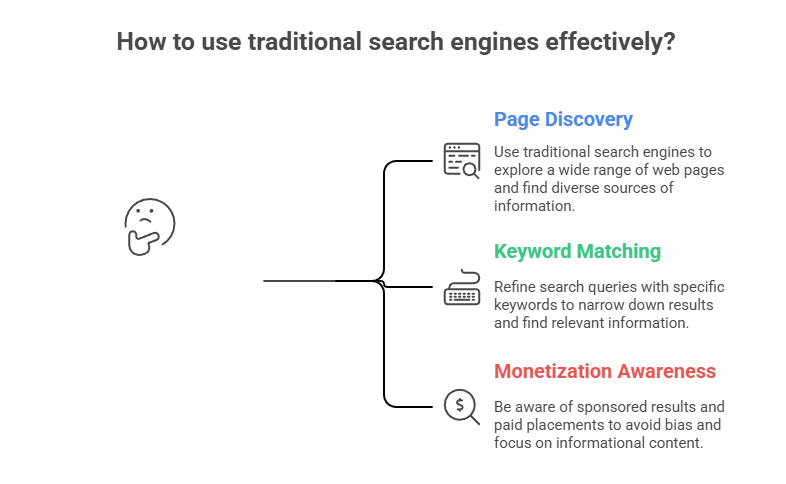
Traditional search engines are digital platforms designed to help users locate information on the internet by indexing vast numbers of web pages and ranking them based on relevance and authority. They act as intermediaries between users and the open web, prioritizing discovery rather than interpretation. The primary goal of traditional search engines is to direct users to external websites where information resides.
These platforms rely heavily on algorithms, backlinks, keyword relevance, and paid placements to determine which pages appear first. While they are highly effective for exploration, navigation, and commercial searches, they place the responsibility of information synthesis on the user.
1. Page Discovery and Indexing
Traditional search engines are built around large-scale web crawling and indexing systems that catalog billions of pages across the internet. Their primary function is to identify which pages exist and store metadata that helps determine relevance during searches. This system excels at breadth, ensuring users can access a wide range of sources, but it does not interpret or summarize content for them.
2. Keyword-Based Query Processing
Search queries in traditional engines are largely processed through keyword matching and semantic approximations. While modern engines have improved contextual understanding, results are still influenced heavily by how well a page aligns with specific search terms. Users often need to refine queries multiple times to surface the most relevant information.
3. Monetization and Advertising Focus
Traditional search engines are deeply integrated with advertising ecosystems. Sponsored results, paid placements, and commercial intent significantly influence what users see first. While ads support free access, they can also distract from purely informational content and introduce bias toward commercial pages.
Key Differences Between Perplexity AI and Traditional Search Engines
Although both Perplexity AI and traditional search engines aim to help users access information, they differ significantly in how they process queries, present results, and support research workflows. These differences reflect two distinct philosophies: one focused on answer generation and the other on content discovery. Understanding these contrasts clarifies when and why each tool is most effective.
1. Answer Delivery vs. Link Lists
Perplexity AI delivers a single, synthesized answer written in natural language that directly addresses the user’s question. It aggregates information from multiple sources and presents it as a unified response, reducing the need for additional exploration. Traditional search engines, by contrast, provide a ranked list of links and expect users to open, read, and compare multiple pages to form their own conclusions—an approach that 83% of users now find less efficient than AI search tools, with many preferring AI-powered search for cohesive, direct answers without clicking through multiple links.
2. Natural Language Understanding
Perplexity AI is optimized for conversational queries and can interpret intent, nuance, and follow-up context more effectively. Users can ask questions in plain language without worrying about precise keyword construction. Traditional search engines still rely significantly on keyword relevance, making query phrasing an important factor in result quality.
3. Source Transparency
Perplexity AI integrates citations directly into its answers, allowing users to see where information originates without leaving the interface. This makes verification faster and more intuitive. Traditional search engines separate content from sources, requiring users to manually assess credibility by visiting individual websites.
4. Research Efficiency
By summarizing and contextualizing information upfront, Perplexity AI minimizes the time users spend switching between tabs and cross-referencing sources. Traditional search engines often require more effort to extract insights, especially for complex or multi-dimensional topics.
5. Advertising and User Experience
Perplexity AI offers a largely ad-free or minimal-ad environment focused on clarity and relevance. Traditional search engines prioritize monetization through sponsored results, which can sometimes overshadow organic informational content and affect user focus.
Perplexity AI vs Traditional Search Engines: Feature Comparison
| Feature | Perplexity AI | Traditional Search Engines |
|---|---|---|
| Primary Output | AI-generated answer | Ranked list of links |
| Question Style | Conversational | Keyword-based |
| Citations | Included in answers | Separate links |
| Ads | Minimal or none | Prominent |
| Research Speed | Fast | Slower |
| Follow-Up Queries | Supported | Limited |
| User Effort | Low | Higher |
When Perplexity AI Is More Useful
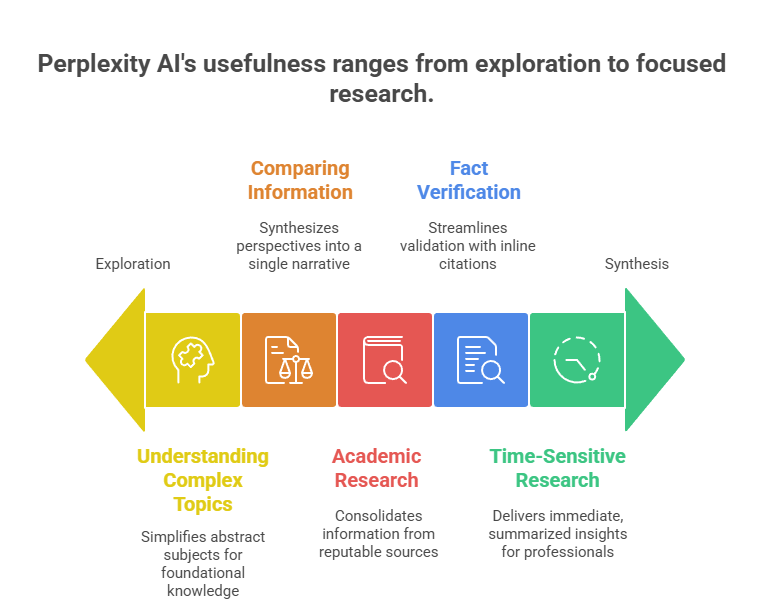
Perplexity AI is particularly effective in scenarios where users need clarity, speed, and synthesis rather than broad exploration. Its design supports structured understanding and efficient research workflows, making it well suited for analytical and informational tasks. When accuracy and context matter more than discovery, Perplexity AI provides a strong advantage.
1. Academic or Factual Research
For academic inquiries and fact-based questions, Perplexity AI quickly consolidates information from reputable sources into a coherent explanation. This reduces the need to manually compare multiple references and helps users grasp core concepts efficiently. Citations further support academic rigor and validation, aligning with broader research trends where 76% of researchers reported using an AI tool in their research workflows, including for discovery and summarization tasks, reflecting how AI is becoming an integral part of academic information synthesis.
2. Understanding Complex Topics
When dealing with technical, abstract, or multi-layered subjects, Perplexity AI simplifies complexity through summarization and contextual explanation. It breaks down information into digestible insights, making it easier for users to build a foundational understanding without extensive prior knowledge.
3. Comparing Information Across Sources
Perplexity AI excels at synthesizing perspectives from multiple sources into a single narrative. This is especially useful for comparisons, trend analysis, or evaluating differing viewpoints without reading numerous articles individually.
4. Fact Verification and Citations
For users who need to verify claims or confirm details, Perplexity AI’s inline citations streamline the validation process. Users can quickly assess source credibility without disrupting their research flow.
5. Time-Sensitive Research
When speed is critical, such as during meetings or decision-making processes, Perplexity AI delivers immediate, summarized insights. This makes it ideal for professionals who need rapid access to reliable information.
When Traditional Search Engines Are Still Better
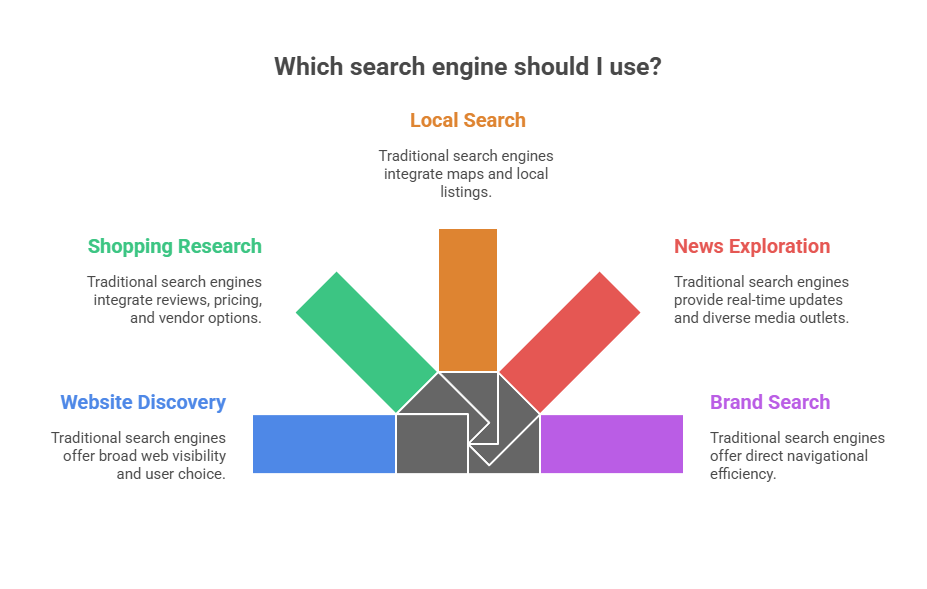
Despite the advantages of Perplexity AI, traditional search engines remain indispensable for many use cases. Their strength lies in breadth, exploration, and commercial or location-based queries. In situations where discovery and choice matter more than synthesis, traditional search engines continue to excel.
1. Website Discovery and Browsing
Traditional search engines are unmatched when users want to explore a wide range of websites or discover new platforms. They provide visibility into the broader web ecosystem and allow users to choose sources based on personal preferences.
2. Shopping and Product Research
For e-commerce and product comparisons, traditional search engines integrate reviews, pricing, ads, and vendor options. This commercial ecosystem is better suited for purchasing decisions than AI-generated summaries.
Location-based queries, such as finding nearby businesses or services, are more effectively handled by traditional search engines due to their integration with maps, reviews, and local listings.
4. News Exploration
While Perplexity AI can summarize news topics, traditional search engines are better for browsing breaking news, accessing diverse media outlets, and exploring real-time updates across publishers.
5. Brand and Site-Specific Searches
When users know exactly which website or brand they are looking for, traditional search engines provide direct navigational efficiency that AI answer engines are not designed to replace.
How Perplexity AI and Traditional Search Engines Complement Each Other
Rather than competing directly, Perplexity AI and traditional search engines function best as complementary tools. Each addresses different stages of the information-seeking process and supports distinct user goals. Together, they create a more complete and flexible research workflow.
1. Rapid Insight Generation
Perplexity AI is ideal for obtaining quick, high-level understanding or answering specific questions efficiently. Users can establish context and direction before engaging in deeper exploration.
2. Deep Exploration and Validation
Traditional search engines allow users to dive deeper into individual sources, explore diverse perspectives, and engage directly with original content. This is valuable for thorough research and critical evaluation.
3. Hybrid Research Workflow
Many users benefit from starting with Perplexity AI for summaries and then switching to traditional search engines for detailed follow-up. This hybrid approach balances speed, accuracy, and depth, improving overall research quality.
TaskVirtual: Smarter Support for AI-Driven Research and Search Tasks

As AI-powered tools like Perplexity AI reshape how individuals and businesses conduct research, managing information workflows, validating sources, and organizing insights can still demand significant time and attention. From structuring research outputs to supporting hybrid workflows that combine AI answers with traditional search exploration, TaskVirtual helps streamline processes associated with traditional search engines, allowing users to focus on decision-making rather than routine task execution..
1. Research Assistance and Information Management
TaskVirtual’s experienced virtual assistants support AI-assisted research by organizing findings, validating cited sources, summarizing insights, and structuring information for reports, blogs, or presentations. They help bridge the gap between AI-generated answers and actionable, human-reviewed outcomes.
2. Affordable and Flexible Pricing
Hiring in-house research or administrative support can be costly, but TaskVirtual offers a budget-friendly alternative. With pricing plans ranging from just $3.12/hour to $14.99/hour, individuals, startups, and enterprises can access skilled assistance without long-term commitments.
3. End-to-End Digital Support Solutions
Whether it’s managing research notes, coordinating follow-up searches, compiling competitive analyses, or maintaining knowledge bases, TaskVirtual provides scalable support aligned with AI-driven workflows. Services adapt easily to short-term research needs or ongoing operational support.
4. Continuous Support and Quality Oversight
TaskVirtual emphasizes reliability and consistency by providing ongoing task monitoring, updates, and quality assurance. This ensures research outputs remain accurate, organized, and aligned with evolving project requirements.
5. Trusted Performance and Client Satisfaction
With 364 positive reviews and a 4.7-star rating across trusted virtual assistant platforms, TaskVirtual is recognized globally for dependable service delivery. Clients rely on TaskVirtual to enhance productivity and complement modern AI tools with human expertise.
Final Answer: How Does Perplexity AI Differ From Traditional Search Engines?
Perplexity AI differs from traditional search engines by focusing on direct answer generation rather than link discovery. It interprets user intent, synthesizes information from multiple sources, and presents concise, citation-backed responses in natural language. Traditional search engines, in contrast, prioritize indexing and ranking web pages, leaving interpretation and synthesis to the user. While Perplexity AI enhances research speed and clarity, traditional search engines remain essential for exploration, discovery, and commercial searches. Used together, they provide a more efficient and comprehensive search experience.
FAQ: Perplexity AI vs Traditional Search Engines
1. Does Perplexity AI replace Google?
No. It complements traditional search rather than replacing it.
2. Is Perplexity AI more accurate than search engines?
It provides concise answers with sources, but accuracy still depends on source quality.
3. Can Perplexity AI access live web data?
Yes, often—depending on configuration and query type.
4. Are traditional search engines becoming obsolete?
No. They remain essential for browsing, discovery, and commercial searches.
5. Which is better for research?
Perplexity AI is faster for summaries; traditional search is better for deep exploration.
 Siddhartha Basu is a Technical Writer at Task Virtual. He loves online games, e-book reading, and Yoga.