

Contents
show
How Do You Measure the Success of a Marketing Campaign?
Measuring the success of a marketing campaign involves far more than checking surface-level metrics or reviewing isolated performance reports; it requires a disciplined, goal-oriented evaluation of whether the campaign delivered meaningful business outcomes within defined time, budget, and resource constraints. In modern marketing environments, virtual assistance plays a critical role by centralizing data collection, automating reporting workflows, tracking KPIs across platforms, and ensuring that performance analysis remains consistent and actionable throughout the campaign lifecycle. According to a report by Salesforce, high-performing marketing teams are 1.5 times more likely to use centralized analytics and automation tools to track campaign performance effectively, reinforcing the value of structured, assistant-supported measurement processes. When supported by virtual assistants handling analytics dashboards, CRM updates, attribution tracking, and documentation, marketing teams gain clearer visibility into results while freeing internal resources to focus on strategy and optimization.
What Is a Marketing Campaign?

A marketing campaign is a coordinated series of marketing activities designed to achieve a specific business objective using consistent messaging across one or more channels. It operates within a defined timeframe, budget, and audience scope to drive measurable outcomes.
1. Purpose of a Marketing Campaign
The primary purpose of a marketing campaign is to influence audience behavior, whether by increasing awareness, generating leads, driving sales, or strengthening customer relationships. Each campaign aligns marketing execution with broader business goals to ensure relevance and impact.
2. Key Components of a Marketing Campaign
A successful marketing campaign includes a clear objective, a defined target audience, tailored messaging, and selected distribution channels. Measurement frameworks and performance tracking mechanisms are also essential components that determine whether the campaign delivers value.
How Do You Measure the Success of a Marketing Campaign?
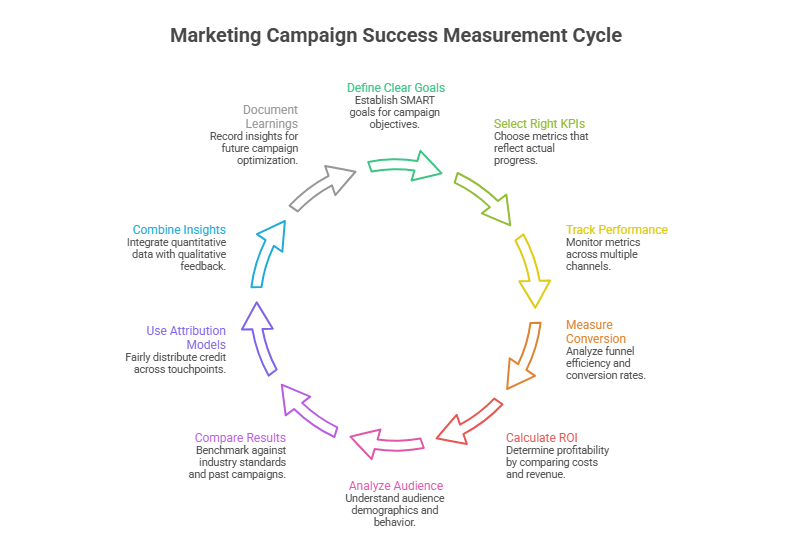
Measuring a marketing campaign’s success means evaluating whether it achieved its intended objectives within the planned timeframe and budget. Success is not universal; it depends on what the campaign was designed to accomplish—brand awareness, lead generation, sales, app installs, or customer loyalty.
A structured measurement approach ensures decisions are data-driven, repeatable, and scalable.
Step 1: Define Clear Campaign Goals
Before measurement begins, campaigns must be anchored in clearly defined SMART goals that specify what success looks like and how it will be measured. These goals establish alignment across marketing, sales, and analytics teams while preventing misinterpretation of results. Virtual assistants often support this stage by documenting objectives, aligning KPIs in reporting tools, and ensuring tracking parameters are correctly implemented. Without a clear goal, metrics lose relevance and analysis becomes fragmented, making it impossible to determine whether outcomes reflect true success.
Step 2: Select the Right KPIs (Key Performance Indicators)
KPIs translate campaign objectives into measurable performance indicators that guide evaluation and optimization. Selecting the right KPIs ensures that teams focus on metrics that reflect actual progress rather than vanity indicators. Virtual assistance adds value here by configuring dashboards, validating data accuracy, and monitoring KPIs consistently throughout the campaign.
1. Awareness Campaign KPIs
Awareness-focused campaigns are measured through indicators that reflect visibility and brand presence rather than immediate conversions. Metrics such as impressions, reach, and share of voice help assess how widely the message was distributed and whether it penetrated the target audience effectively.
2. Engagement Campaign KPIs
Engagement KPIs evaluate how audiences interact with campaign content across platforms. Metrics such as engagement rate, time on page, and interaction depth reveal whether messaging resonated and encouraged meaningful participation rather than passive exposure.
3. Lead Generation KPIs
Lead generation campaigns prioritize measurable actions that indicate buyer interest and intent. Metrics such as leads captured, cost per lead, and form completion rates help assess both volume and efficiency, particularly when evaluated through CRM systems maintained by virtual assistants.
4. Sales & Revenue KPIs
Sales-driven campaigns rely on revenue-centric metrics that connect marketing activity to financial performance. Sales volume, cost per acquisition, and return on ad spend reveal whether campaign investments produced profitable outcomes.
5. Retention & Loyalty KPIs
Retention-focused campaigns measure ongoing customer value rather than first-time actions. Metrics such as repeat purchase rate, churn rate, and customer lifetime value assess long-term impact and relationship strength.
Step 3: Track Performance Across Channels
Marketing campaigns typically span multiple platforms, requiring performance measurement at both channel and aggregate levels. Channel-level tracking reveals which platforms contribute most effectively to campaign objectives and where optimization is required. Virtual assistants support this process by consolidating data from social media, email, paid advertising, and analytics tools into unified reports that provide a clear view of channel efficiency.
Step 4: Measure Conversion and Funnel Performance
Campaign success depends on how efficiently prospects move through the marketing and sales funnel. Measuring conversion rates, identifying drop-off points, and analyzing assisted conversions reveal whether the campaign attracted qualified audiences and guided them toward desired actions. Virtual assistance enables accurate funnel tracking by managing attribution settings, tagging URLs, and maintaining consistency across analytics platforms.
Step 5: Calculate ROI and Profitability
Return on investment is a critical indicator of campaign success, particularly for revenue-driven initiatives. Calculating ROI requires comparing total campaign costs against generated revenue to determine profitability. Virtual assistants often handle cost aggregation, revenue attribution, and ROAS calculations to ensure financial assessments are accurate and timely.
Step 6: Analyze Audience Quality and Behavior
Campaign success is defined not only by volume but by relevance and quality of engagement. Analyzing audience demographics, behavioral patterns, and sentiment helps determine whether the campaign reached the right users. Virtual assistants support this analysis by segmenting data, compiling qualitative feedback, and monitoring audience interactions across channels.
Step 7: Compare Results to Benchmarks and Past Campaigns
Performance metrics gain meaning when placed in context against benchmarks and historical data. Comparing current results to industry standards and past campaigns reveals whether performance improvements are incremental or significant. Virtual assistants often maintain performance archives and benchmark databases that streamline comparative analysis.
Step 8: Use Attribution Models Wisely
Attribution models explain how different touchpoints contribute to conversions across the customer journey. Selecting the right attribution approach ensures fair credit distribution across channels and avoids skewed decision-making. Virtual assistance plays a key role by configuring attribution models and validating conversion paths within analytics systems.
Step 9: Combine Quantitative Data with Qualitative Insights
Quantitative metrics explain what happened, but qualitative insights explain why it happened. Customer surveys, feedback, sales insights, and social listening data add context to numerical performance indicators. Virtual assistants help synthesize these insights by organizing feedback sources and integrating them into performance reviews.
Step 10: Document Learnings and Optimize
Measuring success is incomplete without documenting insights and applying them to future campaigns. Recording what worked, what failed, and why enables continuous improvement and scalability. Research indicates that organizations with strong knowledge documentation and sharing practices are up to 35% more productive, underscoring the importance of structured post-campaign learning. Virtual assistants often manage post-campaign documentation, knowledge repositories, and performance summaries that inform future strategy.
Benefits of Measuring Marketing Campaign Success

Measuring marketing campaign success delivers strategic clarity, financial accountability, and continuous performance improvement. It transforms marketing from a cost center into a measurable growth function supported by data-driven decision-making.
1. Improved Decision-Making
Accurate measurement provides actionable insights that guide optimization and resource allocation. Teams can prioritize high-performing channels and eliminate ineffective tactics with confidence.
2. Better Budget Efficiency
Performance measurement ensures that marketing budgets are allocated based on ROI rather than assumptions. This reduces waste and improves overall financial outcomes.
3. Long-Term Growth Enablement
Consistent measurement builds institutional knowledge that strengthens future campaigns. Insights compound over time, improving scalability and predictability.
Common Mistakes When Measuring Campaign Success
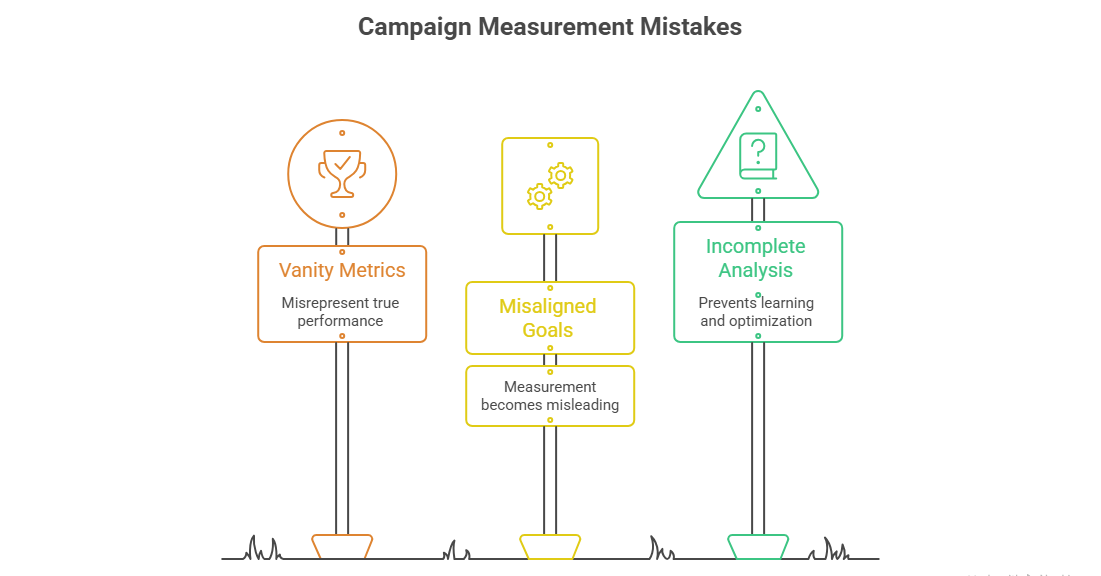
Many campaigns fail not due to poor execution, but due to flawed measurement practices that distort performance interpretation. Avoiding these mistakes ensures accurate evaluation and informed decision-making.
1. Overemphasis on Vanity Metrics
Relying solely on surface-level metrics such as likes or impressions can misrepresent true performance. These metrics lack context when not tied to business outcomes.
2. Misalignment Between Goals and KPIs
When KPIs do not directly reflect campaign objectives, measurement becomes misleading. Clear alignment ensures relevance and accuracy.
3. Incomplete Post-Campaign Analysis
Skipping post-campaign evaluation prevents learning and optimization. Documentation and review are essential for sustained improvement.
TaskVirtual: Your Strategic Partner for Marketing Campaign Measurement

Measuring marketing campaign success requires consistent data tracking, accurate reporting, and disciplined analysis across multiple tools and platforms—tasks that often consume significant internal resources. TaskVirtual supports marketing teams by providing skilled Virtual Marketing Assistants who specialize in campaign performance monitoring, KPI tracking, and analytics coordination, ensuring that success measurement remains precise, timely, and actionable.
1. Campaign Analytics Setup and KPI Monitoring
TaskVirtual’s virtual assistants help configure analytics dashboards, align KPIs with campaign goals, and maintain real-time tracking across channels. They ensure that metrics such as conversions, engagement & ROI, and attribution paths are accurately captured and consistently reported throughout the campaign lifecycle.
2. Cost-Effective and Flexible Support
Hiring full-time analytics or operations staff can be costly, but TaskVirtual offers a flexible alternative. With pricing plans starting from just $3.12/hour to $14.99/hour, businesses gain access to experienced virtual assistants without long-term overhead, making performance measurement scalable and budget-efficient.
3. Multi-Channel Reporting and Data Consolidation
TaskVirtual assists in consolidating data from paid ads, email platforms, CRMs, and analytics tools into unified performance reports. This centralized approach enables clearer insights into channel effectiveness and campaign contribution.
4. Ongoing Performance Reviews and Documentation
Beyond data collection, TaskVirtual supports post-campaign analysis by documenting learnings, preparing performance summaries, and maintaining historical benchmarks. This ensures insights are retained and applied to future campaigns.
5. Proven Reliability and Client Trust
With 364 positive reviews and a 4.7-star rating across trusted virtual assistant platforms, TaskVirtual is recognized for delivering reliable, high-quality support. Marketing teams rely on their expertise to streamline measurement processes and improve campaign decision-making.
Final Answer: How Do You Measure the Success of a Marketing Campaign?
You measure the success of a marketing campaign by aligning clear goals with relevant KPIs, tracking performance across channels, evaluating conversions and ROI, analyzing audience quality, and comparing results to benchmarks. True success is defined not just by numbers, but by how effectively the campaign drives meaningful business outcomes.
FAQ: Measuring Marketing Campaign Success
1. What is the most important metric in a marketing campaign?
It depends on the goal—revenue and ROI matter most for sales campaigns, while reach and engagement matter for awareness.
2. How long should I wait to measure campaign success?
Measure during the optimization campaign and after completion for final evaluation.
3. Are vanity metrics useful?
They provide context but should not be used alone to define success.
4. Should small businesses measure campaigns differently?
The framework is the same, but KPIs should be simpler and budget-focused.
5. Can a campaign be successful without immediate sales?
Yes—awareness and engagement campaigns often drive long-term results.
 Siddhartha Basu is a Technical Writer at Task Virtual. He loves online games, e-book reading, and Yoga.