Contents
show
How Businesses Automate Data Analysis with Claude AI Virtual Assistant
Claude AI, developed by Anthropic, is an advanced AI model family (as of 2026: Opus 4.6 and Sonnet 4.6) optimized for deep reasoning, long-context processing, and data tasks. It powers precise analysis and reporting when paired with virtual assistants (VAs). Businesses upload datasets to Claude via chat, API, or Claude Code, then VAs refine prompts, execute workflows, and deliver actionable reports.
Small businesses, agencies, and startups generate massive data across sales, marketing, finance, and operations, but often lack dedicated analysts; in fact, 65% of small businesses struggle to turn data into actionable insights. Manual reporting is slow, error-prone, and delivers insights too late for effective decisions. Claude AI + VAs address this by combining advanced reasoning (large-context analysis, code execution, agentic tools) with expert prompting and integration skills—enabling faster, more affordable, and scalable analysis without hiring full-time staff.
| Aspect | Manual/In-House Analyst | VA + Claude AI |
|---|---|---|
| Time per report | 10–40 hours | 1–4 hours |
| Monthly cost (est.) | $5,000–$12,000 salary + tools | $800–$2,500 (VA + API) |
| Scalability | Limited by headcount | Instant, on-demand |
| Accuracy oversight | Human only | VA + Claude verification loop |
| Data volume handled | Constrained by time | Full datasets via 1M context |
What This Means for Businesses
US and UK teams now turn raw CSVs, Google Sheets exports, and CRM dumps into executive dashboards in hours instead of weeks. VAs handle the prompting and iteration while Claude AI performs the heavy reasoning, trend detection, and code execution. This delivers faster insights, reduces reporting errors, and maintains compliance-grade accuracy with full audit trails. Founders and managers gain immediate visibility into sales performance, customer behavior, and financial health without waiting for manual analysis. The approach scales effortlessly during peak seasons or growth phases, eliminating the need for additional headcount or expensive tools. Overall, it converts data overload into a strategic advantage, enabling quicker decisions and measurable operational improvements.
How This Actually Works
Claude AI processes tasks through its large context window, constitutional safety training, and built-in analysis tools (Python REPL sandbox and JavaScript visualization engine). VAs provide structured data and precise prompts, iterating through agentic workflows such as multi-step planning and computer use. This model is particularly effective given that around 70% of SMEs have not yet adopted advanced data analytics solutions. It works seamlessly in business workflows because it reasons step-by-step like a senior analyst, generates verifiable code, and delivers clear, stakeholder-ready reports.
Core Capabilities of Claude AI for This Use Case
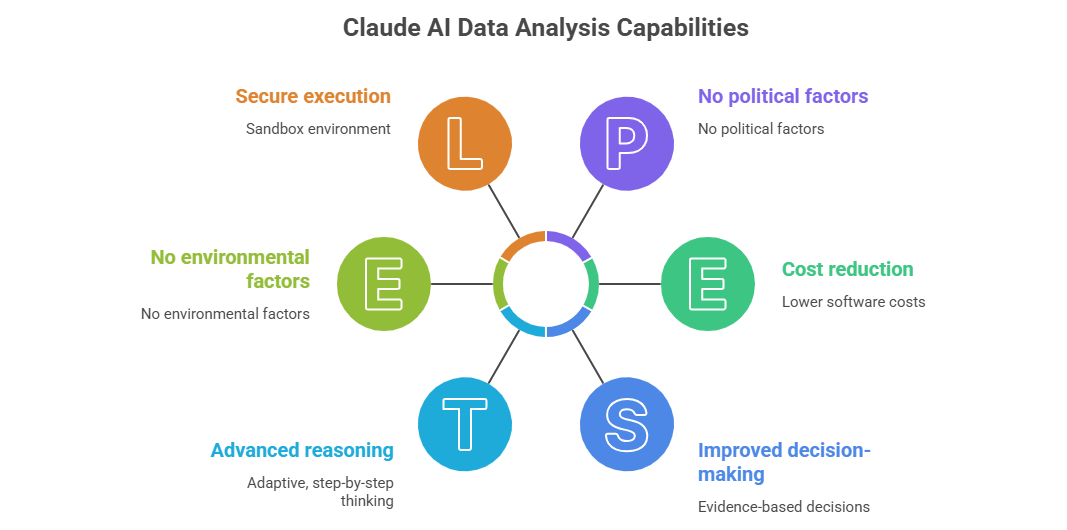
Claude AI excels in data analysis and reporting through its advanced reasoning, massive context handling, and built-in execution tools. When paired with virtual assistants, these features enable end-to-end workflows that process raw business data into clear, actionable insights without fragmentation or external dependencies.
1. 1M Token Context Window
Claude Opus 4.6 and Sonnet 4.6 support a 1M token context window that processes entire quarterly datasets, multiple CSVs, or 500-page reports in a single pass. VAs upload files or link live Google Sheets directly; Claude correlates metrics across sources, maintains coherence, and avoids lossy chunking. Businesses gain complete, holistic visibility instead of fragmented summaries, reducing errors and enabling deeper cross-dataset insights.
2. Advanced Reasoning and Insight Generation
Claude identifies trends, anomalies, causal links, and hidden patterns using adaptive, step-by-step thinking. VAs use targeted prompts such as “Compare Q1 vs Q2 cohort retention, flag key drivers with statistical validation, and explain business impact.” The model delivers verified outputs with plain-English explanations alongside numbers. This replaces guesswork with reliable, evidence-based decisions that directly inform strategy and operations.
3. Code Generation and Execution for Analysis
Claude runs Pandas, SQL queries, time-series models, and visualizations securely in its sandbox environment. VAs request data cleaning, pivot tables, forecasting, regression analysis, or custom calculations; Claude executes the code, explains each step, and returns results with full transparency. No separate licenses for tools like Python or advanced analytics software are needed, lowering costs and speeding delivery.
4. Automated Report and Visualization Creation
Claude automatically generates formatted Markdown reports, professional charts (bar, line, scatter, etc.), and concise executive summaries. VAs refine tone, branding, and structure in quick iterations. Deliverables arrive presentation-ready in minutes, allowing teams to focus on review and action rather than manual formatting or design work.
Why Companies Use Claude AI
Claude cuts analysis time by 80–90%, slashes reporting costs versus full-time hires, and scales instantly for seasonal spikes. API caching and batch processing keep token costs predictable. Safety features (new 2026 constitution) ensure alignment with business ethics and data policies.
Tasks Virtual Assistants Perform Using Claude AI
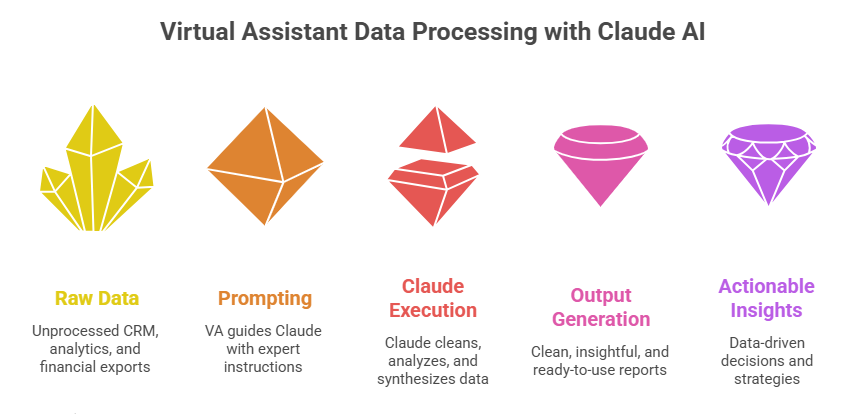
Virtual assistants leverage Claude AI to handle repetitive and complex data tasks with precision and speed. By combining expert prompting with Claude’s reasoning and code execution, VAs deliver clean, insightful, and ready-to-use outputs that directly support business decisions.
1. Sales data cleaning and preprocessing
The VA uploads raw CRM exports to Claude and prompts the model to detect duplicates, standardize formats, handle missing values, and flag inconsistencies using Python code execution. Claude returns a clean dataset along with a detailed audit log of all changes. This matters because accurate base data prevents flawed downstream insights and saves hours of manual Excel work for the team.
2. Monthly performance reporting
The VA feeds Google Analytics, Stripe, and ad platform exports into Claude, instructing it to calculate key KPIs, identify trends, generate visual charts, and draft executive summaries. Claude produces a polished, branded PDF-ready report in minutes. Businesses receive consistent, timely insights without analyst bottlenecks or delays.
3. Customer churn analysis
The VA uploads subscription logs; Claude runs cohort analysis, segments customers by behavior, and identifies the strongest churn predictors with statistical backing. The VA reviews outputs and adds relevant business context before delivery. This drives targeted retention campaigns and directly boosts recurring revenue.
4. Financial forecasting and variance reports
The VA loads budget versus actual spreadsheets; Claude applies time-series models, flags significant variances, and provides clear explanations for each deviation. Outputs include interactive scenario tables for quick what-if analysis. Finance teams can act on forecasts immediately instead of waiting for the CFO review.
5. Competitor and market intelligence synthesis
The VA pastes scraped or exported benchmark data into Claude; the model compares metrics across competitors, highlights performance gaps, and suggests actionable recommendations. The VA refines and formats the final report. This informs pricing and positioning strategies without the cost of external consultants.
Tools and Systems Used Alongside Claude AI
VAs integrate Claude via its official API (with prompt caching), the Claude.ai interface, or Claude Code for agentic workflows, connecting it with tools like Google Sheets/Workspace, Excel plugins, Zapier or Make.com for automation, Notion or Airtable for storage, and Slack or Teams for delivery. This setup aligns with the fact that over 60% of businesses are already using automation tools to streamline workflows, reinforcing the shift toward integrated, automated operations. Enterprise plans further support SOC 2 compliance and secure private data handling, making the setup viable for business-critical use.
Step-by-Step Workflow Used by Virtual Assistants
- The client shares data via a secure link or direct upload (CSV, Sheets, or API export)
- The virtual assistant uses Claude Sonnet 4.6 or Opus 4.6 via API or web interface, Zapier for automated data ingestion, and Google Docs for final formatting and delivery.
- The VA uploads data, crafts a contextual prompt, Claude executes it, and the VA reviews, refines if needed, and adds business context.
- A polished report with charts, insights, and recommendations is delivered in the client’s format.
- Efficiency improves from 15–30 manual hours to 2–4 total hours, with over 85% cost reduction compared to in-house work.
Real Example (Use Case)
A UK e-commerce startup with £2.4M in annual revenue previously spent 25 hours each month manually compiling sales and ad performance reports across multiple tools. Their virtual assistant used Claude Sonnet 4.6 to integrate Shopify, Google Ads, and Klaviyo data in one session. In just 90 minutes, Claude cleaned the data, performed cohort analysis, calculated channel ROI, and produced a 12-page branded report with insights and forecasts. Reporting time dropped to 3 hours, ad efficiency improved by 22%, acquisition costs decreased, and the business reduced costs significantly—paying £650/month for a VA instead of £8,000 for a part-time analyst.
Common Challenges and Limitations
Token costs can rise quickly with very large files, even with prompt caching, requiring VAs to carefully optimize inputs and use batch processing. Claude may occasionally hallucinate on edge-case statistics or rare data patterns, making human verification essential. Data privacy for sensitive financials demands enterprise plans with strict controls. Real-time streaming data still exceeds current capabilities, and complex live dashboards require additional tools. Human oversight remains critical for final sign-off and business context.
Benefits of Outsourcing to Virtual Assistants
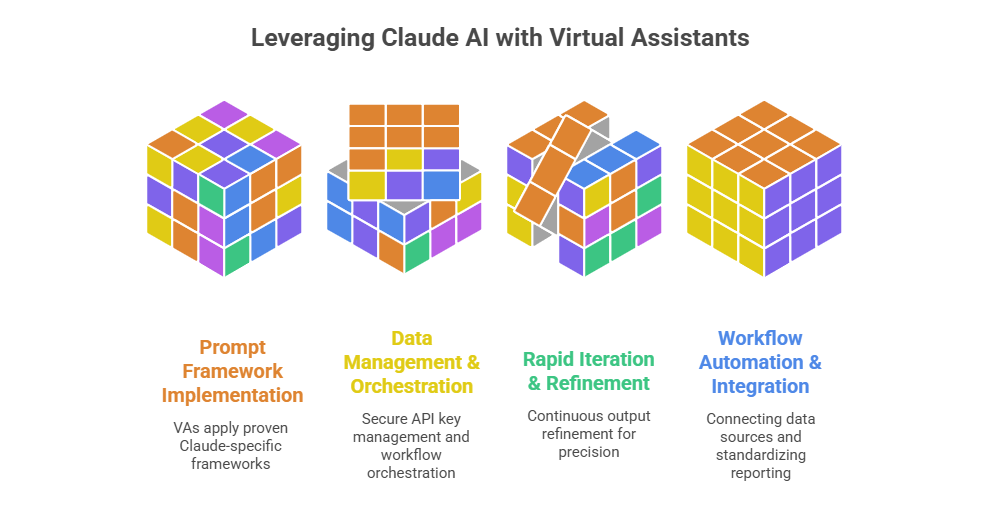
Virtual assistants bring proven Claude-specific prompting frameworks, deep integration expertise, and 24/7 availability across US and UK time zones. They securely manage API keys, structure and validate data inputs, and orchestrate multi-step workflows using Claude’s advanced reasoning and agentic capabilities. Through rapid iteration cycles, they continuously refine outputs for precision, consistency, and business relevance.
Beyond execution, VAs implement workflow automation, connect data sources across tools, and standardize reporting formats for scalability. They maintain audit-ready documentation, enforce data governance practices, and ensure compliance with security and privacy requirements while monitoring output quality and applying human oversight. This enables businesses to fully leverage Claude AI’s capabilities without building in-house expertise, while maintaining control, transparency, and operational efficiency at scale.
Cost and Efficiency Comparison
In-house analyst: £60k–£100k salary plus tools equals £6k–£10k per month effective cost. VA + Claude (Pro/Max + API usage): £1k–£2.5k per month for unlimited reports. Efficiency gains include 8–10x faster turnaround, zero recruitment or training overhead, and a true pay-only-for-output model that scales with actual needs.
When Businesses Should NOT Use Claude AI

Avoid Claude AI for highly regulated sectors that strictly require on-premise models or air-gapped environments. It is unsuitable for real-time high-frequency trading data or ultra-large datasets where token economics become impractical without heavy preprocessing. Skip it if the business has zero tolerance for any AI-generated content and demands full manual recreation of every output.
TaskVirtual: Your Partner in Data Analysis and Reporting Services

Managing data analysis and reporting can overwhelm small businesses, agencies, and startups. From cleaning large datasets to generating timely insights and executive summaries, the process consumes valuable time and resources. TaskVirtual provides expert virtual Claude AI assistant services that simplify data workflows using Claude AI, helping businesses turn raw data into actionable reports with ease.
1. Expert Consultation and Review
TaskVirtual’s skilled virtual assistants assist in selecting optimal Claude AI models, crafting precise prompts, and overseeing the full analysis workflows from start to finish. They upload datasets, run code executions, validate outputs thoroughly, and refine reports to perfectly align with specific business goals and requirements.
2. Affordable and Flexible Pricing
Hiring a full-time data analyst can be expensive, but TaskVirtual makes it highly cost-effective and accessible. With pricing plans starting from just $3.12/hour to $14.99/hour, their services remain budget-friendly and easily available to individuals, families, and growing businesses of all sizes.
3. Comprehensive Data Support Solutions
From sales data cleaning and churn analysis to financial forecasting and performance reporting, TaskVirtual covers it all using Claude AI. Their scalable services adapt flexibly, whether you need occasional one-off help or consistent ongoing reporting support month after month.
4. Ongoing Support and Quality Assurance
TaskVirtual goes beyond initial reports by offering constant updates, multiple iterations, and seamless integration with tools like Google Sheets and Zapier. Their proactive support ensures all insights arrive on time and fully meet your operational needs without any added stress or delays.
5. Proven Track Record of Excellence
With 364 positive reviews and a 4.7-star rating on trusted VA platforms, TaskVirtual is recognised as a reliable partner worldwide. Clients count on their expertise to simplify data analysis and streamline reporting tasks effectively and consistently.
Conclusion
Claude AI, combined with skilled virtual assistants, turns data analysis from a costly bottleneck into a fast, affordable advantage. Businesses gain timely insights, reduce overhead, and scale reporting without adding headcount or expensive tools. With structured VA oversight and Claude’s reasoning, accuracy remains consistent, enabling faster, data-driven decisions. This approach lets teams shift from manual tasks to strategic work while maintaining control and supporting efficient, scalable growth.
Key Takeaways
- Claude’s 1M context and code execution handle full business datasets end-to-end.
- VAs turn raw data into polished reports in hours, not days.
- Combined solution delivers 80–90% time and cost savings versus in-house.
- Enterprise safety features support compliant use in regulated environments.
- Success requires structured prompts, human review, and tight integrations.
FAQ Section
1: Which Claude model is best for data analysis?
Sonnet 4.6 for most reporting; Opus 4.6 for complex statistical or multi-source work.
2: Is data secure with Claude AI?
Enterprise plans offer SOC-2, HIPAA options, and zero-retention policies.
3: How much does it cost monthly?
Typical VA + Claude setup: $800–$2,500 depending on volume.
4: Can Claude replace a data analyst?
No. It augments; VAs provide prompting, validation, and business context.
5: What file types work best?
CSVs, Excel, Google Sheets, and JSON exports perform reliably.
 Siddhartha Basu is a Technical Writer at Task Virtual. He loves online games, e-book reading, and Yoga.