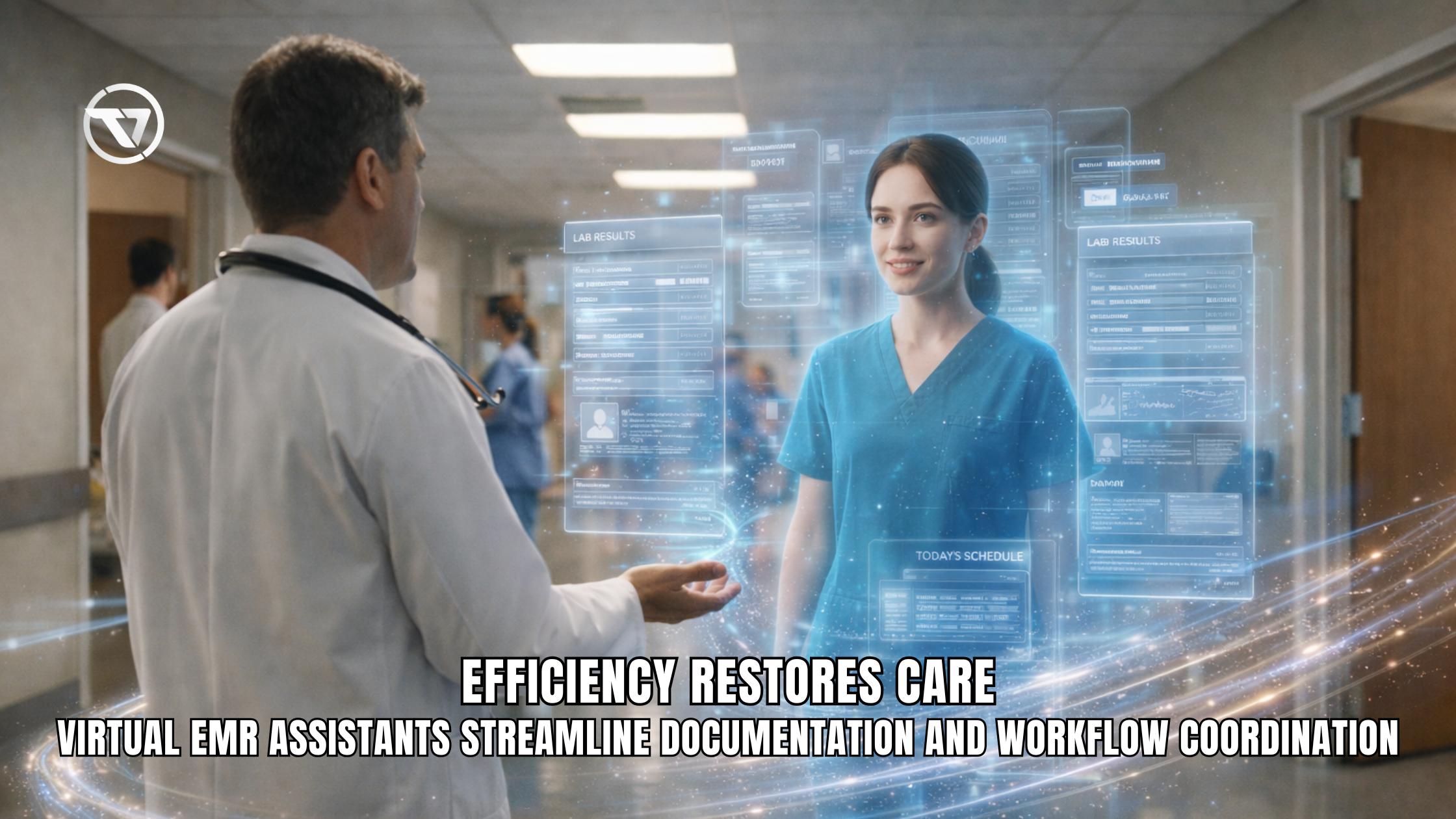
A Virtual EMR Assistant is a remote professional who manages and supports electronic medical records (EMR) systems for healthcare providers. Research indicates physicians spend nearly 49% of their workday on EHR and desk tasks. They handle tasks including patient data entry, record updates, documentation management, appointment coordination, and system organization to improve accuracy overall.
What Is a Virtual EMR Assistant?
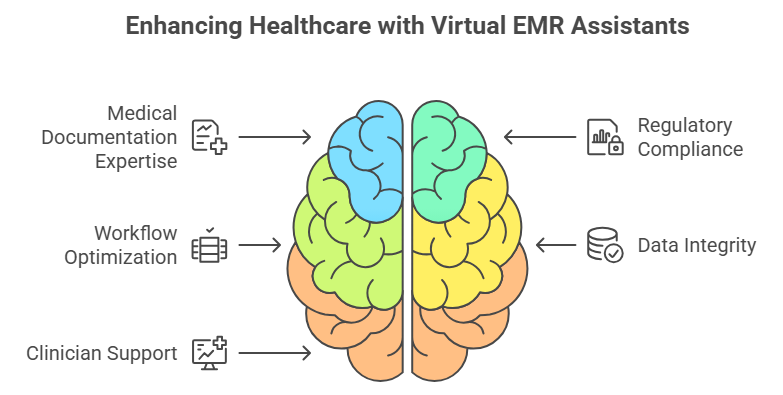
A virtual EMR assistant is a remote healthcare support professional specifically trained to work within Electronic Medical Records (EMR) and Electronic Health Records (EHR) environments. Unlike a general administrative assistant, this role requires working knowledge of medical documentation workflows, patient record structures, and regulatory safeguards governing protected health information (PHI). In the United States, this distinction is critical because healthcare documentation is directly tied to compliance, reimbursement, clinical coordination, and legal defensibility.
A modern EMR virtual assistant or EHR virtual assistant functions as an extension of a healthcare practice’s administrative infrastructure. These professionals operate securely through HIPAA-compliant systems, assisting providers, billing teams, and clinical staff with record maintenance, documentation integrity, and workflow organization. Whether positioned as a virtual assistant for EMR or a virtual assistant for EHR, their purpose remains consistent: preserve data accuracy, improve system efficiency, and reduce the documentation burden on clinicians.
What Does a Virtual EMR Assistant Do?
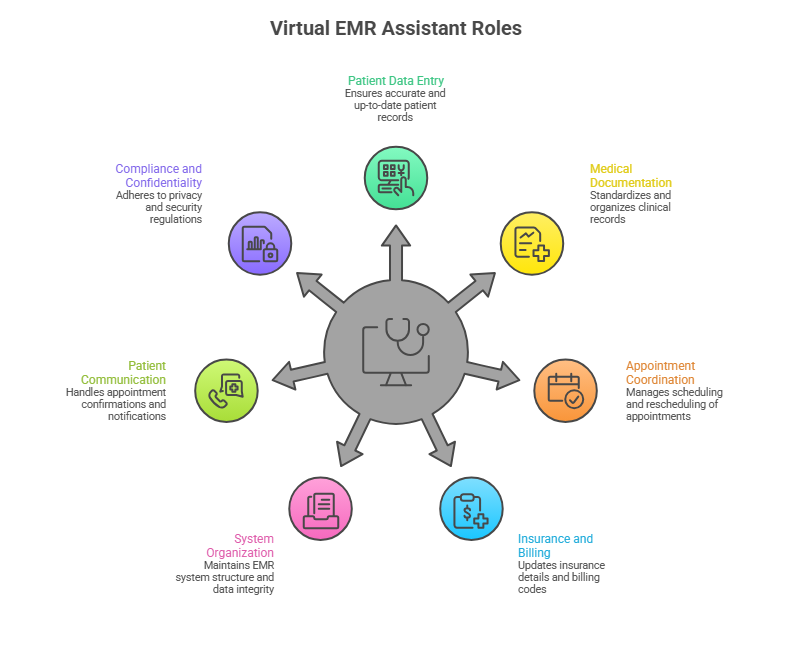
A medical EMR virtual assistant performs a spectrum of structured administrative and documentation-centric tasks designed to support digital record ecosystems. Their responsibilities span data accuracy, documentation integrity, scheduling coordination, and system organization. In practical terms, they ensure that patient records remain complete, accessible, standardized, and compliant with operational requirements.
1. Patient Data Entry and Record Updates
2. Medical Documentation Support
A virtual EMR documentation assistant helps standardize, format, and maintain structured clinical records. They upload reports, organize patient files, and ensure documentation completeness across encounters. Proper documentation management strengthens regulatory compliance and provider efficiency.
3. Appointment and Scheduling Coordination
A remote EMR assistant often manages scheduling functions embedded within EMR workflows. They coordinate bookings, update provider calendars, and process rescheduling or cancellations. Streamlined scheduling mechanisms significantly reduce missed appointments and administrative friction.
4. Insurance and Billing Data Support
An EMR management virtual assistant assists revenue cycle workflows by updating insurance details and verifying patient information. They document billing codes strictly based on provider instructions and maintain record accuracy for claims processing. This administrative layer improves billing consistency and reimbursement reliability.
5. EMR System Organization and Maintenance
A healthcare virtual assistant for EMR helps preserve system structure and data organization. They manage templates, standardize file naming conventions, and monitor record completeness. Organized EMR systems enhance information retrieval and workflow stability.
6. Patient Communication Support
Some EMR virtual assistant services include non-clinical communication functions. Assistants handle appointment confirmations, administrative follow-ups, and record-related notifications. Structured communication processes improve patient engagement and operational coordination.
7. Compliance and Confidentiality Handling
An EMR virtual assistant in the USA must operate within strict privacy and security frameworks. They adhere to HIPAA regulations, confidentiality protocols, and secure-access procedures. Compliance discipline ensures the protection of sensitive patient information and mitigates legal risks.
Skills Required for a Virtual EMR Assistant
The effectiveness of a virtual assistant for EMR or a virtual assistant for EHR depends heavily on specialized competencies rather than generic administrative abilities. EMR environments require a blend of technical accuracy, healthcare workflow awareness, and regulatory sensitivity. High-performing assistants consistently demonstrate structured thinking, meticulous data handling, and procedural discipline.
1. EMR & EHR System Proficiency
A qualified EMR virtual assistant understands the architecture and navigation of major EMR/EHR platforms. They work efficiently within patient charts, documentation modules, and scheduling interfaces. System literacy directly impacts productivity and record integrity.
2. Healthcare Administrative & Documentation Knowledge
A medical EMR virtual assistant must understand clinical documentation flows, terminology, and record structures. They recognize how administrative data supports patient care, compliance, and billing operations. Domain knowledge reduces errors and minimizes provider interruptions.
3. Accuracy, Confidentiality & Organizational Discipline
A remote EMR assistant requires exceptional attention to detail and confidentiality awareness. They consistently maintain structured workflows, documentation consistency, and secure data handling practices. Precision and organization underpin the reliability of virtual EMR support.
Benefits of Hiring an EMR Virtual Assistant
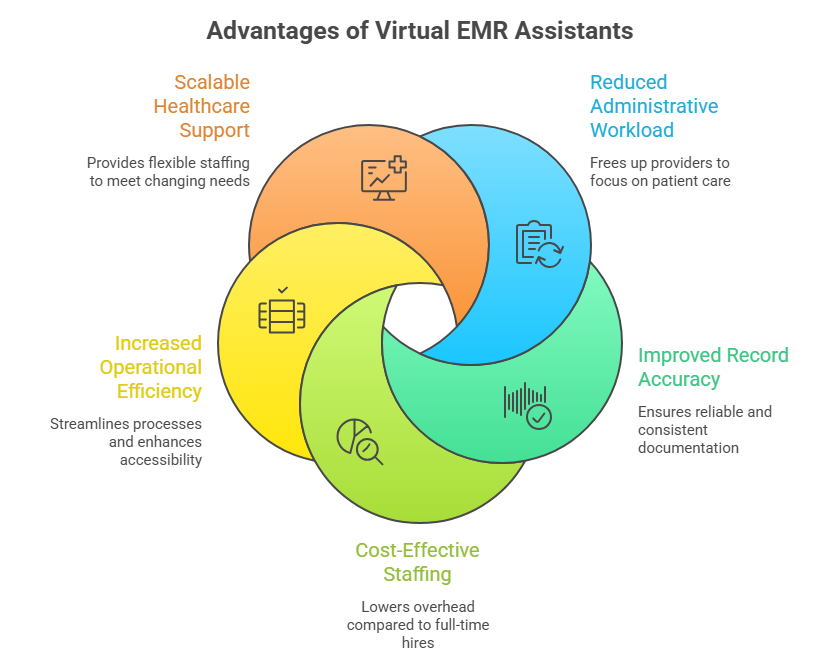
Healthcare organizations increasingly adopt EMR virtual assistant services to optimize administrative efficiency, cost structures, and documentation accuracy. EMR management is time-intensive, requiring sustained attention to record updates, system organization, and compliance safeguards. Delegating these responsibilities to trained professionals produces measurable operational advantages.
1. Reduced Administrative Workload
An EMR virtual assistant for doctors or for clinics significantly decreases documentation-related burdens. Providers can redirect cognitive resources toward patient care rather than administrative maintenance.
2. Improved Record Accuracy
A dedicated virtual EMR data entry assistant reduces inconsistencies, omissions, and transcription errors. Accurate records directly improve care coordination, reporting reliability, and billing workflows.
3. Cost-Effective Staffing Solution
When organizations hire virtual assistant professionals, overhead costs decrease substantially compared to full-time onsite hires. An affordable virtual EMR assistant model eliminates expenses associated with physical workspace and infrastructure.
4. Increased Operational Efficiency
An EMR management virtual assistant maintains structured systems and standardized documentation processes. Efficient record management enhances information accessibility and administrative throughput.
5. Scalable Healthcare Support
An EMR virtual assistant for hospitals or growing practices provides flexible staffing aligned with patient volumes. Studies show 71% of healthcare organizations plan to increase use of remote and virtual staff to manage workloads, demonstrating demand for scalable support without disruptive hiring cycles.
Virtual EMR Assistant vs In-House Medical Staff
| Aspect | Virtual EMR Assistant | In-House Staff |
|---|---|---|
| Location | Remote | On-site |
| Cost | Lower | Higher |
| Flexibility | High | Limited |
| Scalability | Easy | Difficult |
| Overhead | Minimal | High |
Who Should Hire a Virtual EMR Assistant?

Healthcare providers operating within EMR or EHR ecosystems derive immediate benefits from specialized remote administrative support. A virtual EMR assistant for clinics, doctors, and virtual EMR assistant for hospitals model is particularly valuable where documentation volumes are high, staffing flexibility is essential, or operational costs require tighter control. Telehealth organizations, outpatient facilities, specialty practices, and multi-provider groups frequently leverage remote EMR expertise to stabilize workflows and reduce administrative fatigue.
Emerging healthcare businesses, medical billing organizations, and distributed care teams also benefit from a US-based virtual EMR assistant. These assistants integrate into existing systems without requiring physical infrastructure expansion, allowing practices to scale efficiently while preserving compliance integrity. Any organization dependent on structured digital health records can improve efficiency, data accuracy, and administrative continuity through a remote EMR assistant strategy.
TaskVirtual: Specialized Services for Modern Healthcare

Managing electronic medical records is a persistent operational challenge for healthcare providers, particularly as documentation volumes, compliance demands, and administrative workloads continue to expand. Clinics, physicians, and healthcare organizations must balance patient care with time-intensive EMR maintenance, data accuracy controls, and workflow coordination. TaskVirtual delivers structured virtual EMR assistant services designed to reduce administrative strain while preserving precision, security, and system efficiency.
1. Expert EMR Workflow Support and Record Management
TaskVirtual’s trained virtual assistants operate directly within established documentation workflows, supporting patient data entry, record updates, and chart maintenance activities. They help healthcare teams maintain structured, complete, and properly organized digital records without disrupting clinical operations. This specialized support improves documentation consistency and reduces administrative bottlenecks.
2. Affordable and Flexible Pricing
Expanding in-house administrative teams often introduces significant overhead and staffing constraints. TaskVirtual provides a cost-controlled alternative, with service plans ranging from $3.12/hour to $14.99/hour, enabling practices to scale support according to workload demands. This pricing model makes professional EMR assistance accessible to both small clinics and larger healthcare organizations.
3. Comprehensive Virtual EMR Assistance Solutions
TaskVirtual assistants support a broad range of EMR-related functions, including documentation formatting, insurance data updates, scheduling coordination, and system organization. Their services adapt to diverse clinical environments, workflows, and specialty requirements. This flexibility allows providers to maintain operational efficiency without expanding internal staffing complexity.
4. Ongoing Administrative Stability and System Consistency
Beyond isolated tasks, TaskVirtual emphasizes continuous workflow reliability and record accuracy. Virtual assistants help monitor missing data elements, preserve documentation structures, and maintain standardized processes across EMR systems. Sustained administrative stability directly contributes to smoother day-to-day operations.
5. Proven Service Reliability and Client Satisfaction
TaskVirtual’s reputation is supported by 364 positive reviews and a 4.7-star rating across recognized virtual assistant platforms. Healthcare clients rely on this consistent performance to maintain documentation accuracy, scheduling integrity, and system organization. Established trust and reliability remain central to long-term EMR support relationships.
Final Answer
An EMR virtual assistant is a remote healthcare documentation and records management professional who supports Electronic Medical Records (EMR) and Electronic Health Records (EHR) workflows through structured administrative functions. These assistants manage patient data entry, documentation organization, scheduling coordination, system maintenance, and compliance-sensitive processes using secure, HIPAA-aligned technologies. By integrating a medical EMR virtual assistant, healthcare organizations improve record accuracy, reduce administrative overhead, enhance operational efficiency, and preserve clinical focus. The growing adoption of EMR virtual assistant services across the United States reflects the increasing need for scalable, cost-efficient, and documentation-specialized support models in modern healthcare delivery.
FAQ: Virtual EMR Assistant
1. Is an EMR Virtual Assistant HIPAA compliant?
Yes, when properly trained and operating within HIPAA-compliant systems and protocols.
2. Can a Virtual EMR Assistant access patient records?
Yes, with authorized access permissions and secure credential management.
3. Do Virtual EMR Assistants need medical licenses?
No. They perform administrative and documentation-related functions only.
4. Is hiring an EMR Virtual Assistant cost-effective?
Yes. A virtual EMR assistant’s cost structure is typically lower than onsite staffing models.
5. Can small clinics use Virtual EMR Assistants?
Yes. Smaller practices often gain substantial efficiency improvements.
 Siddhartha Basu is a Technical Writer at Task Virtual. He loves online games, e-book reading, and Yoga.