
A construction virtual assistant is a remote professional who supports contractors, builders, and construction firms by handling administrative coordination, scheduling, documentation, and communication tasks critical to daily operations. By delegating these responsibilities, construction businesses improve efficiency, reduce overhead, and maintain smoother project workflows without increasing fixed payroll costs. In fact, businesses can save up to 78% on operating costs by hiring virtual assistants compared to in-house staff, making this support particularly valuable for cost-conscious construction companies. In the U.S. construction environment — characterized by tight timelines, heavy documentation, vendor management, and constant stakeholder communication — a construction virtual assistant helps prevent operational bottlenecks and reinforces process stability. Whether assisting with scheduling, estimates, document control, or client interactions, this role primarily contributes to operational continuity, cost control, and risk mitigation rather than simple administrative convenience.
What Is a Construction Virtual Assistant?
A construction VA is a remote professional who delivers specialized administrative and operational assistance to construction businesses, contractors, developers, and project managers. Unlike general assistants, a virtual assistant for construction understands industry workflows, documentation structures, vendor dynamics, and scheduling complexities. This domain familiarity allows the assistant to integrate directly into project operations rather than merely performing generic clerical work.
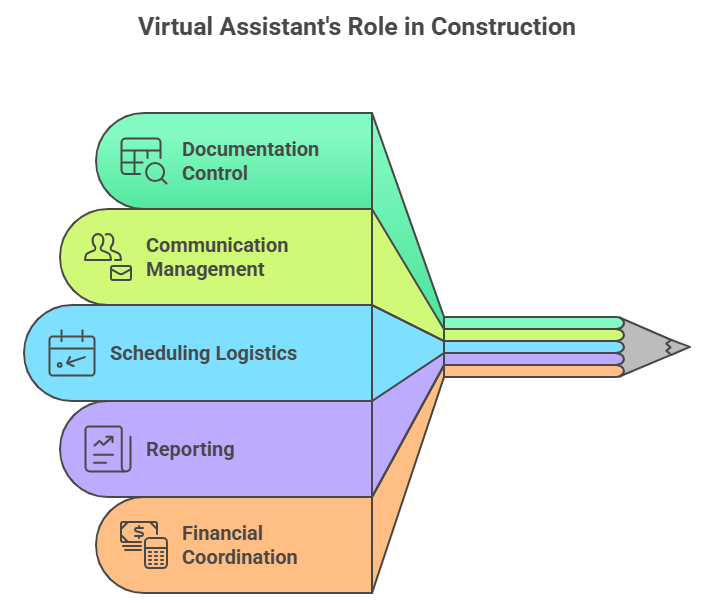
A remote construction VA typically supports tasks tied to documentation control, communication management, scheduling logistics, reporting, and financial coordination. Many firms engage construction virtual assistant services to handle workload fluctuations, improve accuracy, and reduce administrative friction. In the USA, businesses often prefer a US-based construction virtual assistant or a construction virtual assistant USA model when time zone alignment and regulatory familiarity are critical.
What Does a Construction Virtual Assistant Do?
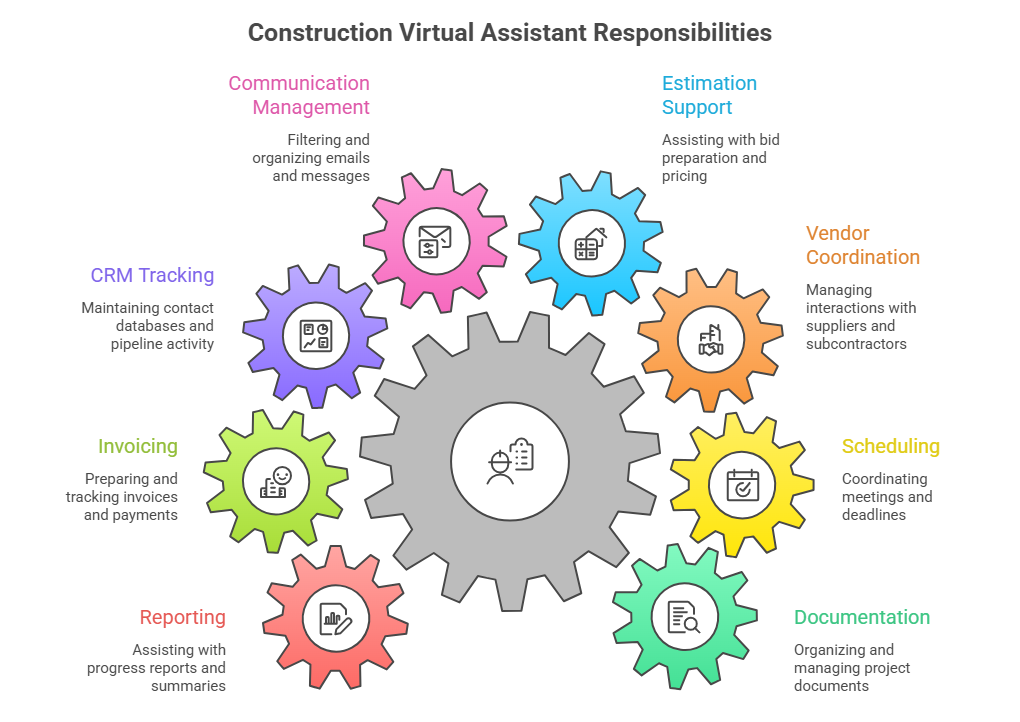
Construction environments generate high volumes of data, communication, and coordination requirements that can overwhelm project teams. A construction project virtual assistant or construction management virtual assistant addresses these operational pressures by handling structured, repeatable workflows. Their responsibilities extend across documentation, scheduling, vendor communication, estimating support, and administrative processes.
1. Project Documentation and File Management
Construction projects produce contracts, permits, compliance records, reports, and technical correspondence that require precise organization. A construction administrative virtual assistant maintains structured digital filing systems to prevent document loss and retrieval delays. Accurate document control reduces disputes, improves audit readiness, and stabilizes project execution.
2. Scheduling and Calendar Coordination
Project timelines involve overlapping tasks, dependencies, and stakeholder availability constraints. A virtual assistant for construction scheduling coordinates meetings, site visits, milestone tracking, and deadline monitoring across distributed teams. Effective scheduling management directly reduces miscommunication, idle time, and avoidable project delays.
3. Vendor and Subcontractor Coordination
Construction operations depend on synchronized interactions with suppliers, subcontractors, inspectors, and consultants. A virtual assistant for contractors tracks deliveries, confirms appointments, and manages routine communication cycles. This coordination layer strengthens workflow continuity and reduces costly logistical disruptions.
4. Estimation and Proposal Support
Bid preparation and pricing updates require disciplined data handling and consistent formatting. A virtual assistant for construction estimating compiles cost inputs, updates pricing documents, and prepares proposal materials. Streamlined estimation workflows accelerate client responses and improve competitive positioning.
5. Email and Communication Management
Construction businesses handle large volumes of operational and client-facing correspondence. A dedicated construction virtual assistant filters messages, flags priorities, and maintains communication records. Structured inbox management prevents information bottlenecks and improves decision responsiveness.
6. CRM and Lead Tracking
Business development activities require disciplined tracking of prospects, follow-ups, and client interactions. A virtual assistant for construction companies updates CRM systems, maintains contact databases, and monitors pipeline activity. Clean data management improves sales visibility and strengthens client relationships.
7. Invoicing and Payment Tracking
Financial coordination tasks require accuracy, timeliness, and procedural consistency. A construction administrative virtual assistant prepares invoices, tracks payments, and monitors expense records. Structured payment tracking supports cash flow stability and reduces revenue leakage.
8. Reporting and Administrative Support
Construction decision-making depends on reliable progress visibility and documentation trails. A virtual assistant for construction project management assists with daily reports, summaries, and operational updates. Consistent reporting strengthens oversight, accountability, and performance analysis.
Skills Required for a Construction VA

An effective construction virtual assistant requires a combination of organizational precision, communication discipline, and industry awareness. Strong documentation management capabilities are essential, as construction workflows depend heavily on structured records, version control, and compliance tracking. Attention to detail directly affects contract accuracy, scheduling reliability, and financial documentation integrity.
Technical fluency with project management platforms, scheduling tools, and collaboration systems is equally important, as modern construction workflows are heavily software-driven. A construction management virtual assistant or construction project virtual assistant must navigate multiple digital environments while preserving workflow continuity and data accuracy. Communication clarity is particularly critical, as research from the Project Management Institute indicates that ineffective communication is a primary contributor to project failure in nearly 30% of cases, underscoring the operational risks of mismanaged information flows. Vendor coordination competence, procedural discipline, and consistency in information handling collectively determine performance quality and project stability.
Benefits of Hiring a Construction Virtual Assistant
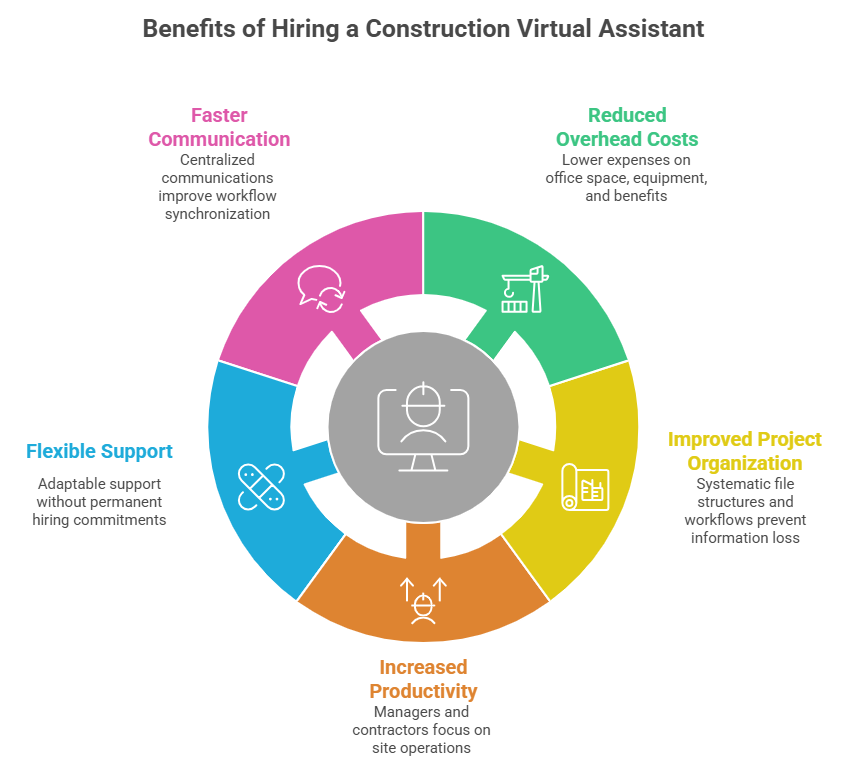
Engaging a remote construction virtual assistant introduces structural advantages that extend beyond basic task delegation. Construction firms increasingly rely on construction VA services to improve workflow stability, reduce administrative friction, and maintain consistent project oversight. For USA-based businesses, selecting a US-based construction virtual assistant frequently enhances communication alignment and operational responsiveness.
1. Reduced Overhead Costs
Choosing to hire a construction virtual assistant significantly reduces expenses associated with office space, equipment, employee benefits, and long-term staffing liabilities. This model converts fixed labor costs into variable operational spending, which is particularly valuable in project-driven environments. Improved cost elasticity enables construction businesses to scale support without increasing financial risk.
2. Improved Project Organization
Construction projects generate large volumes of documentation, schedules, and stakeholder communications that require disciplined management. A construction administrative virtual assistant introduces systematic file structures and standardized workflows that prevent information loss. Strong organizational control directly reduces delays, disputes, and administrative confusion.
3. Increased Productivity for Project Teams
Delegating documentation, coordination, and communication tasks allows managers and contractors to prioritize site operations and revenue-generating activities. Reduced administrative distraction improves decision speed and execution efficiency across project phases. Productivity improvements often compound as teams operate with clearer workflows and fewer interruptions.
4. Flexible and Scalable Support
Construction workloads fluctuate due to project cycles, client demands, and seasonal factors that complicate staffing decisions. A construction virtual assistant for small business environments provides adaptable support without permanent hiring commitments. This flexibility strengthens operational continuity while minimizing structural overhead.
5. Faster Communication and Coordination
A dedicated construction virtual assistant centralizes routine communications, follow-ups, and scheduling interactions across stakeholders. Reduced response latency improves workflow synchronization and minimizes preventable disruptions. Stronger coordination mechanisms directly contribute to schedule adherence and operational clarity.
Construction Virtual Assistant vs In-House Staff
| Aspect | Construction Virtual Assistant | In-House Staff |
|---|---|---|
| Location | Remote | Office-based |
| Cost | Lower | Higher |
| Flexibility | High | Limited |
| Scalability | Easy | Difficult |
| Overhead | Minimal | High |
Many construction firms adopt remote staffing structures to increase agility while maintaining financial discipline.
Who Should Hire a Construction Virtual Assistant?

Construction operations vary widely in scale, specialization, and project complexity, yet administrative pressures remain constant across business types. A construction virtual assistant for builders, contractors, and developers can stabilize workflows regardless of organizational size. For USA-focused companies, engaging a construction virtual assistant in the USA model often improves scheduling coordination and communication efficiency.
1. General Contractors
General contractors manage complex project ecosystems involving multiple subcontractors, schedules, and documentation streams. A virtual assistant for contractors helps maintain structured coordination and reduces administrative overload. This support improves visibility across timelines, communications, and deliverables.
2. Subcontractors
Subcontractors frequently balance overlapping assignments, reporting obligations, and client communications. A construction administrative virtual assistant introduces consistency in scheduling and documentation management. Improved workflow organization reduces missed deadlines and coordination conflicts.
3. Construction Startups
Construction startups operate with constrained resources and unpredictable workload demands that strain internal capacity. An affordable construction virtual assistant provides scalable operational support without increasing fixed employment costs. This structure enables startups to maintain professionalism and responsiveness during growth phases.
4. Project Managers
Project managers require continuous oversight across schedules, reports, vendor interactions, and stakeholder communications. A virtual assistant for construction project management strengthens administrative control and reporting accuracy. Enhanced coordination reduces decision bottlenecks and workflow disruptions.
5. Real Estate Developers
Developers coordinate with contractors, consultants, regulatory bodies, and financial stakeholders throughout project lifecycles. A construction management virtual assistant supports documentation flow and scheduling synchronization. Structured administrative assistance improves process stability and communication clarity.
6. Architecture and Engineering Firms
Design and engineering firms manage substantial project documentation, revisions, and consultant coordination activities. A virtual assistant for construction companies introduces organized workflows and communication tracking mechanisms. Improved administrative control supports efficiency across design and delivery stages.
7. Home Builders
Home builders operate within tight timelines, budget constraints, and client-facing communication cycles. A construction VA for small business environments improves scheduling discipline and documentation management. Stronger coordination enhances client satisfaction and project predictability.
TaskVirtual: Specialized Support for Construction Workflows

Construction firms routinely encounter administrative saturation due to documentation cycles, scheduling dependencies, and vendor coordination demands. TaskVirtual provides a structured construction virtual assistant support to reinforce operational stability within construction environments. By aligning remote assistance with construction-specific processes, businesses gain predictable workflow management without expanding internal staffing overhead.
1. Industry-Focused Administrative Assistance
TaskVirtual’s virtual professionals support documentation control, scheduling logistics, reporting workflows, and communication tracking aligned with construction operations. Their experience with project-driven environments enables consistent handling of time-sensitive administrative tasks. This reduces operational friction while maintaining procedural accuracy.
2. Affordable and Flexible Pricing
Maintaining full-time administrative staff can create significant cost pressure for contractors and growing firms. TaskVirtual offers pricing plans ranging from $3.12/hour to $14.99/hour, enabling businesses to match support levels with workload demands. This model improves cost efficiency while preserving scalability.
3. Comprehensive Construction Coordination Support
TaskVirtual assistants help manage schedules, organize project files, coordinate stakeholder communications, and maintain structured reporting processes. These activities directly improve workflow continuity and information visibility. Construction teams benefit from reduced administrative disruptions and clearer operational control.
4. Continuous Operational Support
Construction workflows require ongoing monitoring of deadlines, communications, and documentation updates. TaskVirtual emphasizes consistent follow-ups, status tracking, and coordination reinforcement. This proactive support structure helps prevent preventable delays and misalignment.
5. Proven Reliability and Client Satisfaction
TaskVirtual maintains 364 positive reviews and a 4.7-star rating across recognized virtual assistant platforms. This performance record reflects process reliability, communication discipline, and service consistency. Construction businesses gain confidence through demonstrated service stability.
Final Answer
FAQ: Construction Virtual Assistant
1. Can a construction va manage project schedules?
Yes. Scheduling and coordination are common responsibilities.
2. Is hiring a construction VA cost-effective?
Yes. It reduces overhead and increases productivity.
3. Do they understand industry terminology?
Experienced VAs often specialize in construction workflows and documentation.
4. Can small contractors hire a construction virtual assistant?
Yes. Many VAs work part-time or on flexible contracts.
5. Do construction VAs handle invoicing and reports?
Yes. Administrative and financial coordination tasks are common.
 Siddhartha Basu is a Technical Writer at Task Virtual. He loves online games, e-book reading, and Yoga.