Contents
show
Can Google Gemini 2.0 Model Search on Google in Real Time
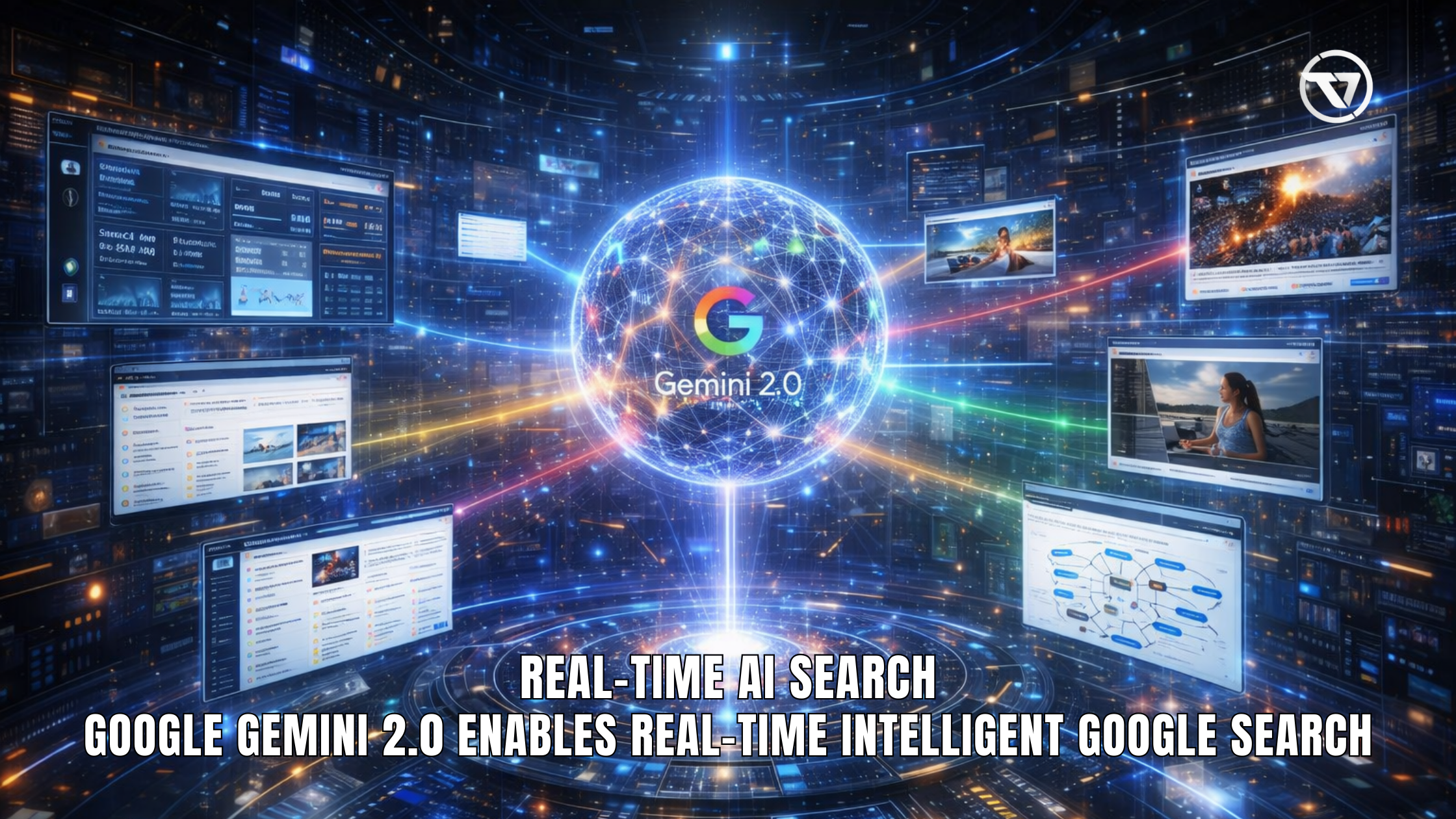
Google Gemini 2.0 does not directly search Google in real time on its own. Instead, Gemini can access information through connected tools, browsing features, and integrated Google services when enabled. In many use cases, it retrieves or summarizes information using live web access, but this depends on product settings, permissions, and the specific Gemini environment (such as Gemini Advanced, Workspace, or developer APIs).
What Does “Search on Google in Real Time” Mean?
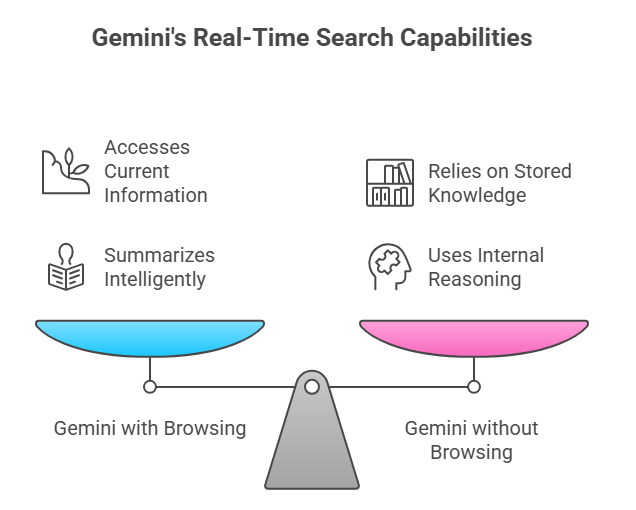
When people ask whether Gemini 2.0 can search Google in real time, they usually mean whether the system can instantly retrieve live results from Google Search, whether it can access fresh and continually changing information, and whether it functions like a combined search engine and intelligent assistant that operates simultaneously. This concept often creates confusion because users assume every response is generated from up-to-the-minute data, when, in reality, Gemini behaves differently depending on the mode it is operating in. According to recent research, 79 percent of consumers expect to use AI-enhanced search within the next year, underscoring how widespread the perception of “real-time AI search” has become.
The reality is more nuanced because Gemini is not fundamentally a search engine, but rather an AI system capable of interacting with search data under certain conditions. In environments where browsing or integrated tools are enabled, Gemini can work with current information and summarize it intelligently, which gives the impression of real-time search functionality. However, without those capabilities turned on, Gemini draws only from internal knowledge and stored patterns instead of actively fetching new information.
Can Gemini 2.0 Search Google in Real Time?
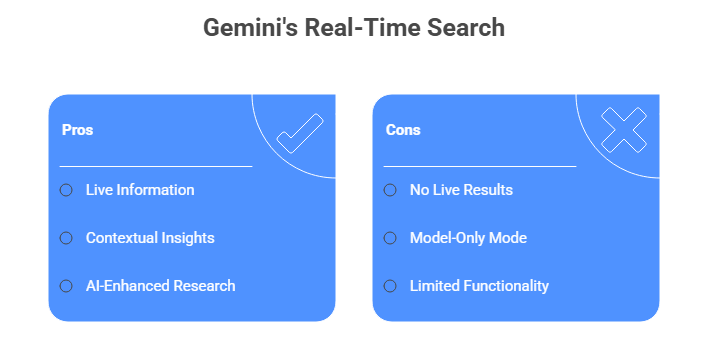
In practical terms, the answer depends on the mode Gemini is operating in, and whether browsing or integrations have been explicitly enabled within the product environment. When browsing is active or connected tools are available, Gemini can retrieve live information, interpret it in context, and present synthesized insights as if it were searching in real time. However, when browsing is disabled, the system functions purely as a model-based intelligence relying on prior knowledge rather than live retrieval.
1. Yes — In Browsing or Connected Mode
In this mode, Gemini can access live websites, interpret current search-based content, and summarize key insights into a clear and contextual response. It behaves like an AI-enhanced research assistant capable of combining reasoning with real-time retrieval. This creates an experience that closely resembles performing a Google Search and receiving an analytical explanation at the same time.
2. No — In Offline or Model-Only Mode
When Gemini operates without browsing or integrations, it generates responses solely from its internal training, stored patterns, and reasoning capabilities. It does not fetch live results, verify current data, or access newly published information. In this state, Gemini functions as a self-contained language model rather than a connected search interface.
How Gemini 2.0 Accesses Information in Real Time
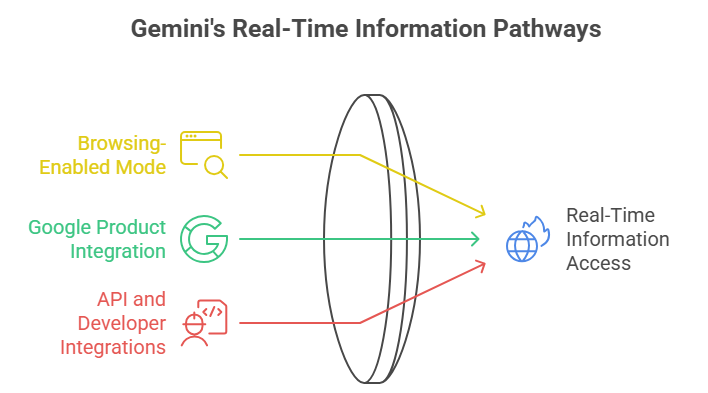
Gemini can interact with real-time information only when certain capabilities are activated, and those capabilities vary across products and environments. In browsing-enabled contexts, Gemini reads live pages and synthesizes information, while in integrated systems, it functions as an intelligent companion enhancing Google services. In developer and API environments, Gemini can retrieve live data through connected applications and external data pipelines.
1. Browsing-Enabled Mode
In this mode, Gemini can open external pages, interpret their contents, and extract relevant insights that are immediately incorporated into its responses. It processes the retrieved material in real time, allowing users to receive summaries and explanations derived from current information. This creates an interactive research workflow where Gemini acts as both reader and analyst.
2. Integration with Google Products
Through integrations with tools such as Search Generative Experience, Workspace applications, and system-level interfaces, Gemini functions as an intelligent layer that enhances existing Google platforms. It contextualizes information already available within those environments and supports productivity tasks without replacing the underlying systems. In these scenarios, Gemini augments user workflows rather than behaving as an independent search engine.
3. API and Developer Integrations
Developers can connect Gemini to live databases, external APIs, and third-party systems that provide continuously updated information. In those implementations, Gemini becomes capable of responding to real-time feeds, operational data, or transactional environments. The model’s reasoning capabilities are therefore combined with externally supplied dynamic information pipelines.
What Gemini 2.0 Cannot Do

Gemini does not automatically operate as a universal real-time search engine, and it does not independently crawl the entire web or access live results unless browsing tools are permitted. It cannot bypass access rules, retrieve restricted content, or view information without explicit permissions configured within its environment. In addition, the system cannot guarantee accuracy or currency of information when browsing is disabled.
Gemini also does not replace the role of Google Search or assume responsibility for verifying every piece of retrieved information. It does not inherently maintain persistent live connectivity to the internet, nor does it evaluate proprietary or private datasets without authorized integration. Human review, validation, and contextual oversight remain essential when using Gemini for research or decision-support activities.
Why Google Separates Gemini and Search
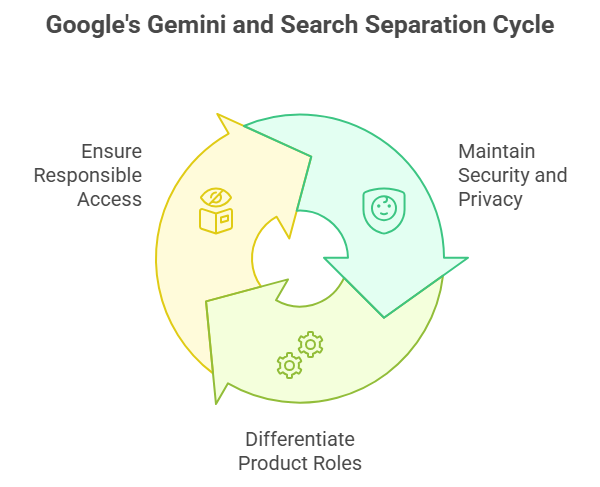
Google maintains a clear separation between Gemini and Search to ensure proper control over privacy, data handling, and system permissions. This structure protects user information and prevents unauthorized retrieval behaviors while supporting safe interaction with web content.
1. Security and Privacy Governance
This separation allows Google to maintain strict safeguards around user data, browsing permissions, and information access boundaries. It ensures that Gemini does not unintentionally retrieve or expose sensitive content, and that all web interactions occur within controlled environments.
2. Product Role Differentiation
By distinguishing Gemini from Search, Google preserves the functional identity of each system while allowing them to complement one another; Gemini operates as an intelligence and reasoning layer, while Search remains a dedicated retrieval engine optimized for discovery and indexing workflows, even as 83 percent of users say AI-enhanced search tools provide more efficient results than traditional search engines, reflecting how rapidly AI-assisted retrieval is influencing user behaviour.
3. Responsible Access and Transparency
Maintaining separate systems enables clearer user understanding of when browsing occurs, how data is accessed, and what tools are active within a session. This structure supports transparency, informed consent, and responsible use of AI-driven retrieval capabilities.
Use Cases Where Real-Time Search Makes Sense
Real-time browsing is most valuable when users are working with time-sensitive research needs, trending information, or evolving market and contextual data. In these scenarios, Gemini can synthesize live sources and provide structured interpretations that support decision-making or rapid discovery activities. The capability allows users to combine information retrieval with analytical reasoning in a single workflow.
Professionals, students, and analysts often benefit from this mode when they are verifying details, reviewing news developments, assessing pricing or availability conditions, or performing technical troubleshooting. Gemini assists by merging retrieved information with interpretive explanations, reducing manual effort while still allowing users to assess and validate the results independently. In these contexts, the system acts as a powerful augmentation to traditional search practices.
Benefits of Gemini with Real-Time Access

When Gemini operates with live access, it becomes capable of providing responses that combine current data with analytical interpretation, enabling more relevant and context-aware outputs. This enhances research efficiency, reduces the need to review multiple sources manually, and supports intelligent synthesis of complex information.
1. Up-to-Date Answers
With browsing enabled, Gemini can incorporate recent developments and current references into its responses, reducing reliance on older training-set knowledge. It supports users who require information tied closely to changing events or updated datasets. This improves the relevance of insights delivered during research or inquiry tasks.
2. Faster Research
Gemini accelerates information gathering by retrieving content and summarizing it into cohesive narratives that reduce manual reading time. It consolidates insights from multiple sources into structured responses that are easier to assess and compare. This allows users to complete research workflows more efficiently.
3. Context-Aware Responses
By combining reasoning capabilities with retrieved material, Gemini can interpret information within the broader context of user prompts and objectives. It does not simply repeat web content, but synthesizes meaning and relationships between concepts. This produces responses that feel analytical rather than purely extractive.
4. Productivity Boost
Gemini supports professional and academic activities by reducing friction in research, analysis, and discovery workflows. It allows users to focus on judgment and interpretation rather than manual data gathering. This integrated capability enhances working speed and extends the value of connected tools and services.
Limitations to Keep in Mind

Gemini’s real-time capabilities are constrained by configuration settings, product boundaries, and regional or platform-specific browsing permissions. It cannot guarantee universal availability of live access, and the reliability of retrieved information may vary depending on the quality of the source content being accessed.
1. Access and Feature Availability
Browsing and integrations may not be active in every region, environment, or account configuration, and functionality can differ between consumer, enterprise, and developer contexts. Users must explicitly enable and authorize these capabilities before Gemini can operate in a live-access mode.
2. Source Reliability and Verification
Content retrieved from external sites may vary in accuracy, credibility, and editorial quality, meaning that not all results should be treated as authoritative. Users should continue to apply critical review and external verification practices when interpreting AI-generated summaries of web material.
3. Operational Boundaries
Gemini does not operate as a constant, fully autonomous crawler or search engine, and its ability to retrieve information depends on permitted contexts and technical integrations. It remains an AI assistant that supplements search rather than replacing the underlying discovery infrastructure.
TaskVirtual: Your Partner for Research and Information Support Services

In an environment where tools like Gemini enable smarter research and real-time insights, many professionals and businesses still need human support to manage online research tasks, information monitoring, and digital workflows. TaskVirtual provides dedicated Virtual AI Assistants who help users organize research activities, manage web queries, track online findings, and coordinate information retrieval across tools and platforms. Their services ensure that users can combine AI-assisted intelligence with reliable human task management for greater accuracy and productivity.
1. Expert Consultation and Review
TaskVirtual’s trained virtual assistants support users in structuring research workflows, evaluating online information sources, and organizing insights gathered through browsing or AI-assisted tools. They help verify findings, document references, and streamline digital research activities so decisions can be made with confidence.
2. Affordable and Flexible Pricing
Hiring full-time research or administrative staff can be costly, but TaskVirtual offers accessible alternatives with flexible plans. With pricing starting from just $3.12/hour to $14.99/hour, their services provide a cost-effective way to scale research and information-support work without long-term overhead.
3. Comprehensive Digital Task Support
From monitoring live web updates and maintaining research logs to assisting with document preparation and online coordination tasks, TaskVirtual delivers end-to-end support for knowledge-driven workflows. Their adaptable service model supports individuals, teams, and organizations managing continuous online research activities.
4. Ongoing Support and Quality Assurance
TaskVirtual ensures continuity and reliability by providing consistent updates, progress tracking, and structured communication throughout task execution. Their proactive approach helps users stay informed, avoid delays, and maintain clarity across evolving online research and information tasks.
5. Proven Track Record of Excellence
With 364 positive reviews and a 4.7-star rating on leading virtual assistant platforms, TaskVirtual is recognized as a trusted support partner worldwide. Clients rely on their expertise to complement AI-powered tools, enhance research efficiency, and streamline real-time information workflows.
Final Answer: Can Google Gemini 2.0 Search Google in Real Time?
Yes, but only when browsing or connected tools are enabled. In those scenarios, Gemini 2.0 can retrieve and summarize live online information, similar to a real-time Google search. However, in default model-only mode, Gemini relies on internal training data and does not automatically pull live search results. Gemini is best understood as a powerful AI assistant that can work with live web data when allowed, rather than a search engine itself.
FAQ: Can Google Gemini 2.0 Search on Google in Real Time?
1. Does Gemini replace Google Search?
No, it works alongside Search, not as a replacement.
2. Can Gemini browse the internet?
Yes, when browsing mode or integrations are enabled.
3. Is real-time access always active?
No, it depends on permissions and product settings.
4. Is Gemini more accurate with browsing enabled?
Often, yes, because it can reference current sources.
5. Can developers give Gemini live data access?
Yes, via APIs and connected tools.
 Siddhartha Basu is a Technical Writer at Task Virtual. He loves online games, e-book reading, and Yoga.