Contents
show
AI-Powered Virtual Assistant: Automating Business Tasks with Smart Technology
An AI-powered virtual assistant is a digital tool that utilizes artificial intelligence to automate tasks, streamline workflows, provide instant support, and enhance productivity. These assistants can handle a range of tasks, including scheduling, data processing, customer service, content generation, email drafting, research, and more—making them valuable for businesses, entrepreneurs, and teams seeking to save time and enhance efficiency.
What Is an AI-Powered Virtual Assistant?
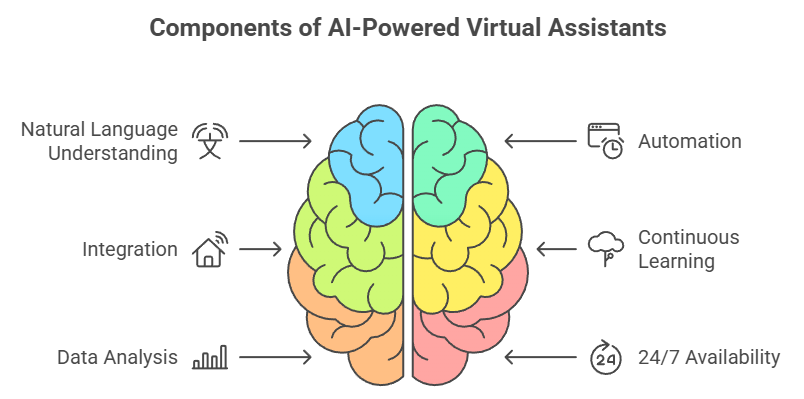
An AI-powered virtual assistant is a software-based system designed to understand natural language, automate workflows, and complete tasks traditionally handled by human assistants. It leverages artificial intelligence, machine learning, and natural language processing to interpret user needs, manage information, and execute tasks accurately and consistently. By integrating with business tools such as CRMs, calendars, communication platforms, and project management systems, it becomes a centralized operational partner capable of handling a broad range of responsibilities without human intervention.
These assistants continuously learn from user behavior, refine their responses, and personalize their support to meet evolving requirements. They analyze data, identify patterns, deliver insights, and automate repetitive processes such as email management, scheduling, and document organization. Available 24/7, they provide uninterrupted assistance, streamline workflows, and enhance decision-making efficiency across industries, including healthcare, finance, marketing, customer service, and e-commerce. In fact, research shows that 78% of companies worldwide now use AI technologies in at least one business function.
How AI-Powered Virtual Assistants Work
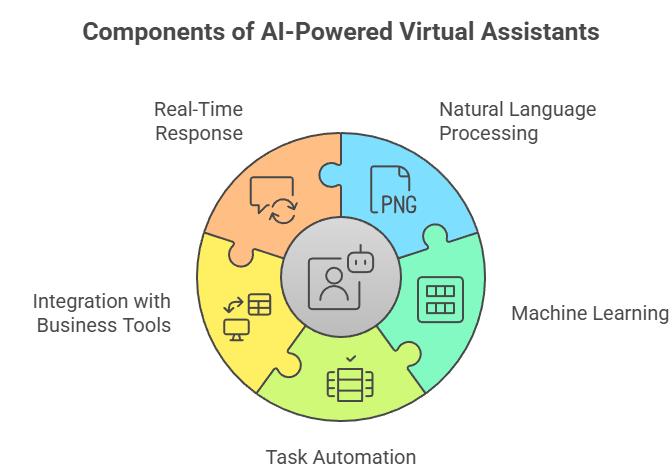
AI-powered virtual assistants operate through interconnected systems that enable them to comprehend language, automate tasks, integrate with various tools, and provide real-time support. These capabilities work together to create a unified digital assistant that can operate independently and at scale. The combination of intelligence, automation, and connectivity enables organizations to streamline operations efficiently.
1. Natural Language Processing (NLP)
NLP enables the assistant to interpret text and voice inputs using linguistic models that understand grammar, context, and sentiment. It transforms natural language into structured data that the AI can process. This allows users to communicate naturally while the assistant handles the technical interpretation behind the scenes.
2. Machine Learning
Machine learning allows the assistant to learn from user interactions, outcomes, and feedback to improve accuracy. Over time, the system adapts to specific preferences, frequently used tasks, and historical behavior. This creates a progressively more efficient assistant capable of anticipating needs and reducing repetitive instructions.
3. Task Automation
The automation layer executes routine activities such as generating messages, updating records, and managing workflows. It interacts with software tools to complete actions without manual involvement. In fact, research shows that about 43% of AI usage in workplace tasks involves automation. Through automation, the assistant eliminates repetitive administrative tasks and accelerates operational processes.
4. Integration with Business Tools
AI assistants connect with CRMs, communication platforms, calendars, and project management systems to centralize work processes. Integrations allow the assistant to retrieve data, update entries, and synchronize information across applications. This unified environment ensures consistent performance and reduced duplication across systems.
5. Real-Time Response
The assistant delivers instant feedback through chat, voice interfaces, or automated workflows. Real-time processing enables rapid task handling, quick information retrieval, and immediate support. This speed significantly improves user experience and operational responsiveness.
Key Features of AI-Powered Virtual Assistants
AI-powered virtual assistants include a wide range of capabilities that simplify workflows and enhance productivity. These features are designed to support daily operations, customer interactions, and internal processes with consistency and precision. Together, they form a comprehensive digital solution that adapts to business needs.
1. Smart Task Automation
The assistant automates activities such as email handling, scheduling, and document management, reducing time spent on repetitive work. It performs tasks consistently and accurately without human intervention. This automation increases productivity and reduces operational delays.
2. Customer Support Automation
AI assistants manage FAQ responses, resolve basic inquiries, and support ticket triage. They provide immediate assistance that reduces wait times for customers. This improves service quality while lowering the workload on human support teams.
3. Data Processing and Analysis
The system evaluates large volumes of information, extracts meaningful insights, and generates structured summaries or reports for decision-makers. It analyzes data rapidly, enabling businesses to make accurate decisions and respond to trends faster than manual methods allow. Notably, approximately 43% of organizations globally report that AI-powered analytics is already implemented in at least one business domain. This function is particularly useful for monitoring performance metrics, detecting emerging patterns, and forecasting future needs.
4. Content Creation
AI assistants generate written materials such as email drafts, blog concepts, product descriptions, and social posts. They create content rapidly based on user-defined styles or templates. This accelerates workflows and ensures consistent communication across channels.
5. 24/7 Availability
The assistant remains active continuously, offering support at any time regardless of business hours. It handles requests, monitors processes, and completes tasks without interruptions. This ensures consistent productivity and availability for global users.
6. Personalized Responses
The assistant adapts behavior based on usage patterns, providing tailored suggestions and customized interactions. It learns preferences related to tone, task execution, and workflow structure. This personalization enhances efficiency and user satisfaction.
7. Multi-Platform Integration
The system connects with tools such as Slack, HubSpot, Salesforce, Google Workspace, and Trello. These integrations enable unified workflows and consolidated data access. As a result, the assistant becomes a central hub supporting multiple business functions.
8. Voice and Chat Interface
Users interact with the system using conversational text or voice commands for rapid engagement. These interfaces make the assistant accessible and easy to use across devices. The flexibility improves user adoption and support availability.
Benefits of Using an AI-Powered Virtual Assistant
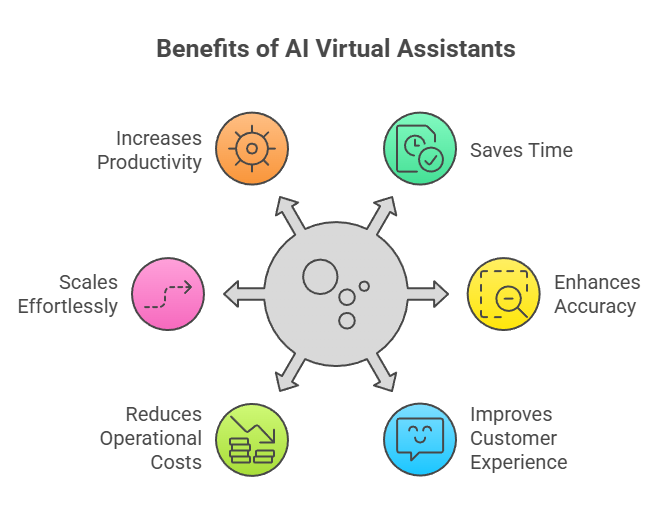
AI-powered assistants deliver measurable advantages by improving accuracy, reducing workloads, and increasing efficiency. These benefits apply across industries and business sizes, making AI assistants adaptable solutions for operational challenges.
1. Saves Time
The assistant automates repetitive tasks, reducing manual effort and freeing time for higher-level strategy. Users regain hours lost to administrative work and routine communication. This time savings leads to more efficient operations and improved focus.
2. Enhances Accuracy
AI reduces the likelihood of miscommunication, scheduling errors, and manual data-entry mistakes. Its consistency ensures predictable and reliable task execution. High accuracy helps organizations maintain professionalism and operational reliability.
3. Improves Customer Experience
Customers receive immediate responses, faster issue resolution, and consistent communication. This responsiveness enhances satisfaction and loyalty across support channels. Businesses benefit from reduced wait times and improved overall service quality.
4. Reduces Operational Costs
By automating tasks normally handled by staff, AI reduces staffing needs and administrative expenses. Organizations save resources by minimizing repetitive work and optimizing workforce allocation. Over time, these cost reductions support scalable growth.
5. Scales Effortlessly
AI assistants handle increased workloads without additional team members or infrastructure. As demand rises, the assistant maintains performance and responsiveness. This scalability supports business expansion and peak-period productivity.
6. Increases Productivity
By organizing workflows and accelerating task completion, AI enhances day-to-day operational output. Users complete tasks faster and with fewer interruptions. This creates a highly efficient environment conducive to business growth.
AI-Powered Virtual Assistant vs. Human Virtual Assistant
Both AI-powered and human assistants contribute unique strengths to organizational operations. Together, they form a hybrid model that combines automation with strategic thinking. The table below highlights their comparative roles and functional differences.
| Feature | AI-Powered Virtual Assistant | Human Virtual Assistant |
|---|---|---|
| Availability | 24/7 | Business hours only |
| Cost | Low ongoing cost | Higher monthly rates |
| Skills | Automation, data processing | Creative, strategic thinking |
| Personal Interaction | Limited | High |
| Scalability | Instant | Slower |
| Error Rate | Very low | Moderate |
Who Uses AI-Powered Virtual Assistants?
AI virtual assistants are implemented across industries and organizational models due to their adaptability. They support small businesses, large enterprises, creatives, and customer service teams. Their flexibility makes them suitable for a wide range of operational needs.
1. Small Businesses
Small businesses use AI assistants to reduce administrative burdens and streamline daily operations. These assistants automate scheduling, communication, and basic data management tasks. This helps business owners maintain focus on growth and strategy.
2. Corporations
Larger organizations deploy AI assistants for workflow automation, customer support, and large-scale data processing. They help teams operate efficiently across departments and time zones. The automation improves consistency in enterprise operations.
3. E-Commerce Stores
Online retailers use assistants to manage product questions, order status updates, and customer inquiries. The assistant delivers fast and accurate responses across digital channels. This improves customer satisfaction and reduces support workload.
4. Marketing Teams
Marketing teams rely on AI to produce content, analyze performance metrics, and manage scheduling. These assistants handle repetitive creative tasks and automate routine reporting. This enables marketers to focus on campaign strategy and innovation.
5. Entrepreneurs
Entrepreneurs use AI assistants for email management, reminders, planning, and daily task automation. The assistant acts as a personal organizer who simplifies decision-making. This helps individuals operate efficiently without additional staff.
6. Customer Service Departments
AI assistants support service teams by handling basic inquiries and triaging support cases. They provide instant responses that reduce wait times and improve service quality. This allows human agents to focus on complex or high-priority issues.
How to Use an AI-Powered Virtual Assistant
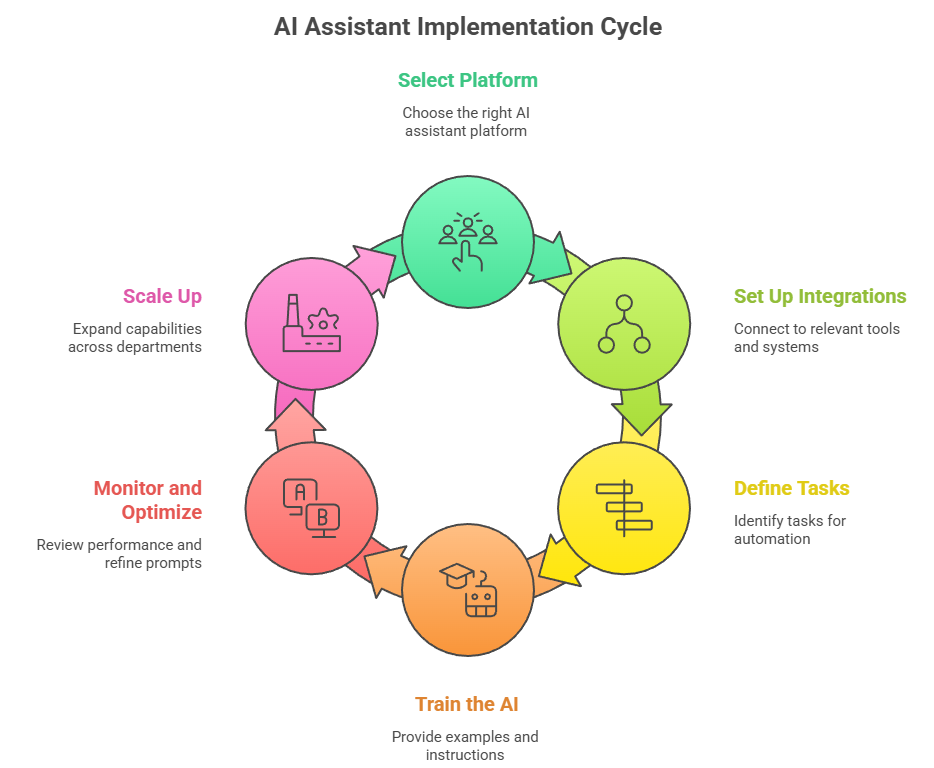
Implementing an AI-powered assistant involves selecting a platform, configuring tools, training the system, and optimizing performance. These steps help organizations ensure that the assistant works effectively and aligns with operational needs.
Step 1: Select an AI Assistant Platform
Users begin by choosing a platform suited to their workflow, such as ChatGPT, Google Assistant, or specialized enterprise tools. The selection process should consider ease of use, integration options, and scalability. Choosing the right platform ensures a strong foundation for automation.
Step 2: Set Up Integrations
The assistant becomes more powerful when connected to CRMs, calendars, communication tools, or project management systems. Integrations enable the assistant to retrieve data, schedule tasks, and update records automatically. This connectivity creates seamless workflows across tools.
Step 3: Define Tasks
Users identify tasks for automation such as emails, scheduling, research, or customer responses. Defining tasks clearly helps the assistant perform with accuracy and consistency. This structure ensures the assistant aligns with user priorities.
Step 4: Train the AI
Training includes providing examples, preferred formats, and workflow instructions. This guidance helps the assistant learn user-specific terminology, preferences, and task structures. Training improves accuracy and personalization over time.
Step 5: Monitor and Optimize
Users review the assistant’s performance and refine prompts or workflows as needed. Monitoring ensures that automation remains aligned with operational goals. Optimization strengthens accuracy and efficiency.
Step 6: Scale Up
Once initial tasks are automated effectively, additional workflows can be added. Scaling expands the assistant’s capabilities across departments or business units. This growth enhances productivity and operational efficiency.
Limitations of AI-Powered Virtual Assistants
While AI-powered assistants deliver significant benefits, they also face limitations in creativity, emotional intelligence, and data governance. Understanding these limitations helps businesses determine where human involvement is necessary. A balanced approach ensures productivity without sacrificing quality or security.
1. Limited Creative Judgment
AI performs well with structured content but may struggle with deep strategic thinking or emotional nuance. Complex creative decisions often require human insight that AI cannot replicate fully. As a result, human oversight remains essential for high-stakes creative tasks.
2. Requires Proper Training
The assistant depends on clear instructions, examples, and feedback to function effectively. Insufficient training can lead to inaccuracies or misunderstandings. Continuous refinement ensures the assistant remains aligned with user expectations.
3. Data Privacy Concerns
Businesses handling sensitive information must implement secure AI systems to prevent unauthorized access. Data protection regulations require careful oversight of how information is stored and processed. Security measures ensure trust and compliance.
4. Not Ideal for Complex Human Interactions
AI lacks emotional awareness, empathy, and real-time judgment needed for certain interpersonal situations. Tasks requiring human sensitivity may not be suitable for automation. Human involvement ensures quality in relationship-driven interactions.
TaskVirtual: Your Partner in AI-powered Assistant Service

Managing daily tasks like online grocery shopping, scheduling deliveries, and staying on top of household essentials can often feel overwhelming. From navigating multiple apps to ensuring timely orders, the process can consume valuable time that could be better spent on work or personal priorities. TaskVirtual simplifies this experience by offering an AI-powered Virtual Assistant tailored to managing grocery orders, coordinating deliveries, and organizing all your online shopping needs efficiently.
1. Expert Consultation and Review
TaskVirtual’s skilled virtual assistants help you select the best grocery delivery platforms, organize and refine shopping lists, and ensure timely order placement. They assist with managing preferences, substitutions, and recurring orders so your essentials are always available. This expertise creates a smoother and more reliable online shopping experience.
2. Affordable and Flexible Pricing
Hiring a full-time personal assistant can be costly, but TaskVirtual offers a budget-friendly alternative. With pricing plans ranging from $3.12/hour to $14.99/hour, their services are accessible for individuals, families, entrepreneurs, and businesses. This flexibility ensures you receive high-quality assistance at a cost that fits your budget.
3. Comprehensive Grocery Support Solutions
TaskVirtual provides end-to-end grocery management, from creating smart shopping lists to comparing prices and managing subscriptions. Their assistants can track recurring needs, coordinate multi-platform orders, and ensure timely restocking. Whether you need occasional support or consistent management, their services scale to meet your lifestyle.
4. Ongoing Support and Quality Assurance
Beyond order placement, TaskVirtual provides continuous updates, reminders, and delivery monitoring to ensure every order meets expectations. Their proactive approach minimizes delays, prevents missed deliveries, and ensures every household requirement is handled smoothly. This commitment provides peace of mind and consistent quality.
5. Proven Track Record of Excellence
With 364 positive reviews and an impressive 4.7-star rating on leading virtual assistant platforms, TaskVirtual is recognized globally for reliability and professionalism. Clients trust their expertise to simplify daily routines, streamline online tasks, and deliver dependable support every time.
Final Thoughts on AI-Powered Virtual Assistants
AI-powered virtual assistants represent a major advancement in operational efficiency by combining automation, intelligence, and real-time responsiveness. These systems reduce costs, optimize workflows, and support business growth across industries. As organizations integrate AI more deeply, these assistants will become essential tools for long-term success and competitive advantage.
FAQ: AI-Powered Virtual Assistants
1. What is an AI-powered virtual assistant?
An AI-powered virtual assistant is a digital system that uses artificial intelligence to automate tasks, provide support, and increase productivity. It performs activities such as scheduling, communication, content generation, and data processing. These assistants operate continuously and adapt to user preferences.
2. Can AI replace human virtual assistants?
AI can automate repetitive and structured work but cannot fully replace tasks requiring emotional intelligence or strategic thinking. Both roles work best when combined. Together, they create a balanced workflow blending automation with human insight.
3. Is an AI assistant expensive?
Most AI assistant platforms offer free or low-cost entry plans with scalable upgrades. Costs remain significantly lower than hiring full-time administrative staff. This affordability makes AI accessible to businesses of all sizes.
4. What tasks can AI automate?
AI can automate emails, reminders, scheduling, customer inquiries, research, document handling, and content creation. It handles repetitive tasks quickly and accurately. This automation saves time and reduces administrative pressure.
5. Does AI learn over time?
Yes, AI systems improve through machine learning based on interactions and user behavior. They refine responses and adapt to preferences automatically. This leads to increased accuracy and smoother performance.
 Siddhartha Basu is a Technical Writer at Task Virtual. He loves online games, e-book reading, and Yoga.