Contents
show
What Is an AI Marketing Agency
An AI marketing agency is a modern digital marketing partner that integrates artificial intelligence, automation, and advanced data analytics into every stage of marketing strategy and execution. Rather than operating on intuition or static reports, these agencies use AI systems to analyze large datasets, predict outcomes, personalize customer interactions, and optimize campaigns continuously. The result is marketing that is faster to deploy, more precise in targeting, and measurably aligned with business growth, revenue, and return on investment.
What Is an AI Marketing Agency?
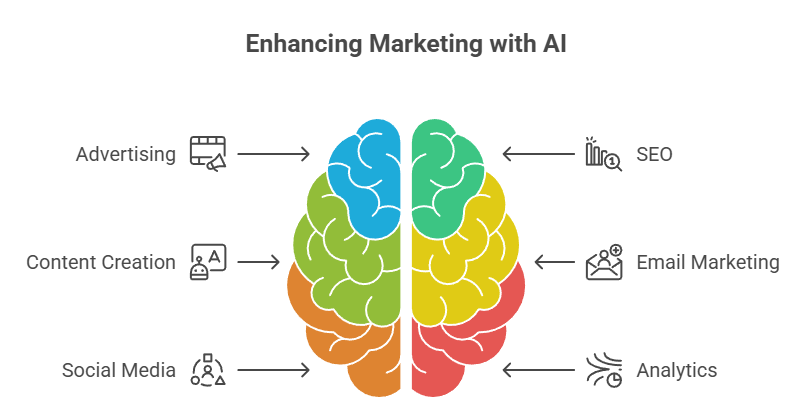
An AI marketing agency leverages artificial intelligence to enhance traditional marketing services such as advertising, SEO, content creation, email marketing, social media, and analytics.
Instead of relying solely on manual processes, AI marketing agencies use machine learning, predictive analytics, automation, and AI-powered tools to make marketing faster, smarter, and more measurable.
The goal is not to replace marketers, but to augment human expertise with AI-driven insights and execution.
How an AI Marketing Agency Works
AI marketing agencies operate at the intersection of technology, data, and strategy, using advanced systems to turn complex marketing information into actionable outcomes. They collect and analyze large volumes of marketing data to identify customer behavior patterns, automate repetitive operational tasks, and optimize campaigns in real time helping organizations achieve measurable performance improvements, as companies leveraging AI for customer targeting report up to 40 % higher conversion rates than those using traditional tactics. AI also delivers personalized experiences at scale, while human marketers retain control over strategy, creativity, and high-level decision-making.
Core Services Offered by an AI Marketing Agency
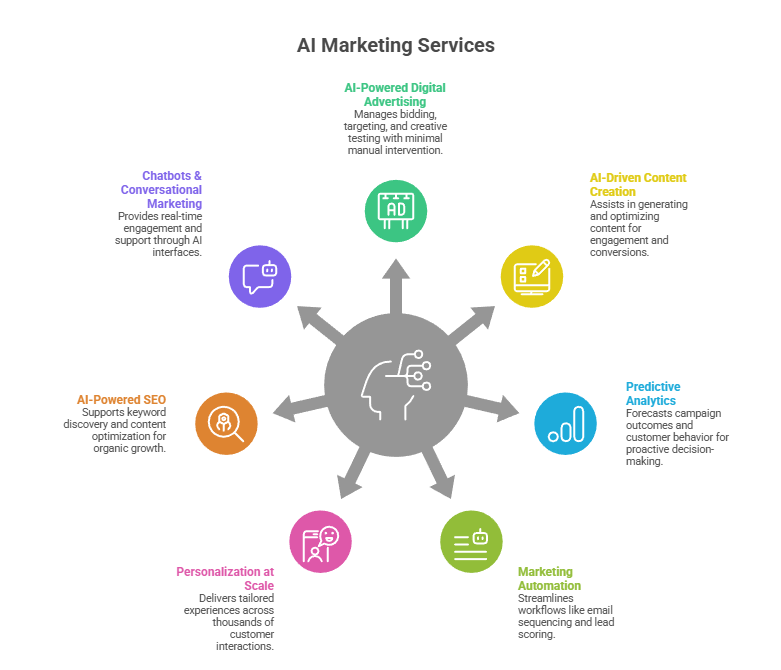
Most AI marketing agencies provide a comprehensive set of services that mirror traditional digital marketing, but with AI embedded at every stage. These services are structured to improve efficiency, accuracy, and scalability across channels.
At a foundational level, agencies analyze data from multiple touchpoints to understand audience behavior, automate execution across platforms to reduce manual workload, and continuously optimize performance using predictive and real-time analytics. This integrated approach allows campaigns to evolve dynamically based on performance signals rather than static plans.
1. AI-Powered Digital Advertising
AI-powered digital advertising relies on machine learning models to manage bidding strategies, audience targeting, and creative testing with minimal manual intervention. These systems automatically identify high-intent users, allocate budgets toward top-performing segments, and adjust bids and placements in real time to reduce wasted spend. Human teams oversee campaign objectives and messaging, while AI ensures efficiency, speed, and performance optimization at scale.
2. AI-Driven Content Creation & Optimization
AI-driven content creation tools assist marketers by generating structured drafts, headline variations, ad copy options, and email subject lines based on performance data and audience preferences. These systems also analyze how content performs across channels and recommend optimizations to improve engagement and conversions. Human editors refine tone, accuracy, and brand voice, ensuring that content remains authentic and strategically aligned.
3. Predictive Analytics & Data Insights
Predictive analytics uses historical and real-time data to forecast campaign outcomes, customer behavior, and conversion probability, enabling teams to anticipate results rather than react to past performance. Studies show that predictive analytics can boost marketing ROI by up to 53 % by improving targeting and resource allocation, helping businesses identify potential churn risks, high-value leads, and funnel bottlenecks before they impact results. This capability enables marketers to make proactive decisions, allocate resources more effectively, and reduce uncertainty in planning, ensuring campaigns are both efficient and strategically aligned.
4. Marketing Automation
Marketing automation powered by AI streamlines workflows such as email sequencing, lead scoring, CRM updates, and customer segmentation. These systems respond dynamically to user behavior, triggering personalized follow-ups and nurturing paths without manual intervention. Automation increases operational efficiency while maintaining consistency across the customer journey.
5. Personalization at Scale
AI enables personalization across thousands or millions of customer interactions simultaneously. By analyzing behavior, preferences, and intent signals, agencies can deliver tailored ads, dynamic website experiences, customized email messaging, and relevant product recommendations. This level of personalization improves engagement, conversion rates, and customer lifetime value without increasing marketing overhead.
6. SEO & Search Optimization Using AI
AI-powered SEO tools support keyword discovery, search intent analysis, content optimization, and competitive gap analysis. These systems process large datasets to identify ranking opportunities and recommend structural or content-level improvements. Human SEO strategists validate insights and guide execution to ensure sustainable, compliant organic growth.
7. Chatbots & Conversational Marketing
AI-driven chatbots and conversational interfaces provide real-time engagement across websites, messaging platforms, and customer support channels. They can answer common questions, qualify leads, schedule appointments, and route complex inquiries to human teams. This improves response times, enhances customer experience, and reduces operational costs.
Benefits of Hiring an AI Marketing Agency
Hiring an AI marketing agency allows businesses to move from reactive marketing to proactive, intelligence-led growth. These agencies combine automation, analytics, and human strategy to improve efficiency without sacrificing control or creativity. The result is marketing that is faster to execute, easier to scale, and more tightly aligned with measurable business outcomes.
1. Improved Performance and ROI
AI marketing agencies continuously optimize campaigns using real-time data rather than relying on periodic manual reviews. This enables faster identification of what is working, what is underperforming, and where budgets should be reallocated. Over time, this approach reduces wasted spend and delivers more consistent, predictable returns on investment.
2. Operational Efficiency and Speed
Automation significantly reduces the manual workload associated with campaign execution, reporting, and optimization. By handling repetitive tasks such as bid adjustments, segmentation, and workflow triggers, AI allows marketing teams to operate faster with fewer resources. This efficiency shortens time-to-market while maintaining accuracy and consistency across channels.
3. Scalable, Data-Driven Growth
AI marketing agencies make it possible to scale campaigns without a proportional increase in cost or headcount. Advanced targeting, personalization, and predictive analytics ensure that growth is guided by data rather than assumptions. This enables businesses to expand confidently while maintaining performance quality and strategic clarity.
AI Marketing Agency vs Traditional Marketing Agency
| Feature | AI Marketing Agency | Traditional Marketing Agency |
|---|---|---|
| Technology Use | High (AI & automation) | Low to moderate |
| Optimization Speed | Real-time | Periodic |
| Personalization | Advanced | Limited |
| Data Analysis | Predictive | Historical |
| Efficiency | High | Moderate |
| Scalability | Easy | Resource-heavy |
Who Should Work With an AI Marketing Agency?
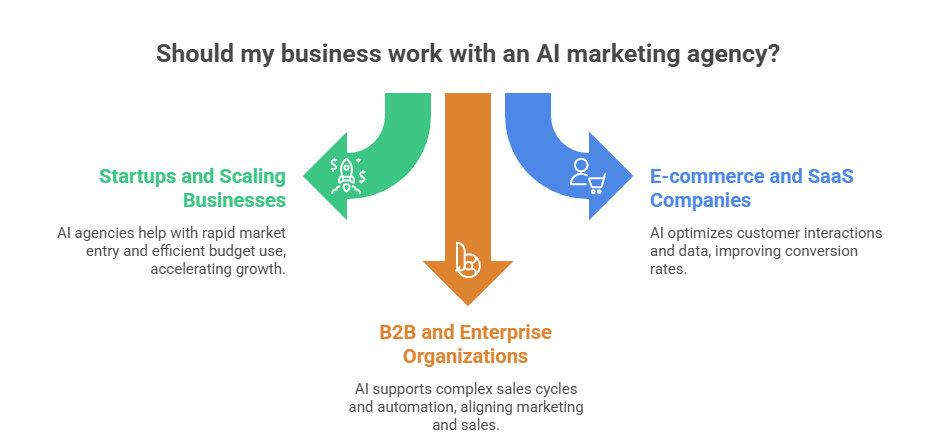
AI marketing agencies are best suited for organizations that rely on data, scale, and measurable performance to drive growth. They support businesses that need advanced targeting, personalization, and optimization without building large internal teams. Companies operating in competitive or fast-moving digital markets benefit most from this model.
1. Startups and Scaling Businesses
Startups and growing companies often need rapid market entry and efficient use of limited budgets. AI marketing agencies help these organizations test, optimize, and scale campaigns quickly using data-driven insights. This approach reduces risk while accelerating growth and learning cycles.
2. E-commerce and SaaS Companies
E-commerce and SaaS businesses manage high volumes of customer interactions and performance data. AI enables precise audience segmentation, personalized messaging, and continuous funnel optimization. This leads to improved conversion rates, retention, and lifetime value.
3. B2B and Enterprise Organizations
B2B and enterprise organizations typically operate complex sales cycles and manage large datasets. AI marketing agencies support these needs through predictive analytics, account-based targeting, and automation at scale. This improves alignment between marketing, sales, and revenue objectives.
Limitations of AI Marketing Agencies
While AI marketing agencies provide efficiency and performance gains, they are not a standalone solution. Their effectiveness depends on data quality, strategic clarity, and proper human oversight. Understanding these limitations is essential for realistic expectations and long-term success.
1. Dependence on Data Quality
AI systems rely heavily on accurate, complete, and well-structured data. Poor data quality can lead to incorrect insights, ineffective targeting, and suboptimal optimization decisions. Continuous data management and validation are therefore critical.
2. Limited Creative and Strategic Judgment
AI excels at analysis and optimization but cannot replace human creativity or strategic thinking. Brand storytelling, emotional resonance, and high-level decision-making still require experienced marketers. AI should be viewed as an augmentation tool rather than a creative replacement.
3. Setup, Learning Curve, and Oversight
Implementing AI-driven marketing requires an initial setup period and ongoing oversight, as teams must invest time in configuration, training, and interpretation of insights to ensure systems function as intended. According to industry research, only about 30 % of organizations have clear AI governance or oversight policies in place, underscoring the need for deliberate planning and human supervision to avoid unintended consequences from automation. Without proper governance, automation can amplify inefficiencies rather than resolve them, making structured oversight and periodic review essential for long-term success.
How to Choose the Right AI Marketing Agency

Selecting the right AI marketing agency is a strategic decision that impacts long-term growth and performance. Businesses must evaluate both technical capability and strategic alignment. A balanced approach ensures AI is applied effectively and responsibly.
1. Proven Results and Case Studies
A credible AI marketing agency should demonstrate measurable results through real-world case studies. These examples should highlight performance improvements, scalability, and ROI. Proven outcomes indicate maturity and reliability.
2. Transparent Technology and Reporting
Agencies should clearly explain their AI tool stack, data usage, and optimization processes. Transparent reporting ensures stakeholders understand how decisions are made and results are achieved. This builds trust and accountability.
3. Strategic Leadership and Ethics
Strong agencies combine AI expertise with experienced strategic leadership. Ethical data practices, compliance awareness, and human oversight are non-negotiable. This ensures sustainable growth without reputational or regulatory risk.
TaskVirtual: Supporting AI-Driven Marketing Operations Through Virtual Assistance

AI-powered marketing requires not only advanced tools, but also disciplined execution, coordination, and operational support. Managing dashboards, campaign assets, reporting workflows, CRM updates, and day-to-day marketing tasks can consume valuable time that teams should spend on strategy and growth. TaskVirtual supports AI marketing initiatives by providing reliable virtual assistance that helps businesses stay organized, responsive, and execution-ready.
1. Marketing Operations and Execution Support
TaskVirtual’s trained virtual assistants help manage recurring marketing tasks such as campaign coordination, reporting preparation, CRM updates, and workflow monitoring. By handling operational responsibilities, they allow marketing leaders and AI systems to function more effectively without operational bottlenecks. This support ensures consistency, accuracy, and smoother execution across AI-driven marketing processes.
2. Affordable and Flexible Engagement Models
Building an in-house support team can be costly and inflexible, especially for growing businesses. TaskVirtual offers scalable virtual assistance services with pricing plans ranging from $3.12/hour to $14.99/hour, making professional support accessible across different business sizes. This flexibility allows companies to align support costs directly with marketing activity and growth stages.
3. Scalable Support for Growing Marketing Teams
As AI marketing efforts expand, operational demands increase alongside campaign volume and data complexity. TaskVirtual adapts to these needs by providing ongoing assistance that scales with business growth. Whether supporting a lean startup team or an established marketing department, their services adjust without disrupting workflows.
4. Ongoing Reliability and Quality Assurance
TaskVirtual emphasizes consistency, responsiveness, and accountability in daily operations. Their virtual assistants provide regular updates, follow established processes, and ensure tasks are completed accurately and on time. This reliability supports smoother collaboration between human teams and AI-powered marketing systems.
5. Proven Trust and Client Satisfaction
With 364 positive reviews and an average 4.7-star rating across trusted virtual assistant platforms, TaskVirtual has established a strong reputation for dependable service. Businesses rely on their expertise to reduce operational friction and maintain focus on strategic, high-impact marketing activities.
Final Answer: What Is an AI Marketing Agency?
An AI marketing agency is a digitally focused marketing partner that integrates artificial intelligence into strategy, execution, and optimization to deliver measurable business results. By combining AI-driven analytics, automation, and predictive modeling with human creativity and oversight, these agencies help businesses market more efficiently, personalize customer experiences, and scale growth without sacrificing control or brand integrity. Rather than replacing marketers, AI marketing agencies enhance decision-making, improve performance consistency, and enable organizations to compete effectively in increasingly complex digital markets.
FAQ: AI Marketing Agency
1. Do AI marketing agencies replace marketers?
No. They enhance marketer productivity and decision-making.
2. Are AI marketing agencies expensive?
Costs vary, but efficiency often reduces overall marketing spend.
3. Can small businesses use AI marketing agencies?
Yes. Many agencies offer scalable packages for small teams.
4. Is AI marketing safe and compliant?
Yes, when agencies follow data privacy and ethical standards.
5. Does AI guarantee better marketing results?
AI improves performance, but strategy and execution still matter.
 Siddhartha Basu is a Technical Writer at Task Virtual. He loves online games, e-book reading, and Yoga.