

Contents
show
Is a Real Estate VA Worth the Investment?
Hiring a Real Estate Virtual Assistant is a strategic move for real estate professionals who want to scale without increasing personal workload. A VA helps streamline operations, improve lead management, and enhance client communication across the business. When implemented with clear systems and expectations, the value created often exceeds the cost of hiring.
What Does “Worth the Investment” Mean in Real Estate?
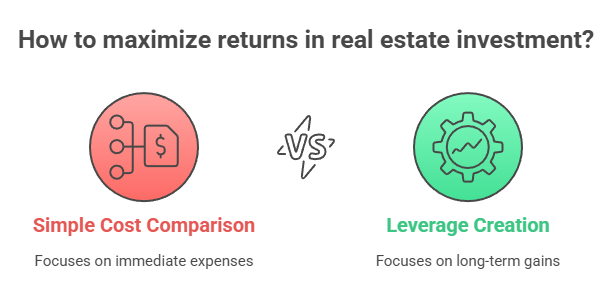
In real estate, determining whether something is worth the investment goes beyond simple cost comparison. It focuses on whether the investment creates leverage by increasing output, efficiency, and revenue without proportionally increasing effort. According to Deloitte, around 70% of businesses report cost savings and improved efficiency by outsourcing non-core tasks, showing how delegation can drive measurable business performance improvements.
From a business perspective, worth the investment means improved performance indicators such as faster response times, higher conversion rates, better client experience, and more consistent closings. When a VA enables an agent to focus on negotiations, listings, and relationship-building instead of administrative work, the financial and operational returns become clearer and more sustainable over time.
What a Real Estate VA Typically Does
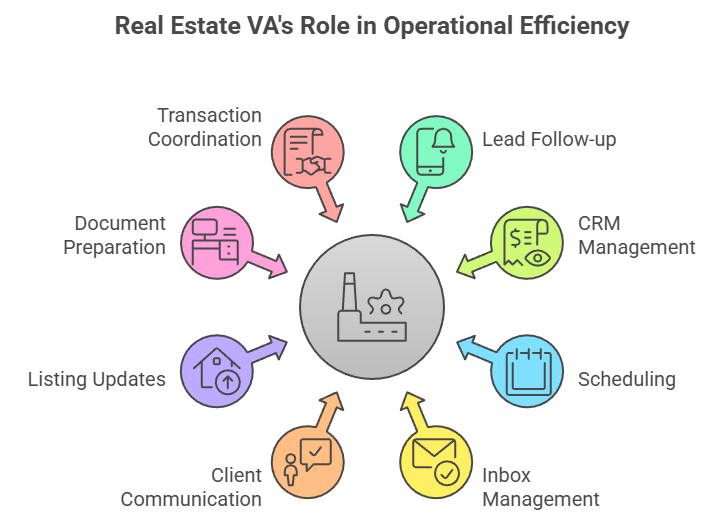
This section explains the functional role of a real estate VA and how their responsibilities support daily operations. A VA is designed to absorb repetitive and time-consuming tasks so the agent can operate at a higher strategic level. Their work creates structure, consistency, and reliability across workflows.
1. Lead follow-up and CRM management
A real estate VA ensures leads are contacted promptly, logged correctly, and nurtured consistently. This reduces missed opportunities and creates a more predictable pipeline. Accurate CRM data also improves reporting and long-term decision-making.
2. Scheduling, inbox, and client communication
By managing calendars and responding to routine inquiries, a VA keeps communication timely and professional. Clients and prospects receive faster responses, which builds trust and credibility. This also reduces daily interruptions for the agent.
3. Listings, documents, and transaction support
A VA can handle listing updates, document preparation, and transaction coordination tasks with proper training. This keeps files organized, deadlines tracked, and processes moving smoothly. Over time, this support significantly reduces operational friction.
Key Benefits of Hiring a Real Estate VA

This section outlines the primary advantages of adding a VA to a real estate business. The benefits extend beyond convenience and directly impact productivity, revenue, and sustainability. Each benefit compounds when systems and delegation are aligned.
1. Time savings and focus
Delegating administrative work allows agents to concentrate on selling and relationship-building. Reduced task-switching improves focus and efficiency throughout the day. Most professionals experience meaningful time relief within weeks.
2. Cost efficiency compared to in-house staff
A VA provides flexible support without the overhead of full-time employment. There are no costs for office space, benefits, or long-term contracts. This makes scaling more financially controlled and predictable.
4. Stronger lead follow-up and conversion
Consistent and timely follow-up increases engagement and conversion rates. A VA ensures no inquiry is overlooked or delayed. This directly supports revenue growth and pipeline stability.
Situations When a Real Estate VA Is Most Worth It
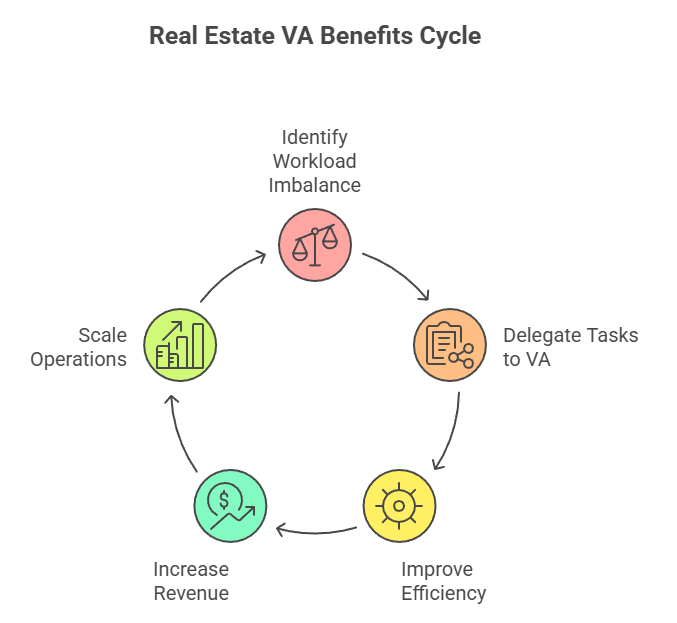
This section identifies scenarios where hiring a VA delivers the highest return. These conditions typically indicate a mismatch between workload and available capacity. In such cases, delegation becomes a growth enabler.
1. Admin work outweighs selling time
When paperwork, emails, and scheduling dominate the day, revenue-producing activities suffer significantly. A McKinsey Global Institute study found that professionals spend up to 60% of their workweek on administrative coordination and routine tasks, leaving limited time for high-value activities like prospecting and deal negotiations. A VA restores balance by removing these low-value responsibilities, allowing agents to refocus on closing opportunities and growing revenue.
2. High lead volume with inconsistent follow-up
Businesses generating many leads often lose opportunities due to delayed responses. A VA introduces consistency and speed into lead handling. This improves conversion outcomes without increasing agent workload.
3. Need to scale without full-time hires
A VA is ideal for growth without long-term staffing commitments. Hours can be adjusted as demand fluctuates. This flexibility supports sustainable expansion.
When It Might Not Be Worth It Yet
This section addresses situations where hiring a VA may be premature. Timing and readiness are critical to achieving positive ROI. Without the right foundation, delegation can create friction instead of value.
1. Very low business volume
Early-stage agents with minimal leads may not generate enough work to justify a VA. In these cases, focusing on sales skills and lead generation is more effective. Support can be added once volume increases.
2. Lack of systems or SOPs
Without documented processes, onboarding a VA becomes inefficient. Tasks take longer to explain, and results vary. Establishing basic workflows first improves future success.
3. High personal efficiency with low stress
If an agent can manage tasks comfortably without distraction, immediate delegation may not be necessary. Automation tools can serve as interim support. A VA can be introduced later as complexity grows.
How to Measure ROI of a Real Estate VA

This section explains how to evaluate whether a VA is delivering measurable value. ROI should be tracked using both quantitative and qualitative indicators. Regular review ensures the investment remains justified.
1. Time saved versus earning potential
Calculate hours delegated and multiply by your effective hourly revenue. When saved time is reinvested into sales activities, the financial impact becomes visible. This is often the fastest ROI indicator.
2. Lead response and conversion metrics
Compare response times and conversion rates before and after hiring a VA. Faster engagement typically improves lead quality and appointment rates. These metrics directly reflect operational improvement.
3. Closed deals and client satisfaction
An increase in transactions, referrals, and positive feedback indicates downstream impact. When service improves alongside reduced workload, the VA’s value is clear. ROI should trend upward over time.
4. Common Concerns & Solutions
This section addresses typical hesitations about hiring a real estate VA. Most concerns are operational rather than capability-based. With proper management, these challenges are manageable.
5. Lack of real estate knowledge
Most VAs can learn industry-specific tasks with structured training. Clear SOPs and examples accelerate onboarding. Knowledge gaps close quickly with repetition.
6. Communication and time zone differences
Regular check-ins and written instructions reduce misunderstandings. Shared tools improve visibility and alignment. Consistency matters more than location.
7. Fear that costs outweigh benefits
Starting with high-impact tasks minimizes risk. Proving value early builds confidence. Responsibilities can expand once ROI is demonstrated.
How to Get the Most Value from a Real Estate VA
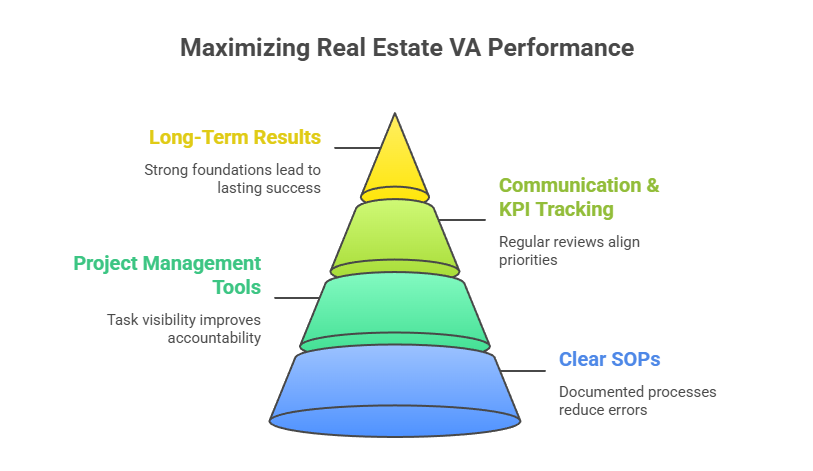
This section focuses on best practices for maximizing VA performance. Effective delegation requires planning, communication, and gradual responsibility growth. Strong foundations lead to long-term results.
1. Clear SOPs and expectations
Documented processes reduce errors and dependency. A VA can work independently with confidence. This improves consistency and efficiency.
2. Use of project management tools
Task visibility improves accountability and prioritization. Tools help track progress and deadlines. This creates smoother collaboration.
3. Ongoing communication and KPI tracking
Regular reviews align priorities and refine workflows. Metrics highlight strengths and improvement areas. Trust grows as performance stabilizes.
TaskVirtual: Your Partner in Real Estate Virtual Assistance

Managing leads, follow-ups, listings, and client communication can quickly overwhelm even experienced real estate professionals. Juggling multiple platforms, inquiries, and transactions often pulls agents away from closing deals and building relationships. TaskVirtual provides specialized Real Estate Virtual Assistant Services that help streamline operations, improve responsiveness, and support business growth with consistency and reliability.
1. Expert Real Estate VA Support
TaskVirtual’s trained virtual assistants support real estate professionals with lead follow-up, CRM updates, scheduling, listing coordination, and transaction-related tasks. They work within your systems and processes to ensure no opportunity is missed and daily operations run smoothly.
2. Affordable and Flexible Pricing
Hiring in-house staff can be costly, but TaskVirtual offers a cost-effective alternative. Pricing plans range from $3.12/hour to $14.99/hour, making professional VA support accessible to solo agents, teams, and brokerages at every growth stage.
3. Comprehensive Real Estate Support Solutions
From managing inbound leads and maintaining CRM accuracy to assisting with listings and documentation, TaskVirtual delivers end-to-end operational support. Their services scale easily, whether you need part-time assistance or ongoing full-time VA support.
4. Ongoing Support and Quality Assurance
TaskVirtual emphasizes consistent communication, performance tracking, and quality control. Regular updates and proactive task management ensure workflows stay aligned with your business goals and service standards.
5. Proven Track Record of Excellence
With 364 positive reviews and a 4.7-star rating on trusted VA platforms, TaskVirtual is recognized globally as a dependable virtual assistant provider. Real estate professionals rely on their expertise to save time, improve efficiency, and scale with confidence.
Final Verdict: Is a Real Estate VA Worth the Investment?
For most real estate professionals, hiring a VA is a worthwhile investment when implemented correctly. The combination of time leverage, operational consistency, and scalability creates long-term business value. Financial returns are often accompanied by reduced stress and improved focus.
The deciding factor is not whether VAs work, but how they are integrated. With clear systems, expectations, and performance tracking, a real estate VA becomes a strategic asset rather than an expense.
FAQ: Is a Real Estate VA Worth the Investment?
1. What tasks should be delegated first?
Start with lead follow-up, CRM updates, scheduling, and inbox management. These tasks produce quick and visible ROI. They also build trust early.
2. How soon can ROI be seen?
Many professionals see improvements within weeks. Faster response times are often the first indicator. Revenue impact follows with consistency.
3. Can a VA increase revenue?
Yes, by freeing time for sales and improving lead nurture. Better follow-up directly supports higher conversions. The effect compounds over time.
4. Is training required?
Some training is necessary, especially for systems and expectations. Clear documentation shortens ramp-up time. Training is an investment, not a cost.
5. How are real estate VAs typically paid?
Common options include hourly, part-time, full-time, or task-based pricing. The best model depends on workload and growth goals.
 Siddhartha Basu is a Technical Writer at Task Virtual. He loves online games, e-book reading, and Yoga.