Contents
show
How to Generate Leads From Facebook for Real Estate
You can generate real estate leads from Facebook by strategically combining Facebook Lead Ads, conversion-focused campaigns, precise local targeting, compelling value-driven offers, and fast follow-up systems; when these elements are supported by strong ad creatives, accurate tracking, and retargeting, Facebook becomes a scalable and cost-effective channel for consistently attracting buyers, sellers, renters, and investors — in fact, real estate Facebook ads tend to achieve an average conversion rate of around 10.7%, indicating strong lead generation performance compared with many other industries.
What Is Lead Generation in the Real Estate Market

Lead generation in the real estate market refers to the systematic process of attracting and capturing contact information from individuals who have shown interest in buying, selling, renting, or investing in property. It focuses on identifying potential clients early in their decision-making journey and nurturing them until they are ready to transact. Effective lead generation combines targeted marketing, value-driven offers, and consistent follow-up to convert interest into qualified prospects. In today’s digital-first environment, platforms like Facebook play a central role in connecting real estate professionals with local audiences at scale.
The Steps Needed to Perform the Lead Generation From Facebook
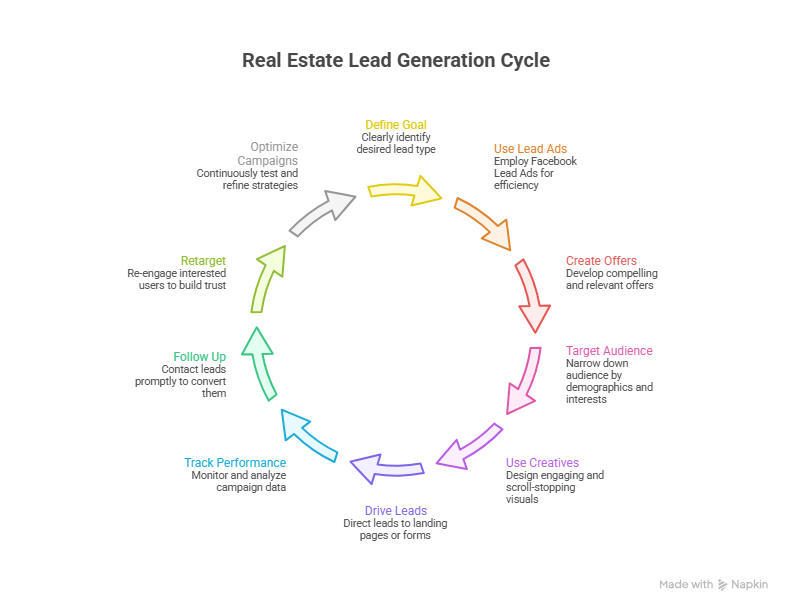
Generating leads from Facebook is not a single action but a structured, repeatable process that aligns campaign goals, audience targeting, ad creatives, and follow-up systems. Each step builds on the previous one to improve lead quality, reduce acquisition costs, and increase conversion rates over time.
Step 1: Define Your Real Estate Lead Goal
The first step in Facebook lead generation is clearly defining the type of lead you want to generate, such as home buyers, home sellers, renters, investors, or open house attendees. This clarity allows Facebook’s algorithm to optimize ad delivery toward users most likely to complete your desired action. A well-defined goal also ensures that your messaging, offer, and follow-up process are aligned with the specific intent of the audience you are targeting.
Step 2: Use Facebook Lead Ads for Real Estate
Facebook Lead Ads are designed to reduce friction by allowing users to submit their information without leaving the platform, which significantly increases conversion rates on mobile devices. These ads work particularly well for buyer registrations, seller valuation requests, and open house sign-ups where simplicity drives results. By keeping forms short, using clear headlines, and setting proper expectations, agents can collect high volumes of leads efficiently while maintaining acceptable lead quality.
Step 3: Create High-Converting Real Estate Offers
The quality of your leads is directly tied to the strength and relevance of your offer. High-performing offers focus on solving a specific local problem, such as helping sellers understand their home value or giving buyers access to exclusive listings. When offers are hyper-local, clearly positioned, and immediately valuable, they attract prospects who are genuinely interested rather than casual browsers.
Step 4: Target the Right Local Audience
Facebook’s targeting capabilities allow real estate professionals to narrow their audience by geography, demographics, interests, and life events. Effective campaigns prioritize location-based targeting, layered with indicators such as household income, homeownership status, or recent moves, and advertisers who refine their audience segments can see up to 35% higher return on ad spend compared with untargeted campaigns, demonstrating the value of precise audience definition for performance and efficiency.
Step 5: Use Scroll-Stopping Real Estate Creatives
Ad creatives determine whether users stop scrolling and engage with your message. High-performing real estate ads typically feature property visuals, neighborhood imagery, short videos, or simple walkthroughs paired with clear local headlines. Strong creatives immediately communicate relevance and value, making it obvious why the viewer should click and what they will receive in return.
Step 6: Drive Leads to Landing Pages or Forms
You can capture Facebook leads using either native lead forms or external landing pages, depending on your objective. Lead forms are ideal for quick submissions and lower cost per lead, while landing pages are better suited for higher-intent actions such as seller consultations or investment inquiries. Regardless of the option, the experience must be mobile-optimized, simple, and focused on a single conversion goal.
Step 7: Set Up Tracking and Lead Management
Accurate tracking is essential for understanding what works and what does not. Implementing the Facebook Pixel, conversion events, and a CRM system allows you to measure cost per lead, conversion rates, and downstream performance such as appointments booked. Proper tracking enables data-driven decisions and prevents wasted spend on campaigns that generate volume without results.
Step 8: Follow Up Immediately With Leads
Speed to contact is one of the most critical factors in real estate lead conversion. Leads contacted within the first 5–10 minutes are significantly more likely to respond and book appointments. Combining automated emails, SMS messages, and prompt phone calls ensures that prospects feel attended to while their interest is still high.
Step 9: Use Retargeting to Improve Lead Quality
Retargeting allows you to re-engage users who have already interacted with your ads, videos, or website. These audiences are warmer and more familiar with your brand, which lowers acquisition costs and increases trust. Consistent retargeting reinforces credibility and helps move prospects from initial interest to action.
Step 10: Test, Optimize, and Scale Campaigns
Facebook lead generation success depends on continuous testing and optimization. By experimenting with different offers, creatives, targeting options, and copy, you can identify what consistently produces high-quality leads. Campaigns that meet your performance benchmarks can then be scaled gradually to increase volume without sacrificing efficiency.
Benefits of Generating Leads From Facebook

Generating leads from Facebook offers real estate professionals a unique combination of scale, precision, and affordability. Unlike traditional advertising, Facebook allows agents to reach highly specific local audiences while maintaining full control over budgets and messaging. When managed correctly, it becomes a predictable system rather than an unpredictable marketing expense.
1. Highly Targeted Local Reach
Facebook enables real estate professionals to target users based on exact locations, demographics, interests, and behaviors. This precision ensures that ads are shown to people who are most likely to buy or sell within a specific market. As a result, agents waste less budget on irrelevant audiences and generate more qualified leads.
2. Cost-Effective Lead Generation
Compared to traditional media and many other digital channels, Facebook often delivers lower cost per lead for real estate campaigns. The platform’s optimization algorithms continuously improve performance as more data is collected. This makes Facebook an accessible option for both new agents and established brokerages.
3. Scalable and Predictable Results
Once a campaign structure is proven, it can be scaled by increasing budgets or expanding audiences without rebuilding the entire system. Consistent testing and optimization allow agents to forecast lead volume and costs more accurately. This predictability supports long-term business planning and growth.
Common Mistakes to Avoid
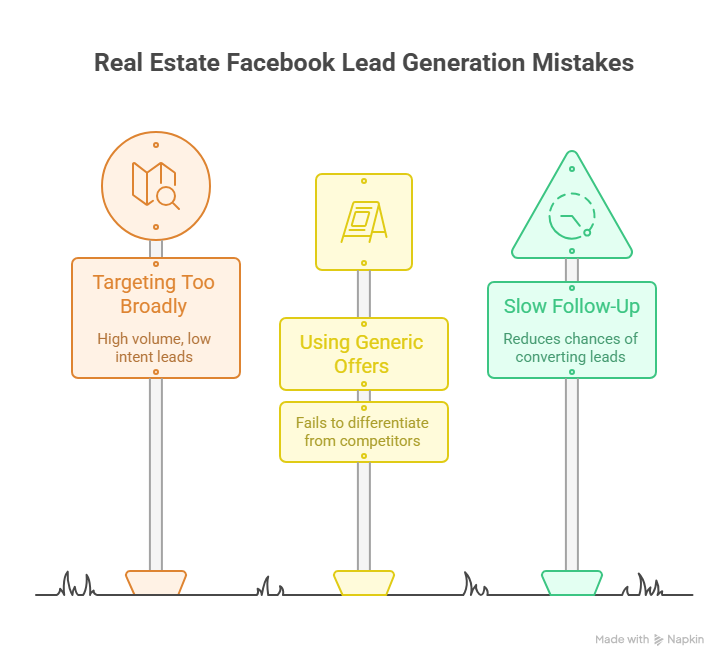
Many real estate agents struggle with Facebook lead generation not because the platform is ineffective, but because of avoidable strategic errors. Recognizing and correcting these mistakes improves both lead quality and overall return on investment. A disciplined approach prevents wasted ad spend and inconsistent results.
1. Targeting Too Broadly
Broad targeting often leads to high lead volume but low intent, resulting in unqualified prospects. Narrowing audiences based on location and relevant behaviors improves relevance and engagement. Precision targeting is essential for sustainable performance.
2. Using Generic Offers
Generic offers fail to differentiate your ads from competitors in the same market. Without a clear local angle or specific value proposition, users have little incentive to submit their information. Strong offers address a defined need and communicate immediate benefits.
3. Slow or Inconsistent Follow-Up
Delays in follow-up drastically reduce the chances of converting leads into appointments. Inconsistent communication creates a poor first impression and lowers trust. Fast, structured follow-up systems are non-negotiable for success.
TaskVirtual: Your Partner in Real Estate Lead Generation Support

Managing Facebook lead generation for real estate requires constant attention, from setting up campaigns and monitoring performance to responding quickly to incoming leads. For busy agents and brokerages, handling these tasks alongside showings, negotiations, and client meetings can become overwhelming. TaskVirtual provides dedicated virtual assistant services designed to support real estate professionals by managing lead generation workflows, organizing prospect data, and ensuring no opportunity is missed.
1. Expert Lead Management and Campaign Support
TaskVirtual’s trained virtual assistants help manage Facebook lead forms, organize incoming inquiries, and ensure leads are routed correctly into your CRM. They assist with monitoring ad performance, tracking responses, and maintaining clean lead records so agents can focus on closing deals rather than administrative work.
2. Affordable and Flexible Pricing
Hiring in-house staff for lead management and marketing support can be costly, especially for growing real estate teams. TaskVirtual offers flexible pricing plans starting from just $3.12/hour to $14.99/hour, making professional virtual assistance accessible for solo agents, teams, and brokerages without long-term overhead.
3. End-to-End Real Estate Support Solutions
From handling lead follow-ups and appointment scheduling to managing email responses and updating databases, TaskVirtual provides comprehensive support aligned with real estate lead generation needs. Their services scale easily, whether you require part-time assistance or ongoing daily support for high-volume campaigns.
4. Consistent Follow-Up and Quality Control
TaskVirtual ensures timely responses to Facebook leads, helping improve contact rates and appointment bookings. Their structured workflows and quality checks help maintain professionalism and consistency across all lead interactions, reinforcing trust with potential clients.
5. Proven Reliability and Client Satisfaction
With 364 positive reviews and an average 4.7-star rating across trusted virtual assistant platforms, TaskVirtual has established itself as a dependable partner for businesses worldwide. Real estate professionals rely on their experience to streamline operations and support scalable lead generation systems.
Final Answer: How to Generate Leads From Facebook for Real Estate
You generate real estate leads from Facebook by implementing a structured process that combines clear lead goals, high-converting offers, precise local targeting, compelling ad creatives, accurate tracking, and immediate follow-up. When supported by retargeting, optimization, and operational support such as virtual assistants, Facebook becomes a reliable and scalable channel for attracting buyers, sellers, renters, and investors. Treating Facebook lead generation as a system rather than a one-time campaign ensures consistent performance, stronger lead quality, and sustainable business growth.
FAQ: Facebook Lead Generation for Real Estate
1. Are Facebook Lead Ads good for real estate?
Yes. They convert well and reduce friction for mobile users.
2. How much should real estate agents spend on Facebook ads?
Start small, then scale based on cost per lead and appointment rate.
3. What’s the best real estate lead magnet?
Home valuation offers and local listings perform consistently well.
4. How quickly should I contact Facebook leads?
Within 5–10 minutes for best results.
5. Is Facebook better than Google for real estate leads?
Facebook is excellent for awareness and early-stage leads; Google is strong for high-intent searches.
 Siddhartha Basu is a Technical Writer at Task Virtual. He loves online games, e-book reading, and Yoga.