Contents
show
Can I Use AI for Lead Generation? A Practical, Results-Driven Guide
Yes, AI is widely and effectively used for lead generation in 2025. Modern AI supports prospect research, intent-based targeting, outreach personalization, lead qualification, and automated nurturing at scale. When paired with human oversight and a clear sales strategy, AI significantly improves speed, efficiency, and conversion performance.
Can I Use AI for Lead Generation?
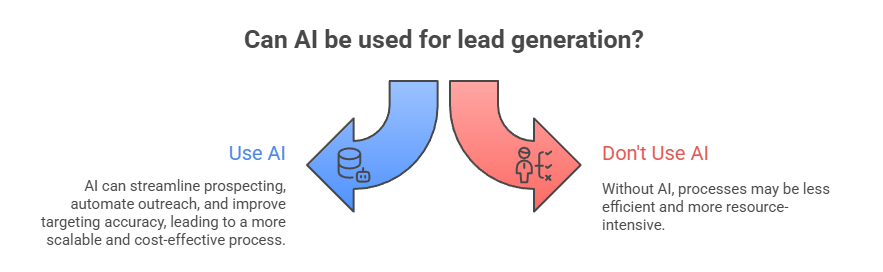
AI can absolutely be used for lead generation in today’s sales and marketing environments. Businesses across industries rely on artificial intelligence to streamline prospecting, automate outreach, and improve targeting accuracy, and 61% of marketers say AI improves lead quality and conversion outcomes. When implemented correctly, AI strengthens lead generation without replacing human decision-making.
AI acts as an intelligent support system that manages repetitive, data-heavy tasks such as research, messaging, and lead scoring. This allows sales and marketing teams to focus on strategy, relationship-building, and closing higher-value opportunities. The result is a more scalable and cost-effective lead generation process.
How AI Is Used in Lead Generation
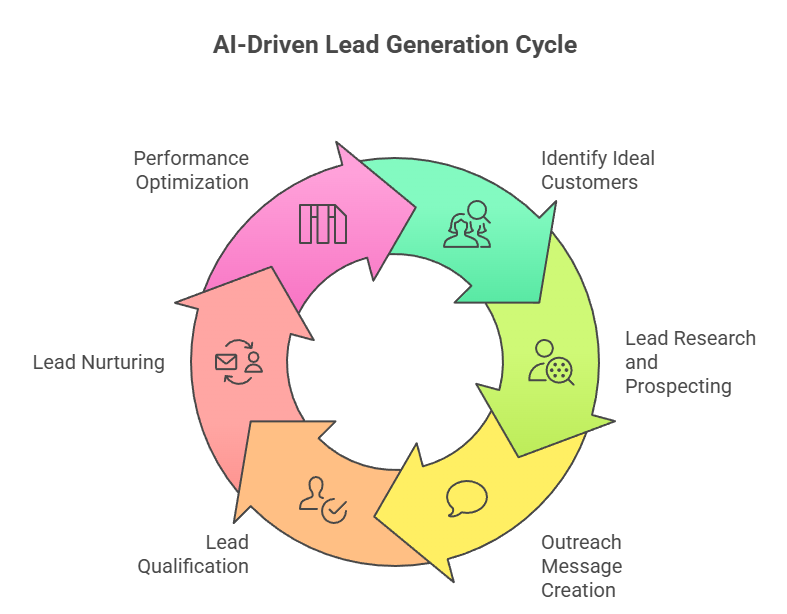
AI now supports the entire lead generation lifecycle, from identifying high-intent prospects to nurturing them through automated workflows. It improves consistency, speed, and personalization across channels. These capabilities make AI a foundational tool for modern growth teams.
AI-driven lead generation allows businesses to operate continuously without increasing headcount. Campaigns become more data-driven, less manual, and easier to optimize in real time. This enables efficient and scalable growth.
1. Identifying Ideal Customers
AI analyzes behavioral data, demographics, firmographics, and intent signals to refine ideal customer profiles. This helps businesses focus outreach on prospects most likely to convert. Over time, targeting accuracy improves based on performance feedback.
2. Lead Research and Prospecting
AI tools scan large datasets and intent sources to identify companies, roles, and buying signals that match targeting criteria. Manual research is significantly reduced while list quality improves. Sales teams spend more time engaging qualified prospects.
3, Outreach Message Creation
AI generates personalized emails, LinkedIn messages, follow-ups, and ad copy aligned with campaign objectives, and personalized email campaigns powered by AI can achieve open rates up to 29% higher than generic campaigns. Messaging still adapts to audience segments while remaining consistent, which improves engagement and relevance across large outreach efforts. This supports high-volume outreach without sacrificing personalization or campaign effectiveness
4. Lead Qualification
AI chatbots, scoring models, and workflows ask qualifying questions and assess intent in real time. Leads are segmented by readiness and routed appropriately. This ensures sales teams focus on high-value opportunities.
5. Lead Nurturing
AI manages ongoing communication through automated email sequences, reminders, and educational content. Leads stay engaged throughout longer buying cycles. Consistent nurturing increases trust and conversion readiness.
6. Performance Optimization
AI analyzes engagement metrics, response rates, and conversion paths across channels. Insights are used to refine messaging, targeting, and timing. Campaign performance improves continuously through optimization.
What AI Can and Cannot Do in Lead Generation
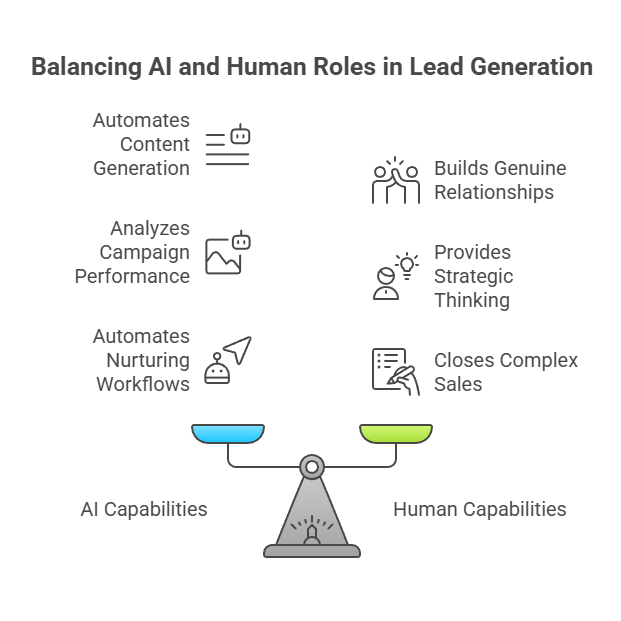
AI offers powerful advantages, but it also has clear limits that must be understood. Knowing what AI can and cannot do ensures realistic expectations and better outcomes. Successful implementation depends on using AI appropriately.
AI excels at automation, analysis, and content generation, but it cannot replace strategic thinking or human relationships. Balancing these roles is critical for long-term success.
What AI Can Do
AI can generate outreach content, assist with prospect research, automate nurturing workflows, score leads, and analyze campaign performance. It improves efficiency by handling repetitive tasks. This allows teams to scale without increasing operational costs.
What AI Cannot Do Alone
AI cannot collect private contact data, build genuine relationships, or close complex, trust-based sales. It lacks full business context without guidance. Human oversight remains essential for strategy and negotiation.
AI Lead Generation vs Traditional Lead Generation
AI-driven and traditional lead generation differ significantly in speed, cost, and scalability. Each approach has strengths, but they operate very differently. Understanding these differences supports better strategic decisions.
AI-driven lead generation emphasizes automation and data-driven execution. Traditional methods rely on manual processes and human interaction. Most high-performing teams combine both approaches.
| Feature | AI-Driven Lead Generation | Traditional Lead Generation |
|---|---|---|
| Speed | Very fast | Slow |
| Cost | Lower | Higher |
| Personalization | Scalable | Limited |
| Automation | High | Manual |
| Human Touch | Limited | Strong |
| Scalability | Easy | Difficult |
Benefits of Using AI for Lead Generation
How to Use AI for Lead Generation

Limitations of Using AI for Lead Generation
Despite its strengths, AI has limitations that must be actively managed to avoid misuse and unrealistic expectations. Human oversight remains essential to ensure accuracy, relevance, and strategic alignment. Responsible implementation determines long-term success.
AI performance depends heavily on data quality, prompt clarity, and proper direction. Without guidance, outputs can decline in accuracy and effectiveness. Understanding these limitations helps teams use AI more effectively.
1. Requires Human Oversight
AI-generated content and insights must be reviewed for accuracy, tone, and brand alignment. Strategic decisions should remain human-led to ensure context and judgment are applied. Oversight ensures consistent quality and trust.
2. Depends on Input Quality
AI outputs are only as good as the prompts and data provided. Clear, well-structured instructions lead to better performance and relevance. Poor inputs directly reduce effectiveness.
3. Compliance Considerations
In regulated industries, AI-generated messaging must be carefully reviewed for legal and ethical compliance. Content must align with industry regulations and internal policies. Risk management remains a human responsibility.
4. Not Relationship-Driven
AI lacks emotional intelligence and cannot build genuine relationships. Complex or high-value sales still require human connection and trust. AI supports engagement but does not replace personal interaction.
TaskVirtual: Your AI-Driven Virtual Support for Lead Generation

Managing AI-powered lead generation tools, outreach campaigns, data cleanup, and follow-ups can quickly become overwhelming for growing teams. From handling CRMs to coordinating AI tools and prospect lists, operational workload often slows execution. TaskVirtual provides skilled virtual assistants who support AI-driven lead generation workflows, helping businesses stay organized, responsive, and conversion-focused.
1. AI Lead Generation Setup and Support
TaskVirtual virtual assistants help manage AI tools for prospect research, outreach scheduling, CRM updates, and lead qualification workflows. They ensure campaigns run smoothly, data stays accurate, and AI outputs are properly reviewed. This allows sales teams to focus on conversations and closing.
2. Affordable and Flexible Pricing
Hiring in-house support can be costly and inflexible, but TaskVirtual offers budget-friendly solutions. Pricing plans range from just $3.12/hour to $14.99/hour, making expert virtual assistance accessible for startups, agencies, and growing sales teams.
3. Scalable Lead Operations Management
From managing lead lists and AI-generated outreach to coordinating follow-ups and reporting, TaskVirtual adapts to your business needs. Whether you require occasional support or ongoing assistance, their services scale alongside your lead generation efforts.
4. Ongoing Support and Quality Assurance
TaskVirtual ensures continuous monitoring of lead generation tasks, providing updates, follow-up reminders, and data accuracy checks. Their proactive approach helps prevent missed opportunities and maintains consistent campaign performance.
5. Proven Trust and Client Satisfaction
With 364 positive reviews and a 4.7-star rating across leading virtual assistant platforms, TaskVirtual is trusted by businesses worldwide. Clients rely on their reliability, efficiency, and expertise to support scalable lead generation operations.
Final Answer: Can I Use AI for Lead Generation?
Yes, you can and should use AI for lead generation to improve efficiency, reduce costs, and scale outreach. AI excels at automation, personalization, and optimization. When combined with human strategy and reliable virtual support, it becomes a powerful growth multiplier.
FAQ: Can I Use AI for Lead Generation?
1. Can AI generate leads automatically?
AI automates research, outreach, and qualification but relies on CRMs, forms, and landing pages to capture leads. It supports the process rather than operating independently.
2. Is AI good for B2B lead generation?
AI is highly effective for B2B lead generation, especially for prospect research and intent targeting. It helps teams prioritize high-intent accounts efficiently.
3. Does AI replace sales teams?
AI does not replace sales teams but enhances productivity and focus. Sales professionals spend more time building relationships and closing deals.
4. Can AI write cold emails?
AI writes effective cold emails when given clear prompts and audience context. It enables scalable personalization with consistent messaging.
5. What tools work with AI for lead generation?
AI works with CRMs, email platforms, chatbots, landing pages, analytics tools, and advertising platforms. Together, these form a complete AI-driven lead generation ecosystem.
 Siddhartha Basu is a Technical Writer at Task Virtual. He loves online games, e-book reading, and Yoga.