Contents
show
Can ChatGPT Do Lead Generation? A Practical Guide for Businesses
Yes, ChatGPT can support lead generation, but it works best as an assistant and automation layer rather than a full replacement for sales or marketing teams. It helps businesses with lead research, outreach messaging, content creation, qualification workflows, CRM preparation, and lead nurturing. When combined with human oversight and proper tools, ChatGPT significantly improves speed, efficiency, and scalability in lead generation.
Can ChatGPT Do Lead Generation?
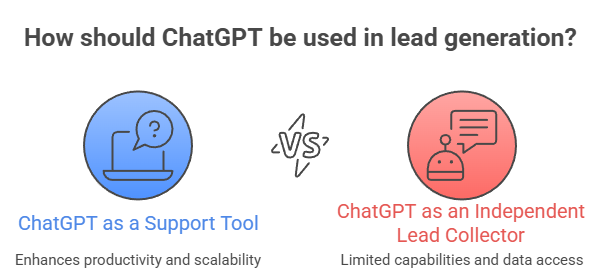
ChatGPT can play a meaningful role in lead generation, particularly in the early and middle stages of the funnel. While it cannot independently collect leads or access private databases, it excels at supporting the tasks that enable consistent and scalable lead generation. For example, businesses using AI for lead generation report up to a 50% increase in sales-ready leads, demonstrating how generative AI tools boost pipeline efficiency and focus efforts on high-value prospects.
Organizations leverage ChatGPT to research prospects, craft outreach messages, build lead magnets, qualify incoming leads, and nurture prospects through content-driven communication. When integrated with CRMs, landing pages, forms, ad platforms, and email tools, ChatGPT becomes a powerful enabler of modern lead generation strategies.
How ChatGPT Supports Lead Generation
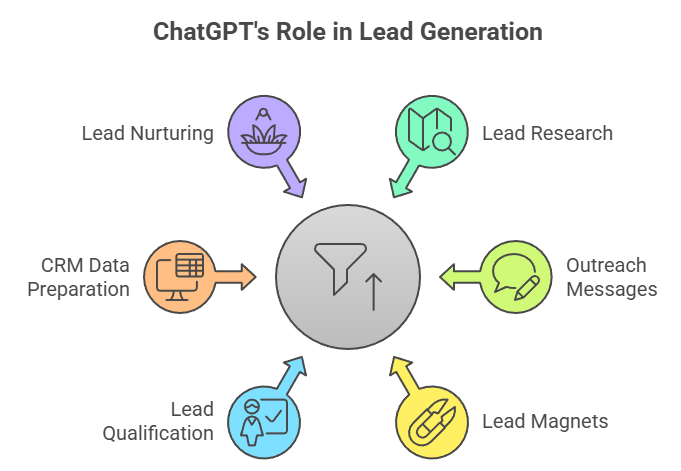
ChatGPT supports lead generation by automating and accelerating many of the manual tasks traditionally handled by sales development and marketing teams. It enhances consistency, reduces turnaround time, and allows teams to focus on strategy and relationship-building.
1. Lead Research & Prospect Profiling
ChatGPT helps businesses define ideal customer profiles, buyer personas, and target segments based on industry, goals, and offerings. It can outline target industries, suggest job titles and decision-makers, and create qualification criteria. This structured approach helps teams focus on higher-quality prospects.
2. Outreach Message Creation
ChatGPT is highly effective at writing outreach messages for cold emails, LinkedIn messages, contact forms, and follow-ups. It can adjust tone, personalize by industry or role, and generate multiple variations for testing. This improves outreach quality while saving significant time.
3. Lead Magnet & Content Creation
ChatGPT assists in creating lead magnets such as eBooks, guides, checklists, webinars, and free reports. It can also draft landing page copy to support inbound lead generation. This content-driven approach helps attract and capture prospects more effectively.
4. Lead Qualification Support
ChatGPT helps design lead qualification questions, chatbot flows, discovery call scripts, and intake forms. These assets allow businesses to pre-qualify leads before involving sales teams, ensuring time and effort are spent on prospects with real buying potential. Research shows that properly qualified leads demonstrate up to a 40% conversion rate compared with just 11% for unqualified leads, highlighting how effective qualification drives stronger outcomes in the sales funnel.
5. CRM Data Preparation
Although ChatGPT cannot directly access CRM systems, it supports CRM workflows by cleaning and structuring lead data. It helps draft follow-up notes, summaries, pipeline stage definitions, and data formats. This improves organization and tracking across sales pipelines.
6. Lead Nurturing Content
ChatGPT creates lead nurturing assets such as email sequences, newsletters, follow-up messages, FAQs, and objection-handling scripts. This content keeps prospects engaged throughout the buying journey. Effective nurturing increases conversion readiness over time.
What ChatGPT Cannot Do in Lead Generation
It is essential to clearly understand what ChatGPT cannot do within lead generation workflows to avoid unrealistic expectations. ChatGPT does not scrape private databases, collect email addresses or phone numbers, or send outreach messages on its own. These functions require dedicated tools and compliant data sources.
ChatGPT also cannot replace CRMs, marketing automation platforms, or human judgment in sales and marketing decisions. It does not manage pipelines, execute campaigns, or guarantee qualified leads independently. ChatGPT delivers the best results when used alongside the right tools and human expertise, not as a standalone solution.
Benefits of Using ChatGPT for Lead Generation
ChatGPT provides tangible benefits when applied strategically within lead generation workflows. Its greatest strengths are speed, consistency, and scalability, rather than direct lead capture. When used correctly, it enhances productivity across sales and marketing functions.
1. Saves Time
ChatGPT automates time-consuming tasks such as writing outreach messages, drafting content, and conducting preliminary research. This reduces manual workload for sales and marketing teams. As a result, professionals can focus more on strategy, relationship-building, and closing opportunities.
2. Improves Outreach Quality
ChatGPT consistently generates clear, structured, and persuasive messaging across campaigns. It reduces inconsistencies that often occur with manual writing. This leads to more professional and reliable outreach at scale.
3. Increases Scalability
ChatGPT allows teams to produce large volumes of outreach and content quickly, meaning businesses can scale campaigns without needing proportional increases in staff. For example, 80% of marketers report that automation increases lead generation and campaign effectiveness, showing how scalable automation tools drive broader reach and efficiency across marketing functions.
4. Cost-Effective
By handling early-stage lead generation tasks, ChatGPT reduces reliance on large teams. This lowers operational and hiring costs significantly. It is especially valuable for startups and small businesses with limited budgets.
5. Enhances Lead Nurturing
ChatGPT supports consistent follow-up and nurturing through emails and educational content. Timely, relevant communication keeps prospects engaged throughout the funnel. This improves long-term conversion potential and pipeline health.
ChatGPT vs Traditional Lead Generation Methods
ChatGPT-assisted lead generation differs significantly from traditional methods in speed, cost, and scalability. While AI-driven support excels at automating content and early-stage tasks, traditional lead generation relies more heavily on manual effort and direct human involvement. Understanding these differences helps businesses choose the right mix for their goals.
| Feature | ChatGPT-Assisted Lead Generation | Traditional Lead Generation |
|---|---|---|
| Speed | Very fast | Slower |
| Cost | Low | High |
| Content Creation | Automated | Manual |
| Human Interaction | Limited | High |
| Scalability | Easy | Hard |
| Data Access | No direct access | Yes |
The most effective strategy is a hybrid approach that combines ChatGPT, human oversight, and dedicated lead generation tools.
Who Should Use ChatGPT for Lead Generation?

ChatGPT is well suited for professionals and organizations seeking to streamline and scale lead generation activities. Its adaptability allows it to support a wide range of workflows, from content creation to outreach and nurturing. Businesses of all sizes can benefit when it is used as a productivity and automation assistant.
1. Small Businesses
Small businesses use ChatGPT to create outreach messages, lead magnets, and follow-up content without building large internal teams. It enables professional-quality output while keeping costs under control. This makes lead generation more accessible for growing businesses.
2. Startups
Startups rely on ChatGPT to test messaging, value propositions, and target audiences quickly. It supports rapid experimentation and iteration during early growth stages. This agility helps startups refine positioning and go-to-market strategies efficiently.
3. Sales Teams
Sales teams use ChatGPT to assist with cold outreach, follow-ups, and lead qualification workflows. It improves consistency and reduces time spent on repetitive tasks. As a result, sales representatives can focus more on closing conversations.
4. Marketing Agencies
Marketing agencies leverage ChatGPT to scale content creation and campaign assets across multiple clients. It significantly reduces turnaround time while maintaining quality. This allows agencies to handle higher workloads without expanding headcount.
5. Coaches & Consultants
Coaches and consultants use ChatGPT to generate inbound leads through content, funnels, and email nurturing. The tool supports authority-building and thought leadership efforts. This helps attract qualified prospects more consistently.
6. Virtual Assistants & SDRs
Virtual assistants and sales development representatives use ChatGPT to accelerate daily lead generation tasks. It improves efficiency across research, messaging, and follow-ups. This enables higher output without compromising quality.
How to Use ChatGPT for Lead Generation (Step-by-Step)
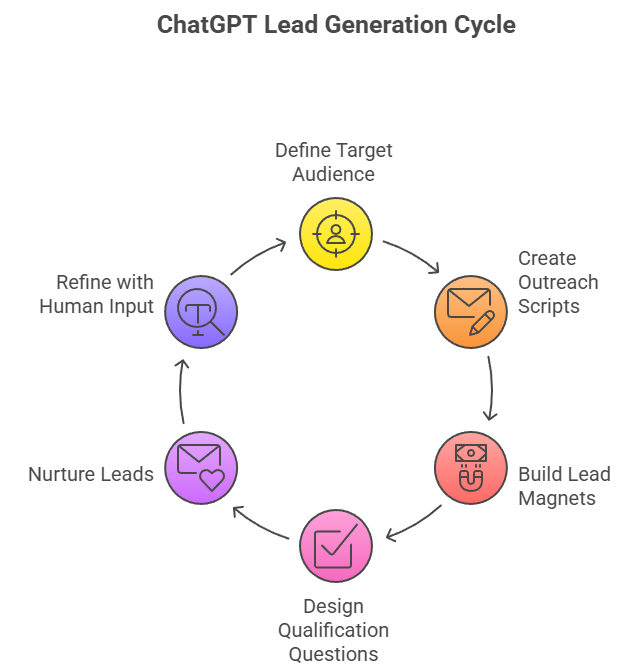
Using ChatGPT effectively for lead generation requires clear prompting, consistent human review, and alignment with your existing sales and marketing tools. A step-by-step workflow helps businesses maintain message quality while scaling outreach and nurturing activities. When used systematically, ChatGPT becomes a reliable support layer across the funnel.
Step 1: Define Your Target Audience
Use ChatGPT to build ideal customer profiles, buyer personas, and pain-point summaries that match your offer. This clarity improves list building, messaging relevance, and conversion potential across channels. Strong targeting ensures your outreach is focused on high-fit prospects.
Step 2: Create Outreach Scripts
Generate cold email templates, LinkedIn messages, and follow-up sequences tailored to industry and role. Create multiple variations to test subject lines, CTAs, and value propositions for performance. Human review ensures personalization and brand alignment before launch.
Step 3: Build Lead Magnets
Ask ChatGPT to outline and draft resources such as checklists, guides, mini-reports, or webinar frameworks. Pair these assets with landing pages and forms to capture lead information effectively. High-value lead magnets strengthen inbound lead flow and credibility.
Step 4: Design Qualification Questions
Use ChatGPT to create intake forms, chatbot scripts, and discovery questions that identify intent and fit early. This helps segment leads based on urgency, budget, or readiness to buy. Better qualification reduces wasted time and improves sales efficiency.
Step 5: Nurture Leads
Generate email sequences, educational newsletters, and follow-up messaging that addresses objections and builds trust. Consistent nurturing keeps prospects engaged until they are ready to convert. This improves pipeline health and increases close rates over time.
Step 6: Refine with Human Input
Review AI outputs for accuracy, compliance, and tone before using them in live campaigns. Adjust messaging to match your brand voice, product details, and target market language. Ongoing testing and iteration ensure continuous improvement and stronger results.
Limitations of ChatGPT for Lead Generation

Despite its strengths, ChatGPT has clear limitations that businesses must understand and manage carefully. Recognizing these constraints helps set realistic expectations and ensures the tool is used effectively within a broader lead generation strategy. ChatGPT delivers the best results when paired with human oversight and supporting tools.
ChatGPT cannot capture leads directly or access private databases, making it dependent on external platforms for lead collection. Its output quality relies heavily on the clarity and specificity of prompts, and all content requires human review for accuracy, tone, and compliance. Additionally, ChatGPT lacks built-in industry awareness for regulated sectors such as finance or healthcare unless explicitly guided.
TaskVirtual: Your Partner in Real Estate Virtual Assistance

Managing leads, follow-ups, listings, and client communication can quickly overwhelm even experienced real estate professionals. Juggling multiple platforms, inquiries, and transactions often pulls agents away from closing deals and building relationships. TaskVirtual provides specialized ChatGPT do lead generation virtual assistant services that help streamline operations, improve responsiveness, and support business growth with consistency and reliability.
1. Expert Real Estate VA Support
TaskVirtual’s trained virtual assistants support real estate professionals with lead follow-up, CRM updates, scheduling, listing coordination, and transaction-related tasks. They work within your systems and processes to ensure no opportunity is missed and daily operations run smoothly.
2. Affordable and Flexible Pricing
Hiring in-house staff can be costly, but TaskVirtual offers a cost-effective alternative. Pricing plans range from $3.12/hour to $14.99/hour, making professional VA support accessible to solo agents, teams, and brokerages at every growth stage.
3. Comprehensive Real Estate Support Solutions
From managing inbound leads and maintaining CRM accuracy to assisting with listings and documentation, TaskVirtual delivers end-to-end operational support. Their services scale easily whether you need part-time assistance or ongoing full-time VA support.
4. Ongoing Support and Quality Assurance
TaskVirtual emphasizes consistent communication, performance tracking, and quality control. Regular updates and proactive task management ensure workflows stay aligned with your business goals and service standards.
5. Proven Track Record of Excellence
With 364 positive reviews and a 4.7-star rating on trusted VA platforms, TaskVirtual is recognized globally as a dependable virtual assistant provider. Real estate professionals rely on their expertise to save time, improve efficiency, and scale with confidence.
Final Verdict: Can ChatGPT Do Lead Generation?
Yes, ChatGPT can absolutely support lead generation, but it works best as an assistant rather than a replacement. It accelerates research, messaging, content creation, qualification, and nurturing while reducing manual workload and costs.
When combined with CRMs, email platforms, ads, landing pages, and human expertise—such as services from TaskVirtual—ChatGPT becomes a powerful component of a modern, scalable lead generation system.
FAQ: Can ChatGPT Do Lead Generation?
1. Can ChatGPT generate leads automatically?
No. It supports lead generation but does not collect leads directly.
2. Is ChatGPT useful for B2B lead generation?
Yes, especially for outreach messaging, content creation, and qualification workflows.
3. Can ChatGPT write cold emails?
Yes, it is highly effective for cold email and follow-up copy.
4. Does ChatGPT replace sales teams?
No. It supports sales teams by automating repetitive tasks.
5. What tools work well with ChatGPT for lead generation?
CRMs, email marketing platforms, LinkedIn, landing page builders, and ad platforms.
 Siddhartha Basu is a Technical Writer at Task Virtual. He loves online games, e-book reading, and Yoga.